“A man rarely notices when one world ends and another begins. There is no wall, no boundary stone, no river dividing one from the other. You simply wake one morning and realize that everyone around you speaks another language, crosses themselves differently, and—for some reason—the roads have become better.”
From the writings of Ansel de Nantes.
We left Rome early in the morning, just as dawn was breaking above the ancient walls. The city of the Apostles slowly disappeared behind us, fading into the blue-grey haze, and with it vanished the familiar Europe I had come to know during my fifteen years of life. Ahead lay southern Italy—a land spoken of in Normandy with almost as much respect as the Holy Land itself.
For us, it held a special meaning.
Only a few decades earlier, younger sons of Norman knights—men who had inherited neither castles nor lands at home—had come here and carved out dominions of their own. Almost everyone knew the story of the Hautevilles. Not so long ago, they had been landless adventurers much like the hundreds of young knights who left Normandy in search of fortune. Now they ruled Apulia, Calabria, and much of southern Italy, while the name of Robert Guiscard was spoken with respect even by men who had once fought against him.
We often passed fortresses above which familiar Norman banners flew.
At one of them, I reined in my horse.
“Does this belong to the Hautevilles as well?”
Geoffroi nodded.
“Once, a Byzantine strategos commanded here.”
“And now?”
“A Norman castellan.”
Drogo grinned.
“You see, little monk… sometimes a good sword is worth more than an ancient claim.”
I thought about that.
Not so long ago, these lands had belonged to the Emperor of the Romans.
Now Normans ruled them.
History changed far more quickly than I had imagined in the monastery.
The farther south we travelled, the more the land itself changed. The roads grew drier, the sun hotter, and the air no longer smelled of Normandy’s wet leaves. Olive groves, vineyards, and cypresses stretched across the countryside. Houses were built from pale limestone and roofed with red tiles, while Italian speech became increasingly common in the markets.
I felt as though I had entered another country entirely.
In one of the towns, another large force joined our army.
The news travelled quickly through the camp.
“Bohemond.”
I had heard the name before. Stories about Robert Guiscard’s son had already taken on the quality of legend. Some called him the finest commander in southern Italy. Others called him the most dangerous enemy Byzantium had ever faced. Still others claimed that one day he would become a great ruler in his own right.
I saw him for the first time that evening.
He rode to Robert’s tent without ceremony, accompanied by several dozen horsemen. Tall and broad-shouldered, with a short dark beard and remarkably calm eyes, he sat his horse with such ease that he seemed to have been born in the saddle.
“Is that Bohemond?” I asked quietly.
Geoffroi did not even turn his head.
“Yes.”
“He doesn’t look like a man from a legend.”
Drogo grinned.
“That’s why men become legends.”
The two Roberts—the Duke of Normandy and Guiscard’s son—spoke privately for a long time. We heard nothing of their conversation, but the following morning both armies marched together.
Our host had grown larger still.
Several days later, the sea appeared before us.
I had never seen it before.
Until then, water had meant a river, a lake, or heavy rain. Now an endless blue expanse lay before my eyes, stretching beyond the horizon itself. It seemed to have no end.
We came to the port of Brindisi.
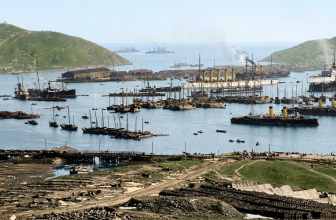
The harbour was crowded with ships. Merchant vessels lay beside war galleys. Sailors shouted to one another in unfamiliar languages, dockworkers carried barrels, sacks, and cages of poultry, and over everything hung the heavy smell of salt, tar, wet rope, and fish.
“Well, little monk?” Geoffroi said with a smile. “Changed your mind about Jerusalem?”
I did not answer.
In truth, the sea frightened me far more than any road.
Loading took almost the entire day.
The horses were led aboard along broad wooden gangways. Most resisted desperately, disturbed by the unfamiliar smell of the water and the movement beneath their hooves. Several had to be dragged aboard almost by force. We squires worked without rest, calming the animals, securing saddles, and stowing equipment below deck.
When our ship finally pulled away from the shore, I watched the Italian coast recede for a long time.
The sea proved nothing like the calm blue surface I had seen from land.
The moment we left the harbour, the deck began to rise and fall beneath my feet. The horizon climbed, dropped, and climbed again, while my stomach unexpectedly decided to pursue a life of its own.
Geoffroi looked at me.
“First time?”
I merely nodded.
“Don’t worry. Everyone goes through it.”
Drogo was sitting nearby with his back against the side of the ship.
His face had taken on a suspiciously pale shade.
Geoffroi could not resist.
“And why are you turning green?”
“Be quiet…”
“Your first time too?”
“Second…”
“Is it easier?”
Drogo sighed miserably.
“Much worse.”
We laughed.
Not even the sea could stop us from laughing at one another.
Several days later, the Balkan coast appeared ahead.
One by one, the ships entered the harbour of Dyrrhachium, the first great city of the Romans we were to see.
I had expected to find myself in a foreign land.
Instead, the first thing I noticed was something quite different.
Order.
No one shouted on the quays.
Every ship went to its appointed berth.
Officials wrote things down upon long scrolls.
Soldiers calmly inspected the newcomers.
Wagons moved in proper order.
Even the merchants did not shove and jostle as they did in the markets of Rouen.
“Strange people,” Drogo muttered.
“Why?”
“They work too quietly.”
I said nothing.
Something else had caught my attention.
They recorded everything.
Goods.
Numbers of horses.
Names of owners.
Even the number of ships arriving in the harbour.
Later, when I became bailiff of Acre, I would remember that day many times.
It was there that I first saw a state held together not only by swords, but by men with inkpots and wax seals.
From Dyrrhachium began a road whose name I had never heard before.
The Romans called it the Via Egnatia.
It had been built by the ancient Romans and crossed the Balkans from west to east. A thousand years had passed. Emperors had come and gone. Entire kingdoms had disappeared. Barbarians, Bulgars, Franks, and Normans had crossed these lands.
The road remained.
Its broad stone pavement stretched through mountains and valleys, linking fortresses, bridges, and posting stations.
I ran my hand across the stone slabs, polished smooth by time.
How many men had walked here before us?
How many armies?
How many merchants?
How many pilgrims?
That day, a strange thought occurred to me for the first time.
Empires are born and die.
A good road outlives almost everyone who built it.
And it was along this road that we were to travel toward a city about which even the crusaders had already begun to tell stories.
Constantinople.
“We expected to meet Greeks. Instead, we met Romans. They called themselves Romans, regarded their emperor as the heir of Caesar, and their empire as Rome. It was then that I first understood that there was more than one Rome in the world.”
From the writings of Ansel de Nantes.
From Dyrrhachium, our road turned east.
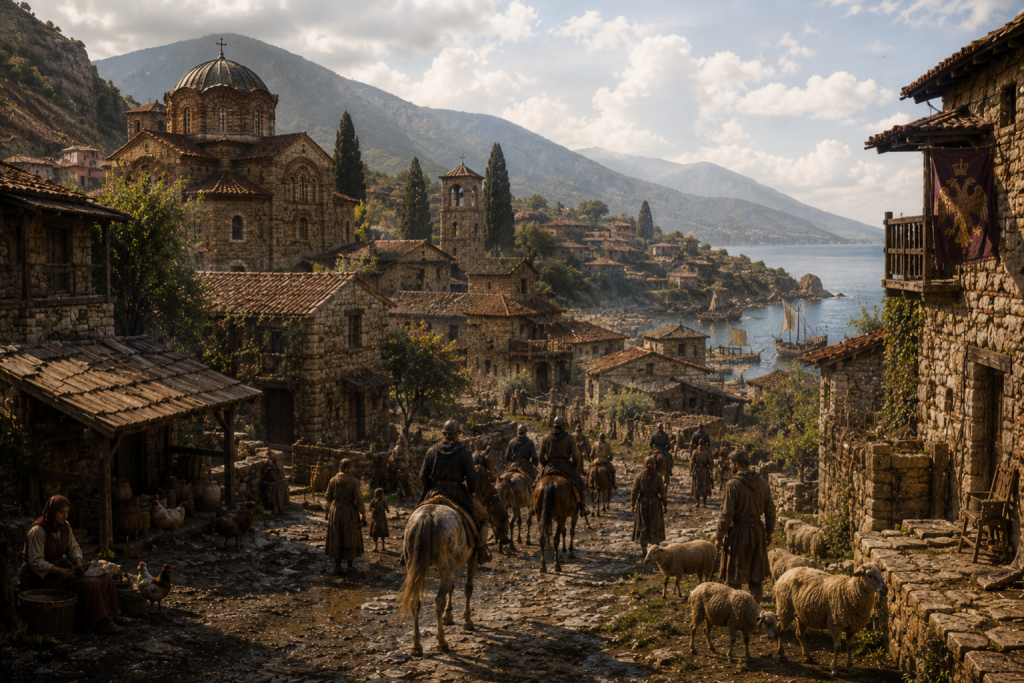
Here began the famous Via Egnatia, laid down in the days of the ancient emperors. Until then, I had believed that good roads existed only near great cities. Here, the stone pavement disappeared toward the horizon, crossing mountains, valleys, and rivers with such confidence that it might have been built only yesterday.
I could not stop marvelling at it.
We crossed a bridge made of enormous dressed stones which, according to one of our local guides, had already stood for more than a thousand years. Beyond it began another stretch of road, every bit as sound as the last. Every few leagues we encountered small stations where imperial couriers changed horses, officials rested, and caravans stopped along their journeys. The garrisons were small, yet discipline seemed to govern everything. Soldiers did not idle about as they often did in castles in the West. They quietly performed their duties, inspecting merchants’ documents, escorting important cargoes, and keeping order along the road.
What struck me most was how rarely anyone seemed to shout.
The markets were as lively with bargaining as those of Rouen, but whenever imperial business was involved, people became remarkably composed. Every official wrote something down. Every toll collector kept accounts. Every garrison commander made his marks upon long scrolls.
One day I asked Geoffroi:
“Do they really write everything down?”
He shrugged.
“Looks that way.”
Drogo grinned.
“That’s why none of them ever has any free time.”
We laughed.
But I continued to watch.
Many years later, I often heard men say that great states are held together by armies alone.
That is not true.
It was on the Via Egnatia that I first understood that a state also rests upon people whom almost no one notices: scribes, tax collectors, road builders, judges, keepers of bridges, and customs officers.
So long as they do their work properly, an army can exist at all.
Perhaps it was then that I first became interested not merely in war, but in the workings of a state itself.
As we travelled on, we encountered more and more great caravans.
I had never seen anything like them.
Long trains of mules and camels moved along the road from east to west. Their packs were laden with bales of silk, sacks of spices, rolls of costly cloth, copper vessels, glassware, and goods whose names I did not even know.
The caravans were accompanied by men of many peoples.
Armenians.
Greeks.
Syrians.
Jews.
Sometimes Arabs.
They spoke among themselves in languages that, to my ears, merged into one continuous stream of unfamiliar words.
I watched them with undisguised fascination.
“They all trade together?” I asked.
It was not Geoffroi who answered.
An elderly Lombard merchant had been travelling alongside our column for several days. He smiled.
“Silver speaks every language.”
I laughed.
The old man continued:
“Where good roads meet reliable authority, merchants will always follow.”
I remember those words almost exactly.
Several days later, we saw our first true Byzantine fortress.
It resembled no Norman castle I had ever known.
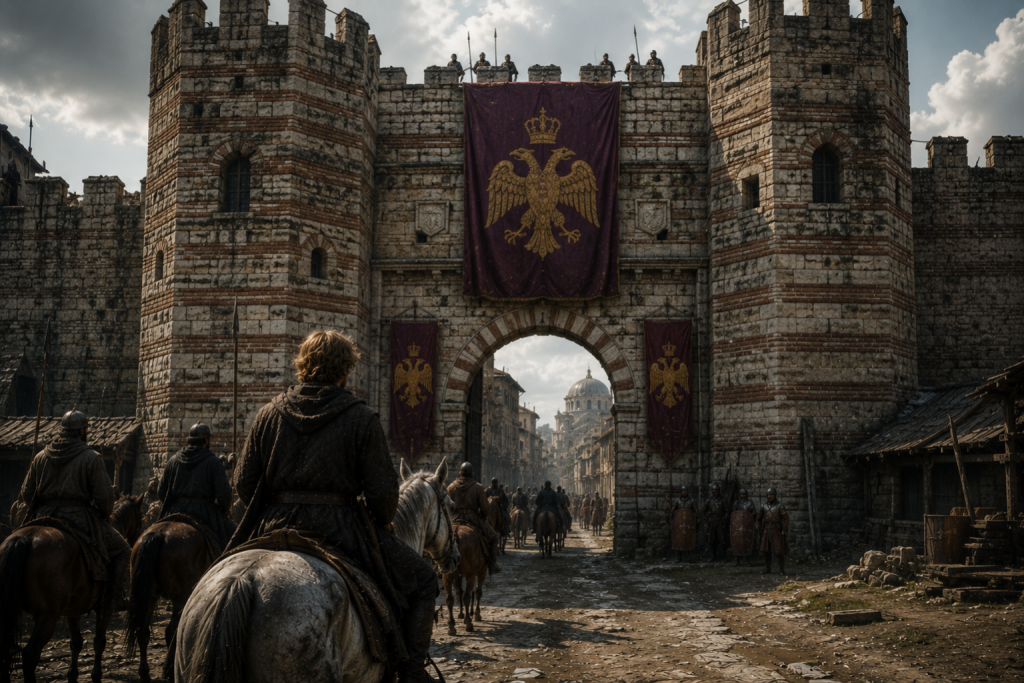
There was no high mound crowned by a timber keep, as in Normandy. Nor were there the heavy square towers of Caen. Before us rose broad stone walls reinforced by round towers, built with such precision that it seemed impossible to slip a knife blade between the blocks.
Guards stood beside the gate.
I involuntarily reined in my horse.
They were not ordinary Roman soldiers.
Tall, fair-haired men with long moustaches and heavy two-handed axes watched the passing columns in silence.
Even among our tall Normans, they looked like giants.
“Who are they?” I asked quietly.
Drogo also turned toward the gate.
“Varangians.”
“Mercenaries?”
“No.”
Geoffroi shook his head.
“The emperor’s bodyguards.”
For a long time, I could not take my eyes off them.
They barely moved.
They did not speak.
They did not laugh.
They seemed to have been carved from northern granite.
I did not yet know that one of those men was destined to become my friend.
The farther east we travelled, the more the land itself seemed to change.
Large monasteries crowned with unfamiliar domes became increasingly common. Instead of the Latin chants I knew, we heard Greek. Priests wore long dark robes and crossed themselves differently from us. Even their icons seemed strange—the stern, almost motionless faces of the saints stared directly into a man’s eyes as though judging him.
I asked an elderly monk:
“Are they Christians too?”
He smiled.
“Of course.”
“Then why is everything different here?”
The old man thought for a moment.
“Because God is one.”
He paused.
“But peoples are many.”
The answer seemed strange to me.
With time, I came to understand how wise it was.
One evening, we made camp near a great hill. From its summit, the land could be seen for many miles to the east. The sun was already sinking when the men riding ahead suddenly began calling to one another.
Geoffroi stopped his horse without a word.
“Ansel…”
“What?”
He raised a hand.
“Look.”
I climbed a little higher.
At first, I thought I could see the sea glittering in the distance.
Then I made out a long dark line.
Then the faint shapes of towers.
And a few moments later, the setting sun flashed upon something golden.
None of us spoke.
Even Drogo was silent.
Before us lay a city too vast to be seen all at once.
We could make out only its silhouette fading into the evening haze.
And for the first time, I understood why the Romans did not call it merely their capital.
They called it the Queen of Cities.
The ancient Via Egnatia had brought us there.
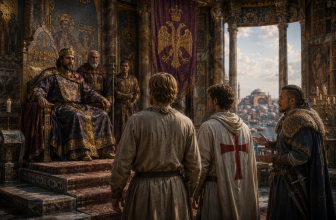
There we would meet the emperor for the first time, see Hagia Sophia, and discover that the Eastern Roman Empire was no mere shadow of ancient Rome. It lived a life of its own—wealthy, intricate, and astonishing.
But as I stood upon that hill, I could not yet imagine that Constantinople would change my understanding of government, trade, and power more profoundly than all the books I had read in the monastery.