Part I. The Last Evening
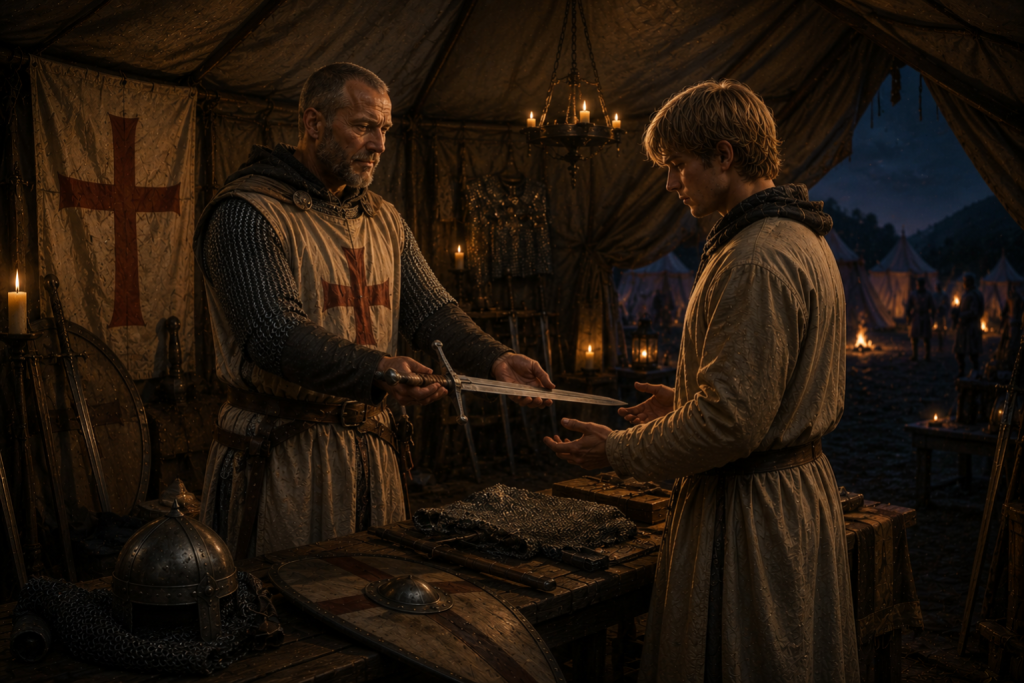
“A man rarely notices where one chapter of his life ends and another begins. Sometimes the boundary is a river. Sometimes it is a narrow stretch of sea. For me, that boundary was the Bosporus.”
From the writings of Ansel de Nantes.
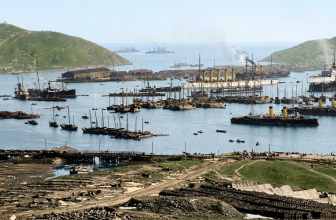
Several days after our audience with the emperor, our camp stirred into motion long before dawn. The commanders of the tens moved from one row of tents to another, rousing their men. Grooms were already leading out saddled horses, while squires hurried to load the last bundles onto the wagons. Morning mist still hung over the Bosporus when the first Byzantine ships began approaching the shore.
The emperor had no intention of keeping the Western army near his capital any longer than necessary.
It was difficult to blame him.
Tens of thousands of armed men, accustomed to settling their affairs by force, made poor neighbours even for the mightiest of rulers.
While the horses reluctantly stepped onto the broad gangways and the oarsmen prepared their vessels for departure, I found myself looking back.
Constantinople was slowly awakening.
Thin smoke rose above the city, its golden domes were already catching the first rays of sunlight, and dozens of ships were beginning to move about the harbour. Even from that distance, the capital of the Romans seemed alive, like some enormous creature that never truly slept.
I watched it for a long time, until Geoffroi nudged me with his shoulder.
“Saying goodbye?”
“I suppose so.”
He turned to look as well.
“Beautiful city.”
“Very.”
Drogo grinned as he adjusted his horse’s girth.
“Don’t get too attached. We didn’t come here to become merchants.”
I smiled but said nothing.
At the time, I believed Constantinople would remain behind me forever. Only many years later did I understand that it was there that the ideas which would shape the rest of my life had first taken root.
The crossing took only a few hours.
The sea was calm, and even Drogo, who had suffered terribly during our voyage from Italy, managed to preserve his dignity this time. He even found the strength to make several jokes at Geoffroi’s expense, claiming that our friend had spent rather too much time admiring Byzantine girls.
“Look,” he said, nodding toward the opposite shore. “A little longer here and you’ll start growing your beard like a Greek.”
Geoffroi snorted.
“If it would help me win the miller’s daughter, I’d shave my head bald.”
Everyone laughed.
So did I.
Perhaps it was the last time for a very long while that our laughter sounded so carefree.
When the ship’s bow gently touched the sandy shore, I was the first to jump down onto the land. The same damp sand lay beneath my feet, the same kinds of trees grew around us as on the European shore, and the wind still smelled of the sea.
“So… this is Asia?” I asked, looking around.
Geoffroi spread his hands.
“So far, it looks no different from Europe.”
“Give it time,” Drogo said with a grin. “The Turks will soon explain the difference.”
The first days of our march along the coast of Asia Minor were deceptively peaceful. We followed Byzantine guides along old roads, passing through small villages and monasteries, many of them abandoned.
Some settlements were still inhabited.
Their people greeted the crusaders with suspicion. Old men crossed themselves, women hid their children behind their skirts, and the men watched our every movement. Only later did a Greek priest explain the reason for their caution.
“Too many armies have passed through these lands in recent years.”
He said it calmly.
Without reproach.
Yet his words made me think.
For us, the campaign was only beginning.
For them, the war had already lasted for decades.
Sometimes we passed burned-out houses beside the road. In places, charred roof beams still jutted into the air, and overturned bells lay near ruined churches. Even Drogo stopped joking when we rode through such places.
“Did the Turks do this?” I asked one day.
Clavier, riding ahead of us, answered without turning.
“Sometimes the Turks.”
He paused.
“Sometimes our own side.”
No one asked another question.
By the evening of the third day, the army halted on a broad plain. Nicaea was now not far away.
The camp was established in silence.
Even the most talkative men seemed quieter than usual.
From early evening, smiths began sharpening swords and replacing bent spearheads. Priests heard confessions almost without pause. Some knights prayed alone, while others sat beside the fires, staring into the flames as though hoping to see what tomorrow would bring.
Even the horses seemed to sense that something unusual was approaching.
They shifted restlessly from hoof to hoof and often raised their heads, listening to the stillness of the night.
I was just finishing cleaning a set of harness when I heard a familiar voice.
“Ansel.”
I looked up.
Clavier stood before me.
“Fetch your cloak. Come with me.”
He offered no explanation.
We walked silently through half the camp, past the smiths whose forges glowed red in the darkness, and stopped before a large tent guarded by two sergeants.
It was the duke’s travelling armoury.
Inside, the air smelled of iron, leather, oil, and fresh wood shavings. Spears stood along the walls, shields hung in neat rows, and long tables held mail shirts, helmets, and swords prepared for the following day’s march.
Clavier approached one of the tables.
For a while, he stood silently studying the equipment laid out before him.
Then he turned toward me.
“Take off your aketon.”
I stared at him in confusion.
“Commander…?”
He interrupted me.
“Tomorrow you’ll stand in the front rank of my ten. You don’t go there wearing nothing but an aketon.”
Without another word, I began undoing the straps.
Clavier took a long, heavy mail shirt and, with a practised movement, settled it over my shoulders.
Its weight caught me so completely by surprise that I staggered.
The commander merely grinned.
“Now you understand why old soldiers don’t like running?”
Gradually, the iron settled across my shoulders. Then came the mail coif, a broad belt, a heavy kite shield, and finally a Norman helmet with a long nasal guard.
When everything was in place, Clavier stepped back and studied me for a long moment.
Then he came forward, adjusted the shield strap, and said quietly:
“Now…”
He gave the slightest nod.
“Now I don’t see a boy from the monastery.”
He laid a hand on my shoulder.
“Now I see a warrior of my ten.”
Those words meant more to me than any reward.
More than a knight’s spurs.
For they had been spoken by the man who had taught me almost everything I knew.
Clavier walked over to a large oak chest standing in the far corner of the tent. For a while, he searched silently among the things inside. Then he carefully lifted out a long scabbard covered in leather darkened by age.
My heart seemed to stop.
I recognized it at once.
Even after fifteen years.
My father’s sword.
Part II. The First Arrows
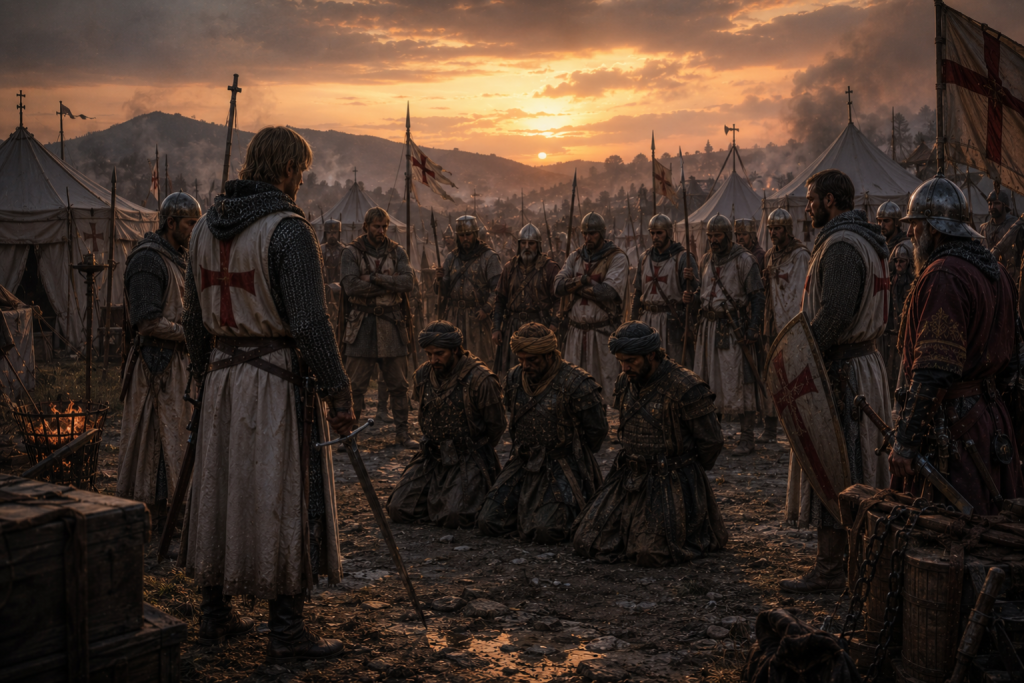
“On the eve of their first battle, men rarely think about death. They think about their armour, their weapons, their horses, and whether they have forgotten something in camp. Only afterward do they understand that all these concerns were attempts to avoid thinking about the one thing that mattered.”
From the writings of Ansel de Nantes.
For a long time, I could not bring myself to take the sword.
It seemed that if I so much as touched the old scabbard, the man I had never truly known would suddenly appear before me. Not the hero of songs, not the bodyguard of Duke William, but simply my father.
Clavier was the first to break the silence.
“Robert kept it for fifteen years.”
I looked up.
“All this time?”
The commander nodded.
“He could have kept it for himself. He could have given it to any knight he pleased. But one day he told me, ‘Give it back to his son. When the time comes.’”
I carefully drew the blade from its scabbard.
The steel had darkened with age, but the edge remained straight and unchipped. Someone had cared for it as faithfully as for the duke’s own weapons.
“Why now?” I asked quietly.
Clavier was silent for a moment.
Then he answered calmly.
“Because tomorrow your father won’t be able to stand between you and death.”
He looked me straight in the eyes.
“From now on, that’s your responsibility.”
I lowered my gaze to the sword.
It seemed heavier than it had a moment before.
Unexpectedly, Clavier held out his hand.
“Give it here.”
I obediently passed him the weapon.
He swung the blade several times with the ease of long practice, as though recalling some movement he had not made in years.
“Good sword.”
He seemed to be speaking more to himself than to me.
“Like the man who carried it.”
For a long time, I hesitated to ask the question.
But at last I did.
“Did you know my father?”
Clavier gave a short laugh.
“No.”
I looked at him in surprise.
“Not as a man.”
He glanced at the blade again.
“As a warrior.”
“Sometimes that’s enough.”
He handed the sword back to me.
“We didn’t serve in the same ten. But we fought alongside one another a few times. He was a good fighter.”
The commander fell silent for a moment.
“A very good one.”
I could not help smiling.
Clavier smiled too.
“Didn’t have a grain of sense, though.”
“What do you mean?”
“Exactly what I said.”
He sat on the edge of the chest and rested his elbows on his knees.
“While the rest of us were still thinking how to win a fight, your father was already charging ahead.”
I listened without speaking.
“Sometimes I thought he was more Viking than Norman. Fought as though death were an old acquaintance. Never looked for the easy way, never stepped back. Men like that become heroes.”
He looked at me with sudden seriousness.
“And far too often, they end up dead.”
Silence settled over the tent again.
Clavier rose and came toward me.
With his own hands, he fastened the sword to my belt.
Then he said quietly:
“Don’t repeat his mistakes.”
I looked at him questioningly.
“Courage is a fine thing. But it’s worth very little if you don’t live long enough for anyone to thank you.”
He adjusted the scabbard strap.
“Keep your head, Ansel.”
His hand settled on my shoulder.
“You’ve only got one.”
When we emerged from the tent, the camp was gradually falling silent.
Only the smiths continued working beside their forges, and somewhere nearby we could hear the soft chanting of priests. The cold night of Asia Minor was settling over the plain.
Clavier stopped beside a campfire.
He took a small flask from his belt.
Drank a few mouthfuls.
Then silently offered it to me.
I looked at him in surprise.
“Drink.”
I took a cautious sip.
The sour red wine was much stronger than anything they had served at the monastery.
I could not help grimacing.
Clavier laughed.
“Never mind. You’ll get used to it.”
It was the first time wine had been offered to me not as a novice serving at table, but as a fellow warrior.
We sat together in silence for a long while.
Sometimes silence says more than words.
At last, Clavier rose.
He put on his helmet.
And as he walked away, he called over his shoulder:
“Stay close to me tomorrow.”
I gave a short nod.
“Yes, commander.”
Those were the last words he spoke to me in our peaceful life.
The camp awoke the following morning before the first rays of sunlight.
The order to march passed from fire to fire almost in whispers. Men prepared quickly, with little conversation. Even Drogo, who rarely missed an opportunity to make a joke, was silent as he carefully checked the string of his bow.
Only when we had taken our places in the marching column did Geoffroi speak quietly.
“Well, little monk…”
“Ready?”
I looked at my new helmet.
At my shield.
At my father’s sword.
Then I turned my eyes toward the road.
“I don’t know.”
Drogo gave a crooked smile.
“Good answer.”
“Anyone who says he’s ready for his first war…”
He paused.
“Usually hasn’t been in one.”
The closer we came to Nicaea, the stronger the feeling grew that someone was watching us.
The road wound between low hills covered in sparse scrub. Now and then, the shapes of horsemen appeared in the distance, but whenever our scouts rode toward them, they vanished without a trace.
Several times I tried to make out even one of them.
Without success.
Clavier noticed my efforts.
“Looking for Turks?”
“Yes.”
“If you can’t see them…”
He left the sentence unfinished.
I understood the rest.
“Then they’ve already seen us.”
Clavier nodded approvingly.
“Exactly.”
The first arrow came without warning.
It struck the trunk of an old oak with a sharp whistle, only a few paces from the road.
The horses threw up their heads nervously.
Several men instinctively reached for their weapons.
But silence returned almost at once.
Only the wind stirred the treetops.
“Hold your positions!” Robert ordered calmly.
The column froze.
Almost a minute passed.
Then another.
No more arrows came.
Geoffroi slowly let out his breath.
“They were testing us.”
Clavier gave a short nod.
“And they’ve found us.”
Several hours later, the scouts brought in the first prisoners.
A handful of Seljuk horsemen had attempted to attack a Byzantine patrol, but Robert’s conroi had driven them back. Everything happened so quickly that I scarcely understood what was taking place.
I saw only the light cavalry disappearing beyond the nearest hill as swiftly as they had appeared, almost as though they had dissolved into the air.
Two dead men remained on the ground.
One was very young.
Perhaps not much older than I was.
I looked at his face for a long time.
There were no fangs, no demonic grin of the kind some pilgrims had described.
Before me lay an ordinary man.
Just as young.
Just as mortal.
And, shortly before his death, probably just as frightened as any one of us would have been.
I turned away in silence.
At that moment, Clavier came up beside me.
He said nothing at first.
He merely looked toward the hills where the Seljuks had disappeared.
Then he spoke a single word.
“Get used to it.”
There was neither cruelty nor indifference in his voice.
Only the weariness of a man who had known the meaning of those words for far too long.
By evening, our army reached the crest of another hill.
The sun was already sinking toward the horizon.
Below us, amid green plains, stretched an enormous lake.
On its eastern shore stood a city surrounded by mighty stone walls and countless towers.
Even from that distance, it was clear that the fortress was well prepared for defence.
Men moved along the battlements.
Green Seljuk banners fluttered above the towers.
Clavier reined in his horse beside me.
I stared ahead in silence.
“Is that Nicaea?” I asked.
He shook his head.
“No.”
I turned toward him in surprise.
The commander did not take his eyes from the fortress.
“That’s war.”
The following morning, we would come to know it for ourselves.