Part I. The Second Rome
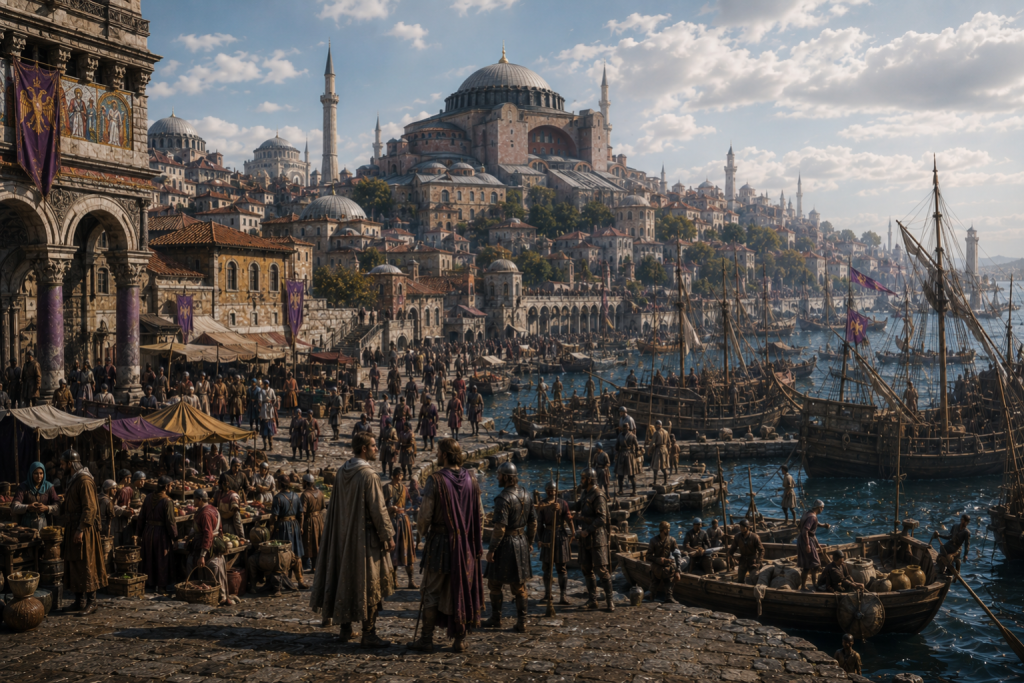
“Some cities astonish a man with their walls. Others with their palaces. But there are cities that change his very understanding of the world. Constantinople was such a city.”
From the writings of Ansel de Nantes.
We made our last camp before Constantinople in a small grove not far from the road. Autumn was already making itself felt, and the evenings were growing cooler, though the Balkans still held the warmth of the southern sun. Smoke from hundreds of campfires rose into the air. Horses neighed somewhere in the darkness, smiths finished setting horseshoes, squires cleaned harnesses, and cooks lifted great cauldrons of thick stew from the flames. It might have been any one of the dozens of evenings we had spent upon the road, yet there was a tension in the camp that no one quite acknowledged. We all knew that tomorrow we would see the capital of the Eastern Roman Empire.
After supper, the men were in no hurry to retire. Several knights, sergeants, and merchants gathered around one of the fires. Among them was the elderly Lombard trader who had been telling us extraordinary stories about Constantinople ever since Italy. His name was Pietro, and over the past weeks we had grown as accustomed to his tales as to our daily prayers.
“Well, my friends,” he said, tossing a dry branch onto the fire, “tomorrow you will finally see a city without equal.”
Geoffroi grinned.
“You’ve told us that twenty times already.”
“Because it’s true.”
“We’ve been to Rome.”
“Which is precisely why I say it.”
Drogo shook his head.
“There cannot be a city greater than Rome.”
The old man laughed so heartily that several knights turned to look at us.
“You northerners judge with your hearts. To you, Rome is sacred. To a merchant, however, every city begins with its harbour.”
He paused, as though searching for the right words.
“In Constantinople there are more ships than you have seen in your entire lives. At a single market stall you might find a Syrian, an Egyptian, an Armenian, a Varangian, an Arab, and a Frank standing side by side. They sell silk woven somewhere beyond the lands we know, spices brought from halfway across the world, precious stones from India, and furs from the distant north.”
Geoffroi gave a sceptical snort.
“And I suppose there’s gold lying about in the streets?”
“No.”
“There, you see.”
Pietro smiled.
“Because someone picked it all up long ago.”
Everyone around the fire burst into laughter.
I alone remained quiet.
Something else was troubling me.
“Tell me,” I asked, “if the city really is so rich, why don’t its people liberate Jerusalem themselves?”
The old man looked at me carefully.
Then he answered slowly.
“Because wealth and strength are not the same thing, young man.”
For some reason, those words remained with me longer than anything else he said.
At dawn, the camp came alive earlier than usual. Thick mist still lay across the hills when the trumpeters began calling the men together and the grooms led out the saddled horses. The column slowly stretched along the road. Duke Robert rode at the front with his household, followed by the knights, then the sergeants, the baggage train, and the pilgrims on foot.
The road began to climb.
The higher we went, the more often men lifted their eyes from the ground before their horses and looked ahead. Even the conversations grew quieter. It seemed that everyone was waiting for the same moment.
One of the scouts riding in advance was the first to stop.
He raised his hand.
The column slowed.
Geoffroi, who was riding a little ahead of me, turned and called softly.
“Ansel… come up here.”
I urged my horse forward and climbed to the crest of the hill.
At first, I thought I was looking at the sea.
It filled almost the entire horizon, shimmering silver beneath the morning sun.
Then my eyes began to distinguish shapes.
Towers slowly emerged from the light haze.
First one.
Then a dozen.
Then hundreds.
Behind them rose a long stone wall, so immense that I could not take in its full length at a glance. It seemed to have no end, stretching away toward the distant line of the sea.
Higher still rose the domes.
Some were covered in dark tiles, while others shone so brightly that they seemed to be gilded.
Above them all stood an enormous church whose size was impossible to judge from such a distance.
I caught my breath.
Before me lay a city.
But a city unlike anything I had ever seen.
Rome had astonished me with its past.
Constantinople astonished me with its present.
“Dear God…” someone whispered behind me.
I think it was Drogo.
For once, no one laughed.
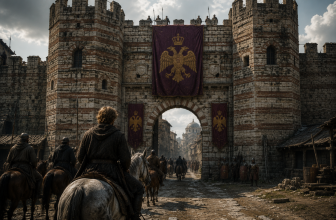
As we approached, the city seemed to grow larger still. What had appeared from a distance to be a single fortress wall gradually revealed itself as an extraordinary system of defences. Before us lay a broad moat, beyond it the first line of walls, then a second, and higher still a third, crowned with mighty towers. Never before had I seen fortifications so formidable.
“Is all that one fortress?” I asked Clavier.
The commander of our ten gave a short nod.
“The Walls of Theodosius.”
“Has no one ever taken them?”
“They’ve defended this city for nearly seven centuries.”
Geoffroi whistled.
“Then I suppose we’ll have to use the gates.”
Even Clavier allowed himself a smile.
But as I continued to study those walls, I realized that Geoffroi’s joke was not far from the truth. Such a fortress could never be taken by courage alone. It had been built by men who understood perfectly well how a besieger thought.
Another surprise awaited us before the gates.
Instead of the usual crowd and confusion, there was almost perfect order. Merchant caravans moved in one line, pilgrims in another, military companies in a third. No one tried to push ahead. Roman officials stood at every entrance. Some checked lists, others inspected cargoes, while still others pressed wax seals onto documents. Soldiers stood quietly nearby, scarcely needing to intervene.
Once again, I found myself studying something other than the walls.
I watched the people.
How they worked.
Why no one argued.
Why everyone seemed to know his place.
Geoffroi noticed where I was looking and laughed softly.
“Staring at the scribes again?”
“Yes.”
“Every normal man here is admiring the city.”
“I’d rather understand how it works.”
Drogo shook his head.
“You know, Ansel… sometimes I think God made you a knight by mistake.”
I smiled.
I did not yet understand how close he had come to the truth.
When our column finally passed through the gates, a warm sea breeze struck my face. It carried more than the smell of salt and tar. Mingled within it were incense, eastern spices, fresh bread, resin, roasting fish, and a dozen other scents I had never encountered before.
I reined in my horse and breathed deeply.
Until that day, wealth had meant silver in chests, jewels, or costly armour.
Constantinople smelled of something quite different.
It smelled of movement.
Of the sea.
Of trade.
And there, before I had seen Hagia Sophia, the imperial palace, or the great Hippodrome, I began to suspect that the power of a state was not born solely upon the battlefield. Sometimes it began in a harbour where hundreds of ships arrived each day, upon roads along which caravans travelled without cease, and with men who calmly entered it all into their account books.
It was with that thought that I first crossed the threshold of Tsargrad, the Queen of Cities—a place that would change the course of my life.
Part II. The City Where the World Meets
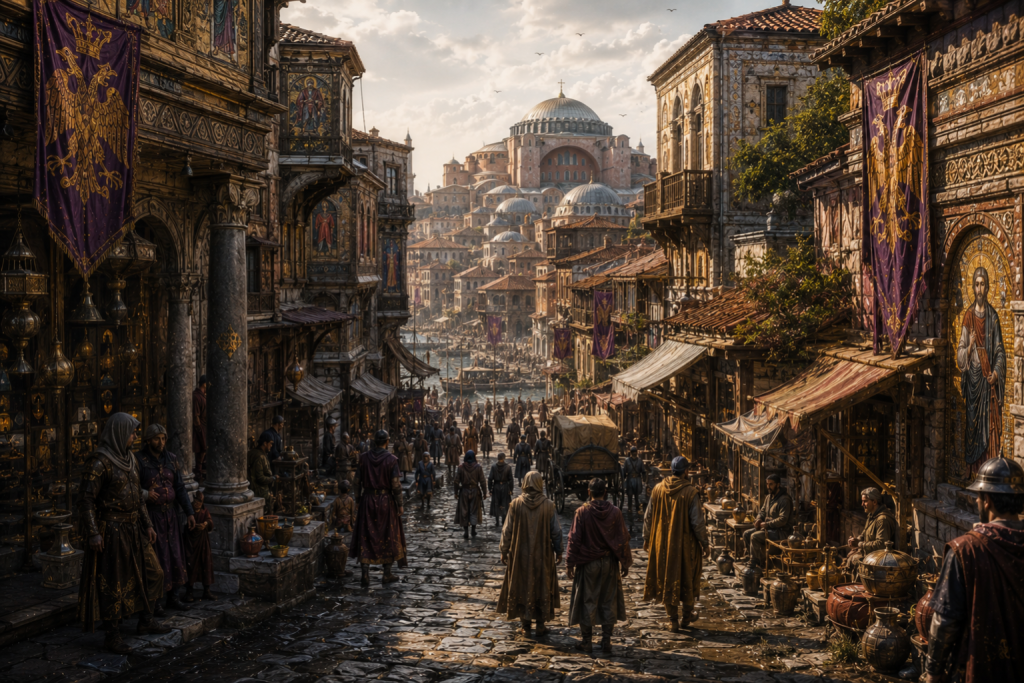
“In later years I would see Damascus, Cairo, Jerusalem, and Alexandria. Yet none of those cities gave me the feeling I experienced while wandering through Constantinople for the first time. It was there that I learned what a true capital of the world could be.”
From the writings of Ansel de Nantes.
After passing through the city gates, our army was not permitted to continue freely into the capital. By the emperor’s orders, each large contingent was assigned a place outside the central districts, lest tens of thousands of armed men turn Constantinople into one vast military camp. Robert accepted the arrangement calmly. He understood perfectly well that, had their positions been reversed, he would never have allowed such a large foreign army to wander unchecked through the streets of his own city.
The first two days were spent establishing our camp. The horses were taken to spacious pastures beyond the walls, the baggage wagons were arranged neatly along the road, and we squires returned to our familiar duties: cleaning armour, mending girths, checking lances, and drying damp horse blankets. Life seemed to continue much as it had in Normandy or Italy, yet whenever I raised my head, my eyes found the sunlit domes of Constantinople. The city seemed determined never to let us forget that it was there.
On the third day, several squires were given permission to enter the city with a small supply convoy. Clavier entrusted its escort to Geoffroi and Drogo and sent me along with them, ordering me to keep my eyes open and stay close.
“Remember,” he said as we were leaving, “this isn’t Rouen or Caen. If you get lost, we’ll be looking for you all the way to Jerusalem.”
We entered through one of the western gates and were almost immediately swallowed by the flow of people. Within minutes, I understood that I had never seen anything like it. In Rouen, the streets had seemed wide until two carts tried to pass one another. Here, entire rivers of people flowed endlessly along the stone pavement. Merchants led heavily laden mules, porters pushed handcarts piled with goods, monks hurried toward churches, officials crossed the squares with purposeful strides, and boys slipped skilfully between them, offering passers-by water, flatbread, or fresh fruit.
What astonished me was not so much the number of people as their variety. In a few hours I saw more peoples than I had encountered in all my previous life. Dark-haired Syrians in long robes passed us, Armenian merchants wore richly embroidered belts, and there were Georgians whom I recognized only from a monk’s descriptions, Jews in dark caps, Italians speaking a dialect resembling Pietro’s, and even swarthy men whom Geoffroi identified as Arabs.
“Aren’t they Muslims?” I asked in surprise.
“Some of them.”
“And they’re allowed into the city?”
Geoffroi shrugged.
“As long as they come to trade rather than fight, the Romans don’t much care how they worship God.”
That answer surprised me almost as much as the Arabs themselves.
In Normandy, the world had seemed much simpler. Friend and stranger could usually be distinguished at once by language, coat of arms, or lord. Here a Greek, an Armenian, and an Arab might walk side by side, argue over the price of a piece of merchandise, and then sit together at a tavern table.
Before long, we emerged onto one of the city’s great forums. The enormous square was filled with market stalls, yet it bore little resemblance to the markets I knew in the West. There was surprisingly little shouting. Each craftsman had his appointed place, goods were arranged neatly beneath awnings, and wagons could pass freely between the rows. I stopped beside a stall selling cloth.
Never before had I seen silk like that.
It shimmered in the sunlight as though woven from water. Beside it lay cloth of a deep imperial purple, fit only for the highest nobility, the finest linen from Egypt, carpets from Syria, and furs which the merchant assured us had come from the distant north.
“Don’t touch it,” Drogo whispered when he saw me reaching out.
“Why not?”
“Because then we’ll have to sell all Normandy to pay for it.”
We laughed, and the merchant, who understood the joke perfectly well from our expressions, merely smiled good-naturedly.
The farther we went into the city, the more my understanding of wealth began to change. Until then, I had imagined that a rich city was one filled with gold. Now I saw something quite different. Its riches lay not merely in its treasuries, but in the endless movement of people, goods, and money. Ships brought new cargoes every day, warehouses filled with merchandise, caravans departed westward, and others arrived to take their place. It seemed as though the whole known world breathed through this city.
We descended toward the harbour of the Golden Horn, and there I finally lost the power of speech.
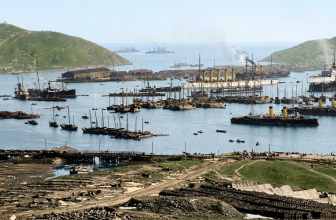
If the port of Brindisi had seemed enormous to me, Constantinople was beyond comparison. Hundreds of ships lay alongside the quays. Heavy Roman dromons shared the waters with Italian merchant vessels, small fishing boats rocked nearby, and farther along the harbour great cargo ships were being unloaded, having arrived, as Pietro explained, from Alexandria.
For a long time, I stared silently at the forest of masts.
“Well?” Geoffroi asked.
“What?”
“Counting again?”
I smiled.
“I’ve lost count.”
“Good.”
“Why?”
Drogo clapped me on the shoulder.
“Because the ships here never end.”
The wind carried the smell of salt, tar, wet ropes, and unfamiliar spices. Dockworkers laboured everywhere, lifting cranes creaked, and sailors shouted to one another across the water. For the first time, I saw a harbour that, according to the locals, worked not only by day but through the night.
Standing upon the stone quay, I suddenly remembered the old Lombard’s words.
Wealth and strength are not the same thing.
Now I was beginning to understand what he had meant. Constantinople was not rich simply because it possessed vast treasures. It was rich because it had become the place where the world met. Much of the silk, spices, and incense came from distant lands, yet all passed through the hands of Roman merchants, officials, and money changers.
It was there that a thought first occurred to me, though I could not yet put it clearly into words.
A state need not grow wealthy only by conquering lands.
Sometimes it is enough to become the place through which the roads between them pass.
The thought remained with me for a long time. That day I merely stood watching the harbour, trying to understand how one city had managed to gather almost the entire known world at its quays. Only years later, when fate brought me to Acre, would I remember that harbour and realize that on the shores of the Golden Horn I had seen not merely a great city, but an example of what a state might become if it learned to turn its place upon the map into a source of strength.
For the moment, however, I still had before me the greatest church in Christendom, the imperial palace, and a man whose acquaintance would bind my fate to the East forever.
Part III. The Emperor and Shortbeard
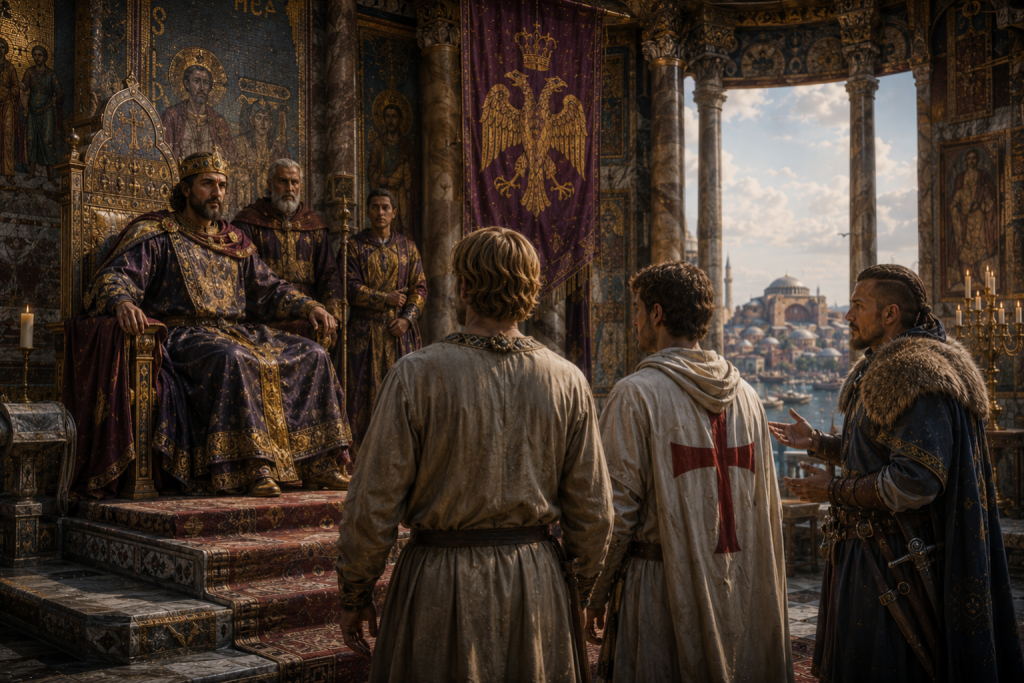
“That day I met two men, each of whom was destined to change my life. One ruled the greatest empire in Christendom. The other stood at the doors of his palace with a battle-axe in his hands. At the time, it seemed obvious which of them would leave the deeper mark upon my fate. How terribly wrong I was…”
From the writings of Ansel de Nantes.
Several days after our arrival in Constantinople, news spread through the camp that Emperor Alexios Komnenos had invited the princes of the West to his palace. The invitation was extended only to the leaders of the expedition and a small number of attendants. Everyone else was to remain in camp.
For me, it meant one thing above all: I would see a real imperial court for the first time in my life.
On the previous evening, Clavier personally inspected our equipment. He examined Robert’s mail for a long time, ran his fingers along the saddle straps, made certain the scabbard was secure, and then called me over.
“Tomorrow you’ll stay close to the duke.”
I felt my stomach tighten.
“Yes, commander.”
He looked me straight in the eyes.
“Remember one thing.”
I waited silently.
“Tomorrow you’ll see men who believe they own half the world. Don’t stare, don’t stand there with your mouth hanging open, and remember that you’re the Duke of Normandy’s squire.”
I nodded.
Clavier gave a faint grin.
“And another thing…”
He paused.
“Keep your eyes open.”
“And your mouth shut.”
The Great Palace was unlike any castle I had known. In Normandy, a fortress was first and foremost a weapon. Thick walls, narrow arrow slits, heavy towers—everything spoke of war. Here, even as we passed through gate after gate and courtyard after courtyard, I felt that I was entering not a fortress, but the residence of an ancient empire.
Water murmured everywhere. Small fountains played between the galleries. Marble columns supported broad porticoes, while the walls were covered in mosaics that shimmered with gold and azure. I had never seen so much light within a building. It seemed as though the walls themselves reflected the rays of the sun.
The gardens astonished me most of all. Peacocks wandered unhurriedly among cypresses and flowering shrubs. Artificial streams murmured somewhere beneath the trees, and the air was filled with the fragrance of flowers I had never encountered before.
Geoffroi, walking beside me, muttered quietly:
“Not a palace. Paradise itself, like something out of a monastery painting.”
Drogo shook his head.
“No.”
He looked carefully around him.
“Paradise ought to be more modest.”
I could not help smiling.
But deep down, I knew that I had never imagined such splendour could exist.
The closer we came to the principal chambers, the more frequently we encountered palace guards.
It was there that I first saw the Varangians properly.
They stood at regular intervals along the corridors, like statues carved from stone. Tall and broad-shouldered, they wore long coats of mail and held heavy two-handed axes upright before them. Not one spoke. Not one turned to watch the princes passing by.
Their stillness impressed me more than any display of strength could have done.
I found myself studying these men rather than the gilded vaults above us.
At that moment, one of the Varangians unexpectedly turned his eyes toward me.
He was perhaps ten years older than I was. His fair hair was cut short, and his beard was neatly trimmed, quite unlike those of the other northerners. There was neither arrogance nor hostility in his face.
Only a faint curiosity.
Perhaps he had noticed how closely I was studying his axe.
For the briefest moment, the corners of his mouth moved.
It was almost a smile.
I smiled back before I could stop myself.
Then we walked on.
I thought nothing more of it.
While the princes attended their audience with the emperor, we waited in an inner courtyard. The meeting lasted a long time. We heard not a single word, but the faces of the barons as they emerged made it clear that the conversation had not been an easy one.
Raymond of Toulouse appeared first. He walked briskly, explaining something to his men in an irritated voice.
Godfrey of Bouillon followed him. His face was perfectly calm, as though nothing of consequence had happened.
Bohemond, by contrast, looked unusually thoughtful. He silently fastened his glove, paying no attention to anyone around him.
Robert came out last.
Clavier approached him immediately.
“My lord?”
The duke removed a glove and answered briefly.
“The emperor wants every land that belonged to the Romans before the Turks came to be returned to him.”
Geoffroi raised his eyebrows in surprise.
“And us?”
Robert shrugged.
“We are going to liberate the Holy Sepulchre.”
That was the whole conversation.
Only years later would I understand how difficult the decisions made behind those palace doors had been. On that day, however, politics seemed very far removed from my own life.
We were preparing to return toward the exit when something happened that would change the rest of my life.
I was carrying a travelling chest behind Robert, filled with spare straps and tools for maintaining his armour. One of the straps suddenly slipped free and fell onto the marble floor.
I bent to pick it up.
But another hand reached it first.
It was the same Varangian.
He silently picked up the strap and held it out to me.
“Here.”
I froze.
He had spoken in our Frankish tongue.
Slowly.
With a heavy accent.
But perfectly clearly.
“You speak our language?”
The Varangian shrugged.
“A little.”
Then, noticing my surprise, he added:
“My father taught me.”
I looked at him more closely.
“You’re not Greek.”
He grinned.
“Fortunately for my commander.”
I burst out laughing.
“My name is Ansel.”
He nodded.
“Hakon.”
I was about to ask him something else when a loud voice rang out from farther down the corridor.
“Shortbeard!”
The Varangian turned.
“Coming!”
He looked back at me and spread his hands in a gesture that was almost apologetic.
“That’s what they call me here.”
I could not resist.
“Why?”
He ran a hand over his neatly trimmed beard.
“Because the others decided I’d cut away half my northern soul along with it.”
There was neither resentment nor annoyance in his voice.
Only a cheerful willingness to laugh at himself.
I smiled.
“Until we meet again, then… Shortbeard.”
He gave a short nod.
“Until we meet again…”
And after a brief pause, he added:
“…monk.”
I raised my eyebrows.
“Why monk?”
Hakon glanced at my closely cropped tonsure. After many months in the duke’s service, it had almost grown out, but traces of it could still be seen.
“Obvious.”
I instinctively touched my head.
He laughed softly.
Then he turned and resumed his place in the line of guards, as though our conversation had never happened.
I watched him for several moments longer.
At the time, I thought it had been nothing more than a chance encounter.
But God sometimes binds men’s fates together with threads so fine that we notice them only many years later.
That day I met the Varangian they called Shortbeard.
I did not yet know that one day I would trust him as I had once trusted Geoffroi, Drogo, and Clavier himself. This man would become my guide to the world of the Romans and, in time, the brother blood had never given me.
From that day onward, the story of my Crusade ceased to be merely the story of a Norman. It became the story of a friendship between two men raised at opposite ends of Europe, who found a common language far from their homes, beneath the vaulted ceilings of the greatest city in Christendom.