Part I. Beneath the City Walls
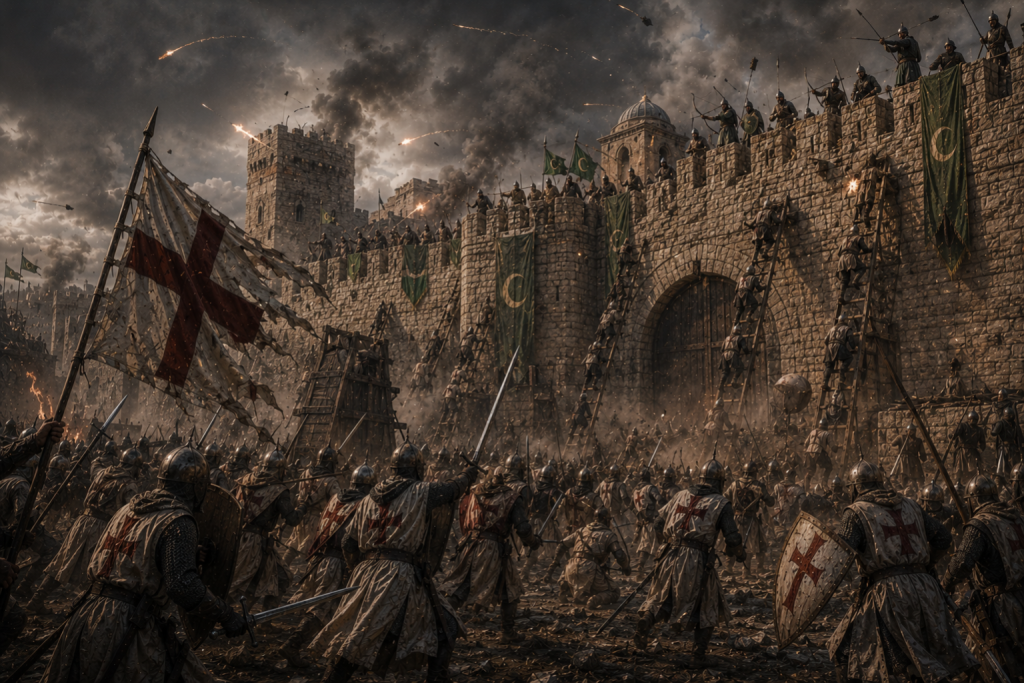
“Nicaea was the first fortress I would have to take by assault. Until that day, I sincerely believed a siege was nothing more than endless blows from a battering ram and ladders raised against the walls. Only later did I understand that a true siege begins long before the first assault.”
From the writings of Ansel de Nantes.
At dawn, our advance patrols reported that the city was less than an hour away. The column gradually slowed, as though the entire enormous army had held its breath at once. Even the most talkative men rode in silence. Everyone understood that the first real objective of our expedition lay ahead.
When the road climbed a broad hill, Nicaea appeared before us in all its splendour.
I had expected a fortress.
I saw an entire city.
High stone walls enclosed a vast circle of houses, towers, and churches. Dozens of square towers rose above them, standing so close together that scarcely any stretch of wall seemed unprotected. To the south lay the enormous Lake Ascania, its calm waters reaching almost to the fortifications. I would later learn that the garrison received food and reinforcements across that lake. At the time, only one thought struck me: taking this fortress would be far more difficult than I had imagined when I left Normandy.
“Impressive?” Clavier asked, noticing that I could not take my eyes off the city.
“Yes.”
He grinned.
“Good.”
“Why?”
“Because walls deserve respect. The moment you start despising them, you’ll be climbing them without your head.”
I smiled.
It was one of Clavier’s favourite habits: turning every conversation into a lesson.
The army spent almost the entire day surrounding Nicaea. Each of the great princes took responsibility for his own section, and soon the whole plain around the city was covered with tents. The banners of Duke Robert, Bohemond of Taranto, Raymond of Toulouse, Godfrey of Bouillon, and dozens of lesser lords rose above the camps. That morning, empty fields had stretched before the walls. By evening, an entire city of timber, canvas, and iron had appeared.
Yet no one was allowed to rest.
I had expected us to begin preparing battering rams or siege towers at once. Instead, the commanders handed out axes, saws, and shovels.
“What are you standing there for?” Drogo called, already resting a heavy axe upon his shoulder. “Or did you think the Lord would build our ladders for us?”
The whole following day was spent in hard labour. Some men felled trees, others stripped branches from the trunks, while still others bound thick poles together to make long scaling ladders. Men wove enormous baskets to hold earth, dug trenches, and prepared timber for siege engines. Even knights whose names were known throughout France helped carry logs and strengthen the camp without the slightest embarrassment.
For the first time, I understood that a siege was less a battle than an enormous building site.
Thousands of men worked from morning until evening so that one day a few hundred others might have the chance to climb the walls.
“Remember this,” Clavier said as we laid another log into the foundation of a siege platform. “Castles are rarely taken with swords.”
He wiped the sweat from his forehead with his sleeve.
“They’re taken with patience.”
Two days later, the trumpets announced the first assault.
Raymond of Toulouse’s men were to test the defences along their section of the wall. Our ten had been ordered to support the assault from below, and before dawn Clavier quickly assigned our duties.
“Geoffroi, you’re responsible for the ladders. If even one is left lying useless on the ground, you’ll climb the wall yourself.”
Geoffroi merely nodded.
“Drogo, gather the covering party. Shields in front, archers behind them.”
“Consider it done.”
Clavier turned to me.
“Ansel, you’re coming with me. We’ll carry out the wounded and pass up whatever the men above need. Watch carefully. Today, you learn.”
His words brought unexpected relief. After our conversation by the fire the previous evening, I had almost convinced myself that I would have to climb a ladder beneath a hail of arrows.
Clavier seemed to read my thoughts.
“Don’t be in such a hurry.”
He tightened the strap of my helmet.
“You’ll have plenty of chances to climb walls.”
The first rays of sunlight had barely touched the towers of Nicaea when hundreds of men raised their heavy ladders and rushed forward together. Almost immediately, signal horns sounded from the walls, and a moment later the sky darkened with arrows.
Until that day, I had believed that tales of clouds of arrows were merely an exaggeration.
They were not.
When several thousand archers shoot at once, the air truly seems to take on a life of its own. The arrows do not whistle separately. They produce a continuous hissing roar, like the sound of a heavy downpour.
The first ladder struck the wall with a dull thud.
Then a second.
A third.
Raymond’s men immediately began climbing.
Clavier and I had taken scarcely a few steps forward when an enormous stone came crashing down from above. It struck the middle of one of the ladders. The wood broke with a sharp crack, and men tumbled to the ground among the splinters.
“Follow me!” Clavier snapped.
We rushed toward the fallen ladder. One sergeant lay pinned beneath his own shield, another was unconscious nearby, and a third, clutching a shattered arm, was struggling to stand. The three of us pulled them free of the wreckage and dragged them back behind the cover of the great pavises.
The moment we returned, the work began again.
Carry forward another ladder.
Pass up a bundle of spears.
Bring water.
Carry away a wounded man.
Go back.
Raise another ladder.
I scarcely saw the fighting itself.
Only the legs of men climbing above us.
Only arrows striking the timber with dull knocks.
Only the faces of wounded men whom we managed to pull away before another stone came crashing down.
Just once, when I raised my head, I saw a Turkish archer standing between the battlements. He drew his bow, loosed an arrow, and immediately disappeared behind the stone parapet. A moment later, another man took his place.
Their defence worked as smoothly as our own efforts below.
By noon, it was clear that the assault had failed.
One after another, the ladders were smashed against the walls. Our archers could not force the defenders from their positions, and the casualties mounted with every passing hour. When the trumpets finally sounded the retreat, no one questioned the order.
The men returned to camp slowly and in silence.
Some supported wounded comrades.
Others carried men on stretchers.
Many places in the ranks remained empty.
That evening, the camp seemed strangely subdued. Even around the fires, men spoke in low voices. Clavier sat with his sword across his knees, slowly working a whetstone along the blade. For a while, no one broke the silence. Only the firewood crackled.
At last, Geoffroi let out a heavy sigh.
“I don’t like sieges.”
“No one does,” Clavier replied calmly, without looking up.
“I thought it would be quicker.”
“Only fools do things quickly.”
He paused.
“And dead men.”
He finished sharpening the blade, slid it into its scabbard, and looked at us for the first time that evening.
“Tomorrow it’s our section.”
Silence followed.
“Raymond’s men will support us from below.”
“We’re going up the walls.”
Drogo gave a crooked smile.
“So now it’s our turn to climb into hell.”
“Now it’s our turn,” Clavier answered calmly.
No one said anything more.
We went to our places, certain that at dawn we would once again have to take up the ladders and march beneath the walls of Nicaea.
But fate had other plans.
The following day, war itself came to us from beyond the horizon.
Part II. The Day the Sultan Came
The night passed with surprising calm. Hardly anyone spoke in the camp. Some slept wrapped in their cloaks beside the fires, others prayed, while still others sharpened their weapons one final time. I lay awake for a long while. Again and again, I saw the walls of Nicaea, the shattered ladders, and the men falling among the broken timber. It seemed that tomorrow I would be among them.
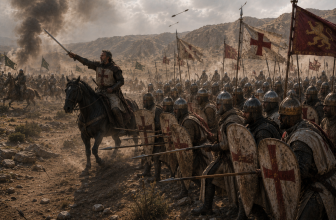
Before dawn, the sound of horns rolled across the camp. The men rose in silence, as though each had already lived through the coming day in his mind. Squires carried ladders toward their appointed sections, archers checked their bowstrings, and priests hurriedly blessed those preparing for the assault. I was tightening the straps of my helmet when an unfamiliar commotion suddenly rose from the city walls.
At first, no one paid much attention.
Then the Turkish signal horns began sounding one after another.
But these were different calls.
Not alarm.
Jubilation.
Men ran along the battlements, pointing toward the south. The garrison waved banners and shouted to their comrades beyond the walls, and then a prolonged roar from thousands of voices rose above the fortress.
Clavier slowly climbed the nearest earthwork.
He shaded his eyes with one hand.
For a long time, he stared into the distance.
Then he said quietly:
“I don’t like this…”
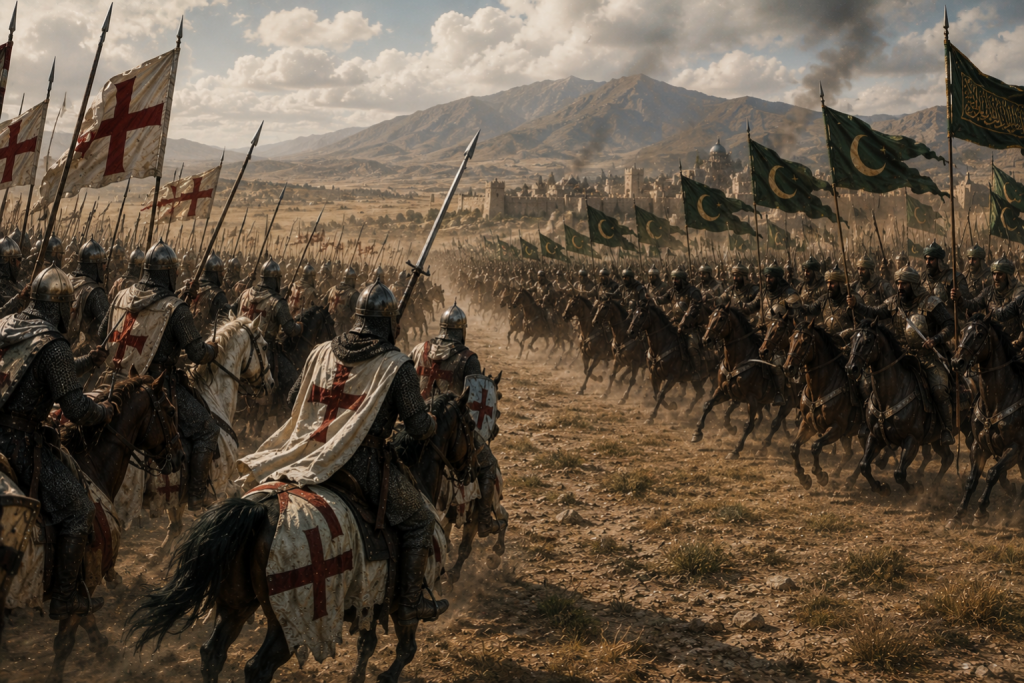
A few moments later, dust appeared on the southern horizon.
At first, a thin line.
Then an entire cloud.
It grew rapidly, swallowing the line of hills.
Robert was already standing nearby.
He was looking in the same direction.
Not a muscle moved in his face.
“Send a messenger to Bohemond,” he ordered calmly. “And another to Godfrey.”
Within a minute, riders were galloping through the camp.
Then the trumpets began to sound.
But this time the signal was entirely different.
Not the call to assault.
The call to form ranks.
“Leave the ladders!” someone shouted.
“Everyone to your horses!”
Men who only moments earlier had been preparing to storm the walls rushed back toward the camp. The scaling ladders lay abandoned on the ground. Some tore off their work gloves, while others hurriedly fastened their mail shirts as they ran. Within minutes, the siege camp had become a vast, seething anthill.
Clavier was already standing beside our horses.
“Quickly!”
He said nothing more.
We mounted in silence.
The entire conroi of Duke Robert was forming beside us.
Lances rose upright.
Shields settled against left shoulders.
For the first time, I stood not on a training ground, not during an exercise, and not at a tournament.
For the first time, a real army was gathering before me.
“Don’t look around,” Clavier said quietly as he rode up beside me. “Keep your distance from my horse. Whatever happens, don’t lose contact with me.”
I gave a short nod.
He looked at me once more.
“And don’t think.”
“Just do what you’ve been taught.”
Those were the last instructions I received before my first real battle.
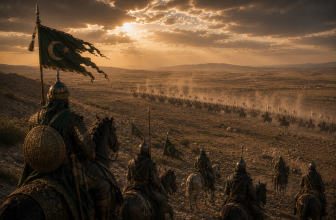
Within minutes, the army of Kilij Arslan came fully into view.
Thousands of horsemen covered the plain. They moved with astonishing ease, scarcely seeming to keep any formation at all, like an enormous living cloud. Sunlight flashed upon spearheads and curved sabres, brightly coloured banners rippled above their heads, and light horse archers darted constantly across the front.
They were in no hurry to attack.
They were watching.
Perhaps just as we had watched the walls of Nicaea a few days earlier.
“Beautiful…” Drogo muttered unexpectedly.
Geoffroi turned his head.
“What?”
“The horses.”
“A shame to spoil them.”
Clavier did not even smile.
“Shut up.”
Duke Robert rode forward.
He passed slowly along the line, studying the faces of his men. He made no long speech.
“Today,” he said, loudly enough for the front ranks to hear, “the Turks have come to save Nicaea.”
He raised his sword.
“Let’s make certain they have no wish to return.”
That was all.
No grand words.
No promises.
He simply turned his horse.
And at that very moment, trumpets sounded along the entire line.
The lances slowly lowered.
I suddenly realized that my fingers were gripping the shaft so tightly they had begun to go numb.
The horse beneath me shifted nervously from hoof to hoof.
Ahead, I could already hear the dull thunder of thousands of hooves.
“Hold formation!” Clavier shouted.
The next moment, the whole earth seemed to move.
First a walk.
Then a trot.
Then a gallop.
I could see almost nothing.
Only Clavier’s back.
The white tail of his horse.
And my own lance pointing forward.
The distance closed with terrifying speed.
The Turkish archers loosed their first volley.
Something hissed above our heads.
Then came a second.
Someone cried out to my right.
But the formation did not stop.
A few more heartbeats.
And the world disappeared.
I do not remember the collision itself.
I remember only a terrible impact that sent a shock through both my arms. My lance struck something living with such force that the shaft was almost torn from my hands. Only later did I understand that I had struck not the rider but his horse in the chest. The animal collapsed beneath the hooves of the following ranks, and my lance remained buried in its body.
There was no time even to look back.
My right hand reached for my sword almost of its own accord.
Everything that followed became an endless succession of movements.
Shield.
Strike.
Shield.
Another strike.
A scream.
Horses.
Dust.
I could no longer tell who stood before me.
I saw no faces.
I did not think.
I merely repeated what Clavier had taught me hundreds of times on the training ground at Caen.
Don’t swing too widely.
Don’t leave yourself exposed.
After striking, cover yourself with your shield.
Keep your place in the formation.
Never chase a single enemy.
At some point, a heavy blow struck me from the side.
My horse reared.
The world turned upside down.
I hit the ground so hard that for several seconds I could no longer tell which way was up.
My helmet flew from my head.
My shield vanished.
A continuous ringing filled my ears.
When my sight finally cleared, all hell had broken loose around me.
Part III. After the First Battle
For a moment, it seemed as though the entire world had shrunk to the few paces immediately around me.
Horses thundered past, their hooves throwing up earth and stones. Someone shouted in French, someone else in Greek, and unfamiliar Turkish voices sounded nearby, but the words no longer meant anything. Only movement remained, and the desperate desire to stay alive.
I tried to stand.
At that very instant, a Seljuk horseman charged straight toward me.
He shouted something as he raised his sabre.
I did not even have time to be afraid.
My body acted on its own.
My left hand instinctively reached toward my belt.
My fingers closed around the familiar haft of my axe.
That was how every training session at Caen had begun, hundreds of times over.
Sword in the right hand.
Axe in the left.
Don’t think.
Act.
The sabre struck my blade with a clang. I scarcely felt the impact. With my next movement, the axe swept through a short arc and bit into the horse’s shoulder. The animal shied violently to one side, its rider lost his balance, and I was already stepping backward with my sword held before me.
I never even saw his face.
Only his eyes.
Dark.
And just as frightened, I imagine, as my own must have been.
A moment later, other horses thundered between us, and the Seljuk disappeared into a cloud of dust.
Then came another.
And another.
I stopped counting.
Then I lost all sense of where our formation was.
At some point, Geoffroi appeared beside me.
“Ansel!”
“Alive?”
I could only nod.
“Then follow me!”
We crashed into a group of our infantrymen who were fighting off several Turkish horsemen. Everything happened so quickly that it was impossible to tell who was driving whom back. Horses collided chest to chest, men fell, and some continued fighting even after they had been knocked to the ground. The air was thick with dust, screams, and the ringing of steel.
I cannot remember how long it lasted.
A minute.
An hour.
Or an eternity.
My memory preserved only fragments.
Clavier’s dented helmet.
A Flemish soldier’s shield split in two.
A white horse without a rider.
A drop of blood slowly running down the blade of my sword.
And Robert’s voice.
“Forward!”
Always forward.
Then something happened that I did not understand at first.
The noise began to recede.
The Turkish horsemen were no longer trying to break through our heavy cavalry. They withdrew in small groups, still shooting as they rode, but the force of their attack had gone. A few minutes later, it became clear that the Seljuks were retreating.
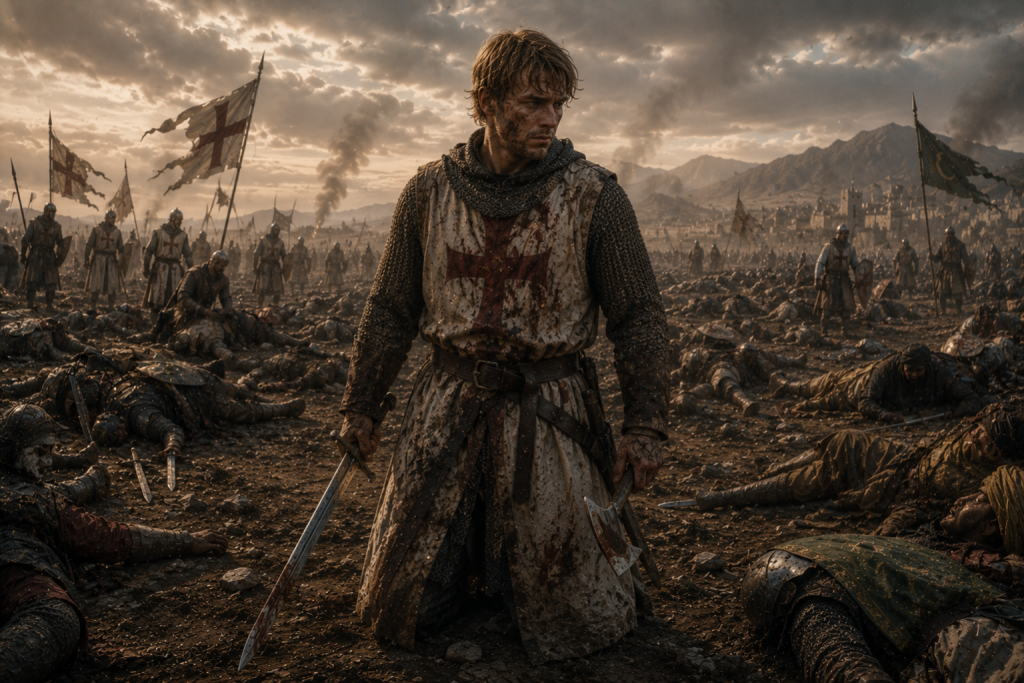
I stood in the middle of the trampled plain, breathing heavily.
My sword was still clenched in my right hand.
My axe in my left.
I looked down.
My hands were trembling.
Not from fear.
From exhaustion.
Clavier was the first to reach me.
He jumped down from his horse and examined me carefully from head to foot.
“Wounded?”
I shook my head automatically.
Only then did I notice a long scratch running across the mail on my left side. A sabre had glanced off the rings without cutting through them.
Clavier touched the damaged spot.
“Good work by the smith.”
Then he looked at my axe.
“See?”
I said nothing.
“That’s why I told you to learn the axe first.”
“A sword is good when there’s room to use it.”
“In a crush like that, an axe is more honest.”
He picked up my lost shield from the ground and handed it to me.
“And never lose this again.”
“A shield saves your life more often than a sword.”
Only then did I fully realize that I had lost it when I fell.
Our losses were heavy.
Across the battlefield, monks were already gathering the dead. Wounded men lay groaning on the ground, waiting for their injuries to be bound. Grooms struggled to calm terrified horses, while squires searched among the fallen for their lords.
I wandered among the bodies for a long time.
I did not quite know why.
Perhaps I merely wanted to make certain that Geoffroi, Drogo, and the others were still alive.
When we finally gathered beneath our banner, Clavier counted his men.
Two were missing.
One had been killed.
The other was badly wounded.
The commander let out a heavy breath.
“For a first battle…”
He did not finish.
But we understood.
It could have been much worse.
Toward evening, Duke Robert rode among his men.
He made no speeches.
He offered no congratulations.
He simply stopped beside each ten, asked about its losses, and rode on.
When he reached us, Clavier gave a brief report.
“One dead.”
“One badly wounded.”
“The rest fit for duty.”
Robert nodded silently.
Then his gaze settled upon me.
Only then did I realize what I must have looked like.
My helmet was dented along one side.
My face was smeared with blood and dust.
I still held my sword in my right hand.
And my Norman axe in my left.
The duke studied me for several long seconds.
Then, unexpectedly, he smiled.
Only a little.
“For a moment…”
He spoke quietly, almost as though addressing himself.
“I thought Hugues de Nantes was fighting beside me again.”
I lowered my eyes.
I did not know what to say.
Robert touched his reins and was about to ride on when he suddenly stopped.
“Remember one thing.”
I looked up.
“Your father went looking for death far too often.”
“Don’t repeat his mistakes.”
With that, he urged his horse forward and continued along the line.
Clavier watched him go.
Then he said quietly:
“You see…”
“Even heroes sometimes get the same advice.”
As the sun began to set, we looked once more toward the walls of Nicaea.
The city still stood.
Green banners still flew above its towers.
The sultan’s army had withdrawn.
But the garrison had not surrendered.
The siege continued.
I sat beside the fire and, for the first time that day, was able to look calmly at my sword.
There was no blood left upon the blade.
I tried to remember the men I had fought that day.
I wanted to recall at least one face.
I could not.
All that remained in my memory were blows, screams, clouds of dust, and the eyes of horses filled with the same terror as those of men.
It was then that I understood something for the first time.
In war, it is far easier to kill a man than to remember afterward whom you have killed.
And that frightened me more than anything else.
That evening, no one spoke of another assault. Men repaired their armour, buried their fallen comrades, and prepared to resume the siege. We had driven off the sultan’s army, but victory was still far away.
The real war was only beginning.