Memoirs of an Old Knight of Acre. Chapter XVII. Victory Without Triumph

“In my youth, I imagined that every victory was followed by trumpets, songs, and the division of spoils. At Nicaea, I witnessed my first victory after which men silently sharpened their swords and went to sleep.”
From the writings of Ansel de Nantes.
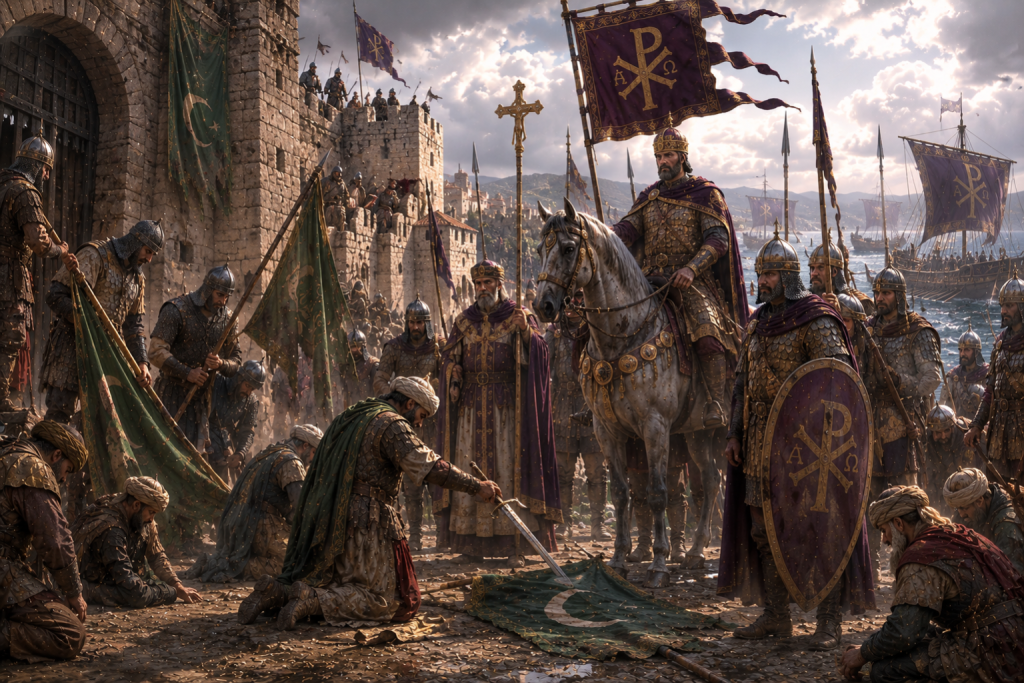
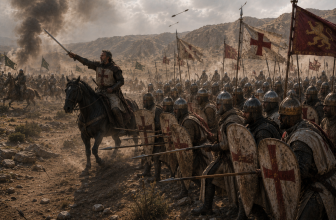
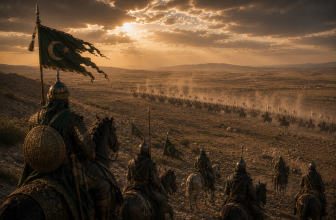
After the defeat of Kilij Arslan’s army, the siege entered a new phase. No one doubted any longer that the city was doomed. The Turks still held the walls, continued shooting their bows, and occasionally made brief sorties, but their hope of swift relief had vanished with the sultan, who had withdrawn into the depths of Anatolia.
The work continued day and night. While carpenters assembled new ladders and battering rams, labourers dug trenches toward the walls, and smiths worked without rest, repairing mail shirts and forging spearheads. I increasingly found myself thinking that a siege resembled an enormous workshop in which every man practised his own trade. A carpenter, a blacksmith, a mason, and a knight were equally necessary.
One morning, the camp suddenly stirred into motion. Men began pointing toward the lake, and before long the entire hillside was crowded with curious onlookers.
Byzantine ships were moving slowly across the water.
For a long time, I could not understand how they had come to be there. Only a few days earlier, the lake had been empty.
“They brought them from the sea,” Clavier said calmly.
I looked at him in astonishment.
“Overland?”
“Overland.”
He watched the vessels in silence for a while, then added quietly:
“Remember something, Ansel.”
I turned toward him.
“Sometimes a good carpenter wins a war before the finest knight has even drawn his sword.”
I looked back at the ships.
They were slowly spreading across the lake, finally cutting the city off from the outside world.
That day, I began to understand that wars were not won on battlefields alone.
Another week passed.
The garrison continued to resist stubbornly, but it was clear that the defenders were nearing exhaustion. Our siege engines were almost ready, and that evening Clavier announced that our section would take part in the decisive assault the following morning.
Geoffroi merely grinned.
“So this time we really are going up.”
“We are,” Clavier replied calmly.
“And we’ll take the city?”
The commander shrugged.
“If God permits.”
We went to sleep firmly convinced that the following day would be the hardest of the entire expedition.
But God, as so often happens, had other plans.
At dawn, the camp awoke to an unfamiliar silence.
There was no hiss of arrows.
No signal horns sounded.
No one was even shouting from the walls.
One by one, men emerged from their tents and stared silently toward the city.
I raised my head.
The green banners had disappeared.
Purple Byzantine standards were flying above the towers.
For a while, no one spoke.
Then the camp seemed to erupt.
“What the devil?!”
“When did they manage that?”
“We’ve been cheated!”
Geoffroi angrily struck a fallen tree with his fist.
“We lost so many men!”
Drogo spat on the ground without a word.
I looked at Clavier.
He stood leaning on his spear, calmly studying the city.
“What happened?”
“The city surrendered.”
“But…”
“The emperor reached an agreement before we did.”
I could make no sense of it.
“So… the Romans won?”
Clavier turned toward me.
“No.”
“We won.”
“Just not in the way we expected.”
He paused, as though choosing his words.
“Tell me, Ansel…”
“Is the city ours?”
“Ours.”
“Have they taken down the Turkish banners?”
“Yes.”
“Then we’ve won.”
I was still uncertain.
“But what about the spoils?”
Clavier merely grinned.
“That’s why princes make decisions, not commanders of tens.”
He adjusted his sword belt.
“The rest is above our station.”
Later, we learned what had happened.
During the night, the Byzantines had secretly accepted the garrison’s surrender. While we prepared for the final assault, imperial commanders were already entering the city through the gates facing the lake.
Many knights were displeased.
Some openly cursed the Romans.
Others believed the emperor had deprived the army of its rightful spoils.
But Robert did not utter a single harsh word.
When one young knight began angrily speaking of betrayal, the duke answered calmly:
“Nicaea belongs to Christians once more.”
“Was that not why we came here?”
No one dared argue further.
Several days later, we began entering the city in small groups.
The emperor did not want the entire enormous army inside the walls at once.
And he was probably right.
I had expected to see smoking ruins.
Instead, I found a living city.
Craftsmen worked in the streets. Women drew water from wells. Dogs barked somewhere nearby, merchants hurried to open their shops, and children, already forgetting the recent siege, ran through the narrow lanes.
Beside one of the houses, I noticed a boy of about ten. He peered cautiously from behind a doorway, clutching a wooden horse tightly against his chest. Our eyes met for only a moment. I smiled at him, but the boy disappeared into the house in fright.
I stood looking at the closed door for a long time.
Then it suddenly occurred to me that, had we launched a general assault, that child would most likely no longer be alive.
Perhaps it was then that I first began to understand that mercy, too, can be a victory.
The following day, the camp began to break up.
One by one, the wagons left their places, the smiths extinguished their forges, and the grooms saddled the horses. The army was becoming a marching column once again.
Just before our departure, Clavier summoned our ten.
He studied each of us carefully.
“Remember Nicaea.”
Geoffroi smiled.
“Our first victory?”
“No.”
Clavier shook his head.
“Our first lesson.”
We remained silent.
The commander slowly looked along the city walls.
“Sometimes a war isn’t won by the man who swings his sword the hardest.”
“Sometimes it’s won by the man who has more patience.”
He adjusted his cloak and was the first to walk toward his horse.
We followed him.
Ahead lay Anatolia.
And beyond it, the road to Dorylaeum, where our commander’s words would take on an entirely different and far more painful meaning.