In the 1950s, Sweden officially remained outside military alliances, built its own fighter aircraft, and prepared to defend its neutrality independently. Behind this respectable façade, however, lay a far more alarming reality: Swedish scientists were studying how to produce nuclear weapons, military planners were selecting possible targets, and Saab engineers were designing an aircraft capable of delivering an atomic bomb to Soviet territory.
That aircraft was the Saab A-36, a supersonic strike aircraft also associated with Project 1300. No prototype was ever built, but the program produced dozens of configurations, wind-tunnel models, and several radical changes in direction. Most importantly, the A-36 was not a private fantasy dreamed up by a few ambitious engineers. It was conceived as part of a genuine national program that could have turned Sweden into a nuclear power.
A Neutrality That Needed an Atomic Bomb
Sweden’s nuclear story began almost immediately after Hiroshima. Just weeks after the end of World War II, the newly established Swedish National Defence Research Institute, known as FOA, began secretly investigating the new weapon of mass destruction. The official purpose was to protect the country against the effects of a nuclear attack, but the research gradually moved toward a more practical question: could Sweden build an atomic bomb of its own?
By the early 1950s, the answer was becoming increasingly confident. Sweden possessed an advanced industrial base, domestic uranium deposits, research reactors, and specialists in nuclear physics. In 1952, Air Force commander Bengt Nordenskiöld publicly declared that Sweden needed nuclear weapons. Studies conducted in 1953, 1955, and 1957 established the basic design of a possible Swedish device and estimated the time required to manufacture it. Researchers concluded that the technical problems could be overcome if the government made the necessary political decision.
The military’s reasoning was straightforward. If Sweden was unwilling to join NATO, it could not automatically rely on the American nuclear umbrella. Neutrality would therefore have to be supported by a national weapon capable of inflicting unacceptable damage on an aggressor.
But producing an atomic bomb was not enough. Sweden also needed a way to deliver it.
From Interceptor to Atomic Bomber
In 1952, Saab began Project 1300, a study of a future combat aircraft. Engineers were initially asked to develop a high-altitude interceptor capable of engaging the supersonic Soviet bombers expected to appear during the following decade. Soon, however, an uncomfortable question emerged: why chase individual bombers if Swedish aircraft could destroy the airfields and missile sites from which the enemy attack would be launched?
The defensive interceptor began turning into an offensive strike aircraft.
The project developed in an almost chaotic fashion. Saab investigated around 100 configurations, including vertically launched rocket aircraft, twin-engine delta-wing designs, straight-wing machines resembling the American F-104, and aircraft expected to reach Mach 2.5 or even Mach 3. Some of these concepts now look more like illustrations from a science-fiction magazine than products of a country whose population had not yet reached eight million.
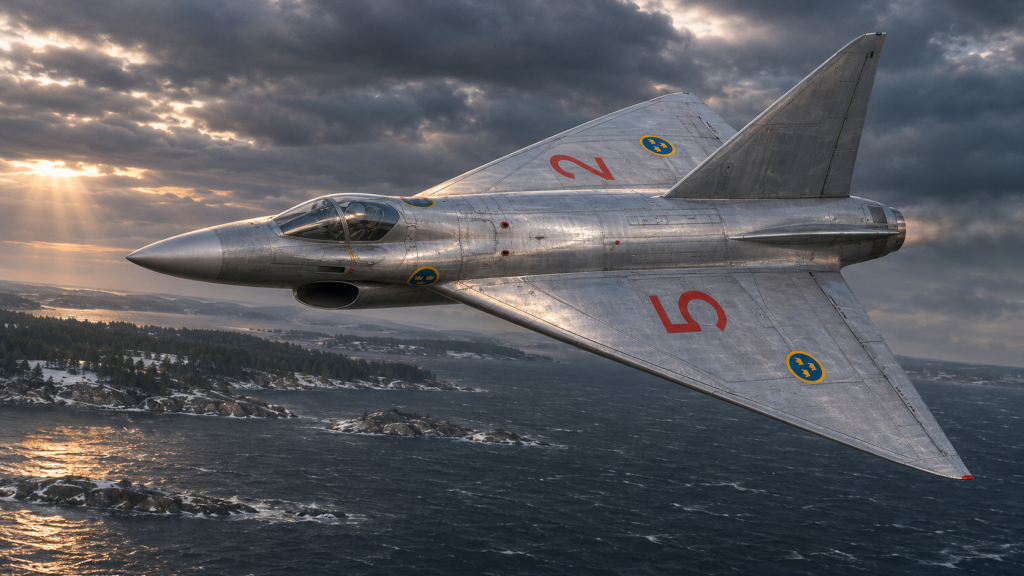
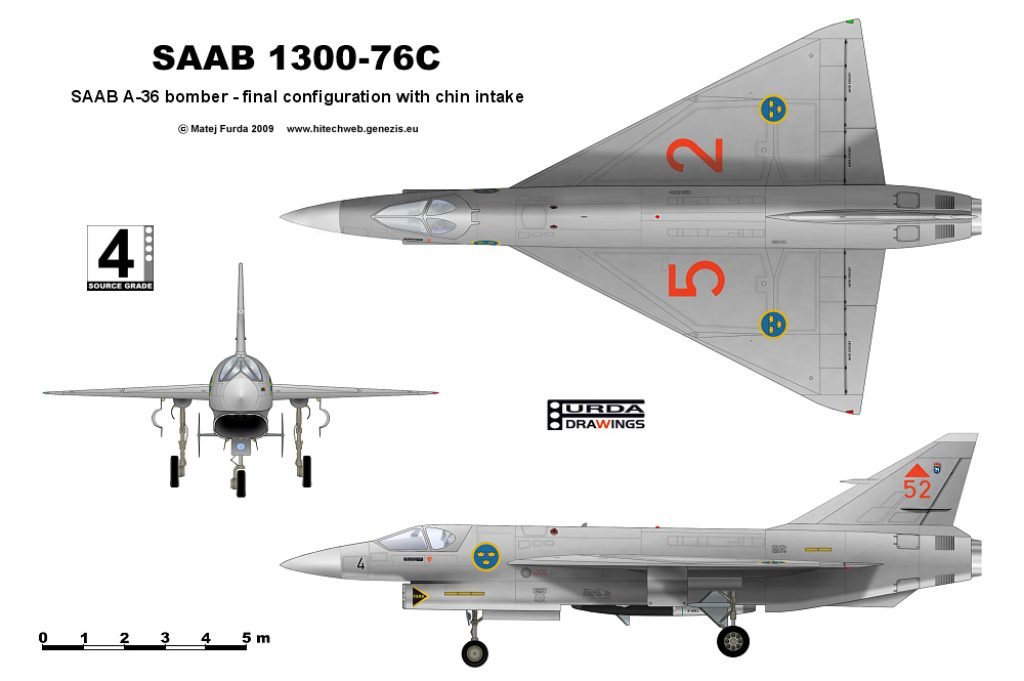
The most advanced configuration was Project 1300-76, which received the designation A-36. The aircraft is also commonly called Vargen—“The Wolf”—although the official status of that name remains uncertain. It was conceived as a single-seat, tailless delta with an internal weapons bay and an air intake beneath the fuselage. An alternative version, Project 1300-77, moved the intake to the top of the fuselage, apparently to protect it from disturbed airflow during low-altitude flight.
What the A-36 Was Supposed to Be
The early requirements bordered on the fantastic. The aircraft was expected to reach Mach 2.5–3 at an altitude of around 18 kilometers, possess a combat radius of at least 410 kilometers, and carry an atomic bomb weighing as much as 800 kilograms.
As development progressed, however, ambition collided with aerodynamics, engine performance, and cost.
By the final stage, the requirements had become more realistic. The aircraft was expected to reach approximately Mach 1.2 at low altitude, have a low-level combat radius of about 350 kilometers, and carry a weapon load of roughly 600 kilograms. Published reconstructions give it a maximum high-altitude speed of Mach 2.14. The chosen powerplant was to be a version of the British Bristol Olympus, an engine family later used by both the Avro Vulcan strategic bomber and the Concorde airliner.
The A-36’s range appears modest for a nuclear bomber. It would certainly have been inadequate for a conventional strategic aircraft intended to strike Moscow or targets beyond the Urals. Sweden, however, had no need to send the A-36 across half a continent. Its probable targets were airfields, ports, command centers, and missile positions on the opposite side of the Baltic Sea.
The aircraft only had to cross the Baltic, penetrate enemy defenses, release its single bomb, and attempt to return home.
One Bomb Instead of an Arsenal
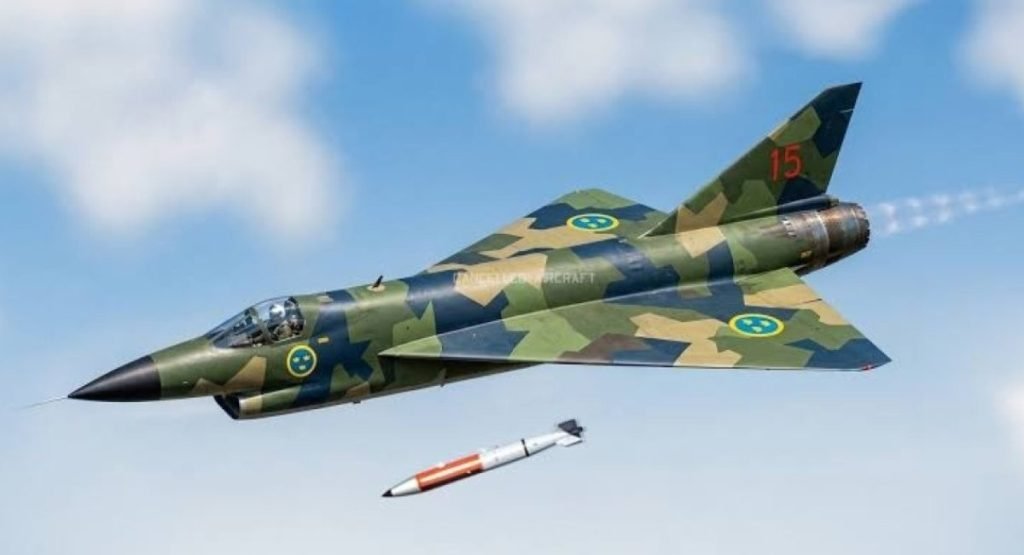
The A-36’s primary weapon was to be a single free-fall nuclear bomb weighing between 600 and 800 kilograms. It would be carried inside an internal weapons bay, preserving the aircraft’s relatively clean aerodynamics at supersonic speeds. An official study of Sweden’s nuclear program explicitly states that the A-36’s bomb bay was intended to accommodate heavy nuclear weapons for strikes against targets on Soviet territory.
This distinguished the A-36 from the large strategic bombers developed by the United States and the Soviet Union. Sweden did not require an aerial truck carrying several tons of conventional bombs. The A-36 was being designed as a fast, specialized delivery system for one exceptionally powerful weapon.
Its likely combat profile would have been close to suicidal. The aircraft was expected to approach its target at low altitude, using terrain to reduce the enemy’s radar warning time. The pilot would then climb or perform a special release maneuver, drop the bomb, and immediately turn away.
Even if the strike succeeded, the pilot would still have to escape the nuclear blast, hostile air defenses, and a possible retaliatory attack.
There would be no navigator, weapons officer, or second pilot. One person was expected to conduct the entire mission, from low-level penetration to the release of a nuclear weapon.
Why Sweden’s Atomic Bomber Never Flew
One popular explanation holds that the A-36 disappeared together with Sweden’s nuclear weapons program. The actual chronology is more complicated. The aircraft had already lost its prospects by 1956–1957, while Swedish nuclear research continued for many more years.
The central problem was cost. The A-36 was becoming too expensive and technically ambitious for the Swedish Air Force. At the same time, military planners were beginning to question the future of manned aviation. During the mid-1950s, many experts believed guided missiles would soon replace both interceptors and strike aircraft.
The Air Staff demanded cheaper projects and gave missile development greater priority. Aeroseum identifies the A-36’s excessive projected cost as a principal reason for the termination of Project 1300.
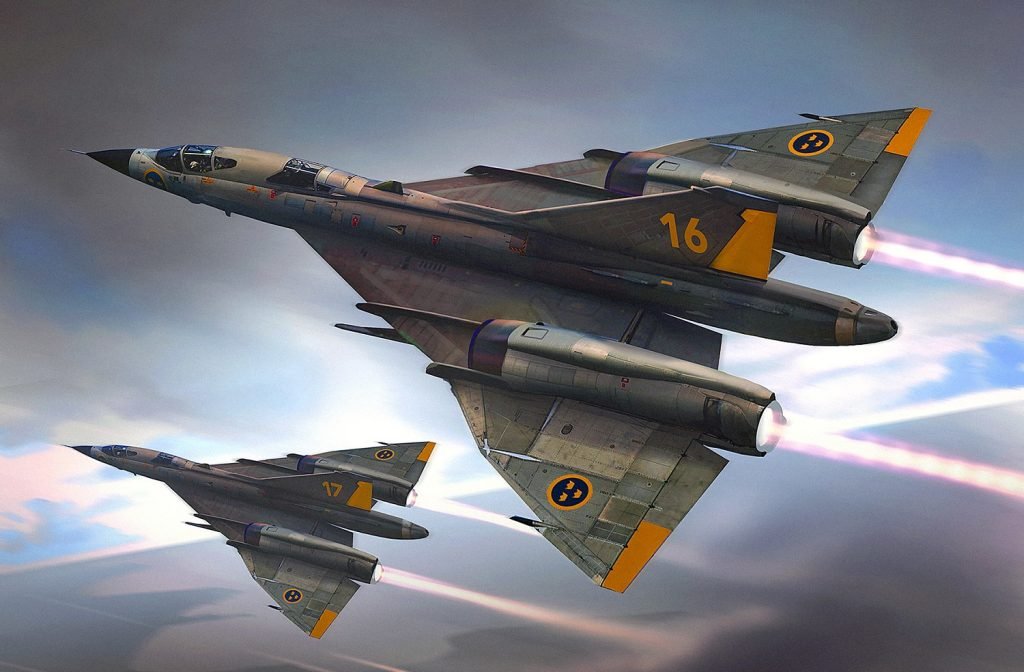
The need for a nuclear delivery system did not disappear. Sweden subsequently considered using the Saab A 32 Lansen and A 35 Draken, as well as missiles equipped with nuclear warheads. Saab also developed the experimental Robot 322, intended to test technologies for a future nuclear-capable missile. One surviving example was later displayed at the Swedish Air Force Museum.
In July 1958, the Swedish parliament selected what was officially called the protective research program. The government did not approve production of an atomic bomb, but neither did it immediately close the question. Instead, it preserved much of the country’s scientific and technical capability while postponing a final decision.
Sweden eventually signed the Nuclear Non-Proliferation Treaty as a non-nuclear state in 1968. The remaining research was gradually wound down, and FOA closed its plutonium laboratory in 1972.
The Aircraft That Disappeared but Left a Legacy
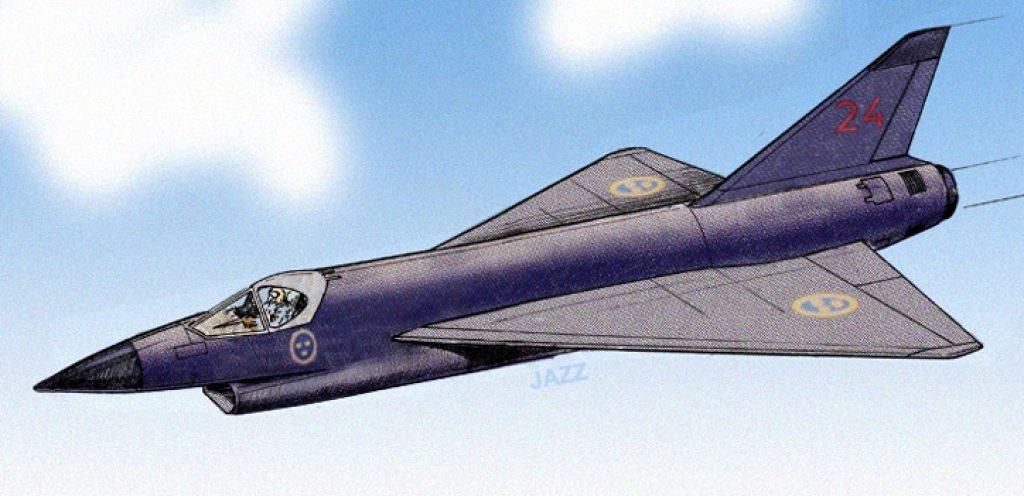
The Saab A-36 never reached the prototype stage. Only drawings, calculations, and wind-tunnel models remained. Yet describing the project as useless would be a mistake.
During Project 1300, Swedish engineers explored supersonic flight, delta-wing aerodynamics, air-intake placement, low-altitude penetration, and the possibility of combining several combat roles in a single aircraft. When the Air Force issued requirements for a new multirole combat aircraft in 1961, much of this accumulated experience contributed to the development of the Saab 37 Viggen.
The result was a peculiar technological paradox. Sweden’s atomic bomber never flew, but some of the knowledge gained during its development helped produce one of the most recognizable European combat aircraft of the Cold War.
Conclusion
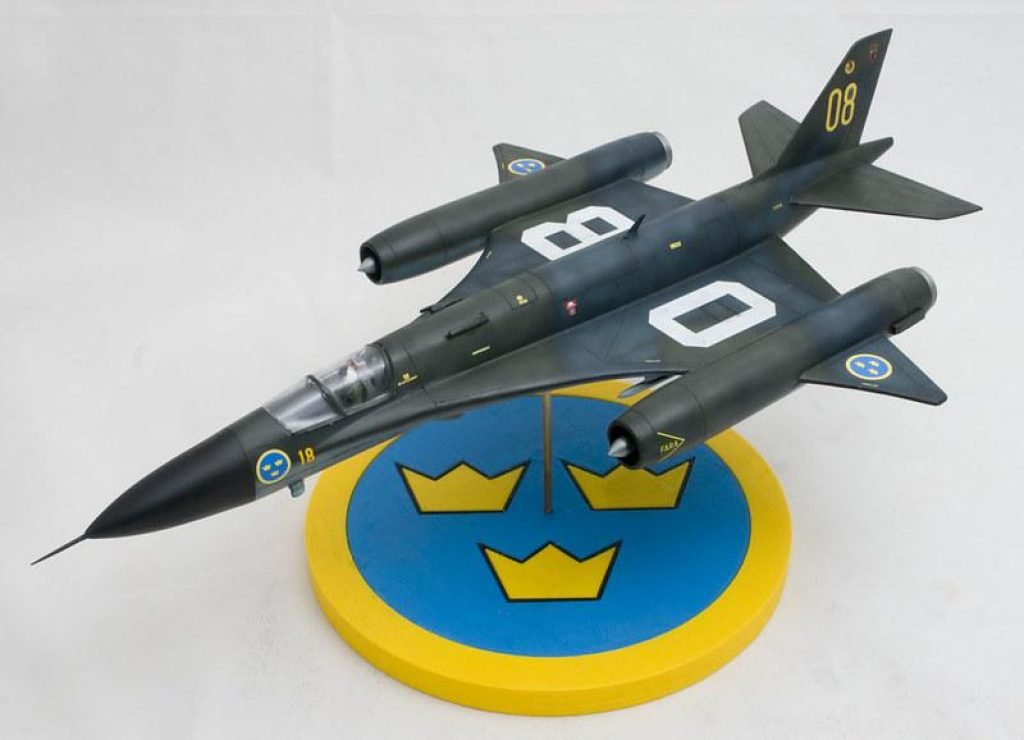
The Saab A-36 is fascinating not because of its projected specifications, most of which never left the drawing board, but because of what it reveals about postwar Sweden and the meaning of armed neutrality.
A country commonly regarded as cautious and peaceful seriously examined the production of plutonium weapons, selected possible targets across the Baltic, and designed a supersonic aircraft to deliver its atomic bomb. The program did not end because of a single moral awakening. The A-36 was defeated by cost and faith in guided missiles, while the Swedish bomb itself was gradually abandoned because of political disputes, public opposition, and changes in the international environment.
What remained on Saab’s drawing boards was one of the strangest symbols of the Cold War: a single-seat “Wolf” intended to carry a Swedish atomic bomb across the Baltic and transform neutrality from a diplomatic formula into the threat of nuclear retaliation.