“As a child, I thought a knight could be known by his sword. Later I learned that it is not his weapon that marks a true warrior. It is the calm and certainty with which he enters any courtyard, as though he already knows how the day will end.”
From the writings of Ansel de Nantes.
The following morning, the monastery awoke earlier than usual.
Though it would hardly be right to call it an awakening. In truth, no one had really gone to sleep. Long before dawn the ovens in the kitchen had been fired again, fresh cloths were being laid in the refectory, the cellarer personally inspected the wine barrels, and the porter had already climbed the gate tower several times to peer along the road running north.
We boys were roused earlier than usual as well. No one explained why, though by then no explanation was needed. Word of the Conqueror’s son had spread throughout the abbey. Even the old brothers who rarely left the library now found one excuse after another to wander into the courtyard. Everyone wanted to see Prince Robert with his own eyes.
Now, after so many years, people sometimes wonder why the heir to a duchy should have needed thirty armed horsemen merely to travel through his own lands. They imagine Normandy as a peaceful country where the same law held sway from Rouen all the way to the coast.
I wish that had been true.
After the death of the great Duke William, the land knew little true peace for many years. Barons quarreled among themselves, old feuds passed from father to son, and the forests sheltered men for whom war had ended only because no one was paying them anymore. Former sergeants, deserters, masterless mercenaries, runaway peasants—all could easily gather into bands and make their living by robbery. A wealthy merchant rarely took to the road without an escort, and even a lone knight might disappear on a forest track if a dozen and a half desperate men happened to stand against him. Every progress through the ducal lands was therefore more than a journey. It was a demonstration of authority. The people had to see their lord, and those who broke his peace had to remember that the duke’s hand could reach even into the deepest forest.
Toward midday, the porter finally raised his hand.
“They’re coming.”
Every conversation stopped at once.
I climbed onto the edge of a stone wall, taking care not to catch the abbot’s eye, and looked where everyone else was looking.
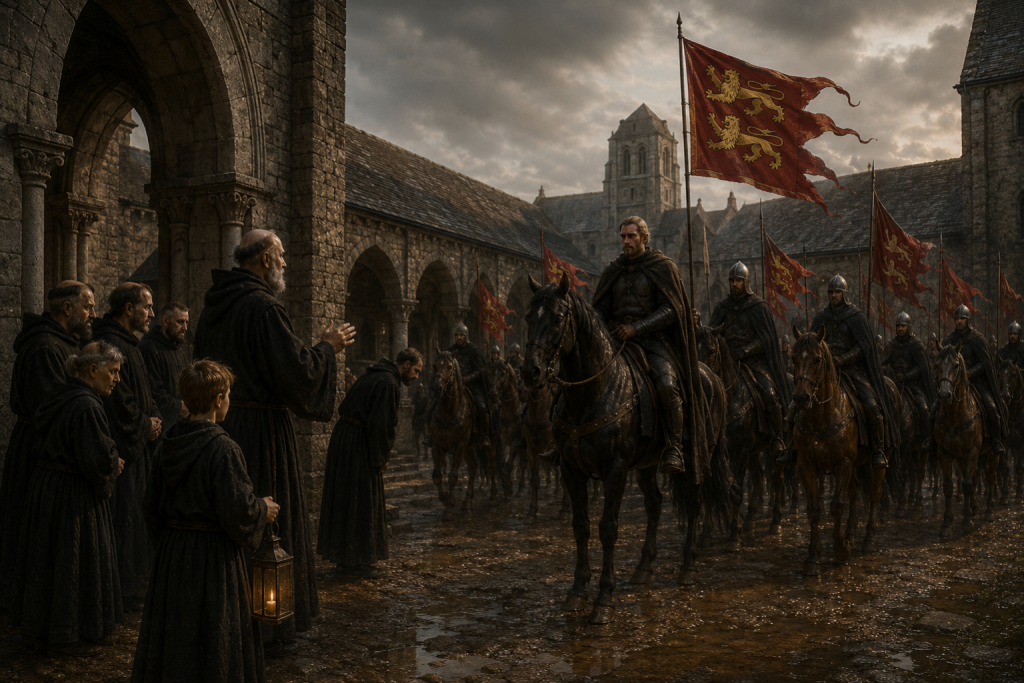
At first there was only a cloud of dust upon the road. Then individual riders began to emerge from it. They came at an easy, measured pace, without hurry, as though they had not already ridden mile after mile that day. There were no banners streaming in the wind, no gleaming suits of armor of the sort painters like to give the heroes of old tales.
All my life, I believed that this was the day I first saw knights.
It was not.
I came to know knights much later.
What I saw that day for the first time were men of war.
They were hard-looking men, sun-browned and unshaven, their faces covered with the dust of the road. Their mail did not gleam like silver. Rust had begun to show on many of the links where there had been no time to scour it away. Their surcoats were faded by the sun and patched more than once with coarse thread. Deep cuts scarred their shields, dried mud clung to their spears, and the scabbards of some of their swords bore so many signs of repair that they seemed older than the men who carried them.
And that was what impressed me most.
They did not look splendid.
They looked dangerous.
Not one of them glanced about in search of admiring eyes. Not one tried to make an impression. They simply went about their business, and every movement carried the easy habit of men who had spent years in the saddle. It was only later that I learned that true strength is almost never loud.
At their head rode a tall man with thick fair hair and a short beard. His cloak was almost the same color as the dust of the road, and from his belt hung a long, undecorated sword. There was so little to distinguish him from the others that no boy could have looked at him and immediately known who he was. Only later did I notice that the other riders kept themselves almost imperceptibly a little behind him, as though his right to ride first required neither command nor explanation.
That was Prince Robert.
The moment the gates closed behind the last rider, the courtyard sprang to life.
The horses had scarcely stopped before the men were already at their accustomed tasks. Some removed saddles, others untied baggage, others checked girths, while still others wiped down their mail with oiled cloth. One of the squires immediately began sharpening his lord’s sword, though the man had not yet even taken off his cloak.
It was then that I understood something for the first time.
A warrior may finish a battle.
He never finishes his service.
If a weapon is not put in order today, tomorrow it may fail you at the worst possible moment.
We younger novices were ordered to help with the horses.
That was when I first found myself standing so close to a true warhorse.
Until then I had known only the monastery’s heavy draught horses that pulled the carts, and the small peasant horses better suited to a plough than to war. I therefore expected some enormous beast.
Once again, I was wrong.
The warhorse was not much taller than the others.
Not broader.
Not so much heavier that one noticed it at first glance.
Its difference lay elsewhere.
It stood perfectly still.
Mail clattered around it, iron rang against iron, men shouted, stable doors slammed, and the horse merely moved its ears from time to time, listening carefully to every sound. When the squire removed its saddle, it waited patiently. When someone accidentally dropped a spear almost at its feet, it did not even flinch.
I was entrusted with bringing it a bucket of water.
I approached cautiously, trying not to look the animal directly in the eye. The horse turned its head and studied me for a long moment. Never before had I seen such calm in a horse’s gaze. It seemed almost as though the creature standing before me understood perfectly well what it had been bred and trained to do.
Later, an old sergeant told me something I never forgot:
“Remember this, boy. Strong legs do not make a good horse. A brave heart does.”
At the time, I had no idea how right he was.
By evening, the courtyard had fallen quiet once more.
The riders had washed, made themselves presentable, and taken their places in the refectory beside the brethren. By monastery custom, no one was given a separate table. The abbot sat beside the guests, ordinary monks beside the squires, while we boys took our places at the very end of the long oak bench, from where we had an excellent view of everything that happened.
When bread, vegetable pottage, cheese, and pitchers of wine had been set upon the tables, the reader rose from his place. By custom, it was his duty to read from Holy Scripture during the meal while everyone else ate in silence.
He had already opened the book when Prince Robert unexpectedly raised a hand.
The refectory fell silent.
The abbot looked at his guest in surprise.
Robert smiled.
“Forgive me, Father,” he said, inclining his head slightly. “But I fear the Lord has sent my men a trial today that they will not survive.”
The abbot raised an eyebrow.
“Another long sermon before supper.”
For a moment, there was silence.
Then one of the sergeants gave a quiet chuckle. The others followed. Even several of the monks could not hide their smiles.
The abbot himself shook his head.
“Your sense of humor has not changed, my lord.”
“My appetite, however, has only grown stronger,” Robert replied. “And a hungry man listens to Scripture less attentively than a well-fed one. Let us feed the men first, and afterward we can speak of the affairs God has entrusted to us.”
The abbot closed the book.
“What would you like to know?”
Robert broke off a piece of bread and, as though asking about the most ordinary matter in the world, said:
“How is the harvest this year?”
The abbot answered at once.
Then came another question.
“Is the bridge over the Eure in good repair?”
“Yes.”
“Have the peasants complained of brigands?”
“More often these past few months.”
“The tithe?”
“A little lower than last year.”
“Why?”
And the conversation went on.
I listened, forgetting the food in front of me.
That evening, I understood for the first time that a man who governs a country thinks very differently from the heroes of knightly songs. Robert spoke hardly at all of war. He wanted to know about bread, roads, bridges, taxes, harvests, the safety of pilgrims, and the well-being of people he might never see again.
The man seated at our table that evening was not merely the son of William the Conqueror.
Before me sat a man carrying an entire duchy upon his shoulders.
And it was then, without even understanding it myself, that I first wanted to become part of his world.