Poland Has Only Just Begun Receiving the Borsuk — and It Is Already Building an IFV 12 Tons Heavier: Why It Needs the 40-Ton Ratel

Poland has only just begun rearming its mechanized infantry with the new Borsuk, with the first production vehicles entering service in late 2025 and a contract for 111 IFVs scheduled for completion by 2029. It might seem that, after decades of operating the aging BWP-1, the problem has finally been solved: Poland now has its own modern infantry fighting vehicle equipped with an unmanned turret, a 30mm cannon, anti-tank guided missiles, and — particularly important given Polish geography — the ability to cross water obstacles under its own power. Yet on September 8, 2026, at the MSPO defense exhibition in Kielce, Huta Stalowa Wola and the state-owned PGZ unveiled another vehicle — the CBWP, unofficially known as Ratel. It uses similar armament and is intended to perform what appears to be the same basic mission, but weighs more than 40 tons compared with roughly 28 tons for the Borsuk.
At first glance, this raises an obvious question: why does Poland need two tracked infantry fighting vehicles at the same time, especially when one has already been developed, entered production, and is officially intended to become the main vehicle of Polish mechanized infantry? Yet the difference of more than 12 tons explains almost the entire rationale behind the new project. The Borsuk was designed around the idea that an IFV must retain strategic and tactical mobility, including amphibious capability. The Ratel is built around almost the opposite idea: if a vehicle is expected to fight alongside Abrams tanks in an environment saturated with mines, anti-tank missiles, artillery, and drones, perhaps it is time to stop sacrificing weight for the ability to swim.
Poland has effectively decided not to choose between a light and a heavy IFV.
It intends to have both.
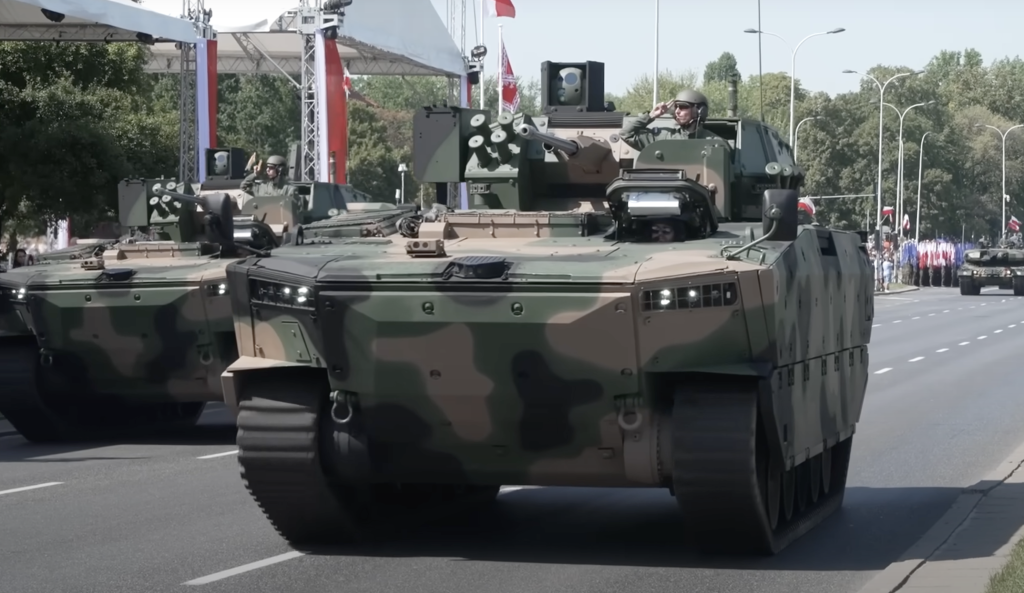
The Borsuk Was Designed Around Polish Geography — and That Is Exactly Why It Has Limits
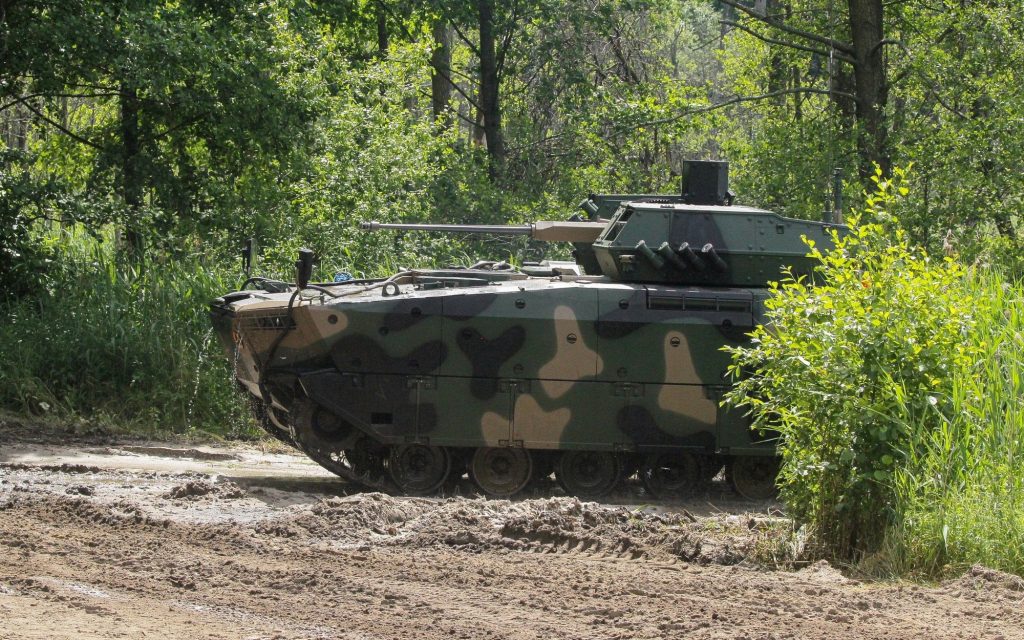
To understand why the Ratel exists, it is first necessary to understand why the Borsuk is comparatively light. Poland is crossed by numerous rivers and other water obstacles, so the ability of mechanized formations to cross them independently has traditionally been important. The Borsuk was designed as an amphibious tracked vehicle: it has to transport infantry, support them with fire, and at the same time avoid turning every river crossing into an engineering operation requiring bridges. This explains its weight of roughly 28 tons — substantial for an amphibious IFV, but noticeably lower than that of the most heavily protected Western vehicles. The Polish Ministry of National Defence continues to describe the Borsuk as the primary future solution for mechanized forces, with the first implementation contract for 111 vehicles, worth approximately 6.57 billion zlotys, signed in March 2025.
The problem is that amphibious capability never comes for free. If a 28-ton armored vehicle has to remain afloat, designers must pay extremely close attention to weight, hull volume, and additional armor. Every extra ton of protection reduces reserve buoyancy, increases draft, and can eventually eliminate the very capability around which the vehicle was designed. There is therefore a fundamental engineering conflict: an IFV can become progressively better protected or preserve full amphibious capability, but it cannot continue maximizing both indefinitely.
The modern battlefield has only made that contradiction more severe. A vehicle is no longer threatened only by a tank gun or an anti-tank guided missile from the front. Mines attack from below, FPV drones and other munitions strike from above and from the sides, artillery fragments damage external equipment, and even armor that successfully prevents penetration does not necessarily preserve combat effectiveness. A damaged track, optical system, or weapon component can turn an otherwise intact IFV into an immobilized target. This is why the emergence of the Ratel is part of a much broader debate about the renewed value of heavy armor: mass alone does not guarantee survival, but the ability to spend additional tons on protection is becoming extremely attractive again.
Poland Chose the Simplest Solution: One IFV Will Swim, the Other Will Survive
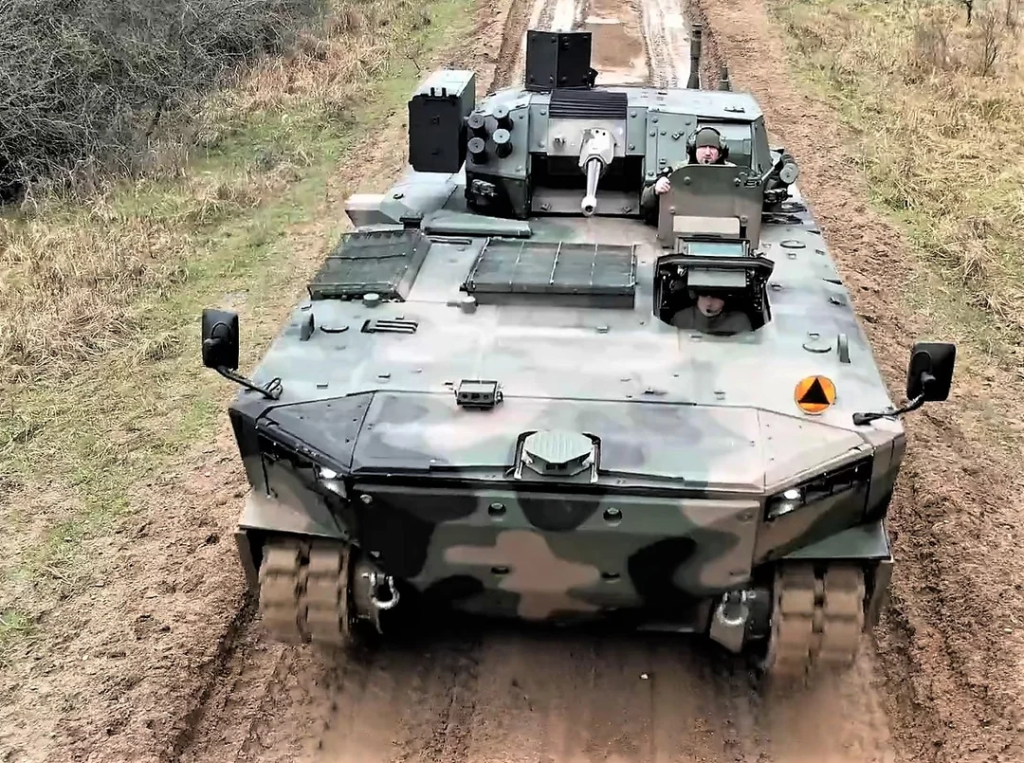
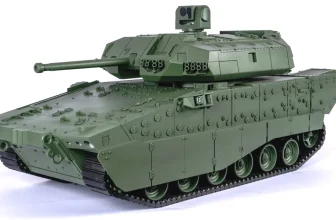
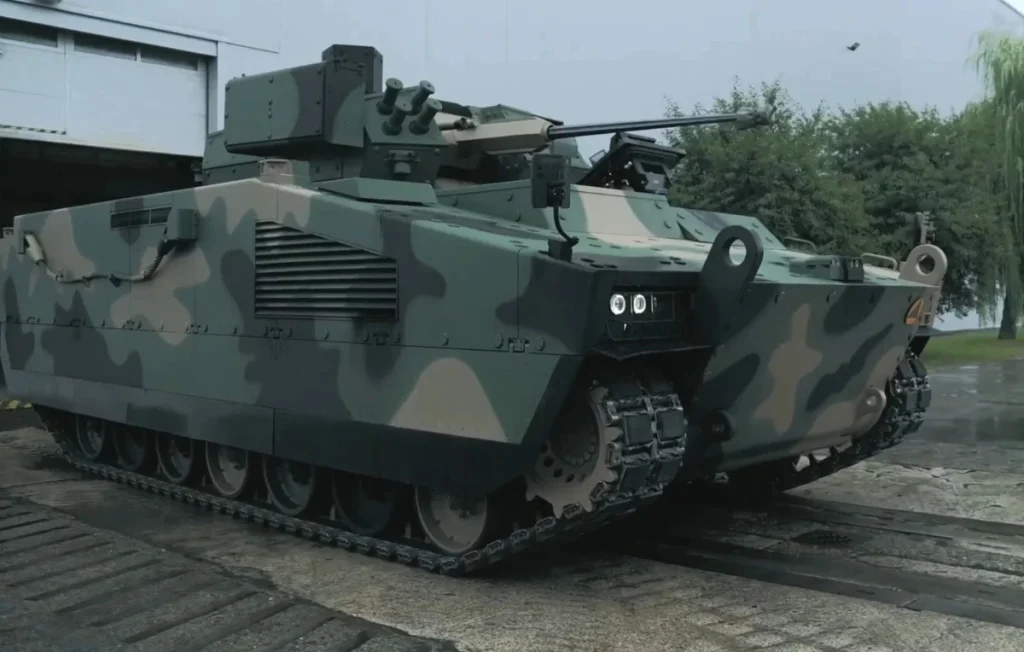
The Ratel effectively removes the restriction that shaped the Borsuk. The new CBWP does not have to swim. Instead, it weighs more than 40 tons, has seven road wheels per side compared with six on the Borsuk, and uses an engine producing more than 1,000 horsepower. The manufacturer emphasizes a high level of ballistic and mine protection as well as modular armor, allowing protection levels to be adapted to different missions. The crew consists of three personnel, while the troop compartment can accommodate up to eight soldiers. For now, however, this remains a demonstrator: the existing vehicle is intended for factory testing, while two full prototypes are expected to be produced in 2027.
This distinction is fundamental. The Ratel is not simply “a Borsuk with more armor.” Adding roughly 12 tons means changing the priorities of the entire design. The Borsuk has a weight ceiling that cannot be exceeded without sacrificing one of its defining capabilities. The CBWP has a much larger weight reserve for armor, mine protection, internal systems, and future upgrades. A more powerful engine is intended to compensate for the increased mass and preserve adequate tactical mobility, although there are no miracles here: a 40-ton vehicle imposes entirely different requirements on bridges, terrain, transportation, recovery, and logistics.
In return, it is much better suited to another part of the Polish Army — its heavy armored formations. Even when Poland originally announced the heavy IFV program, the Ministry of National Defence explicitly linked the vehicle with the 18th Mechanized Division and its Abrams tanks. There is a compelling logic behind this. If an armored formation is built around heavy tanks intended to operate in the most dangerous parts of the battlefield, the infantry accompanying those tanks should not have to enter the same environment in a substantially lighter vehicle simply because that vehicle can swim.
It Is Poland’s Answer to an Old Problem: The Tank Is Better Protected Than the Infantry That Has to Follow It
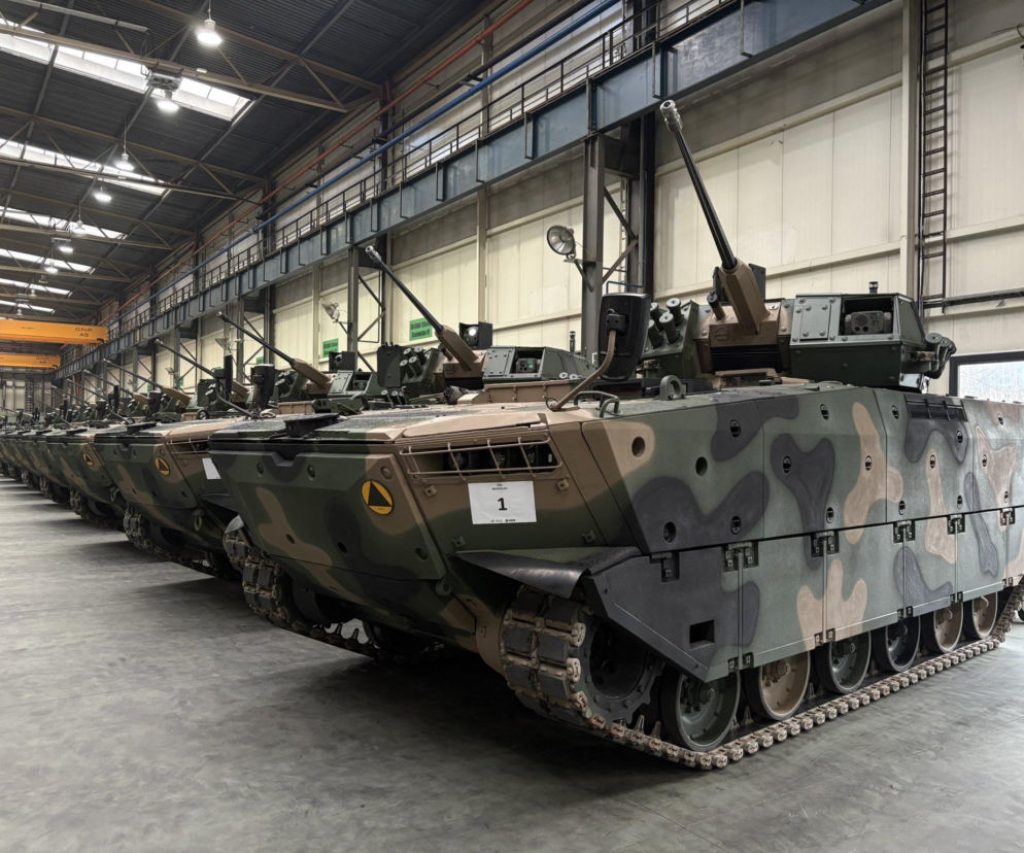
This contradiction has followed mechanized armies almost since the infantry fighting vehicle first appeared. Tanks are needed precisely where the battlefield is most dangerous. But that is also where infantry must accompany them — protecting tanks from anti-tank teams, clearing positions, fighting in built-up areas, and holding captured ground. The vehicles carrying that infantry therefore have to go roughly where the tanks go. If the main battle tank weighs 60–70 tons while the accompanying IFV weighs less than 30, the two elements of the same combat formation inevitably have very different levels of protection.
This is where the heavy IFV concept came from. Israel has taken the idea almost to its logical extreme with the Namer, a tank-derived vehicle that makes troop protection the overriding priority. Germany developed the Puma, while other armies are fielding or considering vehicles such as the Lynx, Redback, and the new American XM30. The weight of modern infantry fighting vehicles is increasingly approaching that of main battle tanks from previous generations. Poland’s Ratel fits into the same trend, although its weight of a little over 40 tons remains comparatively moderate.
The point of a heavy IFV is not to make it invulnerable. Such protection is virtually impossible today: a sufficiently powerful mine, a modern anti-tank missile, a top attack, or repeated FPV drone strikes can disable even a very heavy armored vehicle. Additional armor works statistically. It increases the probability that a particular hit will not be fatal, that fragments will not penetrate the hull, that a relatively small anti-armor warhead will not destroy the troop compartment, or that a mine blast will not produce catastrophic consequences. On a battlefield where armored vehicles can be subjected to multiple attacks during a single operation, the difference between “vehicle damaged” and “vehicle destroyed together with its infantry squad” may justify another dozen tons of protection.
Yet the Heavy and Light Polish IFVs Share Almost the Same Weapons
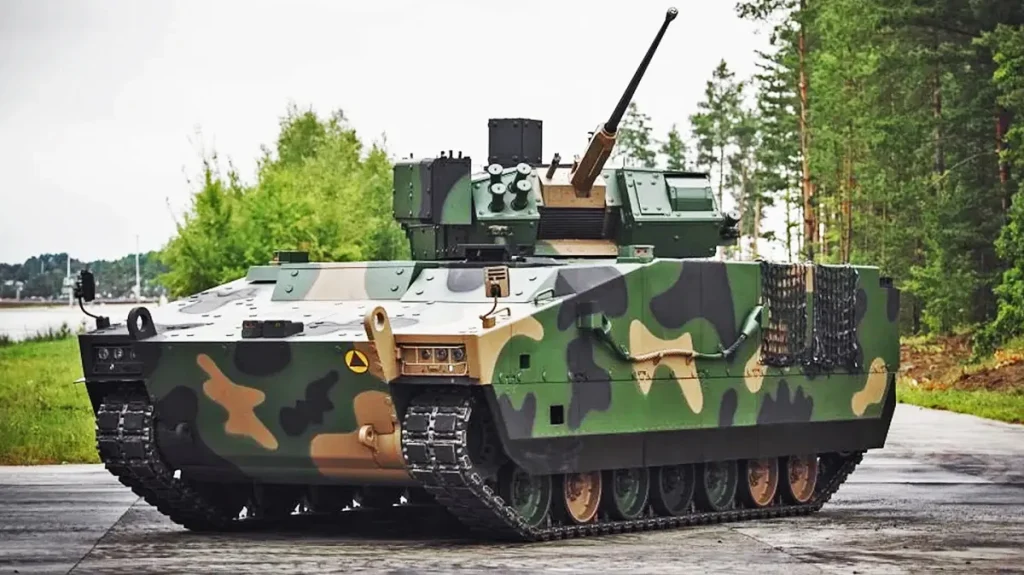
This is where the Polish approach becomes particularly rational. The Ratel has not received an enormous turret with a 50mm cannon or some completely new weapon system. The demonstrator carries the existing Polish ZSSW-30 remotely operated turret, already used on the Borsuk and Rosomak. Its primary weapon is a 30mm automatic cannon capable of firing programmable ammunition, supplemented by a coaxial machine gun and Spike anti-tank guided missiles. The missiles allow it to engage heavy armored vehicles beyond the effective range of the autocannon, while programmable 30mm ammunition expands its capabilities against infantry, positions, and some aerial targets, including drones.
The result is an interesting arrangement: Poland is developing two different IFVs while trying to avoid creating two entirely separate weapon systems. The Borsuk and Ratel differ primarily in chassis, weight, and protection, while the turret, ammunition, anti-tank weapons, and much of the crew-training architecture can remain common. This is particularly important for an army simultaneously purchasing huge numbers of new tanks, artillery systems, helicopters, and other equipment. A second IFV type inevitably complicates logistics, but a common combat module at least prevents the two platforms from becoming completely separate ecosystems.
The Ratel also carries Poland’s OBRA-3 laser warning system linked to smoke grenade launchers. If the vehicle is illuminated by a laser rangefinder or guidance system, the crew receives a warning and can deploy an aerosol screen automatically or manually in an attempt to disrupt observation and targeting. Protection against nuclear, biological, and chemical threats is also planned. What is especially notable, however, is what has not yet been highlighted in the current configuration: a full active protection system capable of physically intercepting incoming anti-tank threats. For a heavy vehicle intended to operate in the most dangerous parts of the battlefield, this could become one of the most important issues during further development.
But Do Another 12 Tons Really Help in the Age of FPV Drones?
This question sits at the center of one of the most interesting debates about the future of armored warfare. If a cheap FPV drone can attack the roof of a vehicle, another drone can direct artillery onto it, and mines can restrict its movement, it is tempting to conclude that armor has simply lost its purpose. Why build a 40-, 50-, or 60-ton vehicle if a munition costing a few thousand dollars can still find a vulnerable point?
Yet the opposite conclusion is equally plausible. If an armored vehicle is likely to be detected and eventually attacked anyway, its ability to survive the first hit becomes even more important. Modern armor no longer guarantees invulnerability — it buys time and increases the probability of survival. That means additional mass can be distributed very differently from how it was twenty years ago: not merely across the frontal arc to resist tank rounds, but around the sides, belly, roof, troop compartment, ammunition storage, and other critical systems.
At the same time, armor thickness alone cannot solve the problem. A heavy IFV operating without counter-drone protection, electronic warfare, reconnaissance, engineering support, and cooperation with other units remains vulnerable. On the modern battlefield, it is increasingly not the individual vehicle that survives, but the system surrounding it. A tank or IFV needs awareness of drone threats, warning of enemy activity, access to jamming and smoke, close cooperation with its own infantry, and preferably an active protection system. A 40-ton Ratel sent forward alone can be destroyed almost as ingloriously as a much lighter vehicle.
So Why Does Poland Need Two IFVs? Because They Are Designed for Two Different Ways of Fighting
This is where the entire concept finally comes together. The Borsuk is needed where operational mobility, independent river crossing, and the ability to move mechanized infantry without constant dependence on engineering units are priorities. It is lighter, easier to transport, and can operate in places where a 40-ton vehicle will encounter limitations imposed by terrain or bridges. This is why the Polish Ministry of National Defence continues to regard the Borsuk as the future primary IFV of the Land Forces rather than an interim solution that will now be replaced by the Ratel.
The CBWP is intended for a different kind of battle — or, more precisely, a different part of the same battle. Its place is alongside Abrams tanks and other heavy formations expected to push through the most dangerous areas and which do not necessarily require their accompanying infantry to swim across rivers independently. In this environment, the ability to cross a river without a bridge becomes less important than the ability to carry eight infantrymen through a zone saturated with artillery, mines, and drones. The Ratel’s 40-plus-ton weight is therefore not a design flaw Poland was forced to tolerate. To a considerable extent, it is the reason the vehicle exists.
The result is a division of labor. Instead of trying to create a single universal IFV that is simultaneously amphibious, heavily protected, lightweight, inexpensive, and capable of keeping up with heavy tanks, Poland has effectively acknowledged that all of these requirements fit poorly into one vehicle. The Borsuk preserves mobility and amphibious capability. The Ratel sacrifices them for additional protection and the ability to operate with heavy armored formations. At the same time, the common ZSSW-30 turret and other shared elements prevent the two platforms from becoming completely independent vehicle families.
And That Makes the Ratel More Interesting Than Just Another Heavy IFV
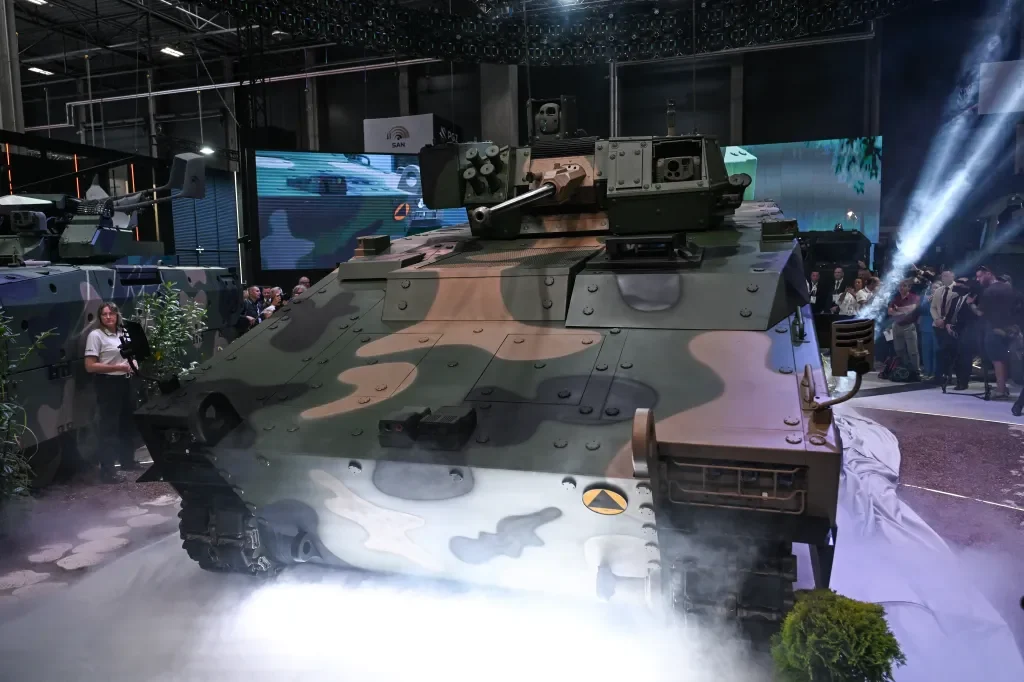
For now, the Polish vehicle remains a demonstrator. In 2025, HSW displayed only a scale model; in September 2026, a full-size vehicle appeared for factory testing; and two full prototypes are expected in 2027. Entry into service is still some distance away, specifications can change, and the final protection level and suite of additional systems have yet to be determined. It would therefore be premature to compare today’s Ratel directly with mature production systems such as the Puma, Lynx, or Namer as if they were already equivalent operational vehicles.
But Poland’s choice is already revealing. Only a few years ago, the heavy IFV program was described as a vehicle intended to operate alongside Abrams tanks. That idea has now materialized as a 40-ton demonstrator. At the same time, the Borsuk is not disappearing: serial production has begun, the first 15 vehicles were handed over to the Polish Armed Forces in December 2025, and the first contract covers 111 vehicles.
Poland is therefore answering one of the central questions facing modern armored forces in a rather unusual way. After the rise of FPV drones, precision weapons, and advanced mines, should infantry fighting vehicles become lighter, cheaper, and more numerous — or should armies move in the opposite direction and invest even more weight in protecting crews and infantry?
Warsaw appears to have decided not to choose.
If the mission requires crossing a river, there is the Borsuk. If the mission requires following Abrams tanks into a place where the vehicle is almost certain to be fired upon, there is the Ratel.
The extra 12-plus tons of Poland’s new IFV should therefore not be viewed simply as additional armor.
They are the price of abandoning the old dream that one armored vehicle can be equally good at everything.