Ravenstorm: an unmanned wingman for European fighter jets, designed to replace an entire squadron

While Europe is trying to figure out what to do with the FCAS program—which has effectively fallen apart—Airbus is betting on a different direction. Instead of spending years debating what a sixth-generation fighter jet should look like, the European company is actively developing what many military analysts are already calling the future of air warfare—unmanned combat support aircraft.
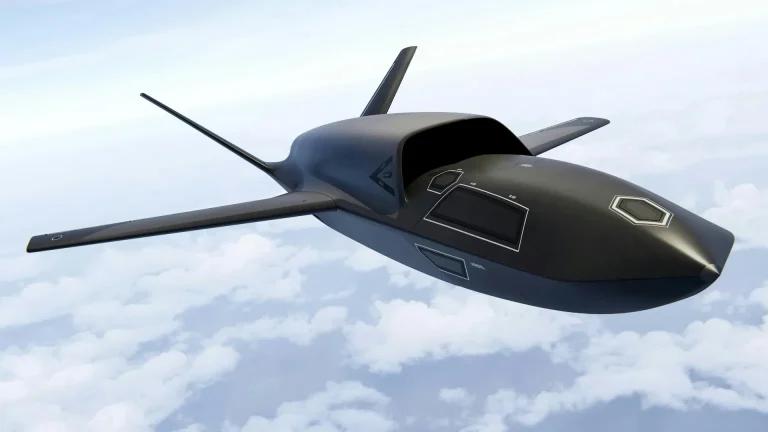
At the ILA Berlin 2026 air show, Airbus unveiled a full-scale model of its new U760 Ravenstorm unmanned aircraft for the first time. At first glance, it resembles a scaled-down stealth fighter. However, its purpose is not to replace manned aircraft. On the contrary, the Ravenstorm is being developed as a partner for modern and next-generation combat aircraft. Its mission is to fly alongside a fighter jet, take on the most dangerous missions, and, if necessary, sacrifice itself in place of a human pilot.
Just a few years ago, projects like these were viewed as experimental concepts. Today, they are gradually becoming one of the key elements of the air force of the future.
From a co-pilot to a co-pilot of an unmanned aircraft
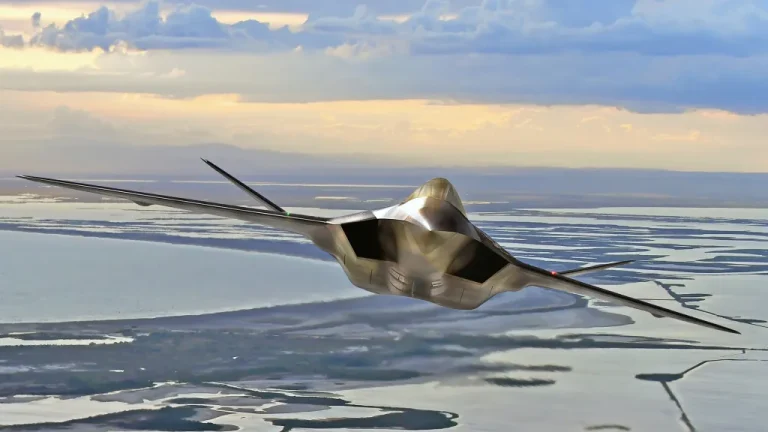
Throughout the history of aviation, fighter aircraft have operated in groups.
The lead pilot made the decisions, while the wingmen provided cover, controlled the airspace, and offered combat support. As technology advanced, a perfectly logical question arose: What if a machine could take on the role of a wingman?
It is precisely this idea that forms the basis of the Uncrewed Collaborative Combat Aircraft concept—unmanned aircraft designed for collaborative combat operations. In the U.S., such systems are known as Collaborative Combat Aircraft (CCA); in Australia, the Boeing MQ-28 Ghost Bat is under development; and Europe is banking on Ravenstorm.
Instead of a single expensive fighter jet, the commander gains the ability to deploy several unmanned aircraft at once. They can conduct reconnaissance ahead of the formation, search for targets, create distractions, carry missiles, or even serve as decoys for enemy air defense systems.
Airbus’s Most Aggressive Drone
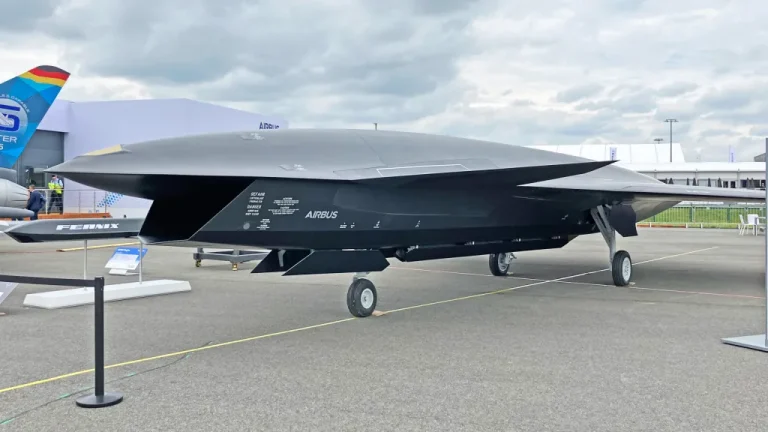
When you look at the Ravenstorm, it’s immediately clear that the engineers drew inspiration from modern stealth aircraft.
The aircraft features a swept-back wing, a V-shaped tail, and an upper air intake. All structural elements are designed with a single goal in mind: to reduce its detectability by radar. Its layout resembles that of the American YFQ-42A, which is being developed for the U.S. Air Force as part of the CCA program.
The drone’s dimensions are quite impressive.
The aircraft is about 13 meters long, and its wingspan reaches 10 meters. In fact, it is no longer a drone in the conventional sense, but a full-fledged unmanned combat aircraft.
Airbus explicitly states that Ravenstorm is designed to carry out missions in the air, on the ground, and in the electronic spectrum simultaneously.
Flying Arsenal
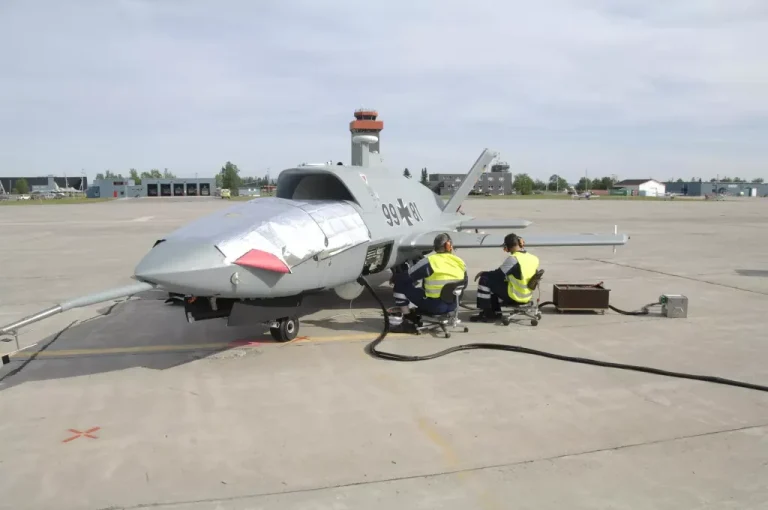
The main feature of such devices is not their speed or their inconspicuousness.
The most important thing is the payload.
Ravenstorm is designed as a versatile platform capable of firing high-precision munitions at ground targets, launching medium- and long-range air-to-air missiles, and performing electronic warfare missions.
In fact, a single unit like this could serve as an additional weapons bay for a manned fighter jet.
Instead of mounting missiles under an aircraft’s wings and increasing its visibility, they can be mounted on an escort drone. If the situation becomes critical, the loss of a drone would be far less devastating than the loss of a modern fighter jet worth hundreds of millions of dollars, along with its pilot.
That is precisely why many experts consider the concept of unmanned escort aircraft to be a true revolution in military aviation.
Artificial Intelligence Instead of a Co-Pilot
But a drone is useless on its own if it cannot operate independently.
To address this challenge, Airbus is developing its own digital architecture, MARS (Multiplatform Autonomous Reconfigurable and Secure Mission System). This architecture is intended to serve as the “brain” of Ravenstorm.
The system uses artificial intelligence and machine data analysis to perform tasks autonomously. It is expected that a single pilot will be able to control several such aircraft simultaneously, assigning targets and tasks among them.
In essence, a pilot is gradually evolving from a pilot into the commander of an air group consisting of manned and unmanned aircraft.
This approach is already being actively implemented in both the United States and Europe.
Europe is betting on a driverless future
It is telling that the Ravenstorm presentation took place just a few days after it became abundantly clear that the Franco-German program to develop the sixth-generation FCAS fighter jet was on the verge of complete collapse.
While politicians argue over who will control the future aircraft, Airbus is clearly trying not to waste any time and to invest in the area that is developing the fastest.
The company is already openly discussing the development of an entire family of unmanned combat aircraft. In addition to the Ravenstorm, the lineup includes the U740 Valkyrie—based on the American XQ-58A—as well as other autonomous systems designed for various purposes.
It is quite possible that in ten years, these very aircraft will form the backbone of the European air forces’ strike capabilities.
Not because they will replace pilots, but because they will allow a single pilot to control an entire formation of unmanned combat aircraft.
Preliminary Specifications for the Airbus U760 Ravenstorm
Type: Unmanned Combat Aircraft (UCCA)
Разработчик: Airbus Defence & Space
Length: 13 m
Wingspan: 10 m
Concept of Use: Unmanned Follow-On Aircraft (Loyal Wingman)
Armament:
- high-precision air-to-surface munitions;
- medium-range air-to-air missiles;
- long-range air-to-air missiles;
- electronic warfare systems.
Main objectives:
- escorting fighter jets;
- air battle;
- strikes against ground targets;
- air defense suppression;
- interference;
- Reconnaissance and target acquisition.
Control System: MARS Mission System with AI components
Expected release: early 2030s.
Today, Ravenstorm exists only as a demonstrator and a full-scale mockup. But if the trends of recent years continue, it is precisely these types of aircraft that could become the missing link between traditional combat aviation and the fully autonomous aerial systems of the future.
based on https://www.twz.com/air/ravenstorm-at-the-center-of-airbuss-new-combat-drone-portfolio