Saab Unveils the A3 Uncrewed Fighter: Why Gripen’s New “Wingman” Is Nothing Like the Ghost Bat

Just a few years ago, the term “loyal wingman” painted a fairly straightforward picture of the future of combat aviation. A crewed fighter would fly at the center of the formation, accompanied by one or more relatively inexpensive drones. These would carry additional missiles, perform reconnaissance, provide electronic warfare support, distract the enemy, and, if necessary, take risks that would otherwise endanger an expensive aircraft and its pilot. It was around this idea that Australia’s MQ-28 Ghost Bat and the U.S. Collaborative Combat Aircraft program emerged.
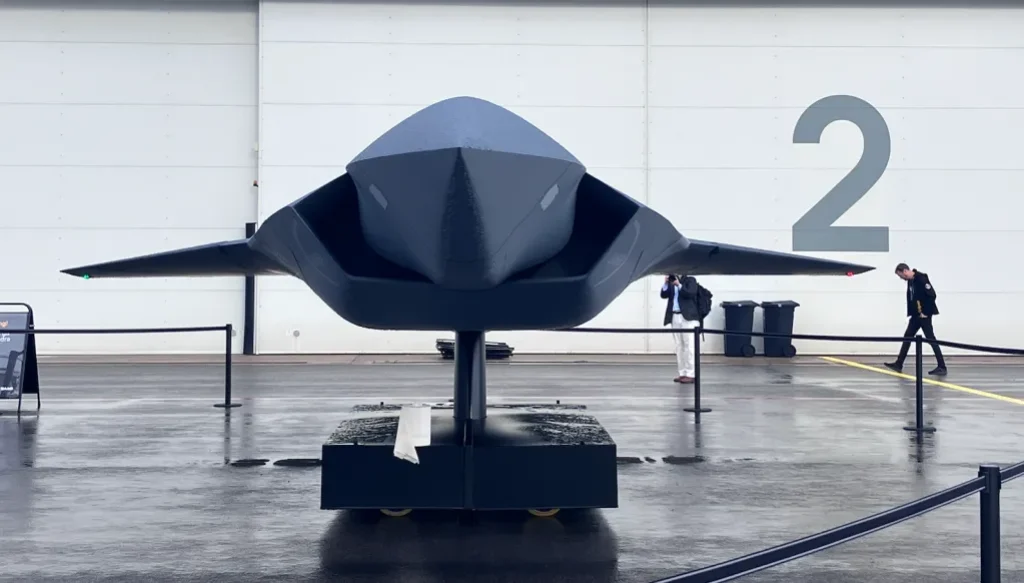
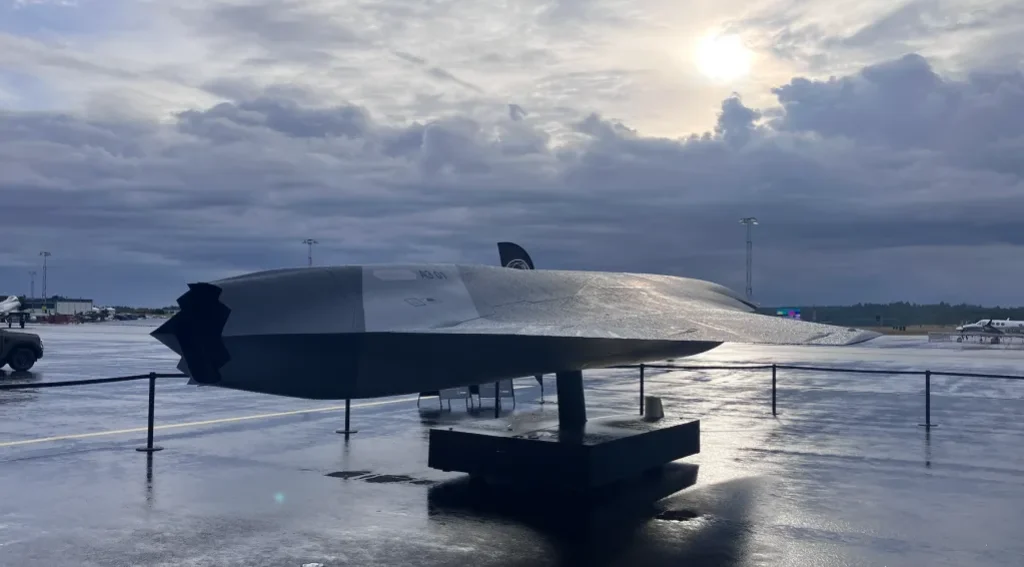
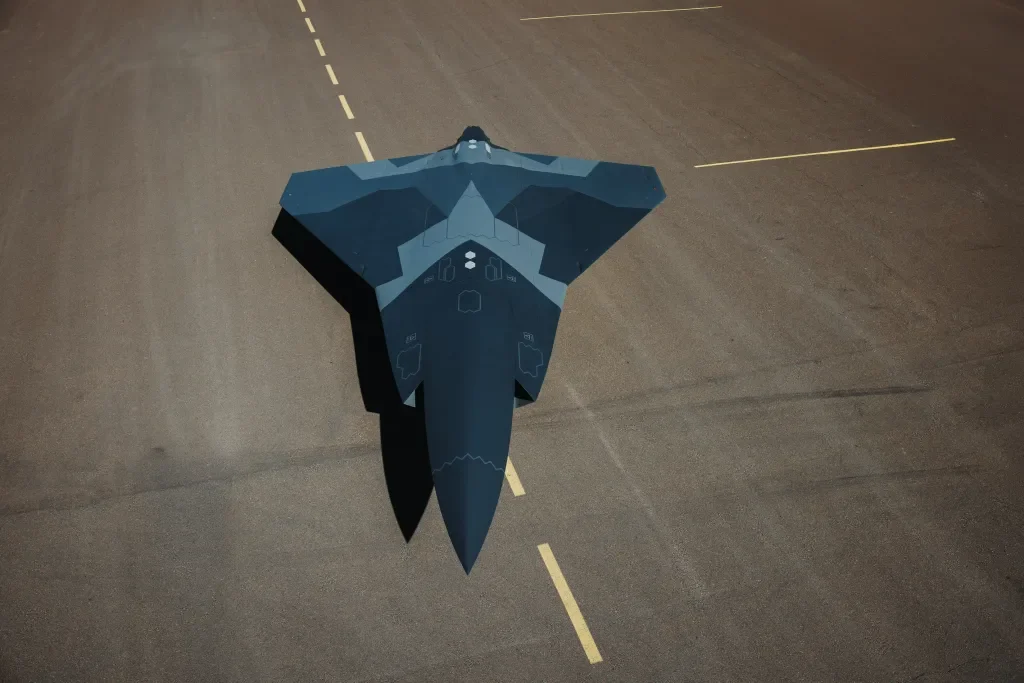
But on August 21, 2026, Saab unveiled something considerably more ambitious in Sweden. The full-scale A3-001 mock-up looks less like a “wingman” and more like a complete low-observable combat aircraft that simply happens to have no cockpit. A tailless aerodynamic configuration, internal weapons carriage, DSI intakes, measures to reduce the signature of the exhaust section and, most importantly, planned supersonic performance make it look more like a fighter than a conventional supporting drone.
Saab calls the aircraft an Autonomous Collaborative Platform, or ACP. It is intended to operate alongside Gripen E fighters and GlobalEye airborne early warning and control aircraft, but its proposed mission set hardly sounds secondary. Air-to-air combat, electronic warfare, suppression of enemy air defenses, reconnaissance, and precision strikes deep inside heavily defended airspace would effectively transfer some of the most dangerous jobs currently performed by crewed fighters to an uncrewed platform.
And that raises a much more interesting question than simply asking what kind of new drone Saab has unveiled. What happens to the entire loyal wingman concept when the wingman gradually becomes almost a full-fledged fighter?
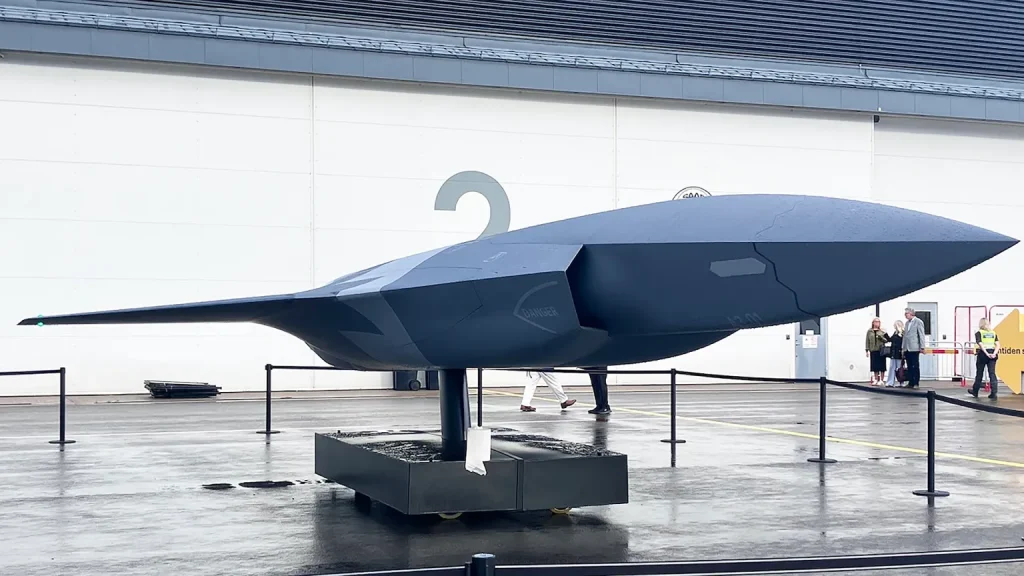
The A3 Is Not an Aircraft Yet
There is an important caveat. The Saab A3-001 shown to the public is a full-scale conceptual mock-up, not a flying prototype. The Swedish government has not yet ordered the development of a production aircraft, so describing it as Gripen’s future operational drone would be premature. However, behind the impressive mock-up is a very real research program, and that is what makes the unveiling far more significant than an ordinary exhibition display.
The project is part of Sweden’s broader KFS program — Koncept för Framtida Stridsflygplan — which is intended to explore the future shape of Swedish combat aviation. Saab is already working on two uncrewed demonstrators, known as A1 and A2, funded by the Swedish Ministry of Defence. The first is intended to validate basic aerodynamic solutions, low-observable characteristics, and the feasibility of building a fully supersonic uncrewed aircraft. A2 will take the technology further. Only after that could the accumulated experience potentially lead to an operational aircraft whose conceptual appearance is now represented by A3.
The schedule is also surprisingly aggressive. Saab intends to fly the A1 within roughly the next 15 months, completing the path from the beginning of the project to a flying demonstrator in just 36 months. If the government decides to continue the program, a contract for full-scale ACP development could emerge around 2030, followed by flight testing of a more advanced aircraft in the early 2030s and initial operational capability around the middle of the next decade. A3, therefore, should not be viewed as an almost finished aircraft. It represents the direction in which Saab believes Swedish combat aviation could evolve.
But Its Engine Is Very Real
One of the most interesting aspects of the program is that Saab does not intend to power its experimental aircraft with some small engine borrowed from a conventional UAV. The A1 and A2 are expected to use the GE Aerospace F414, from the same engine family used by the Gripen E/F. With approximately 22,000 pounds, or around 98 kN, of thrust, the engine should give the demonstrator supersonic performance.
For Sweden, this is a highly practical decision. Saab already understands the F414, its maintenance requirements, operating characteristics, and support infrastructure thanks to the Gripen E program. If a future uncrewed aircraft retains a similar powerplant, this could reduce the amount of unique ground equipment, spare parts, and maintenance procedures required. For a relatively small air force, logistics of this kind can be just as important as a few extra percentage points of thrust or range.
It also fits particularly well with Sweden’s traditional concept of dispersed air operations. Gripen was designed from the beginning to operate not only from major air bases but also from small facilities and prepared sections of public roads. The fighter can be refueled, rearmed, and serviced rapidly by a relatively small ground crew. Saab wants to extend this philosophy to the ACP. Externally, it may look like a futuristic stealth drone, but operationally it is intended to become another element of the same system in which Gripen already operates.
Why Does a Drone Need Supersonic Speed?
This is where the Swedish concept begins to differ significantly from many existing CCA designs. Supersonic performance is expensive. It requires a powerful engine, more complex intakes and aerodynamics, stronger structural requirements, and generally greater fuel consumption. If an uncrewed aircraft is only supposed to accompany a fighter, carry a couple of additional missiles, or serve as a remote sensor, there is an obvious question: why make it this complicated?
The answer lies in the missions Saab envisions for the ACP. The company sees it operating inside heavily defended airspace, suppressing enemy air defenses, engaging aircraft, conducting electronic warfare, and striking targets deep behind hostile lines. For missions like these, speed stops being a luxury. It allows the aircraft to reach a target area more quickly, keep pace with crewed fighters, intercept airborne targets, and leave dangerous airspace faster. Low observability and internal weapons carriage are intended to reduce the chances of detection at the same time.
And this is where the word “wingman” gradually starts to lose its meaning. If an aircraft possesses fighter-like performance and can perform missions previously assigned to crewed combat aircraft, it is no longer simply an additional missile magazine for Gripen. What begins to emerge is a separate class of high-end uncrewed combat aircraft.
This Is Where the Ghost Bat Becomes the Perfect Comparison
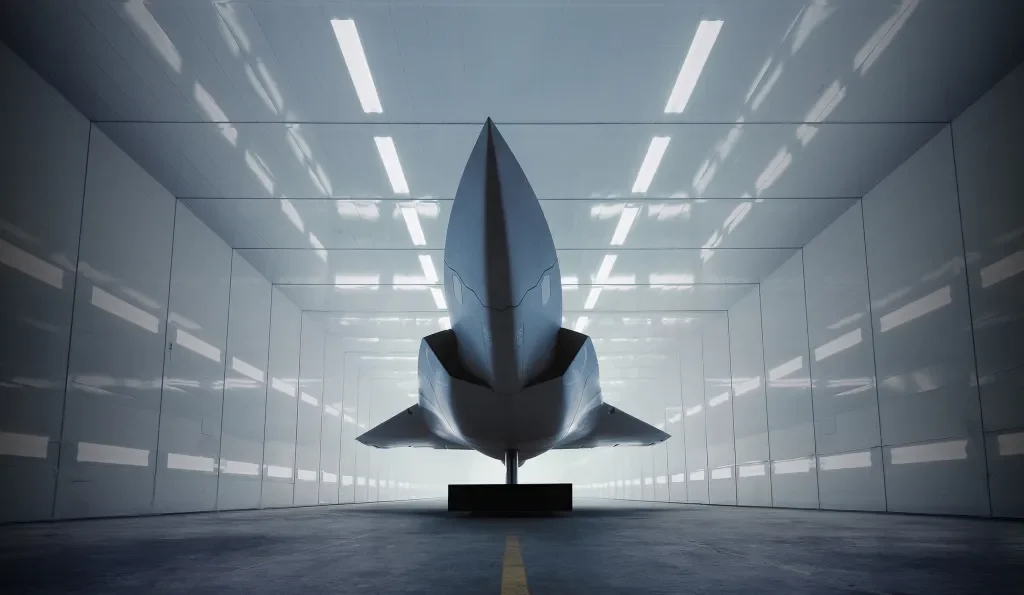
Australia’s MQ-28 Ghost Bat, developed by Boeing Australia together with the Royal Australian Air Force, has long been one of the clearest examples of the loyal wingman concept. It is also designed with low observability in mind, can operate autonomously alongside crewed aircraft, and is intended to expand the capabilities of existing combat platforms. But the original philosophy behind the MQ-28 differs somewhat from what Saab is now proposing.
Ghost Bat was initially conceived primarily as a mission extender — a platform that could provide crewed aircraft with additional sensors, range, reconnaissance capability, and eventually weapons. One of the MQ-28’s defining features is its interchangeable nose section, allowing different sensors and payloads to be fitted for different missions. Boeing advertises a range of more than 2,000 nautical miles and emphasizes autonomy, modularity, and cooperation with other aircraft.
But Ghost Bat has also evolved. In June 2026, Boeing unveiled a further development of the aircraft featuring a wing enlarged by more than 25 percent. The additional internal volume allows approximately 2,000 pounds, or around 907 kilograms, of extra fuel, weapons, or other payload to be carried. Even more importantly, internal weapons bays have appeared. The new configuration can potentially carry two AIM-120 AMRAAMs or four Small Diameter Bombs internally. Boeing has also reported successful validation of the aircraft’s low-observable characteristics.
The result is an interesting convergence of two evolutionary paths. Ghost Bat began primarily as a sensor and supporting uncrewed platform but is gradually becoming more heavily armed. Saab is approaching the problem from the opposite direction, proposing from the outset an aircraft whose characteristics are much closer to those of a full-fledged combat aircraft. In one case, the supporting drone is gradually becoming a strike platform. In the other, the drone begins its development already looking very much like a fighter.
Two Aircraft, Two Different Philosophies
For that reason, directly comparing A3 and Ghost Bat in terms of which one is “better” would make little sense. MQ-28 already exists as a flying aircraft, while A3 remains a concept that Saab hopes to reach through the A1 and A2 demonstrators. It is far more interesting to compare the philosophies behind the two programs.
In the case of Ghost Bat, the central priorities remain long range, modularity, interchangeable payloads, autonomy, and the ability to extend the capabilities of crewed aircraft. Internal weapons are being added as the program matures. Saab, by contrast, is emphasizing from the beginning a combination of supersonic performance, low observability, and the ability to conduct demanding combat missions including air-to-air combat, SEAD, electronic warfare, and deep strike. The Swedish aircraft is not merely supposed to accompany Gripen; when necessary, it should go ahead of it into airspace considered too dangerous for a human pilot.
The difference should not be exaggerated. Ghost Bat continues to evolve and become more heavily armed, while any future A3 could differ substantially from the mock-up shown today. Nevertheless, Saab’s direction is clearly more radical. The company is effectively asking why an uncrewed platform should be limited to the role of assistant if removing the pilot makes it possible to build the combat aircraft differently in the first place.
Remove the Cockpit, and the Whole Aircraft Changes
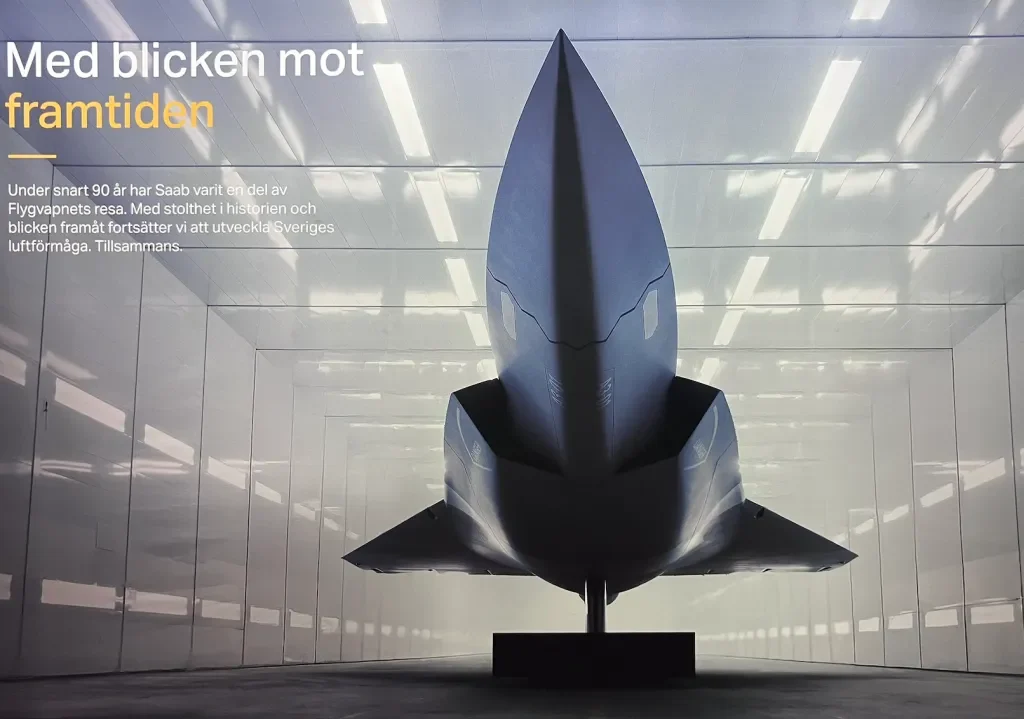
The appearance of the A3 demonstrates some of the potential advantages. The aircraft uses a tailless blended configuration in which the wing and fuselage merge smoothly. The forward fuselage features pronounced chines, while the wing planform and exhaust area are clearly shaped with low observability in mind. DSI — diverterless supersonic inlet — intakes are positioned on the sides, eliminating conventional boundary-layer splitter plates and reducing the number of features that could produce undesirable radar reflections.
Weapons are expected to be carried internally, but the absence of a cockpit may be even more important. A pilot occupies considerably more space inside an aircraft than it might seem. A cockpit requires a canopy, ejection seat, displays, flight controls, oxygen equipment, life-support systems, and an acceptable field of view. The airframe also has to account for human physiological limitations and provide the pilot with a reasonable chance of surviving an emergency.
Remove the pilot, and the designer gains additional freedom. The nose can be shaped primarily around aerodynamics, sensors, and radar signature rather than visibility from the cockpit, while the internal volume that has been freed up can be used for fuel, electronics, or weapons. Maneuvering limits can theoretically change as well, although structural strength, the engine, and weapons will still impose their own restrictions. An uncrewed fighter is therefore not simply “a normal fighter without a seat.” Removing the human can gradually change the architecture of the entire aircraft.
Uncrewed Does Not Mean Cheap
This is also where Saab’s project challenges the popular image of future air forces filled with swarms of cheap, almost disposable loyal wingmen. A3 is not intended to be such an aircraft. It would be a sophisticated reusable combat platform, and it is unlikely to be inexpensive.
According to Saab estimates, the ACP’s lifecycle cost could potentially be around one-third that of a Gripen, although the acquisition price would represent a significantly larger proportion. Company representatives have suggested that, depending on configuration, one ACP might cost roughly half as much as a Gripen. Using commonly cited open-source estimates for a new Gripen E as a rough reference, this could still mean tens of millions of dollars per aircraft.
That distinction is fundamental. An aircraft like this would not be deliberately expended as a decoy at the first opportunity. It would be maintained, repaired, upgraded, and operated for years. What emerges is a new intermediate category: a platform far more capable and expensive than a conventional UAV, but cheaper than a crewed fighter and without the risk of losing a pilot.
Why This Could Matter Especially to Sweden
The United States can simultaneously fund several generations of crewed fighters, the B-21 strategic bomber, NGAD, multiple CCA projects, and a large number of specialized programs. Sweden cannot follow the same model. After Gripen E, the country will eventually have to decide what the next generation of Swedish combat aviation should look like, and developing an entirely new national sixth-generation crewed fighter would require enormous resources.
There are several possible paths. Sweden could develop another crewed fighter independently, join a foreign program, continue deeply modernizing Gripen, or build a system in which existing crewed fighters are progressively complemented by increasingly capable uncrewed platforms. A decision on the broader direction of Swedish combat aviation is expected around 2028–2030, and the ACP program is intended to provide real technological data before that choice has to be made.
In this context, A3 becomes much more than simply “a wingman for Gripen.” It could provide a way to extend the relevance of the existing crewed platform while acquiring some next-generation capabilities without immediately committing to the development of an entirely new national fighter.
Gripen, GlobalEye, and Several Uncrewed Fighters
When the proposed system is viewed as a whole, Saab’s logic becomes clearer. At the upper information layer sits GlobalEye, capable of monitoring a vast area and building a common picture of the battlespace. Gripen E operates below it and becomes more than an individual fighter. Saab explicitly envisions the Gripen pilot acting as a tactical mission commander, coordinating the overall mission of a group of autonomous ACPs.
One or more A3-type aircraft could operate ahead of the crewed fighter. They might conduct reconnaissance, use their own sensors, perform electronic warfare, attack ground targets, or engage hostile aircraft, with the uncrewed platforms entering the most dangerous areas first. The Gripen pilot would not have to manually control every movement as if flying a small remotely piloted drone. The entire purpose of autonomy is to allow the human to define objectives and make critical decisions while the aircraft independently handles much of the execution.
The true combat unit therefore stops being a single aircraft. The network becomes the combat unit: GlobalEye sees, Gripen coordinates, and the uncrewed platforms push sensors and weapons forward.
And This Is Where Ghost Bat Appears Again
Australia is moving toward a broadly similar model. The MQ-28 is intended to operate alongside crewed platforms, increase the number of available sensors and weapons, and distribute combat capability across multiple aircraft. Boeing itself describes Ghost Bat as a means of increasing combat mass and extending the capabilities of existing aviation.
But the two programs highlight a fundamental choice now emerging in the development of collaborative combat aircraft. One approach is to build large numbers of relatively affordable platforms whose loss is considered acceptable. The other is to build fewer, much more sophisticated aircraft — low-observable, supersonic, well-armed, and designed for years of operational service.
The first approach maximizes the number of targets, sensors, and weapons that can be put into the air. The second attempts to bring the capability of each individual uncrewed aircraft closer to that of a full-fledged combat aircraft. And there is no reason to assume that one philosophy will ultimately eliminate the other.
Future Air Forces May Need Both
Future combat formations do not have to consist of identical drones. On the contrary, there is growing reason to expect several tiers of uncrewed combat aviation. The cheapest aircraft could serve as decoys, electronic warfare platforms, or additional weapons carriers. More expensive CCAs could carry sophisticated sensors, internal weapons, and larger fuel loads. At the top of this hierarchy could be aircraft like the Saab A3 — effectively full-fledged uncrewed combat aircraft capable of independently penetrating defended airspace and performing demanding missions.
In such a structure, the term loyal wingman gradually loses its original meaning. “Wingman” works well for a relatively simple aircraft accompanying a crewed fighter. But if the aircraft flying alongside it has its own sophisticated sensors, low observability, supersonic performance, internal missiles, and the ability to fight independently, the question of which aircraft is actually the centerpiece of the formation becomes much less obvious.
That Is Why the A3 Is More Interesting Than Another Futuristic Mock-Up
For now, Saab has shown exactly that: a mock-up. The A1 still has to fly, the A2 must follow, funding for a full-scale A3 has not been approved, and the configuration of any production aircraft would almost certainly change. Even the engine for a future operational ACP has not been finalized, although commonality with the F414 remains an attractive option. Treating the aircraft on display as an almost finished Swedish uncrewed fighter would therefore be a mistake.
But the concept itself reveals a much more important trend. When the MQ-28 Ghost Bat first appeared, the idea seemed relatively straightforward: give a crewed fighter an uncrewed assistant that could bring additional sensors and capabilities. Then Ghost Bat began acquiring weapons. American CCAs are gradually becoming a distinct class of combat aircraft. Now Saab is proposing a supersonic low-observable platform whose mission set already includes air combat, SEAD, electronic warfare, and deep strike.
And this creates an intriguing dividing line. If an uncrewed aircraft has fighter-like speed, carries weapons internally, possesses a low radar signature, can independently attack air and ground targets, and is expected to enter modern air-defense zones first, how accurate is it to continue describing it simply as a wingman?
Perhaps we are watching the concept enter its next stage. First, drones became additional eyes for crewed aircraft. Then they became additional missile magazines. Now Saab is proposing a machine that is gradually becoming a full-fledged fighter — simply without a human in the cockpit.
And that is why the most important question raised by the A3 goes far beyond this particular Swedish project. If autonomy, networking, and artificial intelligence eventually allow such aircraft to perform increasingly complex combat missions on their own, the next debate could become much more uncomfortable for supporters of traditional crewed aviation.
The question used to be: how many uncrewed wingmen should one fighter control?
Now it is gradually becoming something else.
Does the next fighter need a pilot at all?