An article by Stanislav Chernikov from the WARSPOT website, dated February 5, 2014.
Few people realize that during the Great Patriotic War, mines played a significant role in destroying the Wehrmacht’s military equipment and personnel. In the summer of 1941, most sapper and engineering units were diverted to build fortifications along the western borders of the Soviet Union. When the armed forces of Germany and its allies attacked the USSR, most of these units were destroyed. This led to the lightning-fast advance of German tank formations deep into Soviet territory in the summer of 1941. The Wehrmacht held an overwhelming advantage in the air, while the Red Army had only a small number of anti-tank units (a meager number of 45-mm anti-tank guns distributed among regiments and divisions). In the summer of 1941, the Red Army—lacking a echeloned defense and a defensive doctrine—was unable to stop the Wehrmacht divisions. In such a situation, mines could have been a significant factor in holding back German tanks. As early as 1941, the Soviet command set about reviving engineer units and mobile barrier detachments.
Sappers and military engineers played an active role in the Battle of Stalingrad, but the Battle of Kursk truly marked the peak of mine usage, particularly that of antitank mines. The Soviet defensive system near Kursk was no longer what it had been in 1941. In addition to the Red Army’s superiority over the enemy in manpower and military equipment, Soviet units were well prepared for the Wehrmacht divisions’ offensive. A powerful, echeloned defensive system was constructed, featuring numerous camouflaged anti-tank guns. Heavy artillery, ground-attack aircraft, and even anti-aircraft artillery were used to combat German armored vehicles. True snipers were selected from among the Soviet artillerymen. These actions by the Red Army were well-founded. Near Kursk, Hitler committed large numbers of new heavy tanks—the “Panther” and “Tiger”—as well as “Ferdinand” self-propelled guns to the battle. The new German tanks and self-propelled guns could engage from long ranges all tank models in service with the Red Army in 1943. The Soviet T-34s, KVs, and Lend-Lease tanks, on the other hand, had to engage in close combat and use sub-caliber shells to destroy the new German vehicles. For example, the “Ferdinand” self-propelled gun had 200 mm of frontal armor, which could be penetrated by guns of 122 mm caliber and larger. This is precisely why Soviet generals placed great hope in anti-tank mines. In 1943, the density of the Soviet defensive minefields was approximately 550–750 mines per kilometer of front line, whereas in 1942 there were just over 200 mines per kilometer. The depth of the minefield near Kursk was within 100 meters. The mines were laid in 3–4 rows, with the rows spaced 10–40 meters apart and the individual mines spaced 6–10 meters apart. Over 237,000 anti-tank mines were laid in the Central Front’s defensive sector (1,400–1,600 mines per kilometer). Near Kursk, four times as many mines were laid as near Stalingrad, and six times as many as near Moscow. The mines were meant to stop the German steel monsters. “We laid mines, then cleared them. We built bunkers and pillboxes. “We laid so many mines that it’s impossible to count them. And I can’t even begin to imagine who later had to clear them all away,”—an excerpt from the memoirs of veteran sapper Nikolai Efimovich Tolmachev.
The German offensive began on July 5, 1943. And German tank units suffered their first casualties precisely in the minefields, which German sappers had managed to clear only partially. The Russians, like no one else, knew how to reinforce their anti-tank defenses using minefields and anti-tank obstacles, as well as mines scattered haphazardly in the gaps between minefields. “The speed with which the Russians laid mines was astonishing. In two or three days, they managed to lay over 30,000 mines. There were instances when we had to clear up to 40,000 mines in a single day along a corps’ line of advance. Even though we had advanced up to 20 km into the depth of the Russian defenses, minefields still surrounded us, and anti-tank defense zones hindered further advance. In this regard, it is worth emphasizing once again the Russians’ highly skillful camouflage. Not a single minefield or anti-tank zone could be detected until the first tank hit a mine or the first Russian anti-tank gun opened fire.” — an excerpt from the memoirs of Wehrmacht Tank General Friedrich von Mellentin, chief of staff of the 48th Tank Corps, who took part in the Battle of Kursk. On July 9, 1943, 10 new “Ferdinand” self-propelled guns were destroyed by mines. In defensive battles along the Central Front alone, from July 5 to 12, 1943, approximately 420 German tanks and self-propelled guns were destroyed by mines, and over 4,000 Wehrmacht soldiers and officers were killed. Having lost a track when struck by mines, German tanks and self-propelled guns became excellent stationary targets for Soviet artillerymen and infantrymen armed with incendiary mixtures. Although German troops managed to repair a significant portion of the military equipment put out of action by mines, they lost what mattered most—time and the pace of their offensive. While Wehrmacht sappers were clearing minefields and repair-and-evacuation brigades were removing damaged vehicles from the battlefield (which was no easy task: for example, evacuating a disabled “Tiger” tank required three 18-metric-ton tow trucks), Soviet troops managed to establish a new line of defense. The German forces failed to carry out a blitzkrieg near Kursk.

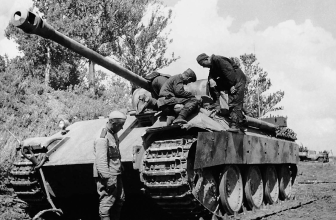
“Ferdinand” No. 501, from the 654th Division, was destroyed by a mine. The vehicle is listed as No. 9 in the GABTU commission’s inspection records. It was this very vehicle that was repaired and sent to the NIBT testing ground. It is currently on display at the Armored Vehicles Museum in Kubinka. Kursk Salient, near the village of Goreloye. Source: https://waralbum.ru/

“Ferdinand” No. 501, from the 654th Division, which was destroyed by a landmine. The vehicle is listed as No. 9 in the GABTU commission’s inspection records. It was this particular vehicle that was repaired and sent to the NIBT testing range. It is currently on display at the Armored Vehicle Museum in Kubinka. Kursk Salient, near the village of Goreloye. Source: https://mihalchuk-1974.livejournal.com

The “Ferdinand” heavy assault gun, side number “731,” chassis number 150090, from the 654th Division, was destroyed by a mine in the 70th Army’s defensive line. Later, this vehicle was sent to an exhibition of captured military equipment in Moscow. The Kursk Bulge. Source: https://mihalchuk-1974.livejournal.com

“Ferdinand” No. 502, assigned to the 5th Company of the 654th Division, was destroyed by a landmine. It was destroyed by a landmine. Later, this very self-propelled gun was tested under fire. Source: https://mihalchuk-1974.livejournal.com

Two damaged Ferdinand tanks from the headquarters group of the 654th Battalion. Near the Ponyri station, July 15–16, 1943. On the left is staff “Ferdinand” No. II-03. The vehicle was set on fire using bottles filled with KS after a mine damaged its running gear. Source: https://mihalchuk-1974.livejournal.com

Two damaged Ferdinand tanks from the headquarters group of the 654th Battalion. Near the Ponyri station, July 15–16, 1943. On the left is staff “Ferdinand” No. II-03. The vehicle was set on fire using bottles filled with KS after a mine damaged its running gear. Source: https://mihalchuk-1974.livejournal.com
Soviet troops actively employed minefields until the very end of the war, especially in areas vulnerable to tank attacks and in places where the Wehrmacht had managed to break through Soviet defenses. Mines were actively used during the Balaton Defensive Operation in Hungary in March 1945. Behind the army lines, front-line defensive positions were being prepared, as well as intermediate and cut-off positions. Overall, the depth of the Soviet forces’ defenses between Lakes Velence and Balaton was 30–50 kilometers from the front line. Minefields were laid across the entire front; the average density in the sector of the 4th Guards, 26th, and 57th Armies was 730 antitank and 670 antipersonnel mines per kilometer, and on the most critical tank-threatened sectors, it reached 2,700 and 2,500 mines, respectively. In addition to artillery, the defense plan called for the widespread use of mobile barrier detachments—sapper units equipped with stocks of antitank and antipersonnel mines. In total, by March 5, there were 68 such units, comprising 73 vehicles, 164 wagons, 30,000 antitank and 9,000 antipersonnel mines, as well as 9 metric tons of explosives. The front command had at its disposal three mobile mine-laying detachments (motorized) consisting of a motorized engineer battalion and two sapper companies, each of which had 4,500 anti-tank mines. The 4th Guards Army, based on its engineer-sapper battalion, formed two such motorized detachments, each equipped with 3,200 anti-tank mines and 1,000 anti-personnel mines. The 26th and 57th Armies each had one detachment (a sapper company with four vehicles and 1,000 antitank mines). Corps detachments typically consisted of a company—a sapper platoon with a stockpile of 300–500 antitank mines; divisional detachments—10–25 sappers in a single vehicle with 200–250 mines, and regimental detachments—5–7 sappers with 100 anti-tank mines on carts. Simultaneously with the advance of the artillery units, measures were taken to mine the terrain; for this purpose, the mobile mine-laying detachments of the 64th Rifle Corps and the 57th Army were transferred to the Balazhka area as early as the afternoon of March 6. During the first 24 hours, these detachments laid more than 6,600 antitank mines and 1,300 antipersonnel mines. By the morning of March 7, the entire section of the enemy’s incursion was bordered by minefields, and the density of mines extending into the depth of the main defense line in the sector of the 113th Rifle Division reached 1,000 antitank mines per kilometer of front.

A Pz.Kpfw. VI Ausf. B “King Tiger” heavy tank from the 509th Heavy Tank Battalion, which hit a mine and was abandoned by its crew. Despite the turret’s 82 mm side armor, the tank crew clearly feared Soviet anti-tank artillery and additionally “reinforced” the turret sides with a garland of spare tracks. The number of the Soviet captured tank crew was “25.” Budapest area. Source: https://mihalchuk-1974.livejournal.com

German heavy tank Pz.Kpfw. VI Ausf. B “King Tiger,” part of the “Feldhernhalle” heavy tank battalion, which hit a mine and was thrown into a ditch. Source: https://mihalchuk-1974.livejournal.com
Soviet sappers were not as well known to the public as, say, tank crews, pilots, or artillerymen. But it was precisely the sappers, through their work—constantly teetering on the edge between life and death (a sapper makes only one mistake)—who halted the Wehrmacht’s armored hordes, thereby saving the lives of thousands of Soviet soldiers.