When a Heavy Cruiser Becomes a Light Cruiser. The Incredible Transformation of the Mogami into IJN Banjō — the Ultimate Japanese Light Cruiser

During World War II, the Imperial Japanese Navy possessed a rather unusual cruiser fleet. Its heavy cruisers, armed with powerful 203 mm guns, were considered among the strongest in the world. However, the backbone of its light cruiser force consisted of relatively old ships built in the early 1920s. Even the introduction of the new Agano-class cruisers and the Ōyodo failed to completely change this situation. But what if Japanese admirals had decided to take an entirely different approach and build a light cruiser based on a heavy cruiser, arming it with not six, or even fifteen, but no fewer than eighteen 155 mm guns?
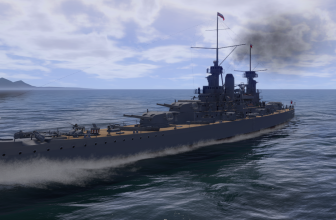
This is precisely the kind of warship proposed by our fellow enthusiast Herfinde_NavyTD. His IJN Banjō, supposedly commissioned in 1941, is an enormous, fast cruiser approaching the dimensions of a battleship. But why could such an imposing warship be classified as a light cruiser at all? And how realistic would its appearance in the Japanese fleet have been? Let us take a closer look.
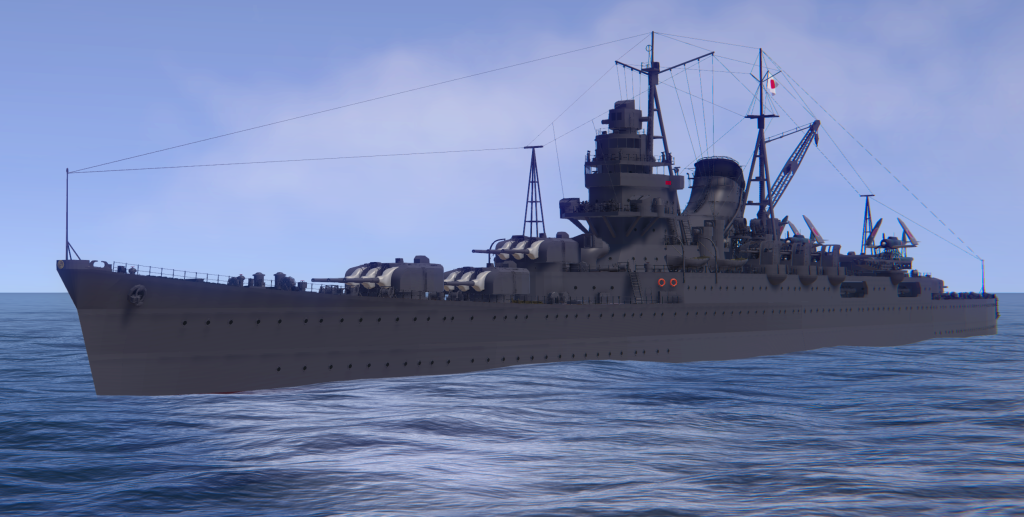
How the Japanese Learned to Turn Heavy Cruisers into Light Cruisers
It all began with the Washington and London Naval Treaties, which restricted the construction of major warships. Under the terms of the 1930 London Naval Treaty, cruisers were divided into two categories: heavy cruisers, armed with guns larger than 155 mm, and light cruisers, whose guns could not exceed 155 mm.
For Japanese admirals, this classification opened up some interesting possibilities. After all, a ship carrying fifteen 155 mm guns was formally considered a light cruiser, even if its dimensions, armor protection, and displacement were practically identical to those of a heavy cruiser.
This was precisely how the famous Mogami-class cruisers came into existence. They were originally equipped with fifteen 155 mm guns in five triple turrets, although their design allowed these weapons to be replaced later with ten 203 mm guns. In 1939–1940, this conversion was indeed carried out, transforming the former light cruisers into heavy cruisers.
However, this created another problem. Following the rearmament of the Mogami class, the backbone of Japan’s light cruiser fleet once again consisted of aging Kuma-, Nagara-, and Sendai-class vessels, armed primarily with 140 mm guns. Their capabilities were becoming increasingly inadequate for the demands of modern naval warfare.
In actual history, the response was the development of the new Agano-class light cruisers and the specialized Ōyodo. In our alternative timeline, however, the Japanese naval command makes a far more radical decision.
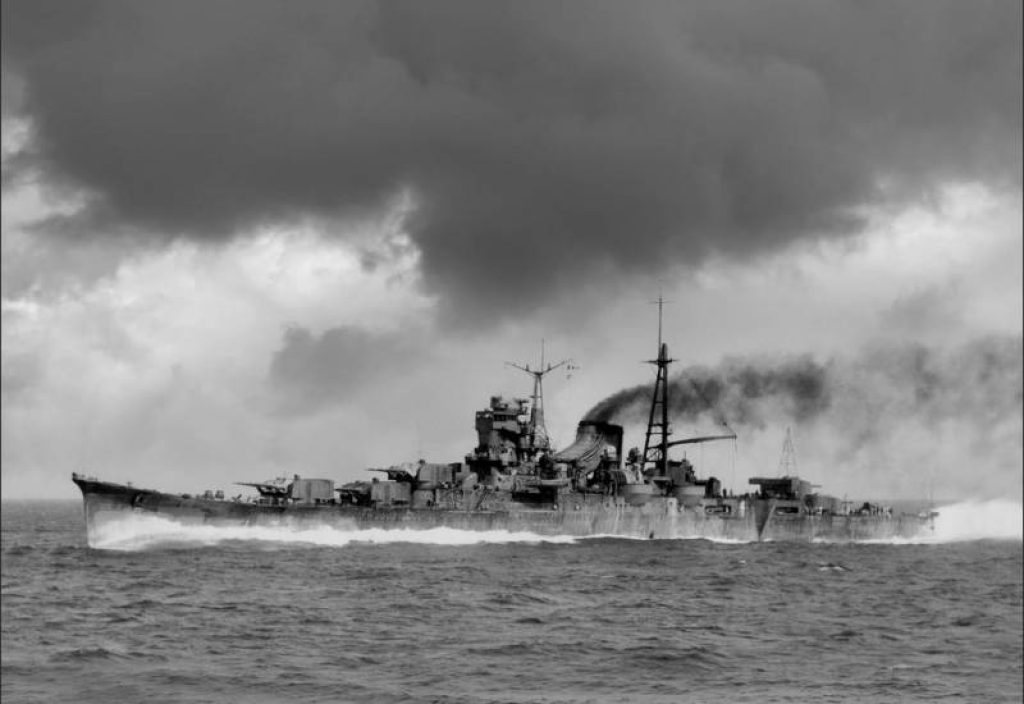
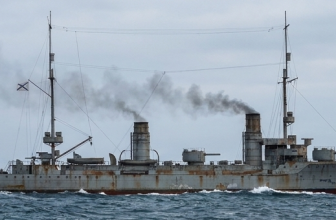
Cruiser of the Mogami class
The Birth of a Giant Light Cruiser
Our historical point of divergence occurs in 1937. Instead of developing an entirely new, relatively small cruiser, Japanese engineers are tasked with creating a ship that uses proven design features of the Mogami class but carries even more powerful artillery armament.
This leads to the Banjō project, named after the Banjō River in Ōita Prefecture. The original plan calls for the construction of four such ships, but limited shipbuilding capacity and shortages of resources lead to the cancellation of the other three before their keels can be laid.
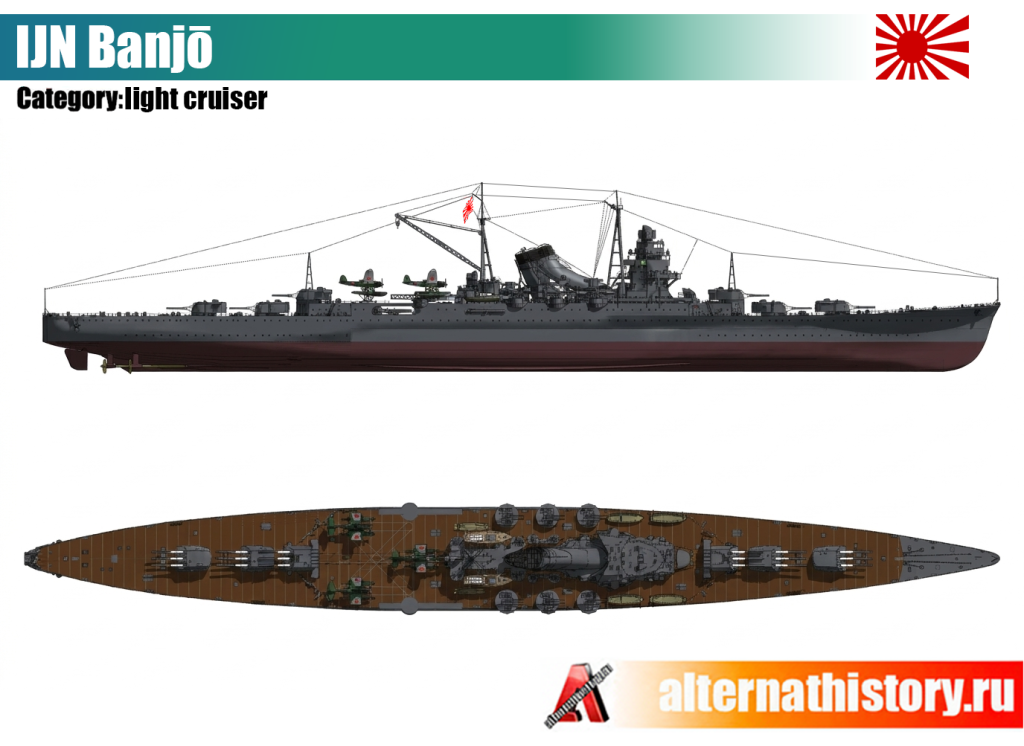
The lead ship is laid down in 1937 and enters service with the Imperial Japanese Navy in 1941. The result is a true giant: measuring 226.7 meters in length and 26 meters in beam, with a maximum speed of 34.5 knots.
In terms of dimensions, the new cruiser surpasses not only every real Japanese light cruiser but also the famous Mogami-class heavy cruisers. Indeed, its length approaches that of certain battleships.
However, the Banjō’s greatest advantage is not even its displacement, the exact figure for which the author does not provide, but its artillery armament, which is almost unbelievable for a light cruiser.
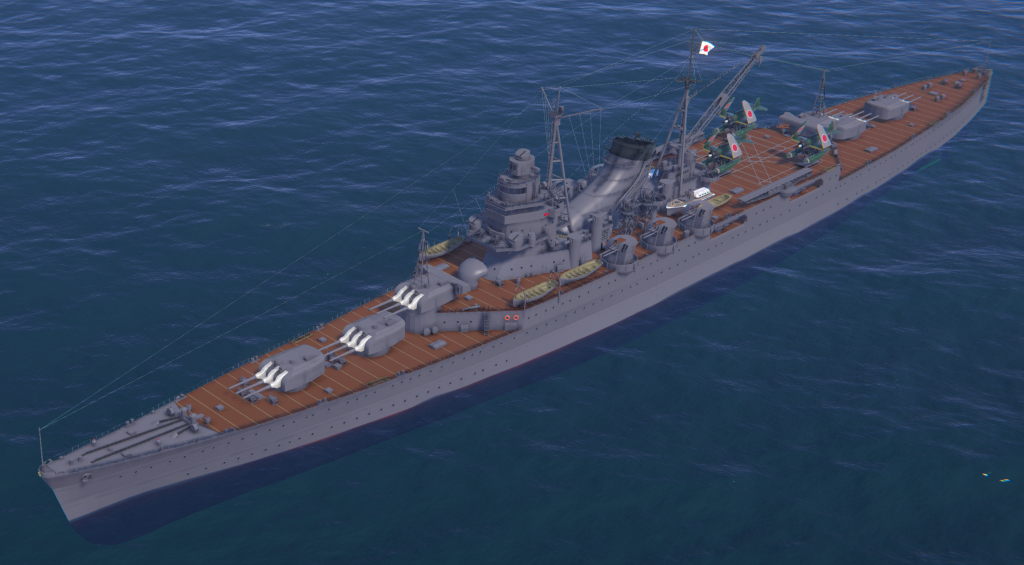
Eighteen Main Battery Guns
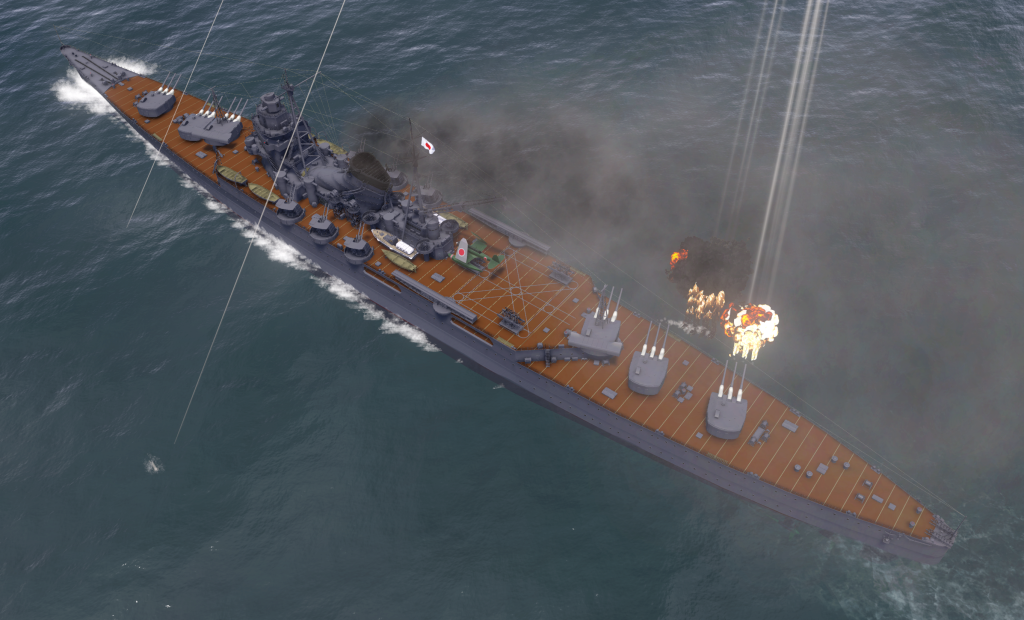
The Banjō carries no fewer than six triple turrets equipped with 155 mm/60 Type 3 guns. In total, the ship mounts eighteen main battery guns — three more than the original Mogami-class cruisers.
For comparison, the real Japanese Agano-class light cruisers carried only six 152 mm guns, while the Ōyodo was armed with six 155 mm guns. Thus, the new warship exceeds both classes in the number of main battery guns by a factor of three.
Such armament would have been particularly impressive in a confrontation with American Brooklyn- and Cleveland-class light cruisers. The former carried fifteen 152 mm guns, while the latter had twelve. Consequently, in an artillery engagement at relatively short ranges, the Banjō could deliver an exceptionally high volume of fire.
However, this enormous number of guns also comes with disadvantages. Six heavy turrets require considerable internal space, increase the ship’s weight, and complicate the arrangement of ammunition magazines. This is precisely why the designers are forced to increase the dimensions of the hull so dramatically.
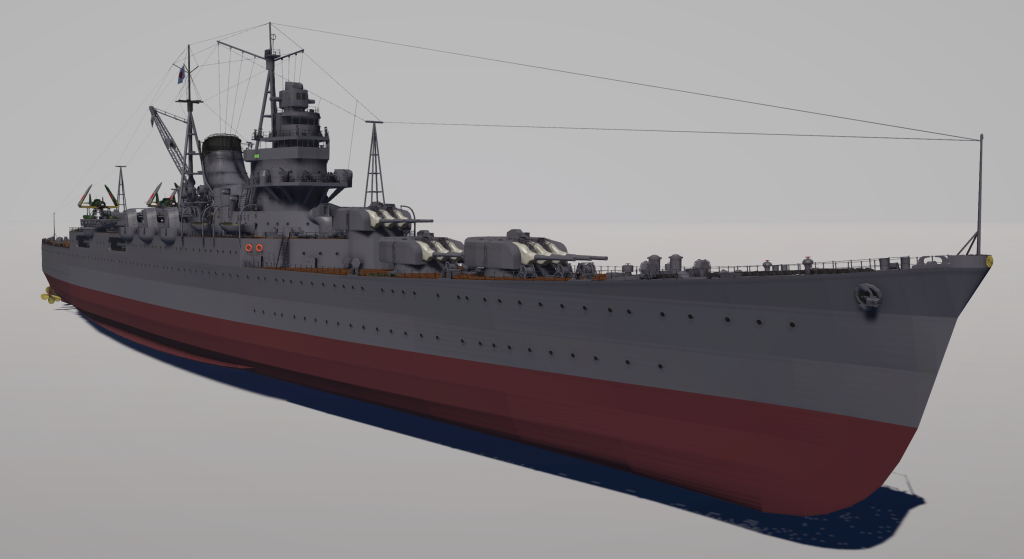
Not Just Guns, but Torpedoes Too
Japanese cruisers were traditionally distinguished by their powerful torpedo armament, and the new ship is no exception. Four quadruple 610 mm torpedo launchers are located beneath the aircraft deck. Thus, the Banjō can launch a salvo of sixteen torpedoes at once.
Considering the famous Japanese Type 93 oxygen-powered torpedoes, such armament would make the ship a dangerous opponent not only for cruisers but even for battleships.
Its secondary battery consists of twelve 127 mm Type 89 dual-purpose guns mounted in six twin turrets. Close-range air defense is provided by sixteen 25 mm Type 96 automatic guns.
For 1941, this combination of weapons looks quite impressive. However, subsequent events of World War II demonstrated that Japanese 25 mm anti-aircraft weapons had serious shortcomings, while the absence of modern radar-based fire-control systems significantly reduced the effectiveness of their air defenses.
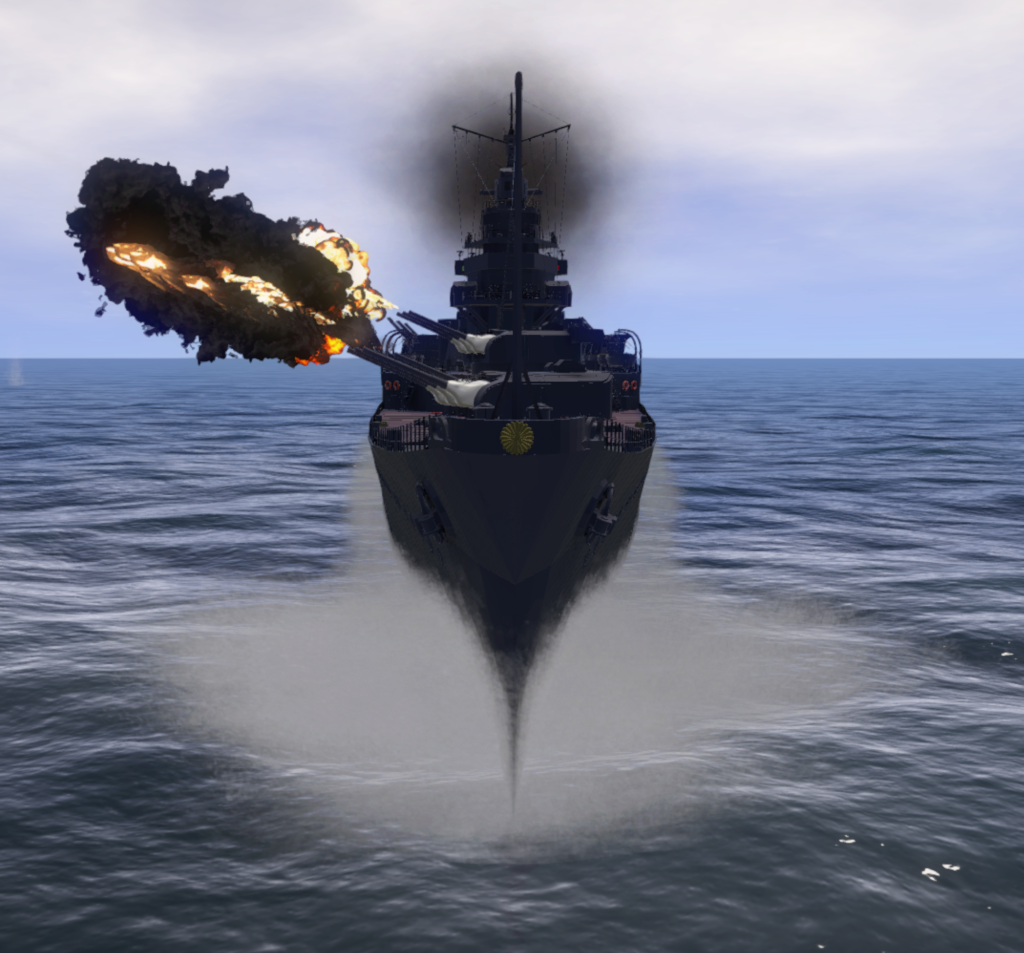
Technical Specifications of IJN Banjō
- Country — Empire of Japan.
- Type — large light cruiser.
- Year laid down — 1937.
- Commissioned — 1941.
- Planned — 4 ships.
- Built — 1 ship (in the author’s alternative timeline).
- Length — 226.7 m.
- Maximum beam — 26 m.
- Beam at the waterline — 24 m.
- Maximum speed — 34.5 knots.
- Main armament — 18 × 155 mm/60 Type 3 guns.
- Main battery turrets — 6 triple turrets.
- Dual-purpose artillery — 12 × 127 mm/40 Type 89 guns.
- Anti-aircraft armament — 16 × 25 mm Type 96 automatic guns.
- Torpedo armament — 16 × 610 mm torpedo tubes in four quadruple launchers.
- Aviation equipment — reconnaissance floatplanes.
The author does not specify the exact displacement, machinery output, armor thickness, or crew complement. Therefore, providing specific figures for these characteristics would be incorrect.
Could the Banjō Have Changed the Course of the Pacific War?
If we imagine that such a ship had actually entered service on the eve of the attack on Pearl Harbor, the Japanese naval command would have acquired an exceptionally powerful artillery cruiser. It could have escorted aircraft carrier formations, operated alongside heavy cruisers, and spearheaded night attacks.
Its deployment in the battles around the Solomon Islands would have been particularly promising, since Japanese warships repeatedly demonstrated a high level of preparation for night combat.
However, there would also have been serious limitations. Such an enormous vessel would present a conspicuous target, while its protection against aircraft would hardly have been adequate for the threats of the second half of the war. Furthermore, building such a large cruiser would inevitably have diverted resources from other shipbuilding programs.
Therefore, a single Banjō could have become a formidable opponent in individual engagements, but it would hardly have changed the overall course of the war.
Instead of an Afterword
The IJN Banjō project is interesting primarily because it takes the Japanese concept of the large light cruiser, first realized in the Mogami class, to its logical extreme. While the latter originally carried fifteen 155 mm guns, our alternative giant mounts eighteen.
But this raises the central question: how justified would it have been to build an enormous warship, comparable in size to a battleship, merely to equip it with medium-caliber guns? After all, when confronting heavy cruisers, the enemy’s 203 mm guns could have enjoyed a significant advantage in effective engagement range and armor penetration.
Nevertheless, as a ship intended to combat light naval forces, escort larger formations, and conduct night artillery and torpedo attacks, the Banjō would have been a truly formidable warship.
What do you think? Did the Japanese Navy need such an enormous light cruiser? Or would it have been far more sensible to build several conventional Agano-class ships instead?
Source — Fictional IJN Large Light Cruiser Banjō (1941), Reddit