The Cruisers the Russian Empire Lost. What If Muravyov-Amursky and Admiral Nevelskoy Had Been Completed in Russia?

The Imperial Russian Navy could have acquired two highly unusual light cruisers. Fast turbine-powered warships based on German naval engineering, built in Russian shipyards and armed with six 152 mm guns mounted in three armored turrets. Moreover, these turrets would not have been newly manufactured but removed from the battleship Slava.
In reality, the cruisers Muravyov-Amursky and Admiral Nevelskoy never flew the Russian naval ensign. Ordered by Russia from German shipyards, they were confiscated following the outbreak of World War I and entered service with the Imperial German Navy under the names Pillau and Elbing. But what if events had taken a different course?
The original idea for this alternative history belongs to our respected colleague Stvolyar. However, his concept has undergone substantial literary and historical revision with the assistance of artificial intelligence, so I am publishing this article under my own name. Let us examine how realistic such a project might have been, how these cruisers could have performed during World War I, and what fate might have awaited them after the revolution.
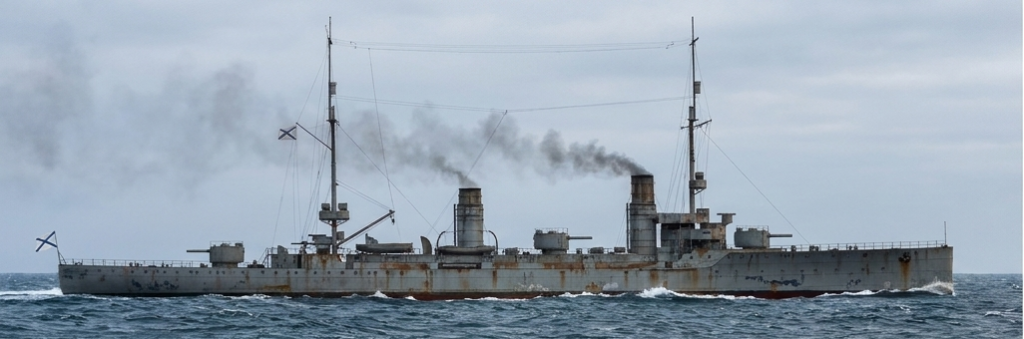
Two Russian Cruisers That Became German
The history of these ships began as part of the program to rebuild the Russian fleet after the Russo-Japanese War. Particular attention was paid to the Pacific Ocean, where the aging cruisers Askold and Zhemchug needed replacing.
Two relatively small but fast ships were planned for reconnaissance missions, escorting destroyers, and operations against enemy shipping.
In 1912, the contract was awarded to the German firm Schichau, which operated a shipyard in Danzig. The design called for a displacement of approximately 4,400 tons, a steam-turbine propulsion system, and a speed of around 27.5 knots.
Their armament was to consist of eight 130 mm guns and four 63.5 mm guns. For their time, these ships represented a thoroughly modern type of small cruiser.
Both ships were officially laid down on September 10, 1913, according to the Julian calendar then used in Russia. According to a report by the Russian Naval Ministry, by the end of that year Muravyov-Amursky was 31.2% complete, while Admiral Nevelskoy had reached 13.8% completion.
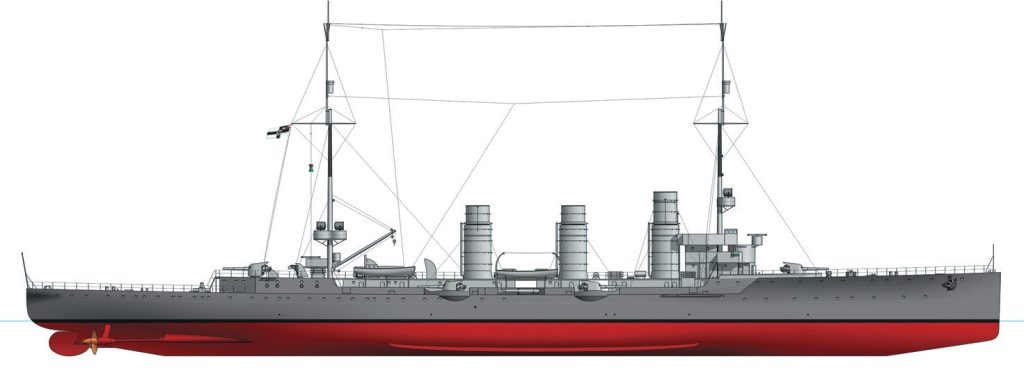
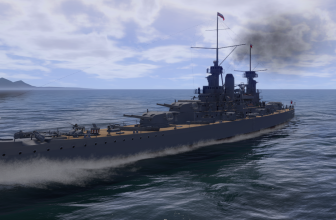
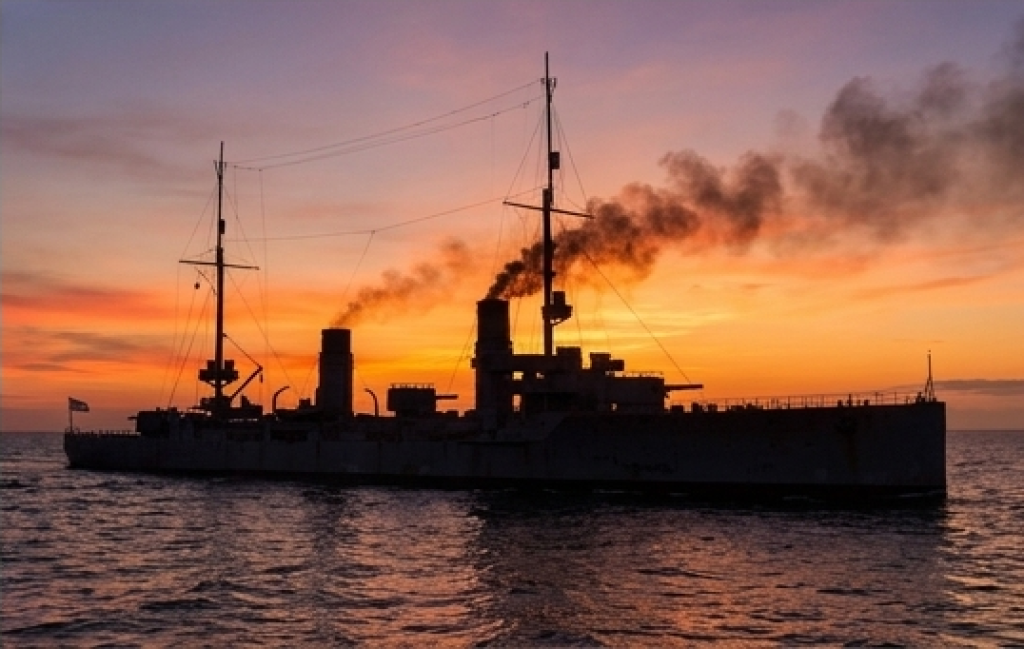
Pillau-class light cruiser
However, Russo-German cooperation proved short-lived. Following the outbreak of World War I, Germany confiscated both ships. Muravyov-Amursky was renamed Pillau, while Admiral Nevelskoy became Elbing.
The Germans modified their armament, installing eight 150 mm guns on each ship. Pillau entered service in December 1914, followed by Elbing in September 1915.
Both participated in the Battle of Jutland. Elbing was lost during the night of June 1, 1916, after colliding with the German battleship Posen. Pillau survived the war, was transferred to Italy, and continued serving for several decades under the name Bari.
That is what happened in actual history. In our alternative reality, events unfolded quite differently.
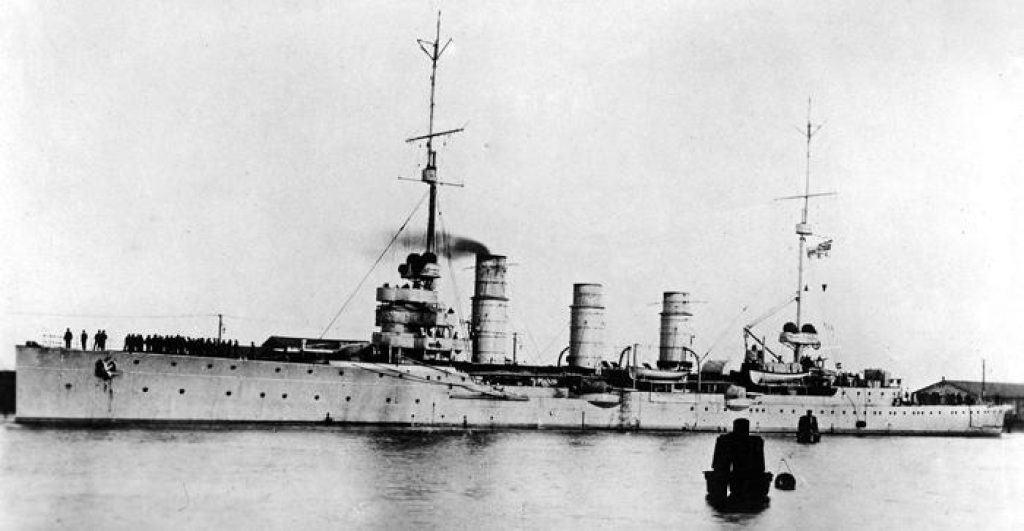
Light cruiser Pillau
The 1909 Point of Divergence: What to Do with Slava’s Turrets?
In 1909, the Russian Naval Ministry did indeed consider proposals for a comprehensive modernization of the battleship Slava.
The central idea was to strengthen her artillery by replacing the aging 152 mm guns with more powerful 203 mm weapons.
The well-known naval engineer Vladimir Kostenko developed several modernization proposals. Some called for the installation of new eight-inch guns in turrets, which would have brought Slava’s combat capabilities closer to those of the Andrey Pervozvanny-class battleships.
However, such an extensive modernization would have required substantial expenditure. In actual history, the plans were abandoned.
In our scenario, events develop differently.
In early 1910, funds are finally allocated for Slava’s rearmament. The battleship is sent to a shipyard for an extended refit, during which her six-inch artillery is removed.
Battleship Slava. The turrets relevant to our story are located along the sides of the ship.
At this point, the Naval Ministry unexpectedly encounters a problem.
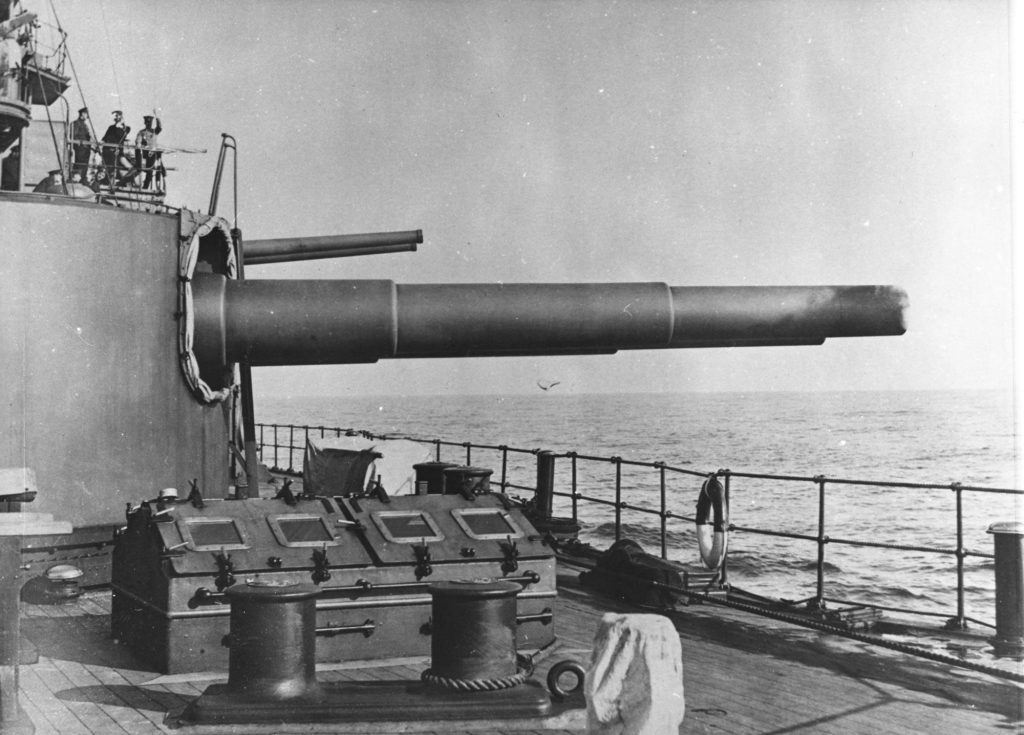
Six twin-gun turrets containing twelve 152 mm Canet guns have been removed from the battleship. Their mechanisms are still in working order, and the turrets retain considerable operational value. Naturally, the authorities are reluctant to consign such expensive equipment to storage.
Initially, the possibility of using the guns for coastal defense is considered. But then a far more interesting proposal emerges: install the turrets on two new light cruisers being designed for the Pacific Fleet.
The idea proves attractive primarily for economic reasons. The Naval Ministry can reuse artillery installations that have already been paid for while substantially increasing the firepower of the future ships.
Thus emerges a project destined to become one of the most unusual in the history of the alternative Russian fleet.
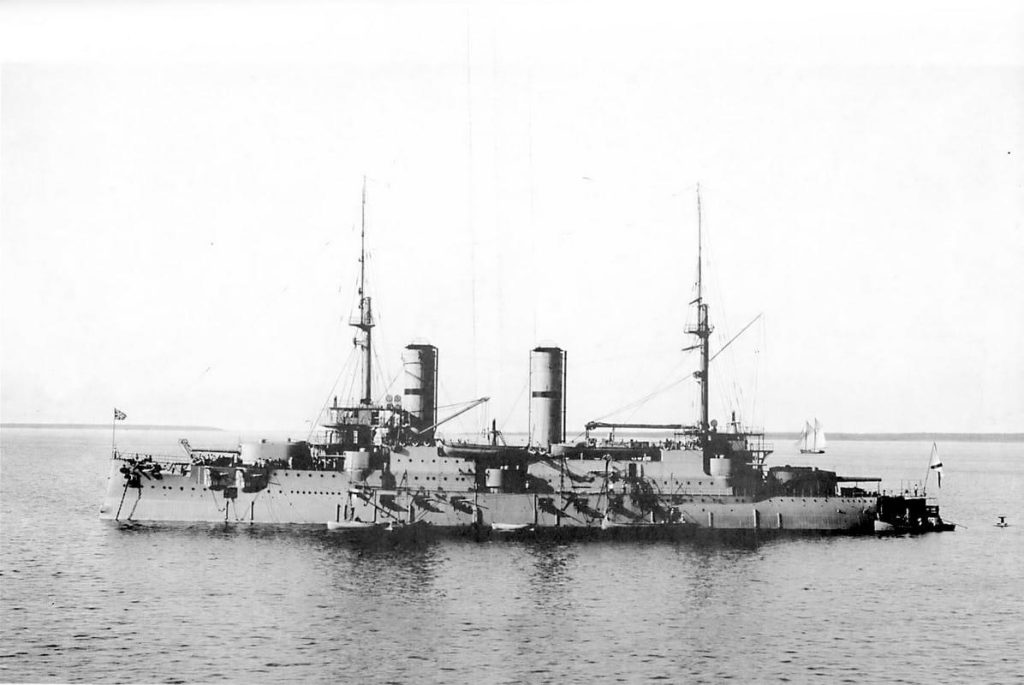
Slava’s main battery. The 152 mm guns that interest us can be seen behind the turret in the foreground.
German Hulls and Russian Artillery
In 1911, the Naval Ministry begins refining the design of the future cruisers.
To shorten development time, it is decided to make use of technical assistance from the German firm Schichau. However, construction of the new ships is organized not in Germany but at Russian shipyards.
In our alternative history, the Putilov Shipyard in St. Petersburg becomes the principal contractor, while the German company supplies part of the technical documentation and assists with the introduction of the propulsion system.
This decision proves exceptionally important. When World War I begins in 1914, both ships are already in Russia and cannot be confiscated by the enemy.
The most significant departure from the original design concerns the artillery.
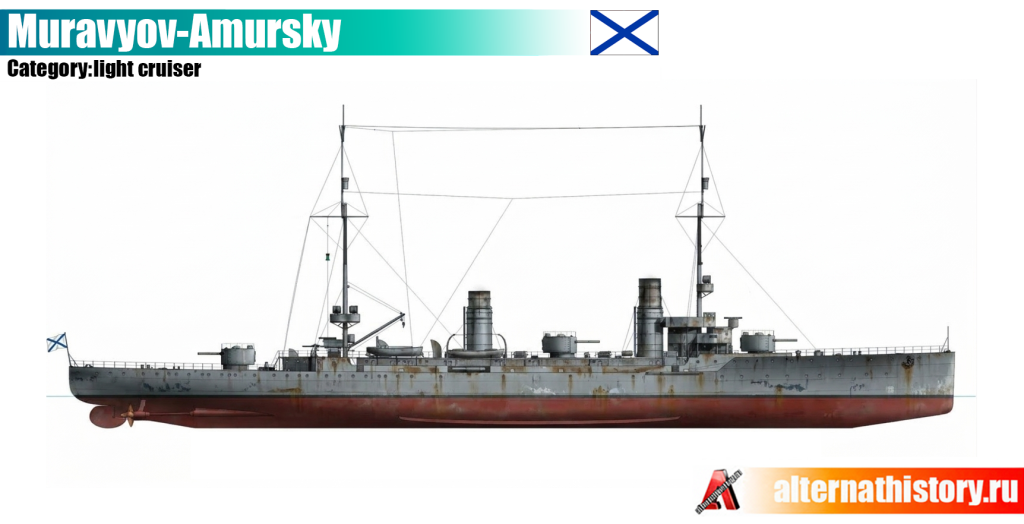
Instead of eight 130 mm guns, each cruiser receives three twin 152 mm turrets removed from Slava.
One turret is positioned forward, while the other two are placed aft, with one mounted in a superfiring position. This arrangement allows all six guns to be brought to bear on either broadside.
Adapting the old turrets to the new hulls, however, proves far from straightforward. The decks must be reinforced, barbettes constructed, and the ammunition magazines and hoists redesigned.
The considerable weight of the artillery installations creates further difficulties. As a result, the design displacement increases and the ships’ speed decreases slightly.
In return, the cruisers acquire exceptionally powerful turret-mounted artillery for vessels of their size.
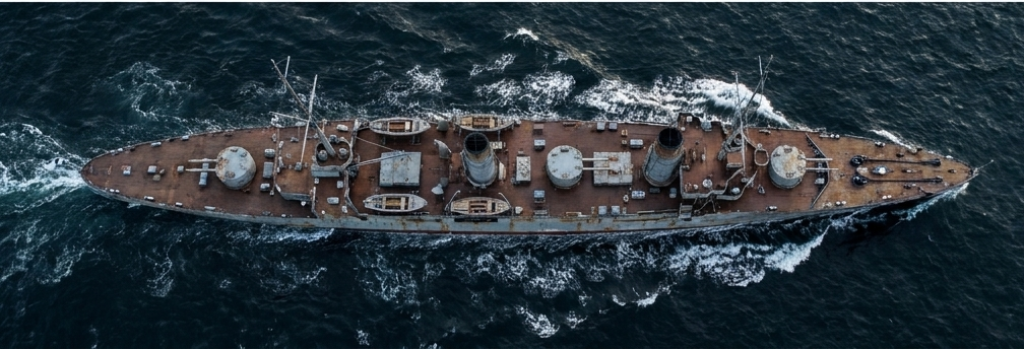
Six-Inch Guns That Could Have Changed Everything
When transferring the turrets from Slava, the designers abandon the original ammunition-handling system.
Experience gained during the Russo-Japanese War had demonstrated the inadequate performance of older loading mechanisms, particularly during sustained firing.
The artillery installations are therefore modernized: the ammunition hoists are modified, the handling mechanisms strengthened, and new sighting equipment installed.
Special attention is paid to ammunition. Instead of the previous shells weighing approximately 41.4 kg, the new cruisers receive heavier projectiles intended to improve range and destructive effect.
In this alternative scenario, a shell weighing approximately 50 kg is adopted, requiring the ammunition-handling mechanisms to be redesigned. Special testing and adjustments to the propellant charges are necessary, since increasing projectile weight does not automatically guarantee greater range.
It is assumed that, following the modernization of the turrets, the practical rate of fire reaches approximately four rounds per minute per barrel.
Consequently, a full broadside from both cruisers would consist of twelve six-inch shells.
In combat against enemy destroyers and light cruisers, such artillery would represent a very serious threat.
However, this arrangement also has a disadvantage: three turrets are heavier and more difficult to maintain than the open deck-mounted guns specified in the original design.
The actual capabilities of such vessels would therefore depend heavily on the quality of their design and the preservation of adequate stability.
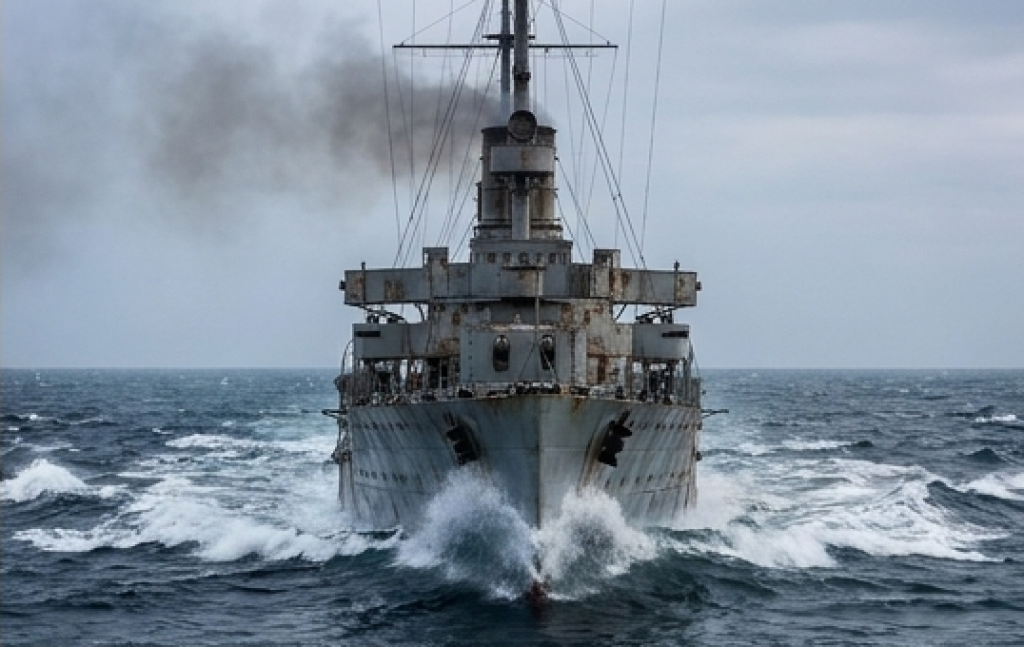
What Were the Alternative Cruisers Like?
By the spring of 1914, both ships are already under construction on the slipways. Muravyov-Amursky is launched in June, while Admiral Nevelskoy follows in September, after the war has already begun.
Thanks to German technical documentation and the domestic industrial base, construction progresses reasonably well, although difficulties in mastering the new turbines and installing the heavy turrets cause delays.
In our scenario, Muravyov-Amursky enters service in the autumn of 1915, followed by Admiral Nevelskoy in the spring of 1916.
Their estimated technical specifications are as follows:
-
Standard displacement — approximately 4,800 tons.
-
Full-load displacement — approximately 5,500 tons.
-
Length — 135 m.
-
Beam — 13.8 m.
-
Draft — approximately 5.5 m.
-
Propulsion — steam turbines driving two propeller shafts.
-
Power output — 30,000 hp.
-
Maximum speed — approximately 26 knots.
-
Cruising range — approximately 3,000 nautical miles at economical speed.
-
Main armament — six 152 mm Canet guns in three twin-gun turrets.
-
Anti-torpedo-boat armament — four 63.5 mm guns.
-
Torpedo armament — two 450 mm torpedo tubes.
-
Armor protection — armored deck 20–40 mm thick, with additional protection for the ammunition magazines.
-
Main battery turrets — frontal armor up to 152 mm thick.
-
Crew — approximately 400 officers and sailors.
These specifications represent the author’s reconstruction rather than the characteristics of actual ships. In particular, combining heavy turrets with a relatively small hull would have required careful calculations of stability and weight distribution.
Nevertheless, the cruisers would have retained the characteristic advantages of the German design: good speed and a fairly long cruising range.
World War I: The Baltic Instead of Vladivostok
Both cruisers were originally intended for the Pacific Fleet. However, once Russia enters World War I, sending them to the Far East no longer makes practical sense.
The German fleet is operating directly in the Baltic, and it is there that the new warships are urgently needed.
In the autumn of 1915, Muravyov-Amursky joins the Baltic Fleet and begins operating in the Gulf of Finland.
Her primary duties include escorting destroyers, covering minelaying operations, and conducting reconnaissance near enemy shores.
Her first serious test comes in early 1916, when the cruiser helps cover a minelaying operation in the central Baltic.
On their return voyage, the Russian ships encounter German destroyers. The enemy attempts to close the distance in preparation for a torpedo attack, but Muravyov-Amursky opens fire with her forward turret.
After several ranging salvoes, the aft turrets join the engagement. One German destroyer is damaged, forcing the enemy formation to abandon its pursuit.
For the Russian Navy, this encounter provides the first confirmation that the chosen armament arrangement was justified.
In the spring of 1916, Admiral Nevelskoy joins Muravyov-Amursky.
The Baltic Fleet now possesses a pair of relatively fast cruisers capable of operating alongside destroyers and providing them with artillery support.
Moon Sound: A Trial by Fire
The most serious test for the new ships comes during the fighting for the Moon Sound Archipelago.
In our alternate history, both cruisers are assigned in the summer of 1917 to the forces responsible for defending the approaches to the Gulf of Riga.
Their main mission is to protect Russian destroyers and counter German light naval forces.
In October, when the German fleet launches its operation to capture the islands of the archipelago, Muravyov-Amursky and Admiral Nevelskoy are among the ships covering the withdrawal of Russian formations.
During one engagement, Admiral Nevelskoy exchanges fire with German destroyers.
Her six-inch guns allow her to engage at ranges exceeding the effective firing distances of many enemy vessels of this class.
However, the disadvantages of heavy turret-mounted artillery soon become apparent. During vigorous maneuvering, the ammunition-handling mechanisms experience interruptions, while the considerable weight of the turrets limits the potential for further modernization.
During the engagement, the cruiser receives two hits. One damages the superstructure, while the other puts an anti-torpedo-boat gun out of action.
Despite the damage, the ship maintains her speed and, together with Muravyov-Amursky, covers the withdrawal of Russian destroyers.
Both cruisers return safely to the Gulf of Finland.
It is important to emphasize that, in this alternative scenario, their participation does not change the overall outcome of the Moon Sound operation. The German fleet retains a substantial advantage in capital ships, and two light cruisers cannot compensate for the shortage of heavy naval forces.
However, they help reduce losses among Russian light forces and enable a more orderly withdrawal.
A New Enemy: Aircraft
Another important development is the gradual appearance of German naval aviation in the Baltic.
Initially, airplanes and seaplanes are regarded primarily as reconnaissance platforms. During the war, however, they begin to pose a direct threat to warships.
As a result, the armament of both cruisers is strengthened in 1916–1917.
Each ship receives two 75 mm anti-aircraft guns developed by converting older Meller naval gun mounts.
The guns are installed on specially prepared platforms providing relatively wide fields of fire.
The addition of anti-aircraft artillery does not transform the cruisers into fully capable air-defense warships, but it allows them to repel attacks by individual aircraft and interfere with enemy aerial reconnaissance.
At the same time, the ships’ searchlights, communications equipment, and artillery fire-control positions are modernized.
By the end of 1917, both cruisers differ considerably from their original design.
Revolution: The Fate of the Ships and Their Crews
The February Revolution of 1917 proves no less disruptive to the Russian Navy than the war itself.
Ships’ committees emerge aboard the vessels, discipline weakens, and relations between officers and sailors become increasingly strained.
These developments affect both new cruisers.
A substantial part of Muravyov-Amursky’s crew initially supports maintaining the ship’s combat readiness. However, as the political crisis deepens, the influence of the ship’s committee grows.
Events aboard Admiral Nevelskoy take a more confrontational course. In the autumn of 1917, some officers leave the vessel, while the command effectively finds itself compelled to coordinate its orders with representatives of the crew.
Following the October Revolution, both cruisers come under the control of the new government.
In the spring of 1918, they participate in the transfer of Baltic Fleet warships from Helsingfors to Kronstadt. The passage is complicated by severe ice conditions, but both ships safely reach their destination.
Their subsequent careers, however, take different paths.
After a brief refit, Muravyov-Amursky remains among the active forces of the Baltic Fleet. During the Russian Civil War, she is used to defend the approaches to Petrograd and support naval detachments.
Admiral Nevelskoy, by contrast, spends most of 1919 undergoing repairs. Machinery wear, shortages of spare parts, and a lack of trained specialists severely restrict her combat effectiveness.
Nevertheless, both ships survive the revolution and Civil War, avoiding the fate that befell many other vessels of the former Imperial Navy.
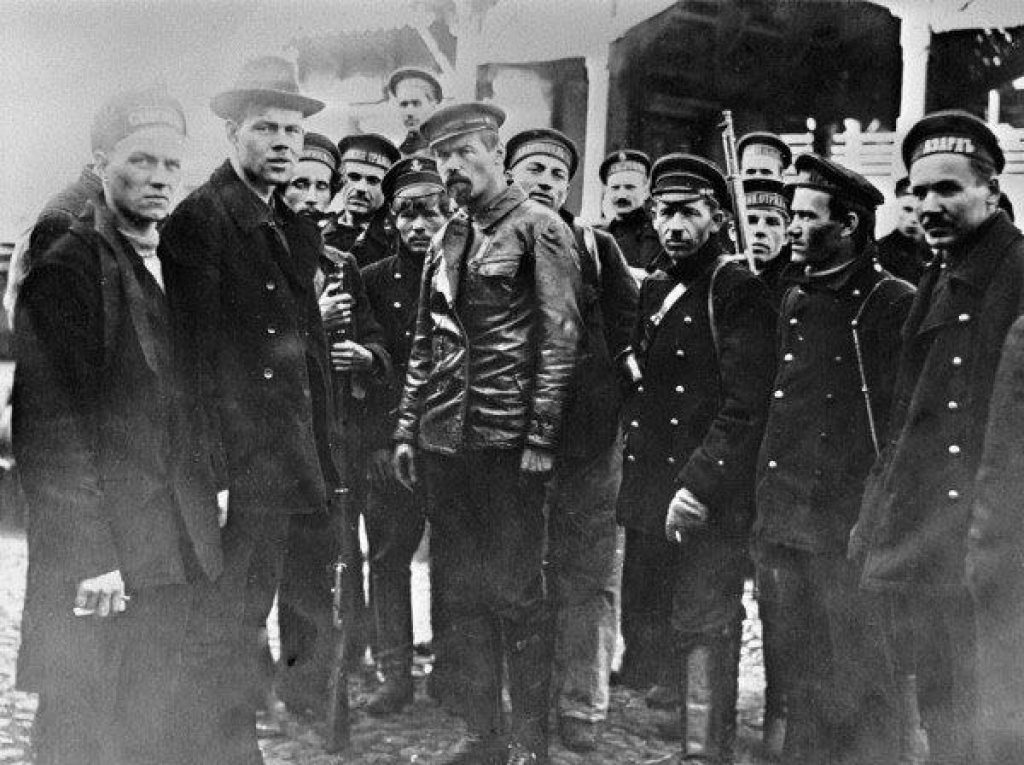
Revolutionary sailors aboard the cruiser
Under the Red Flag: The Final Years of Service
In the early 1920s, the Soviet naval command begins assessing the condition of the ships inherited from the Imperial Russian Navy.
Both cruisers are considered valuable enough to retain in service. Despite their relatively modest dimensions, they possess powerful artillery and turbine machinery that remains modern by the standards of the period.
However, the condition of their boilers and auxiliary equipment leaves much to be desired.
In our alternative history, Muravyov-Amursky is renamed Amur in 1923, while Admiral Nevelskoy becomes Dalnevostochnik.
The first ship undergoes a major overhaul in 1924–1925, while the second returns to service somewhat later.
The six-inch turrets remain in place. Soviet specialists consider replacing the old guns with more modern 130 mm mounts but ultimately abandon the proposal because of the high cost of reconstruction.
By the late 1920s, the cruisers are used primarily as training ships of the Baltic Fleet.
Gradually, their age begins to show. Worn-out machinery, outdated equipment, and limited anti-aircraft capabilities make their continued operation increasingly difficult to justify.
In our version of history, Amur is struck from the naval register in 1935, followed by Dalnevostochnik in 1937.
Thus, the former Imperial cruisers end their careers under the Soviet flag, having survived a world war, two revolutions, and the Russian Civil War.
How Realistic Was This Alternative History?
The idea of reusing Slava’s artillery turrets is certainly attractive, but implementing it would have required solving a number of difficult technical problems.
First and foremost, the new cruisers would have been noticeably heavier than the ships originally planned. The additional weight associated with the turret arrangement, reinforced foundations, and ammunition magazines would have placed a substantial burden on the hulls.
The boiler rooms, funnels, and superstructures would also have required redesign to provide suitable firing arcs for all three turrets.
Furthermore, the old 152 mm installations could not have used substantially heavier ammunition without modification. Consequently, modernizing the artillery would have become a separate and rather expensive program.
Yet the greatest problem was not actually the turrets.
In reality, Russia ordered the new cruisers from Germany precisely because its domestic shipyards were occupied with the construction of battleships, destroyers, and other vessels. Transferring the order to Russia would have required either an earlier expansion of shipbuilding capacity or a change in the priorities of the naval construction program.
For this reason, Stvolyar’s alternative scenario is most convincing if the decision to build the two cruisers at Russian shipyards is made as early as 1910–1911.
Nevertheless, the outcome could have been extremely interesting. The Imperial Russian Navy would have acquired two unusual small cruisers combining the German approach to designing fast warships with powerful Russian turret-mounted artillery.
By themselves, these ships would not have changed the outcome of World War I or the revolutionary events. However, their appearance could have substantially expanded the capabilities of the Baltic Fleet during reconnaissance missions, minelaying operations, and destroyer escort duties.
Most importantly, two ships that, in our actual history, fought against Russia under German flags would instead have remained part of Russian naval history.
Source of inspiration: Stvolyar — LiveJournal