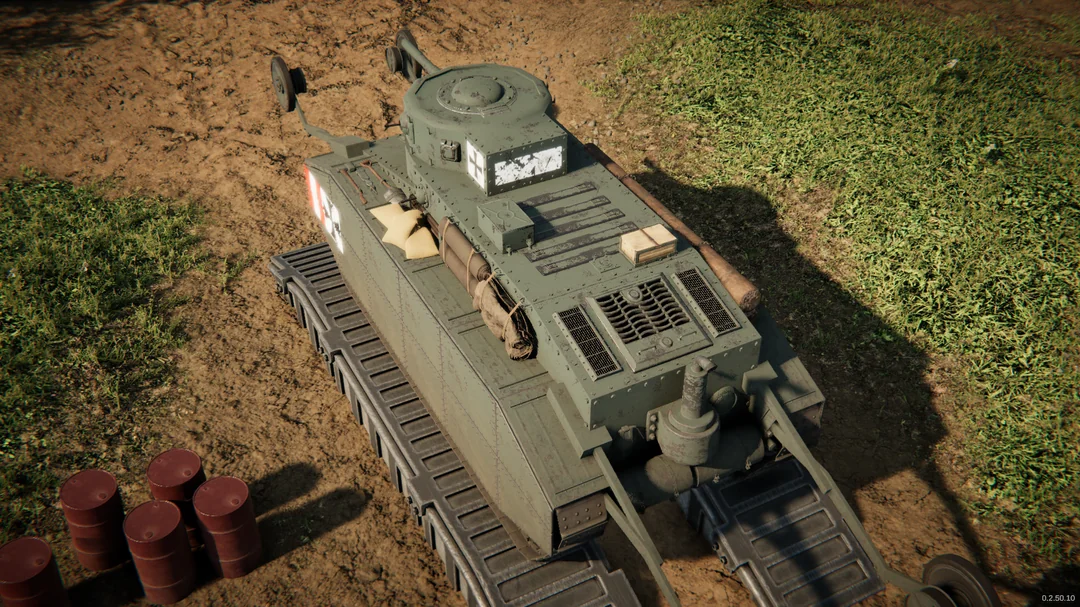
The “Carpathian Monster” of the dual monarchy. What if Austria-Hungary had put the “Amber” tank into production?

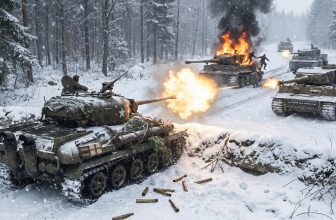
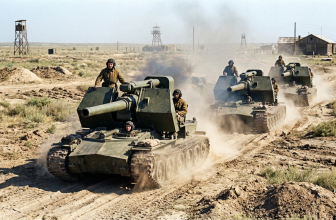
The morning of May 2, 1915, in Galicia did not begin with the usual roar of artillery, but with a low, guttural rumble that made the damp earth vibrate. Through the morning mist and the shards of shattered parapets, steel behemoths crept toward the Russian positions. They did not get bogged down in the mud—they crushed it, grinding through barbed wire, breaking through earthen barriers, and silencing the “Maxims” that, just a minute ago, had been mowing down the Austrian infantry wave after wave. The Russian soldiers, accustomed to the grind of trench warfare and artillery duels, encountered for the first time something for which there was no name in the military manuals—something that neither the Mosin rifle nor the standard 76-mm field gun, firing armor-piercing shells at point-blank range—shells of which there were simply not enough in the arsenals.
“The Carpathian Monster” — as it was immediately dubbed in the trenches — crawled across the trenches like a giant beetle, and behind it, in a tactical “armored corridor,” the Austro-Hungarian infantry advanced to the attack. The psychological impact was devastating: units that had held the front line just the day before began to falter. The lack of effective anti-tank weapons turned the Gorlice breakthrough from an operational objective into a catastrophic retreat. The Austro-German wedges, supported by tracked armor, advanced faster and deeper than the logistics of the time allowed. The war had entered a new era—and it did so at the crossroads of the Carpathian Mountains.
The Birth of “The Amber Beast”
The idea of an armored tracked vehicle did not originate on the battlefield. Its initial blueprints appeared during peacetime, but it was the Austro-Hungarian War Ministry, having assessed the project’s conceptual potential, that made a gamble capable of breaking the deadlock. Realizing that the stalemate would inevitably spread to the Eastern Front, the General Staff authorized the creation of a specialized Sonderkonstruktionsbüro für Panzerfahrzeuge. It brought together the empire’s finest minds: engineers from Austro-Daimler, designers from Škoda, and military theorists who had meticulously studied reports on the use of early armored vehicles in the Balkans.
The final design differed radically from the initial, lightweight concept. The vehicle evolved into a full-fledged medium tank, capable not only of conducting reconnaissance but also of systematically breaching fortified lines. Work was completed in late 1913, and by August 1914, when war was declared, there were just under 40 vehicles in the experimental tank companies. They were named “Burshtyn” (from the German “Bernstein”—“amber”), a name referring both to the color of the first camouflage coatings and to the surname of Günter Burštyna, whose early work formed the basis of the project.
On the Empire’s Assembly Line
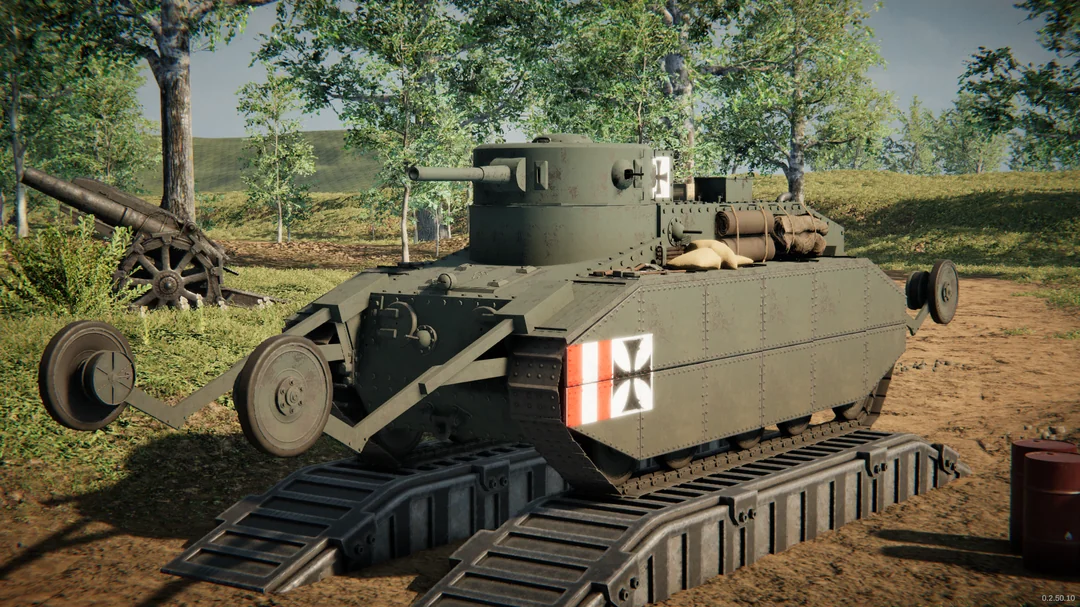
From the very first days of the war, the “Burshtyn” was designated a national security priority. Mass production was launched at two industrial giants: in Wiener Neustadt (Austro-Daimler), where the vehicle was originally designed, and in Plzeň (Škoda Works). Austro-Daimler urgently erected additional assembly shops, partially repurposing its aircraft and artillery production lines for armored hulls and running gear. Škoda supplied the gun systems and transmission components. Despite growing problems with the supply of alloy steel and high-octane gasoline, the assembly line operated at full capacity. By November 1918, 358 “Burshtyn” tanks of various modifications had rolled off the assembly line.
Technical Profile
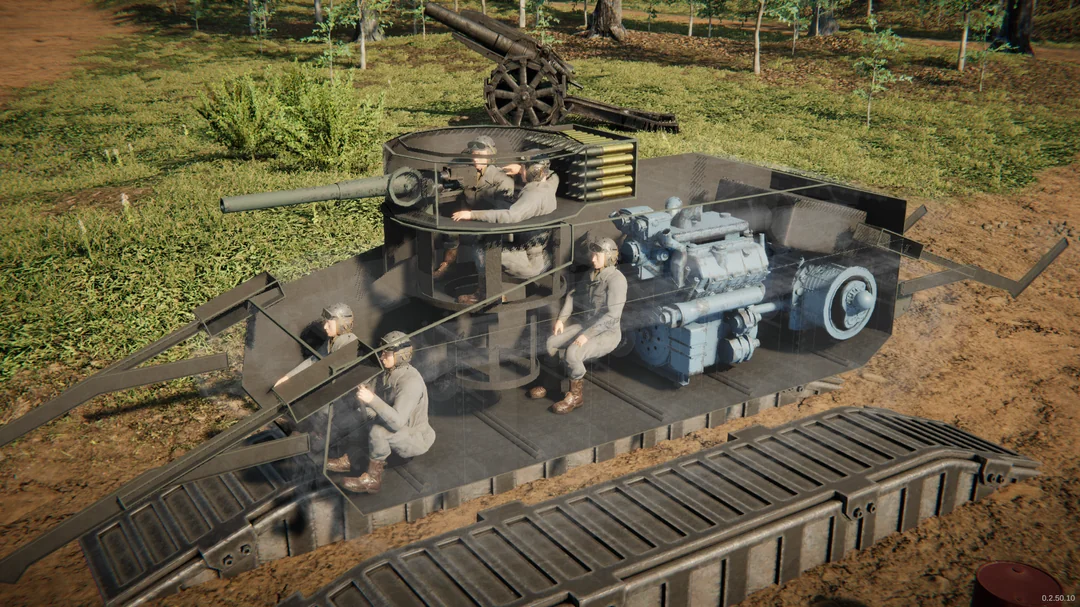
The vehicle was a well-balanced medium tank for its time, with specifications carefully tailored to the conditions of the Eastern European theater:
- The vehicle’s combat weight is 14.5 metric tons.
- A tank crew consists of five people, including the commander, gunner, loader, driver, and machine gunner.
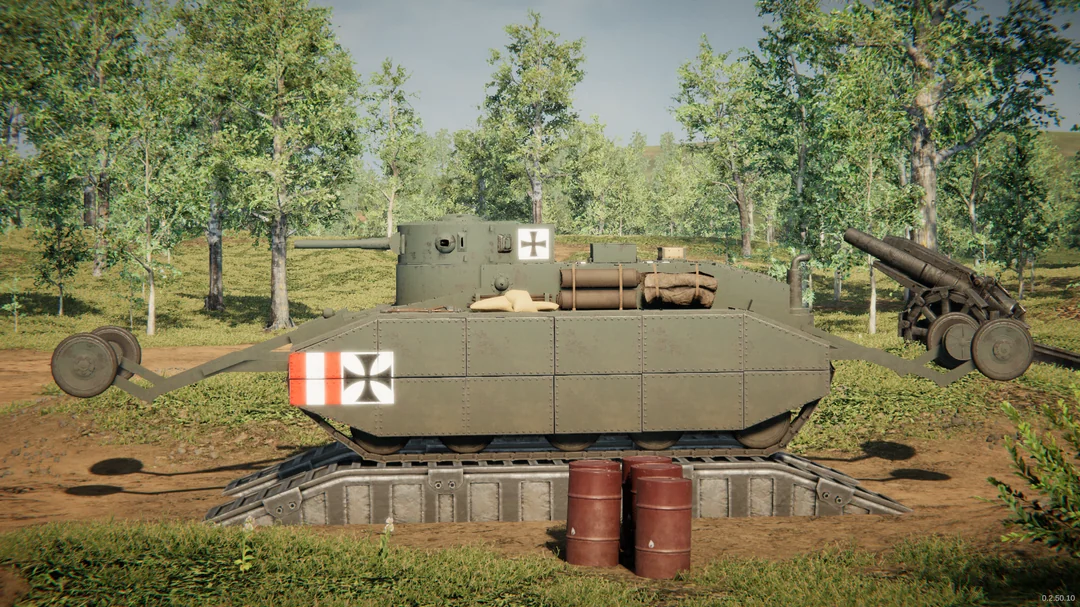
- The length of the body, excluding the extension arms, is 6.2 meters.
- The length of the vehicle with the landing gear lowered is 8.1 meters.
- The hull is 2.4 meters wide.
- The height of the tank, measured to the top of the commander’s cupola, is 2.7 meters.
- The front armor of the hull and turret is 16 millimeters thick.
- The thickness of the side and stern armor is 12 millimeters.
- The armor plating on the roof and underbody is 6 millimeters thick.
- The main armament consists of a single 37-millimeter rapid-fire Gockis or Skoda cannon in the turret.
- Secondary armament consists of two 8-millimeter Schwarzlose machine guns, one of which is mounted alongside the main gun, while the other is located in the rear hull plate.
- The gun’s ammunition load consists of 120 artillery rounds.
- The machine gun ammunition load consists of 4,000 rounds in belts.
- The power plant consists of a single 6-cylinder, liquid-cooled Austro-Daimler gasoline engine.
- The engine’s maximum power output is 100 horsepower.
- The maximum speed on the highway is 14 kilometers per hour.
- The maximum speed on rough terrain is 6 kilometers per hour.
- The fuel range when driving on roads is 80 kilometers.
- The fuel tanks have a total capacity of 180 liters.
- The width of the trench that can be crossed using the extension wheels is 3.2 meters.
- The height of the vertical wall to be scaled is 0.8 meters.
Tactics, Strategy, and Inevitable Outcomes
The “Amber” tanks truly changed the tactical landscape of the Eastern and Italian Fronts from 1914 to 1916. Near Gorlice, on the Soča River, and in the Carpathians, they served as mobile strongpoints, suppressing machine-gun nests and providing the infantry with an “armored corridor” for rapid advancement. Casualties among Austro-Hungarian and German infantry in head-on attacks fell by 30–40%, while the rate of operational breakthroughs increased significantly.
However, tanks could not solve the empire’s strategic problems. The Entente’s economic blockade was stifling industry, interethnic tensions undermined the combat effectiveness of rear garrisons and logistics hubs, and a general shortage of resources—especially fuel, copper, and high-quality steel—prevented production from scaling up to the necessary levels. By the fall of 1918, when hundreds of new-generation tanks were already rumbling across the Western Front and Austria-Hungary was on the brink of internal collapse, the “Amber” tanks remained a localized tactical phenomenon amid a global strategic catastrophe. The empire collapsed, but its steel heir outlived its creator.
Legacy: From the Carpathians to a Global Doctrine
In an alternative branch of history, the “Burshtyn” tank made its way into textbooks not as a curious sketch or a forgotten prototype, but as the forerunner of global tank design. It was precisely its design—featuring a fully rotating turret, balanced armor, and an independent track system—that became the benchmark for interwar designers. The French Renault FT, which in reality earned the title of the first “classic” tank, ceded the top spot in this chronology to the Austro-Hungarian vehicle, whose captured examples and technical documentation were carefully studied in Paris, London, and Berlin as early as 1916–1917.
The doctrine of armored forces, honed during the Galician breakthroughs, formed the basis of the theories of Guderian, Fuller, and de Gaulle. The “Carpathian Monster” did not save the dual monarchy from historical oblivion, but it forever changed the face of war. In a world where 1915 marked the first mass deployment of medium tanks, the stalemate proved shorter, and the development of armored vehicles accelerated by a decade. History knows no “what ifs,” but the archives of this alternative reality still hold the yellowed blueprints of the “Amber”— — a reminder of how a single engineering breakthrough can be ahead of its time, even if its creators did not live to see the fruits of their labor.