The section of the third book dealing with the technical capabilities of the Russian fleet is titled “At the Forefront of the Revolution.” The time period covered is immediately following the receipt of the Ito Ultimatum and the conclusion of the Anglo-Japanese Alliance Treaty.
4
The situation with the fleet was more complicated. After all, the issues there concerned not only plans for waging war, but also technical capabilities and organizational structure. However, Nicholas did manage to establish another fleet in Russia—the Pacific Fleet. In this version of history, it had three bases: Vladivostok, Talianwan—where it was based in Talianwan Bay— Port Arthur and the Elliot Islands, as well as Pearl Harbor in the Hawaiian Islands. It had coal-loading stations in the bays of Primorye and Sakhalin, in Petropavlovsk-Kamchatsky, and on the Paracel Islands in the South China Sea. At the same time, all fleets were divided into divisions based on their ship composition: battleship, cruiser, and mine divisions. Moreover, there could be several divisions of each type within a single fleet. The divisions themselves had a brigade-level structure, and the brigades had a division-level structure. This made it possible to clearly define the chain of command for admirals and officers. In addition, the fleet included a special division, a specialized division, and a special brigade. The divisions comprised the fleets of Finland and the Kingdom of Hawaii, respectively, while the brigade comprised the fleet of Montenegro.
The tsar also focused on the fleet’s ship composition. As early as the beginning of 1897, shipbuilding programs—which had been geared toward a confrontation with Great Britain—were revised. Both the twenty-year program of 1882 and the shipbuilding program for the emergency reinforcement of the fleet, adopted two years prior to the last revision, At that time, Japan was recognized as the most likely adversary. Consequently, new changes were introduced into shipbuilding, with a focus on countering the Japanese fleet in the Pacific Ocean. There were, so to speak, two phases. In the first stage, the tsar ordered the cancellation of the construction of the “Peresvet”-class armored cruiser, the “Rossiya”-class armored raider, and the third “Pallada”-class armored deck cruiser-raider. Instead, it was proposed to build four second-class battleships based on the French “Henri IV” design. However, these were to feature an elongated hull capable of entering the dry dock at Port Arthur and three turrets with main-caliber guns, arranged in a linear-elevated configuration at the stern. And these guns were to be 10-inch caliber. The ship’s maximum speed was set at twenty-one knots. The design was based on the assumption that it would be able to outrun any enemy that might threaten it, while also being capable of catching up to and destroying a weaker opponent. Mine-countermeasure armament, range, and, to some extent, armor were sacrificed. The anti-mine armament was limited to six 4-inch Kane guns, which had been adopted by the fleet. The range was limited to the ability to make the voyage from Port Arthur to Vladivostok on a standard fuel supply. This was due to the fact that the ship was designed to use a mixed fuel system for its boilers—coal and fuel oil. As for maximum armor, it was limited to nine inches. This was based on the assumption that shells fired by Japanese battleships would not penetrate this armor at a range of sixty cable lengths. However, a requirement for the maximum possible side armor was subsequently introduced.
Well, a little later—but still half a year earlier than in the version of the story familiar to Nikolai—a new meeting was convened. At that meeting, it was decided to drastically strengthen the fleet by building—taking into account the ships proposed for construction under the 1995 program— ten squadron battleships, four second-class battleships, four coastal defense battleships, thirteen long-range reconnaissance cruisers, five squadron reconnaissance ships, three mine transport ships, five gunboats, five mine cruisers, twenty counter-mine vessels, and ten destroyers. It was planned to build four additional transport ships in addition to this number of warships. However, the tsar ordered that plans be made to purchase an additional ten high-speed cargo-passenger steamers. Furthermore, the bases in Talianwan and Hawaii were to be equipped with floating docks capable of accommodating squadron battleships. Vladivostok and Talianwan were to be provided with port icebreakers and rescue vessels.
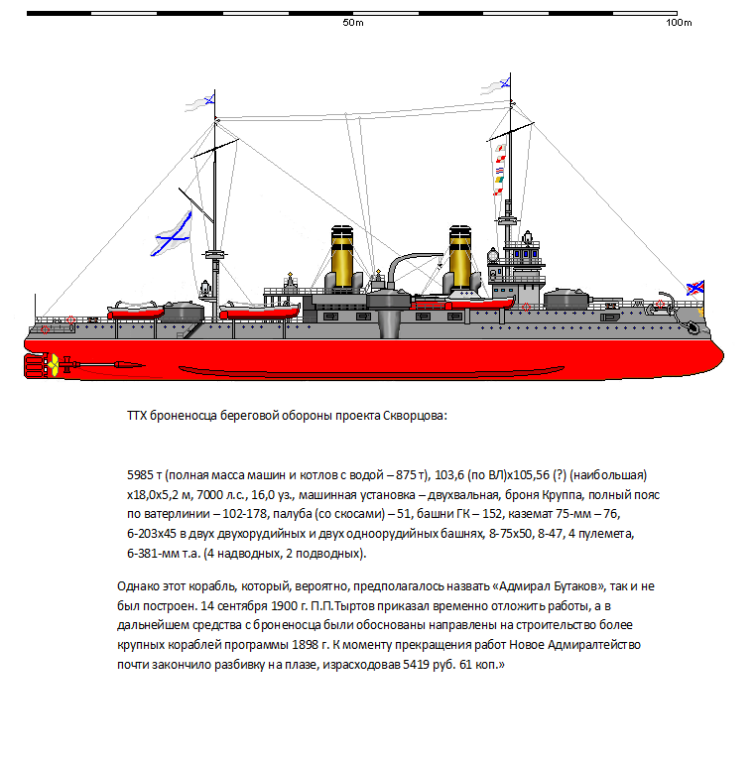
Of this number of ships, by the beginning of 1897, the armored cruisers *Peresvet* and *Oslyabya* and the raider cruisers *Pallada* and *Diana* had been laid down. Changes were made to their designs by order of the tsar; on these first ships, the anti-mine caliber was abandoned, and fourteen 6-inch guns were initially installed on these cruisers. This armament was made standard for long-range reconnaissance ships. A redistribution of weight was also carried out, which immediately allowed the ships to reach their design speed during trials. However, two minelayers had already been ordered[13]—the *Amur* and the *Yenisei*—for which the tsar ordered an artillery armament consisting of five 120-millimeter guns, as well as four second-class battleships, named the *Gromoboy*, “Aurora,” “Venus,” and “Freya.” The lead ship was to be ordered from France, while the rest were to be built in Russia. The squadron battleships were to be built based on the design of the battleship “Prince Potemkin-Tauride.” A design competition was organized. The competition program also called for the construction of new cruisers, including mine cruisers. These were given specifications similar to those of the “Egipteos” scout ship, at 1,200 metric tons. These were immediately named “Alexandra,” “Olga,” “Tatiana,” “Maria,” and “Anastasia.” As for the gunboats, it was decided to build them as colonial vessels, armed with a pair of 120-millimeter guns and four 75-millimeter guns. It was also decided, outside of the competition, to build coastal defense battleships based on Sokolov’s design. This design implemented the ideas of the acting Admiral General, Grand Duke Alexander Mikhailovich. But here, too, the tsar intervened with his own proposals. As a result, the ship’s displacement increased. The design speed of the battleships was raised to eighteen knots. Their main armament was to consist of eight 8-inch guns in four turrets. The side turrets were positioned so that they could fire across the ship’s width. It was decided to lay down two battleships based on this design immediately: the *Admiral Butakov* and the *Vice Admiral Popov*. The other two ships, at the tsar’s suggestion, were to be laid down later based on a revised design—and would be the first major turbine-powered capital ships.
It was decided to build four coastal defense battleships for the Finnish Navy, based on the *Khrabrij* but larger in size, with increased speed and a different gun layout. These were to be equipped with two 8-inch guns at the bow and stern and four 4-inch guns along the sides. In addition, plans called for building four mine cruisers of 1,200 metric tons, a dozen torpedo boats, and a couple of mine transport ships for this fleet. The Hawaiian fleet, meanwhile, was to be created using salvaged Chinese ships. As for the Montenegrin fleet, it was to consist of a pair of former Portuguese coastal defense battleships, completed in Germany after their launch; two cruisers built in the United Kingdom as part of a Brazilian order but put up for sale due to the customer’s lack of funds and subsequently acquired from the United States[14], and a couple of gunboats. This included one gunboat completed in Italy that had originally been ordered by Turkey.
Another area of naval development that the tsar began to focus on was the modernization of previously built ships. First, orders were issued to rearm all ships, using only rapid-firing and long-range guns. This category included four so-called turret frigates, the monitors *Smerch* and *Charodeyka*, the clippers and gunboats *Mina* and *Yorsh*, as well as the *Dozhd* class, “Bobr” and “Koreets,” as well as the mine cruisers “Lieutenant Ilyin” and “Captain Saken.” And while the former frigates, having received six-inch guns and anti-mine guns in their turrets, remained in their original ship class, all other ships—including the minelayers, which were equipped with a pair of 120-millimeter guns—were reclassified, with the exception of the gunboats (which had always belonged to that class), were reclassified into this very class of ships. At the same time, the *Smerch* and *Charodeyka* were stripped of their turrets. In their place, round armored superstructures were constructed, upon which 8-inch guns were mounted. And on the bridges, standard 75-millimeter Kane anti-mine guns[15]—common in the Russian Navy—were mounted. As for the old coastal defense gunboats, their large-caliber guns were replaced with a rapid-firing medium-caliber gun, which transformed them into a quite effective means of coastal defense[16].
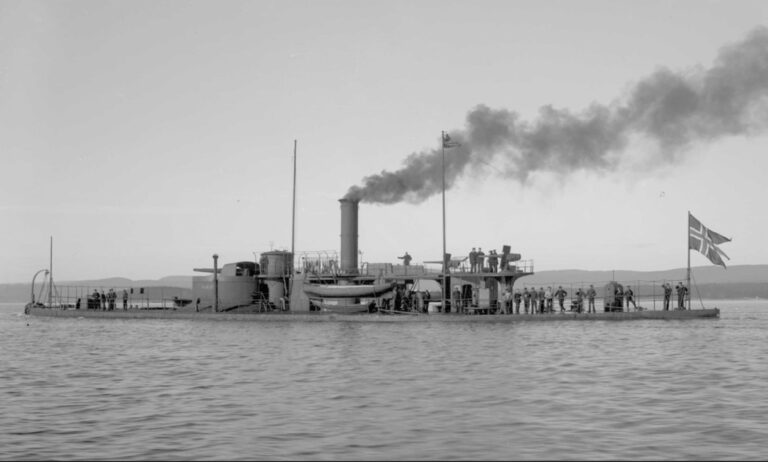
The Norwegian monitor “Mjölner”
Second, orders were given to identify those that were to undergo a major modernization. In addition to the former Turkish ships, this category included all four battleships of the series modeled after the battleship *Ekaterina II*, as well as the battleships *Twelve Apostles*, *Emperor Alexander II*, “Emperor Nicholas I,” “Gangut,” and “Peter the Great.” And the cruisers “Admiral Nakhimov,” “Dmitry Donskoy,” “Vladimir Monomakh,” “Memory of Azov,” “Admiral Kornilov,” and “Rynda.” The older armored cruisers and the cruiser “Memory of Mercury” were to be converted into mine transport ships. And third, to remove from the fleet those ships whose combat value was extremely low. These were the three armored floating batteries “Pervenets,” “Kremlin,” and “Don’t Touch Me,” two “Popov-class” ships, a dozen “Bronenosets”-class monitors, and all the torpedo boats, which were to be converted into auxiliary vessels. Furthermore, the ships “Peter the Great,” “Dmitry Donskoy,” “Vladimir Monomakh,” and “Rynda” were to be used within the fleets as training artillery ships.
All captured ships were also re-armed with Russian-style rapid-fire guns. This included both Turkish ships—including those that had been completed—and British ships. The exception was the ironclad “Barfler,” which retained its British armament and primarily performed diplomatic functions, representing the Russian fleet. It even visited Australia in this capacity, although this ironclad was usually stationed in the Indian Ocean at a base in Siam, just before the entrance to the Kra Canal, which was under construction. It was decided to modernize the other two British captured ships quite extensively. Only the former Turkish ships *Ivan the Terrible*, *Yunona*, and *Avos* were radically modernized. The rest of the former Turkish ships were, in essence, merely rearmed. As for the prizes from China, however, the situation was more complicated. The salvaged ships were not only repaired and rearmed but also significantly modernized. These included five armored cruisers, two minelayers, and four destroyers—captured by the Russian Navy during the war with China in 1900—were merely repaired and rearmed with Russian guns.
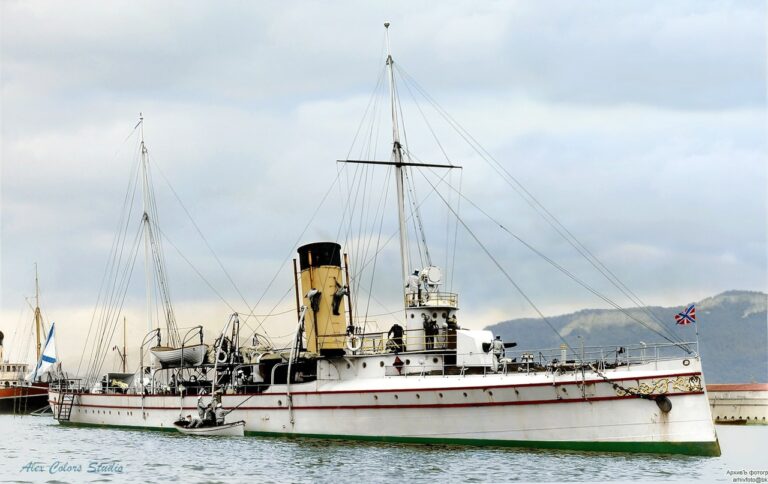
The minelayer “Abrek,” Toulon, 1898.
Another avenue for strengthening the Russian fleet was to be the development of the merchant fleet. The operations of companies such as ROPIT and Dobroflot were expanded to all the seas surrounding the empire. These companies began hastily introducing harbor vessels, which were intended to be converted into coastal defense ships and minesweepers once the war began. The necessary armaments and equipment were stockpiled in ports for their conversion. Among other things, ships were ordered under the guise of yachts for port commanders; these were intended to be converted into mine cruisers, similar in characteristics to the so-called “volunteers,” and internal-combustion-engine destroyers known as “gasoline boats.” However, conventional yachts were also purchased. In particular, the American high-speed yacht “Oriental” was purchased for the needs of the Far East. It was built on the hull of a minesweeper.
The expansion of the fleet through the creation of auxiliary cruisers from high-speed steamers also followed this same line of thinking. At that time, it was believed that such a ship had to be fast enough to catch up with steamers and evade pursuit. It also had to have a huge fuel supply to remain at sea for long periods without refueling. Six such steamship cruisers were built for Dobroflot: the *Moscow*, *St. Petersburg*, *Smolensk*, *Saratov*, “Oryol,” and “Kherson.” However, this concept fell significantly short of the idea that such a ship should not be fast and that its appearance should not attract attention. Furthermore, these steamships were built as cargo-passenger vessels. This made them, at the turn of the century, unprofitable to operate—and this was true worldwide. Consequently, such cargo-passenger vessels were taken out of service globally, with their roles being taken over by specialized vessels. Nicholas ordered the navy to purchase such steamships—not only in Russia—to repair them, keeping in mind the problem with the boilers on such vessels, and to use them as army transports to deliver troops and cargo to the Pacific Ocean before the war began. But the plan was to prepare armaments for them in Hawaii, where these steamships were supposed to sail once the war began—to convert them into auxiliary cruisers.
In part thanks to funding from the Main Directorate for Merchant Shipping and Ports in Russia, the operation of these turbines on the fleet began. Nikolai purchased a replica of the “Turbinia” at his own expense. Afterward, the administration acquired several harbor vessels equipped with this propulsion system for trial operation. This was done to gain experience and train personnel. The plan was then to build combat ships, starting with destroyers and progressing to larger vessels, such as cruisers and battleships. As for transporting small ships to the Pacific Ocean, the Main Directorate of Merchant Shipping and Ports ordered two dock ships capable of lifting even a cruiser if docked together. And following the voyages of the icebreaker *Ermak* in the Arctic Ocean—which, based on those results, was transferred to the Baltic Sea—the same agency ordered four even larger and more modernized icebreakers. These vessels surpassed the first standard-class icebreaker in terms of their specifications, and their commissioning was scheduled for the year 1903. As the tsar had calculated, these icebreakers were intended to ensure the safe passage of ships across that ocean.
Well, as for the design competitions—in which the tsar tried not to interfere—the only thing that happened right away was that, based on the long-range reconnaissance ship design, they abandoned the anti-mine guns, leaving only a couple of saluting cannons per ship, and rejected the advanced ram bow, resulted in the German designs “Askold” and “Novik” winning the cruiser competition. These were subsequently ordered for construction. Meanwhile, based on the “Potemkin” design, the French developed the battleship “Tsarevich.” It featured their signature sloped sides but had medium-caliber guns in casemates. And it was commissioned by them. But aside from that, some interesting proposals emerged outside the competitions. The first to step forward was the American Kramm. He proposed building, based on his own design—outside the competition but drawing on the “Potemkin” design—a pair of battleships, an armored cruiser, and a series of destroyers at the shipyard he had built. The shipyard was to be located on the Russian Pacific coast. Plus, the terms were very favorable, and the project would be completed very quickly. And the tsar agreed to the construction of the battleships and the shipyard in Dalny. The battleships were named “Retvizan” and “Pobeda.” Then, outside of the competition, various firms began submitting designs for cruisers: a German firm with the “Bogatyr” design, a French firm with the “Bayana” design, and even a Danish firm with the “Boyarina” design. The latter, while slightly inferior to the “Novik” in speed, significantly surpassed it in seaworthiness. And in general, in terms of operational performance and crew living conditions. And the Tsar’s mother strongly insisted on the construction of this cruiser. In short, since the Tsar had no intention of issuing a decree requiring ships to be built exclusively at domestic shipyards, all these ships were commissioned. However, the Bayan’s armament was specified as seven 8-inch guns: two in turrets, four in casemates, and one on the deck. This allowed for a broadside of five such guns.
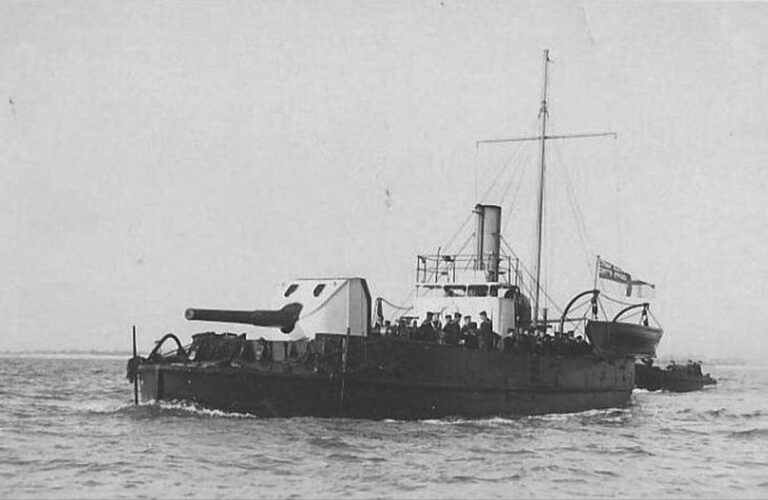
The iron gunboat HMS “Kite” after the installation of a 152-mm gun.
But then the difficulties began. The “Askold” design did win out, and in addition to it, three more such cruisers—the “Varyag,” “Vityaz,” and “Voin”—were laid down at Russian shipyards. As a result, the training ship “Voin” was renamed the training ship “Gardemarine.” And based on the “Novik” cruiser design, Russia had already ordered four cruisers—the “Almaz,” “Zhemchug,” “Izumrud,” and “Yakhont.” However, other designs submitted outside the competition were also deemed promising. Based on the “Bogatyr” class, the cruiser “Oleg” was laid down. Based on the “Boyarin” class, three cruisers were ordered at once: two built in the Black Sea region—“Ochakov” and “Kagul”—and one built by Kramp—“Pamyat Merkuriya.” Three cruisers of the “Bayana” class were also ordered.
The situation with the battleships was no less chaotic. Although the French “Tsarevich” design won the competition, it was decided to continue building battleships of the “Retvizan” class at domestic shipyards. Russian shipyards were capable of replicating this design without any significant reduction in performance. This stood in contrast to the sharp decline in a ship’s performance—particularly in terms of protection—that would have resulted from attempting to adapt the “Tsarevich” design to the capabilities of Russian industry. In short, the battleships “Borodino” and “Emperor Alexander III” were laid down based on the “Retvizan” design. But then the design was revised, and a dozen 6-inch intermediate-caliber guns were replaced with the corresponding number of 8-inch guns, resulting in a corresponding increase in displacement. The rest of the design’s specifications, however, remained unchanged. Based on this revised design, construction began on the battleships “Prince Suvorov,” “Orel,” and “Slava.” Together with the coastal defense battleships under construction according to the Sokolov design, they were intended to form the backbone of the Russian fleet.
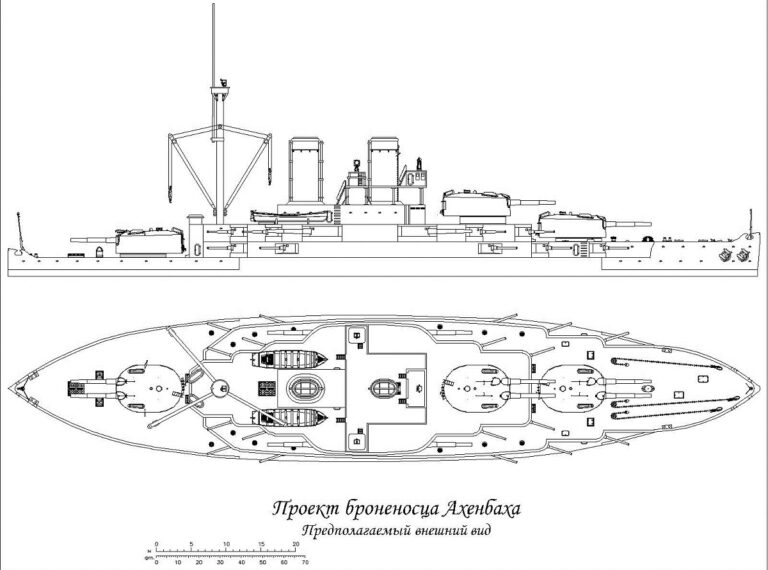
Well, the fifth coastal defense battleship was laid down based on a truly unusual design. It was designed by engineer Achenbach. According to the original design, it was to be equipped with ten 12-inch guns in three turrets and four casemates, as well as nearly twenty anti-mine guns. But under pressure from the tsar, the design was revised. It ended up with eight main-caliber guns in four turrets arranged in a linear, elevated configuration, a turbine propulsion system, and a speed of about eighteen knots. With a range and seaworthiness sufficient for operations in the Baltic Sea. Officially, however, different figures were announced at the keel-laying ceremony. Two main-caliber turrets in a linear-elevated arrangement in the bow, and a hangar for torpedo boats in the stern. But that was a proposal for a different fleet—one that Nikolai had no intention of immediately trumpeting to the whole world. And for starters, it was necessary to win the war.
However, plans for the construction of counter-mine destroyers and minehunters did not pan out. Far more of them were ordered. Thus, construction began on the Black Sea on six “Sokol”-class counter-minelayers, while twelve more of this type were laid down for the Baltic and Pacific Fleets. And the tsar did not object to this, fully understanding that, by definition, there could not be many ships of this class. Besides, they saved time. Even if it came at a cost. In addition, the “Kazarsky”-class mine cruisers were rearmed with two 75-millimeter guns, which had become the standard armament for counter-minelayers. This came with a demotion in status to counter-minelayers. But it very quickly became clear that this class of ships was rapidly becoming obsolete. To study foreign experience, counter-minelayers were ordered from abroad. Six each from France and Germany, and one from Great Britain. However, the prototype for the Nevsky Shipyard’s design turned out to be an entirely different type of British minesweeper. And it was precisely on the basis of the Nevsky Shipyard’s design that a series of minesweepers was laid down. The so-called “Nevoks.” Eleven for the Pacific Ocean and six each for the Baltic and Black Seas, along with their surrounding areas. One of the “Nevoks,” the minesweeper “Vidny,” was to be equipped with a turbine propulsion system. Although it was not intended to be the first turbine-powered ship in the Russian Navy.
Destroyer were being built for the fleet. A dozen such ships were laid down for the Pacific Ocean. Two were based on the “Improved Ussuri” design, but with a 75-millimeter gun on the forecastle, and ten were based on the design of the French destroyer “Cyclone.” But almost immediately, two “Improved Ussuri” destroyers were ordered, this time with a turbine as the ship’s powerplant. And for Kramp, for his shipyard in Dalny, a dozen ships were ordered, modeled after the German destroyers captured from the Chinese navy. And a dozen “harbor yachts” of the “gasoline-powered” type. Also with internal combustion engines. The plan was that once built, they would enter service as a means of defending the roadstead.
And it was with precisely this fleet—which, according to estimates, was to be completed by the end of 1903—that Nicholas intended to enter the war. At the same time, there were generally sufficient funds. It seems that because Sandro became Admiral General, up to a third of the navy’s budget was no longer being spent on Grand Duke Alexei Alexandrovich’s French mistresses. No, Alexander Mikhailovich also dipped into the navy’s budget. But at that time, he still loved his wife. So much so that, practically every year, he presented the tsar with a new nephew. Later, discord would set in within his family, and they would both go off the rails—so much so that they would end up living apart in exile. But for the time being, Sister Ksenia, she cost her father far less than the French ballerinas. And the proceeds from the looting of the Padmanabhaswamy Temple in Kovalam, in southern India, went to the navy. And it was with precisely this technical background that Nikolai set out to consult with his naval leadership on how they planned to wage war against Japan.
[13] That was the term used at the time to refer to mine layers.
[14] The U.S. Navy cruisers *New Orleans* and *Albany*. Acquired by the U.S. Navy prior to the Spanish-American War. However, the *Albany* entered service with the U.S. Navy after the war had ended.
[15] Monitors built for the navies of the Scandinavian countries were modernized using a similar approach at the turn of the century.
[16] Similarly, coastal defense gunboats in a number of European navies were re-equipped, including those in Great Britain.
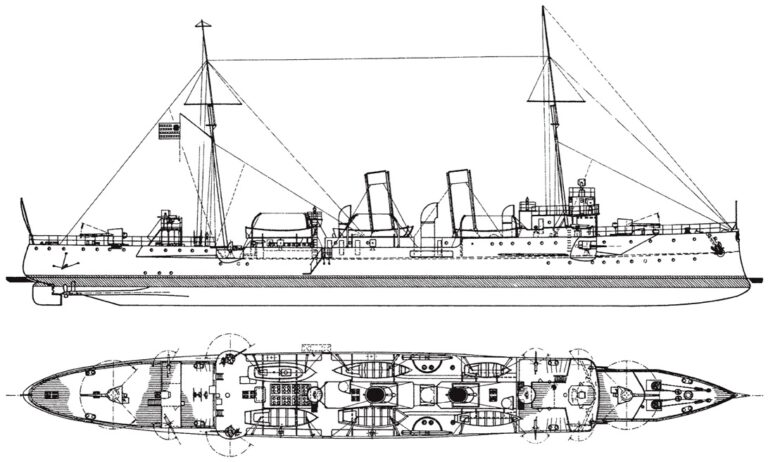
A 1,200-metric-ton minelayer. In this case, it is the *Uruguay*.