The History of Rus' After Its Adoption of Western Christianity. Part 52. The Persian Campaign and the Death of Peter I Fyodorovich

In 1722, Mirza Tahmasp, the son of Sultan Hussein who had fled the besieged capital of Persia, sent several trusted men to the court of Peter I Fedorovich to request assistance. When the prince found support within the country, he recalled his envoys, but it was already too late. Plans for the Persian campaign had long been in the works in Vladimir-on-Klyazma, and Emperor Peter I Fyodorovich had no intention of abandoning them.
In June 1722, Peter I Fyodorovich arrived in Astrakhan. He sent 9,000 infantrymen under the overall command of General-Feldwebel Gavriil Semenovich Kropotov overland, while he himself led a large force of 22,000 men across the sea. The Georgian kings Vakhtang VI, Iesse, and David XI also joined Gavriil Kropotov with their detachments.
However, on November 2, 1722, King David XI of Kakheti died, having named his brother Teimuraz as his heir—a decision contested by another brother, the illegitimate Konstantin. He proclaimed himself king and launched a rebellion. It fell to the Caucasian governor, Field Marshal Boyar Prince Ivan Yuryevich Trubetskoy, to deal with this situation, which is why his forces and part of the Georgian troops did not take part in the Persian campaign.
A flotilla of the Caspian Fleet, commanded by Rear Admiral Vasily Yakovlevich Levashyov, arrived at the assembly point and joined forces with the detachments of Gavriil Kropotov and the Georgian kings on July 27, 1722, and Peter I Fyodorovich was the first to go ashore.
Russian and Georgian troops advanced southward. Almost all the local rulers voluntarily pledged allegiance to the Russian emperor, with the exception of Aydemir, the ruler of the Principality of Endireyev. Peter I Fyodorovich sent Colonel Boris Alekseyevich Vetrov against him, but a sudden enemy attack resulted in heavy losses for Vetrov, and he began to retreat. Colonel Daniil Denisovich Naumov was then dispatched to Endirey with a large army; he captured and burned Endirey, forcing Aydemir to submit.
On August 12, the emperor, accompanied by a large army, made a triumphant entry into the capital of Shamkhal Tarku Adil-Gerey II, the vali of Dagestan. He welcomed Peter I Fyodorovich warmly, declared himself his subject, and set out with his troops in his wake, aiming to subjugate all of Dagestan with Russian support. Through his efforts, he persuaded Khan Cholak Surkhay I of Kyura-Kazikumukh, who had been hostile toward him from the very beginning, to form an alliance with the Russian emperor.
Forty kilometers from Tarku, Peter I Fyodorovich laid the foundation for the Fortress of the Holy Cross, a move that drew open criticism from Adil-Gerey II. And on August 16, Peter I Fyodorovich set out for Derbent at the head of his army, with the fleet carrying supplies of food and weapons following behind.
On August 30, a battle took place on the Inchhe River between Russian forces and the army of Utamish Sultan Mahmud and Kaytag Utsmi Ahmet Khan, ending in a Russian victory. Utamish was burned to the ground, and the sultan’s territories were transferred to Adil-Gerey II.
On September 3, Russian troops captured Derbent, a strategically important city because it controlled the coastal route along the Caspian Sea. A few days later, all Russian forces, including the Caspian flotilla, converged on Derbent. Leaving Gavriil Kropotov in command, Peter I Fyodorovich withdrew with the bulk of his army. After spending the winter in Astrakhan, the emperor returned in 1723 with a smaller force.
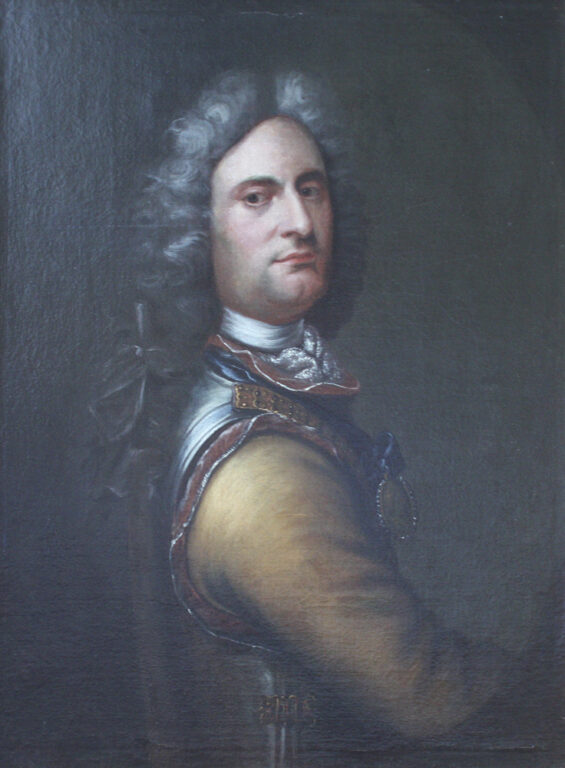 Lieutenant Field Marshal Gavriil Semyonovich Kropotov
Meanwhile, the Russian consul in the Persian province of Gilan, Semyon Semyonovich Avramov, reported that local residents were seeking protection from the Russian Empire. Peter I Fyodorovich took note of this, and in November 1722, a landing force under the command of Colonel Peter Mikhailovich Shipov landed in Gilan and captured the city of Rasht. All attempts by the Persians to recapture Rasht were repelled.
On July 6, 1723, Russian troops laid siege to Baku. Peter I Fyodorovich offered to allow the city to surrender voluntarily, but the besieged refused; however, after several unsuccessful sorties, the city surrendered without a fight on July 26.
In the spring of that same year, 1723, the Egyptian army invaded Persia. Shahanshah Tahmasp II, who was contesting the throne against the usurper Mir Mahmud Shah Hotaki, sent his envoy Ismail-bek to Peter I Fedorovich’s headquarters near Baku to seek an alliance against Egypt and Hotaki.
The peace treaty was signed on September 12, 1723, and under its terms, in exchange for assistance against the invaders, Persia recognized Russia’s sovereignty over Derbent and Baku, as well as the province of Gilan, and ceded the provinces of Mazandaran and Astrabad.
These territories were organized into the Lower Governorate-General, with its capital in Reshta, and Lieutenant Field Marshal Gavriil Semyonovich Kropotov was appointed its head. To defend this outpost, which was so important for trade, he was given 12,400 men.
Peter I Fyodorovich allocated substantial funds to the navy—specifically to the Baltic, Mediterranean, Caspian, and Okhotsk flotillas. But the Russian Empire’s resources were not infinite, and the Black Sea Flotilla found itself among those receiving little funding; with its access to the Mediterranean Sea, it would seem to have lost its significance.
After signing a peace treaty with Persia, Peter I Fyodorovich was planning to return, and it is not known whether he intended to assist the Shahanshah, but he unexpectedly fell ill. Grand Duke Eustace Fyodorovich was planning to seize the opportunity.
The Grand Duke had long been hatching plans to claim the imperial throne, and it was he who urged his hesitant brother to sign the “Act of Succession”; however, his hopes of becoming the official heir were not realized. Moreover, another Grand Duke, Ivan Yuryevich, emerged as his rival—a man far more generous with promises, yet just as cunning and arrogant as Evstafy Fyodorovich. But in 1721, Ivan Yuryevich died in an accident after falling out of a window while drunk, leaving Evstafy Fyodorovich with one less rival.
A far more formidable rival for him was the emperor’s grandson, Grand Duke Peter Vladimirovich, but he was too young to lead the anti-Menshevik faction, and Eustafy Fyodorovich assumed that role instead. At the same time, the Grand Duke, having no children of his own, promised that, should he ascend the throne, he would name his nephew as his heir.
However, in the event of his death, Peter I Fyodorovich drew up a secret will in which he named his grandson, Grand Duke Peter Vladimirovich, as his heir, with his favorite, Alexander Menshik, serving as regent. Only a select few were aware of this will, which was to be made public after the emperor’s death, and Evstafiy Fyodorovich was not among them.
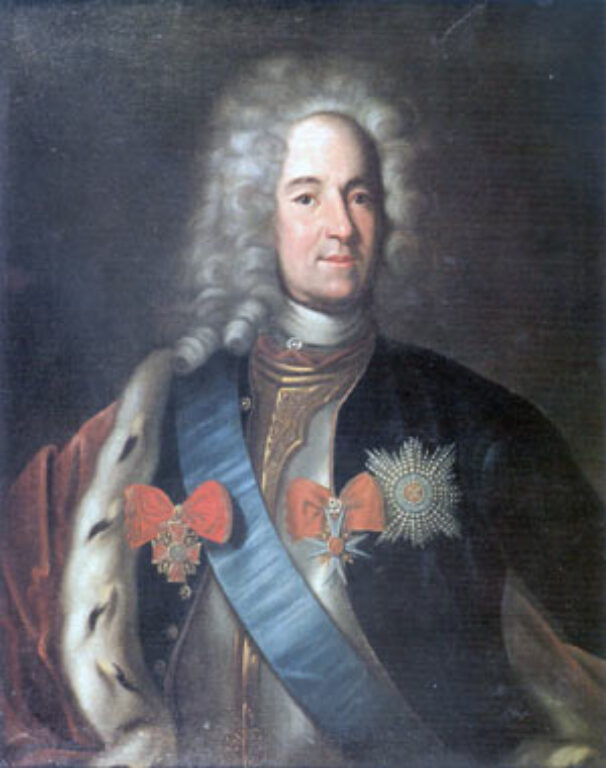 Field Marshal Alexander Danilovich Menshik, Duke of Taurida, Boyar, Prince of the Holy Roman Empire of the German Nation, with the title of His Excellency
When Peter I Fyodorovich set out in 1723 to capture Baku, he left his favorite—who, in addition to serving as Minister of War, was also Governor-General of the capital region—in the capital to govern the country in his absence. However, he decided to keep prominent generals from among the enemies of the “semi-sovereign ruler” close at hand. But now, when he unexpectedly fell ill, that decision backfired on him.
Almost the entire general staff serving under Peter I Fyodorovich joined the Grand Duke’s conspiracy. They isolated the emperor’s personal physician and all the doctors treating him, as well as the generals loyal to him. All of this was justified by the threat of an epidemic.
Evstafiy Fyodorovich entered Peter I Fyodorovich’s tent, accompanied by his loyal generals, and presented the emperor with an ultimatum: either he would name his younger brother heir to the throne and receive medical care, or he would continue to be stubborn and be denied medical treatment, which would almost certainly lead to his death.
However, Peter I Fyodorovich understood perfectly well that even if he appointed his brother as his heir, he would be unlikely to receive medical care, so he firmly refused the conspirators. Evstafiy Fyodorovich then threatened the emperor, saying that in that case, a priest would not be allowed to see him, but Peter I Fyodorovich merely drove the conspirators away.
The emperor had no intention of dying; he believed his body could fight it off on its own, but soon he began to grow weaker day by day, and the emperor gave in.
As Peter I Fyodorovich lay dying, doubts began to creep in among the conspirators: what if the emperor recovered? Some were already cursing themselves for having supported the Grand Duke, while Eustace Fyodorovich visited his brother every day; during one of these visits, Peter I Fyodorovich agreed to all the terms, provided that a priest be allowed to see him.
After performing the final rites, the priest left the emperor’s tent, and Evstafiy Fyodorovich entered it. Overcome with fear for his own fate, he decided to play it safe, still afraid that his brother might miraculously recover. On October 7, 1723, Grand Duke Eustace Fyodorovich entered the tent, glanced at the will that had been drawn up, took a velvet pillow in his hands, and suffocated his older brother. The great reign of Peter I Fyodorovich, which had lasted thirty-four years, came to an end.