The History of Rus' After Its Adoption of Western Christianity. Part 54. Emperor Peter II Vladimirovich

Grand Duke Peter Vladimirovich was born in 1712 to Grand Duke Vladimir Petrovich, heir to the throne, the eldest son of Emperor Peter I Fyodorovich, and the German Princess Charlotte Ludovika, who was the daughter of Prince Ludwig Rudolf of Blankenburg, the father-in-law of Emperor Charles VI, who in 1731 inherited the Duchy of Brunswick-Wolfenbüttel from his older brother.
The Grand Duke lost his parents at an early age: on November 2, 1712, Grand Duchess Charlotte Ludvigovna died of a cold, and in 1715, Grand Duke Vladimir Petrovich left the country and never returned. Peter I Fyodorovich took his grandson to live with him and began preparing him for the throne.
The emperor made every effort to give his grandson an excellent education; he hired the very best teachers he could find for him. Young Peter was taught economics, history, the basics of government, military science, Russian and German, Latin, theology, music, and dance; the Grand Duke showed an interest in his studies and was known for his diligence and perseverance. And among this entire cohort of educated people, Andrei Ivanovich Osterman stood out.
He was born Heinrich Johann Friedrich Ostermann in 1686 in Bochum, the son of Pastor Johann Konrad Ostermann. In 1697, he happened to catch the eye of Lieutenant Colonel Wilhelm von Schwenden, an aide to General Franz Lefort, head of the Grand Embassy of the Roman Emperor Andrew I, who was traveling incognito, and entered his service as a valet. Together with Schwenden, Heinrich Johann found himself in Tafros, which was under siege by Russian troops, and for all five years of the siege he devoted himself, as much as was possible under the conditions of the siege, to self-education, including studying the Russian language.
Heinrich Osterman had made such great progress in learning Russian that it was him whom Wilhelm von Schweiden—who by that time had taken command of the Romayevs’ defense— sent him to the headquarters of Lieutenant Field Marshal Yakov Vasilyevich Bruce to negotiate the surrender of the fortress. When the Russian flag was raised over Tafros, Yakov Bruce offered Heinrich Osterman a position in his service, to which Osterman readily agreed.
Soon, Andrei Ivanovich—as Heinrich Johann was now known—gained the trust of Emperor Peter I Fyodorovich and, in 1707, became a translator in the office of the Imperial Counselor for Foreign Affairs; In 1711, he became the advisor’s secretary, and in 1715, the emperor appointed him tutor to Grand Prince Peter Vladimirovich.
Andrei Ivanovich Osterman took his new appointment very seriously. Younger Peter took up residence in his home; Osterman cared for him, while his wife, Martha Ivanovna Streshneva (interestingly, she was the granddaughter of Boyar Iradion Matveyevich Streshnev, the tutor to Empress Maria Sheina’s children, including the future Emperor Peter I Fyodorovich; the Emperor’s wedding gift to Osterman was the title of okolnichy), effectively served as a mother figure to Younger Peter. Peter I Fyodorovich was constantly occupied with affairs of state and devoted little time to his grandson, but he always attended his exams. A strict but fair grandfather, wholly devoted to working for the good of his homeland, became a role model for Peter.
Younger Peter was taught military affairs by a Lithuanian, Ivan Stepanovich Sapieha, the last Grand Hetman of Lithuania, with whose son, Pavel, the Grand Duke was particularly close. Subsequently, the Sapiehas gained considerable influence over Younger Peter.
Despite his obvious status as heir to the throne, the younger Peter was never officially designated as such, most likely because of his young age. As he set out on the Persian campaign, Emperor Peter I Fyodorovich drew up a secret will in which he named his grandson as his heir, with his favorite, Alexander Menshik, serving as regent; however, only a few people knew about this will, and it was never carried out.
It was only upon the accession of his uncle, Eustathius I Fyodorovich, that the Grand Duke was proclaimed heir to the throne; this took place at his uncle’s coronation on May 28, 1724. However, this did not bring about any major changes in the younger Peter’s lifestyle, and Eustace I Fedorovich treated his nephew with indifference.
The Grand Duke took up residence in the Grand Palace, in a separate wing. The Grand Palace had originally been built as the official imperial residence, but when Emperor Peter I Fyodorovich separated from his wife, Empress Sophia Christianovna, the palace stood empty for only a few months before the widowed Empress Alexandra Matveyevna Apraksina moved in; she lived there until the end of her days and became the center of court life. Empress Sophia Christianovna lived in seclusion in the Danish Palace, where Danish customs prevailed and German was spoken, while Peter I Fyodorovich lived in the small country house of Mainhertz and was immersed in routine work practically every day.
In 1716, the cheerful and carefree Alexandra Apraksina died, leaving the court bereaved, and the Grand Palace stood empty for several years. The servants and courtiers kept it in decent condition and continued to receive their salaries from the treasury. The Grand Palace welcomed new residents again in 1723, when the new Emperor of Great Russia, Eustace I Fedorovich, moved in. Under his reign, it once again became the main imperial residence.
In 1724, Eustace I Fedorovich appointed Okolnichy Andrei Osterman to the Inner Council and assigned him to the Ministry of Foreign Affairs, where he effectively became a second-rank diplomat, replacing the disgraced okolnichy Pyotr Pavlovich Shafirov in that position. Preoccupied with state affairs and court intrigues, Andrei Osterman paid less and less attention to his protégé, Marfa Ivanovna was occupied with her own children, and the Sapiehas began to exert an ever-greater influence on the young Grand Duke, a fact that would later play a significant role.
Peter II Vladimirovich ascended the throne on May 26, 1727. Since he was only 14 years old, the Inner Duma, in order to avoid disputes over the regency, declared the young emperor to be of age. No one mentioned Peter II’s father, and he himself had no intention of making his presence known from the remote backwoods of Jutland.
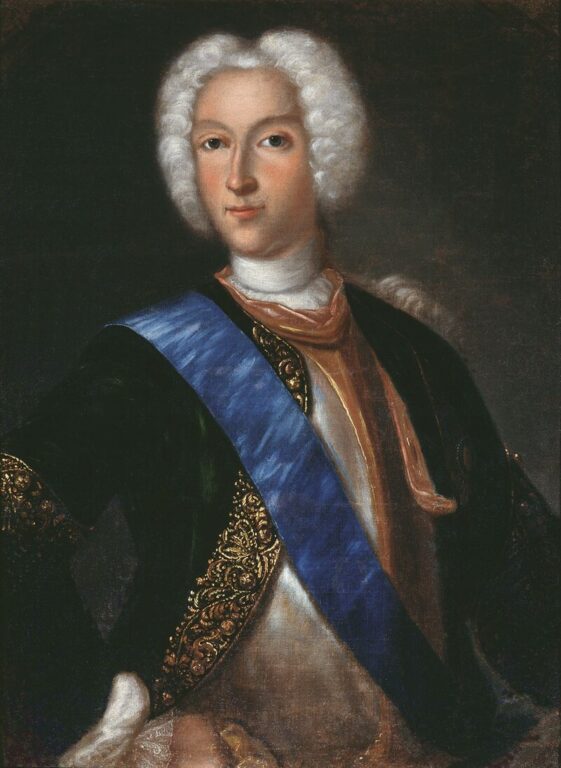 Emperor Peter II Vladimirovich
Like his great-uncle, Peter II Vladimirovich began his reign with a reshuffle. Thus, the Governor-General of Vladimir, General Boyar Prince Mikhail Vladimirovich Dolgorukov, was removed from his post and appointed Governor-General of Siberia (the previous Governor-General of Siberia, Prince Alexei Mikhailovich Cherkassky, had resigned, as he had long requested), while retaining his position as centumvir. Ivan Stepanovich Sapieha became the new Governor-General of Vladimir; the emperor conferred upon him the rank of field marshal and bestowed upon him the boyar’s cap. His son, Pavel Ivanovich Sapieha, also became a boyar and received the significant court position of Grand Chamberlain, a title granting the privilege of unrestricted access to the monarch’s private chambers at any time of day or night. Peter II appointed two new members to the Inner Chamber: the Minister of War, Field Marshal and Boyar Prince Mikhail Mikhailovich Golitsyn, and the aforementioned Ivan Sapieha.
The new emperor treated Eustathius I Fedorovich, his favorite, leniently. Boyar Stepan Petrovich Neledinsky-Meletsky was dismissed from his post as centumvir, expelled from the Inner Duma, and forbidden from appearing at court. He was a good-natured, cheerful man who had made no enemies and was quickly forgotten.
Emperor Peter II Vladimirovich was tall, well-built, and looked somewhat older than his years. He immediately immersed himself in governing the state: for example, he devoted his mornings to his studies, and in the afternoons he attended the Lower House, the Cabinet of Ministers, or the Council of Centumviers. His only day off was Sunday, which he spent sleeping and reading. The young emperor delved into every detail, took an interest in everything, and foreign diplomats reported to their rulers that the Emperor of Russia showed great promise and that his demeanor reminded them of his great-grandfather.
Under Eustathius I Fedorovich, the imperial court came alive after a period of calm under Peter the Great and began to resemble a lively carnival, rivaling Versailles in its wealth and splendor. Peter II, however, decided to put an end to this and return to his grandfather’s ideals: he significantly cut the court’s funding, abolished a number of court titles, and put an end to balls, carnivals, and feasts. The emperor lived and ate modestly, was indifferent to wine and tobacco, and called for moderation.
The coronation of Peter II Vladimirovich as Emperor of Great Russia took place on March 7, 1728, and was presided over by Joseph IV Ivanovich Volynsky, Archbishop of Kyiv and Vladimir and Primate of Ruthenia, with not only Archbishop Fyodor Pavlovich Pototsky of Gniezno, Primate of Poland, but also Archbishop Karol Petrovich Panzhinsky of Vilnius serving alongside him. During the coronation, he named his aunt, Grand Duchess Elizabeth Petrovna, as his heir; moreover, her husband, Prince-Bishop Karl August of Lübeck, was required to convert to Catholicism or divorce her. If he had converted to Catholicism, he would not have become co-emperor with his wife, but would have had to settle for the title of Grand Duke.
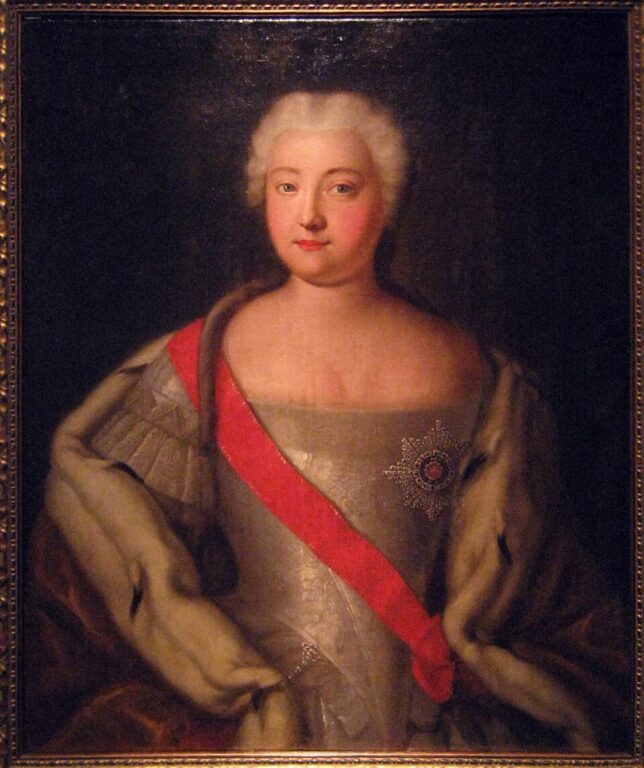 Grand Duchess Elizabeth Petrovna
Elizaveta Petrovna was born in 1696 and was the youngest child of Emperor Peter I Fyodorovich and Empress Sophia Christianovna. While her older sister, Anna Petrovna, remained true to her faith and became the wife of the future King of Sweden and Duke of Holstein-Gottorp, Charles Frederick (Anna Petrovna died in 1718, a few weeks after the birth of her only child, Crown Prince Karl Peter Ulrich), Elizabeth Petrovna remained unmarried for a long time. At one point, Sigismund Franz von Habsburg, Count of Tyrol, sought her hand in marriage, but the Grand Duchess found him unattractive, and the marriage did not take place.
Following the death on April 24, 1726, of Prince-Bishop Christian August of Lübeck, his eldest son, the nineteen-year-old Karl August, succeeded him. He was a frequent guest of his cousin, King Charles Frederick, and in the king’s palace he saw a family portrait of Anna Petrovna and Elizabeth Petrovna. Enchanted, he traveled to Vladimir-on-Klyazma to meet them. He was welcomed at court, caught the eye of Grand Duchess Elizabeth Petrovna, and Emperor Eustace I Fedorovich gave his consent to the marriage. The wedding took place on November 27, 1726, with two ceremonies—Catholic and Protestant—and the celebrations lasted nearly a month. The couple had no children for a long time, until 1734, when their only child, a daughter named Elizabeth Augusta, was born.
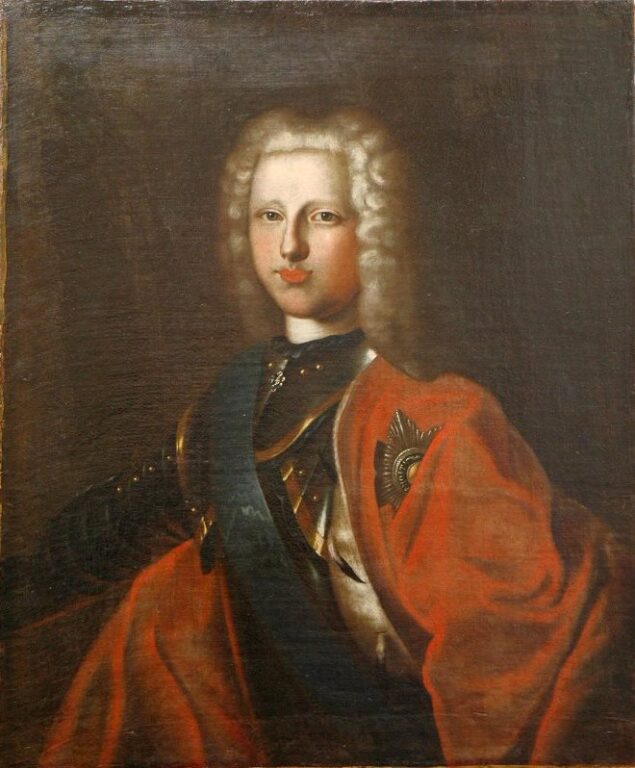 Karl August von Holstein-Gottorp
After Karl August’s marriage, his two younger brothers, Friedrich August (August Khristianovich) and Georg Ludwig (Georgy Khristianovich), joined him and entered military service.
Shortly before his coronation, in January 1728, Peter II dispatched a military detachment under the command of Field MarshalLieutenant Prince Vasily Vladimirovich Dolgorukov to capture the Free and Hanseatic City of Lübeck by sea for Prince-Bishop Karl August and establish it as a base for the Baltic Fleet. The fleet bombarded Lübeck’s fortifications, causing considerable damage and destroying the coastal artillery; it then landed troops and, following a fierce assault, captured the city and plundered it.
On January 21, 1728, Prince Vasily Dolgorukov arrived at City Hall and read aloud, in German, Charles Augustus’s decree on the incorporation of Lübeck into theof the Bishopric of Lübeck and the transfer of the capital from Eitingen to Lübeck, which provoked a largely negative reaction. Thus, neither Emperor Charles VI nor the Reichstag of the Holy Roman Empire of the German Nation would recognize this action as legitimate, and Denmark and Prussia formed an official alliance against Russia. This alliance was advantageous to both: Denmark possessed a strong navy but a weak army, while Prussia, conversely, had a strong army but a weak navy; however, Prussian King Frederick William I considered a war with Russia too costly, and Danish King Frederick IV, who remembered the Russian soldiers near Copenhagen all too well, feared a new war with Russia.
The appearance of Russian soldiers right on the borders of Holstein-Gottorp greatly alarmed King Charles Frederick of Sweden and the Swedish Riksdag. While maintaining the appearance of friendly and neutral relations, Sweden began to slowly drift toward an alliance with Denmark and Prussia. Meanwhile, the kings of Great Britain and Scotland congratulated their Russian counterpart on acquiring a new base in the Baltic Sea.
A Russian garrison, commanded by Prince Vasily Dolgorukov, was stationed in Lübeck, and he effectively held power over the entire Principality-Bishopric of Lübeck. After successfully capturing the city, Peter II Vladimirovich granted him the rank of boyar and awarded him the Order of St. Andrew the First-Called.
In 1728, Peter II traveled to Poland. The nobility sent countless complaints to Vladimir-on-Klyazma about the Polish governor, Stanisław Rafałowicz Leszczyński, who, despite being Polish himself, pursued a policy of aggressive Russification, in an effort to curry favor with the Russian emperors. For a time, this strategy worked, until a young boy, driven by the noblest of intentions, ascended the throne.
Upon arriving in Lublin, the capital of the Kingdom of Poland, Peter II Vladimirovich removed Stanisław Leszczyński from the post of governor of the kingdom and convened the Sejm, addressing the deputies with a speech in which he promised to sacredly honor Polish traditions, respect the nobility, their honor, and their property, and concluded by declaring that his eldest child would inherit the Russian crown, his middle child—Poland, and his youngest would take the throne of Lithuania; it was precisely this declaration that sparked debate not only in Poland but also in Russia, of which Lithuania was a part. Peter II Vladimirovich then suggested that the deputies elect a governor-general themselves, and after several days of voting and behind-the-scenes intrigues, their choice fell on the Grand Crown Chancellor Jan Franciszek Szembek. After confirming him in office, the monarch dissolved the Sejm and left Poland.
Upon becoming governor, Jan Szembek repealed all of his predecessor’s unpopular changes, thereby calming the situation in Poland, which had been on the brink of rebellion. Stanisław Leszczyński, however, fearing reprisals—and not without reason—fled to Dresden, where he tried to keep a low profile and avoid drawing attention to himself.
On November 21, 1728, a member of the Inner Duma and the Governing House, Admiral General Boyar Fyodor Matveyevich Apraksin, a member of the Lower Duma and the Governing House; he was succeeded as Minister of the Navy by Admiral Pyotr Ivanovich Sievers, a Dane who had served as a midshipman in the Danish navy, was taken prisoner during the Battle of Bornholm, and entered Russian service, rising to the rank of admiral over the course of twenty years. On February 17, 1729, another member of the Inner Duma, Boyar Pyotr Andreevich Tolstoy, head of the Office of Secret and Investigative Affairs, passed away; and the emperor appointed Andrei Ivanovich Ushakov to replace him; Ushakov was known for being the grandson of the first head of the Office of Secret and Criminal Investigations, Alfery Klementyevich Ushakov. The Inner Duma now consisted of five members, and the emperor had no intention of expanding it. Moreover, he increasingly referred to the Inner Duma as unnecessary and burdensome, and on more than one or two occasions spoke of his intentions to convene a Council of the Russian Land.
The members of the Inner Duma didn’t expect anything good from the heir to the Russian throne, Grand Duchess Elizabeth Petrovna, either. She spoke hostile words about this body, calling Osterman a “German pig” and threatening to cut off his head; she called Boyar Golovkin a “bald old fox for whom the gallows have long been weeping,” Cardinal Prokopovich a “baseless Jesuit,” and Sapieha a “stinking scoundrel”; only Prince Dolgorukov aroused her sympathy. Four members of the Lower Duma tried to influence the Grand Duchess in some way through her husband, but Karl August merely listened attentively and replied that he could promise nothing.
Thus, the four most influential people in the empire (excluding Sapieha, since he remained in the emperor’s favor and enjoyed his trust) lost their influence over the ruler and were left at a loss.
By 1729, no one had any doubt that Peter II intended to restore Lithuanian statehood. Thus, representatives of the Lithuanian nobility began arriving in Vladimir-on-Klyazma, and a special commission on this matter was formed under the Council of Centumvirov, chaired by Prince Yuri Mikhailovich Chartoryisky (one of the last appanage princes, a retired general, and former governor of Volhynia), with Lithuanians making up the majority of its members. The emperor himself took a very active part in the commission’s meetings and, seizing the opportunity, demonstrated his knowledge of the Lithuanian language.
Initially, a proposal was put forward to restore the autonomous Grand Duchy of Lithuania to the state it was in at the time of its abolition in 1710, and this plan—despite significant resistance from the upper echelons—was close to being implemented, but Peter II Vladimirovich proposed an unexpected alternative—an independent Kingdom of Lithuania in a personal union with the Russian Empire—which the commission accepted with genuine enthusiasm. The borders of the new state were defined (within the boundaries of the three governorates—Vilnius, Kovno, and Suwałki), and its symbols were established; work began on drafting its legislation (to replace Vytautas’s clearly outdated charter); the first samples of the new Lithuanian ducats were minted at the mint; and plans were made to convene the Tariba. The signing of the manifesto establishing the independent Kingdom of Lithuania was scheduled for early 1730.
Opponents of the Lithuanian project (most of whom were also opponents of the Provisional Duma) rallied around Grand Duchess Elizabeth Petrovna, who vehemently opposed her nephew’s idea, arguing that since her illustrious father had abolished the Grand Duchy of Lithuania, he must have had his reasons. Quarrels between her and the emperor became increasingly frequent, and it reached the point where Peter II ordered that the Grand Duchess and her husband not be received at court. Everything was leading to Elizabeth Petrovna’s fall from grace.
In 1729, Peter II began to show his affection for Princess Karolina Nikolaevna Radziwill, the daughter of Lieutenant Field Marshal Prince Nikolai Nikolaevich Radziwill. The Emperor awarded Karolina Nikolaevna the Order of Saint Olga and her father the Order of Vitis; on August 3, he appointed him governor of Minsk and, moreover, recognized him as a prince of the Russian Empire— a distinction that not even Alexander Menshik had been able to attain (this was the first such instance, since previously, in both the Russian Kingdom and the Russian Empire, the princely title had been granted only to aristocrats descended from ruling houses—the Rurikids, the Gediminids, the Chingizids, and the Bagrationis)! The engagement was about to take place, but Karolina unexpectedly fell ill and died on December 26, 1729. Peter II Vladimirovich was deeply grieved by her death; he became gloomy and unsociable.
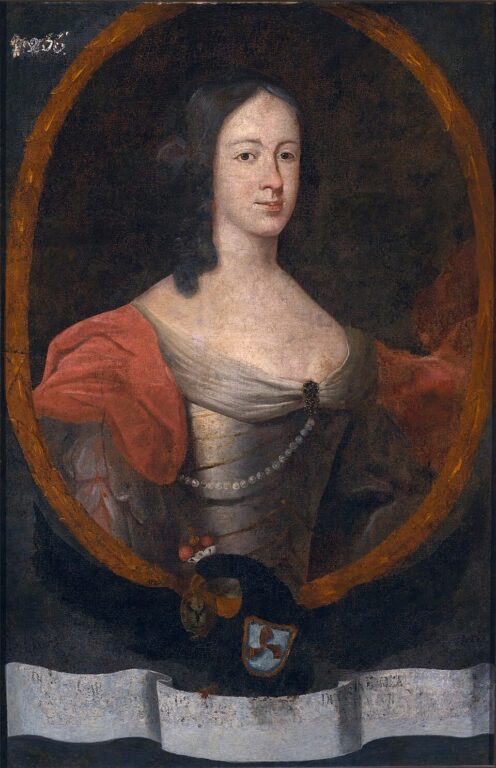 Princess Karolina Nikolaevna Radziwill
The death of his beloved took a heavy toll on the young emperor. On the night of January 5, 1730, Peter II, wearing nothing but a light caftan thrown over a thin shirt, went out into the bitter cold for a walk in the garden. After several such walks, the emperor developed a fever; he took to his bed, and the doctors confirmed his worst fears—smallpox.
No one was willing to take on the task of dealing with Peter II Vladimirovich, who had managed to turn many against him, and the Inner Duma convened for another—but this time very important—session. Admittedly, not all members were present: just the day before, Boyar Ivan Sapieha had fallen seriously ill and was unable to attend, while the cautious Andrei Osterman declined to participate, citing his foreign origins. But three people seemed a bit too few, so Osterman was persuaded to take part in the session, which was to elect a new Emperor of Great Russia.
Meanwhile, Peter II clearly realized that he was dying. While still conscious, he drafted a manifesto in which Grand Duchess Elizabeth Petrovna and her descendants were declared forever deprived of the right to inherit the throne, and the new heir to the throne was designated as the great-grandson of Emperor Vladimir VII Alexeyevich, Duke Christian Wilhelm of Schleswig-Holstein-Sonderburg-Beck, Christian Wilhelm, with the requirement that he immediately convert to Catholicism. But before it was published, the document fell into the hands of the Minister of Foreign Affairs, Boyar Gavriil Golovkin (a member of the Inner Duma), who removed all references to Duke Christian Wilhelm, and the document was published in this abridged form that very evening. Grand Duchess Elizabeth Petrovna and her husband were immediately taken into custody.
Thanks to the “Act on Succession to the Throne,” there were several potential claimants to the throne, including even the Swedish Crown Prince Carl Peter, and the Lower Duma deliberated and debated for several days until Andrei Osterman proposed as emperor yet another great-grandson of Vladimir VII Alexeyevich, Prince Fyodor Ivanovich Bogolyubsky, who lived in the provinces and was virtually unknown in the capital. Other members of the Inner Duma approved this decision; a corresponding manifesto was drafted and presented to Peter II Vladimirovich for his signature.
But Peter II flew into a rage, tore the manifesto into tiny pieces, and ordered them to be expelled. But the members of the Inner Duma were not discouraged; they won over the chamberlain, Prince Ivan Alekseyevich Dolgorukov, who entertained the emperor by skillfully forging his handwriting. And on January 29, 1730, the manifesto appointing Prince Fyodor Ivanovich Bogolyubsky as heir to the throne, bearing a forged signature of Peter II Vladimirovich, was published.
The emperor was confined to his chambers, but this measure proved unnecessary; Peter II fell into a coma and died on January 30, 1730, at the age of 17. The flag was lowered over the Grand Palace, and, in accordance with the manifesto, Prince Fyodor Bogolyubsky was proclaimed emperor. Immediately, on the very same day, Okolnichy Andrei Osterman and the Minister of War, Field Marshal Boyar Prince Mikhail Golitsyn, Okolnichy Andrei Osterman and the Minister of War, Field Marshal Boyar Prince Mikhail Golitsyn, personally set out for the Tikhvin Governorate to escort the former Prince Fyodor Bogolyubsky—now their new emperor, Fyodor III Ivanovich—to the capital.