The History of the Most Unusual Soviet Missile System. Why Is There a Radar on the "Yastreb" Missile System?

In the mid-1960s, the Soviet Army used the “Luna” and “Luna-M” unguided missile systems to deliver tactical nuclear warheads to enemy positions. These systems were capable of delivering a warhead with a yield of approximately 10 kilotons to ranges of about 30 and 60 kilometers, respectively.

A
battery of 9P113 launchers from the 9K52 “Luna-M” systems during training firings (Sovetsky Voin magazine, 1980s). Source: http://militaryrussia.ru/blog/topic-864.html/topic-192.html
These systems continued to be used in the USSR and other countries (with missile units lacking a special warhead) and received positive reviews. However, they had a significant drawback: their missiles lacked guidance systems. Guidance was achieved by orienting the launch vehicle and setting the projectile’s launch angle. In flight, the projectile was stabilized solely by aerodynamic stabilizers and rotation generated by four engines located in the middle section of the rocket (“Luna-M”).

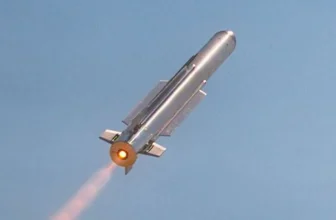
Launch of the 9M21 rocket from the “Luna-M” system. The engines that cause the projectile to rotate around its axis for stabilization in flight are clearly visible.
As a result, the circular error probability relative to the aiming point could reach 700 meters. The presence of a nuclear warhead does not compensate for this lack of accuracy: for a warhead with a yield of about 10 kilotons, such a deviation significantly reduces the extent of damage to the target. Therefore, to ensure a successful strike, several missiles had to be launched simultaneously. Clearly, the missile required in-flight trajectory correction.
Contents:
Idea
To identify methods for solving the problem, the 3rd Central Research Institute of the Ministry of Defense conducted research under the code name “Kholm.” This resulted in the identification of two approaches: the creation of a projectile with an inertial guidance system and the development of a product with radio-command target guidance.
The first project was designated “Tochka,” and the second, “Yastreb.” OKB-2 of the State Committee for Aviation Technology, now known as MKB Fakel, JSC, was appointed the lead contractor for both projects. This company specialized in the development of anti-aircraft missile systems.
It should be noted that this is not the same “Tochka” system that entered service in 1975. The first project bearing this name, on which Design Bureau No. 2 was working, was never completed. All the materials were transferred to the Mechanical Engineering Design Bureau, which ultimately developed the well-known 9K79 “Tochka” system. But that was already a completely different system.

A
diagram of the “Tochka” system, currently under development by OKB-2. The chassis is easily recognizable—it is the BAZ-135LM, similar to the one used in the “Luna-M” system, and which later became the basis for the “Uragan” multiple launch rocket system. Illustration from the 2003 book *”Fakel” Rockets*.
Concept
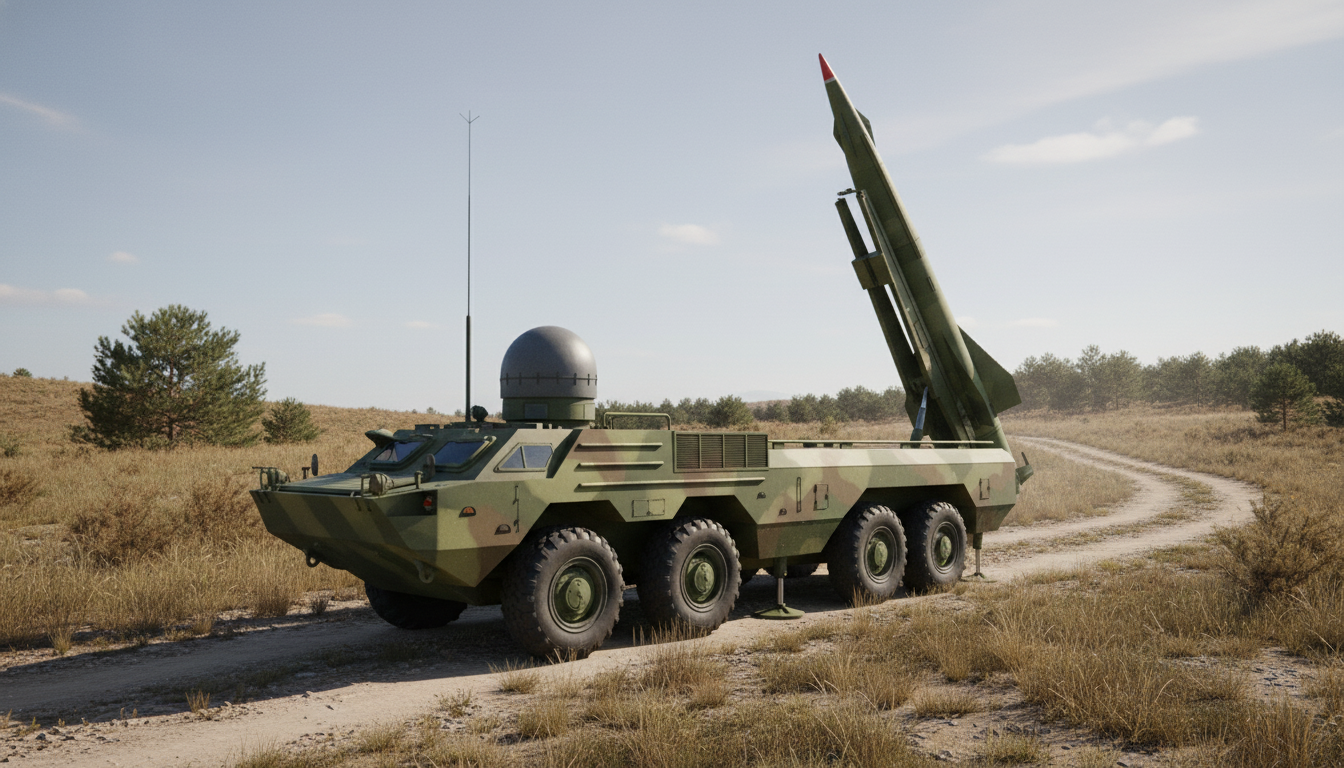
The system, developed as part of the “Yastreb” project, was intended to be mounted on a high-mobility vehicle chassis.
The ballistic missile for the “Yastreb” was developed based on the existing V-611 (4K60) missile from the M-11 “Shtorm” naval anti-aircraft system, which had also been developed at OKB-2 shortly before that. The casing and wing design, control system, engine, and several other components were borrowed from it. Such standardization was intended to significantly reduce the program’s time and cost, but in reality, the outcome turned out to be different.

Launch of a B-611 missile from the “Storm” air defense system
According to available information, the missile was intended to be equipped exclusively with a special (nuclear) warhead. Compared to the standard warhead of an anti-aircraft missile, it was heavier, which altered the missile’s balance. To compensate for this, the nose cone was equipped with destabilizers.
A stabilizer is a horizontal tailplane mounted in front of the wing and designed to provide or improve the aircraft’s longitudinal control.
The rocket was launched from a beam-type launch guide.
At the front of the chassis, behind the control cabin, was a radar station, which was the main feature of the “Yastreb” missile system.

Diagram of the “Yastreb” missile system from the 2003 book *”Fakel” Missiles*
It was assumed that, after launch, the radar would track the projectile’s trajectory, and the control system’s automatic controls, by comparing the actual and target trajectories, would transmit commands via a radio channel to the control surface actuators to correct the flight path toward the target. Control was to be maintained throughout the entire active phase of flight.

B-611
missile from the M-11 “Storm” air defense system. Photo source: Vitaly V. Kuzmin, CC BY-SA 4.0, via Wikimedia Commons
In theory, this guidance method should have ensured the necessary accuracy parameters at a relatively low cost per projectile, since all the automatic systems were housed on the self-propelled launcher, and the missile merely received control commands.
But this solution had its drawbacks. In particular, after firing, the combat vehicle could not immediately leave its firing position and take cover, since it took some time to track the projectile.
In addition, to control the projectile’s flight, there must be no obstacles between it and the launcher that could interfere with the transmission of the radio signal or cause jamming. For this reason, for example, it was practically impossible to use the “Yastreb” in mountainous terrain.
It is also worth noting that an active radar system further exposes the installation to the enemy’s electronic intelligence capabilities, and the radio control channels may be vulnerable to electronic warfare systems.
Yes, in the 1960s they weren’t as advanced as they are today, but I’m sure that if the “Yastreb” had been adopted, the Americans would inevitably have begun actively developing countermeasures.
Work on the “Yastreb” project did not progress beyond the preliminary design stage. Only individual elements were implemented in prototypes. Why was development halted? Several factors likely played a role. First, the combat vehicle was becoming extremely complex and expensive due to the use of radar and automated systems for projectile control.
The missile itself, which was based on a model designed for an air defense system, likely did not meet the range requirements (8–35 km). The original V-611 could engage air targets at ranges of up to 55 km, but for the “Yastreb,” the missile was converted into a ballistic missile and equipped with a heavier, specialized warhead, which negatively affected its range. Most likely, the designers concluded that achieving a greater range within the specified dimensions was impossible.
The only component of the system that underwent active testing at proving grounds was the chassis.

Object 560
Various sources indicate that the chassis for the “Yastreb” was developed by the Bryansk and Kutaisi Automobile Plants and the Mytishchi Machine-Building Plant. In the only available footage of the chassis tests, one can make out Mytishchi’s Facility 560 with a scale model of the radar system.

It is possible that Object 1040—which was being developed by KAZ engineers to house the future “Osa” air defense system—was considered as a chassis option. It was a further development of the Object 1015B prototype armored personnel carrier.
In the end, this prototype didn’t pan out: the production-model “Osa” was mounted on a chassis from BAZ.

Universal Chassis, Item 1040
The project to develop a tactical missile system codenamed “Yastreb” was terminated no later than 1966. At the same time, work on the inertially guided “Tochka” was also halted. The documents related to the project were transferred to the Kolomna Mechanical Engineering Design Bureau, which successfully completed the task: in 1975, the 9K79 “Tochka” tactical missile system was adopted for service. But this was already a completely different system.

Based on material from — https://pikabu.ru/story/zachem_radar_takticheskomu_raketnomu_komleksu_istoriya_samogo_neobyichnogo_sovetskogo_trk_13841906