The Last Breath of Piston-Engine Aviation. The Tu-80—The Final Chapter in the History of Soviet Piston-Engine Bombers

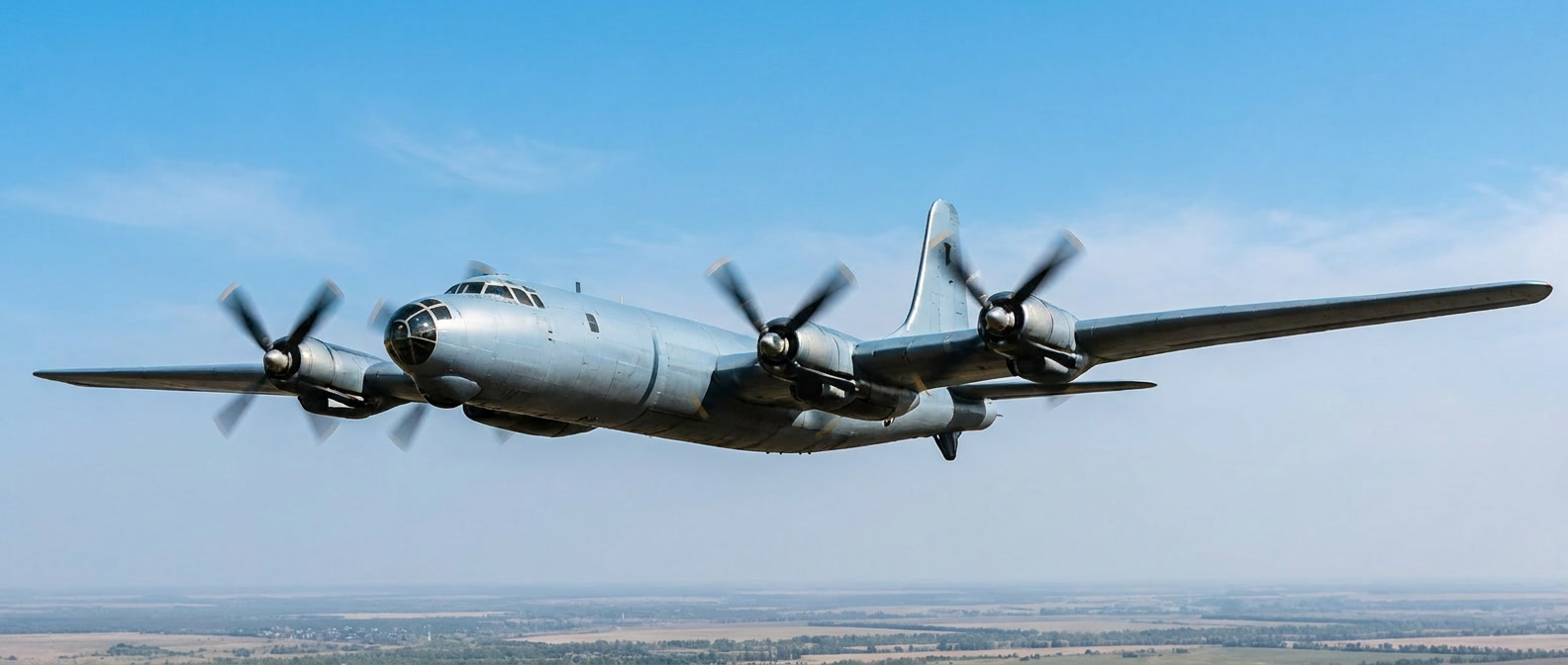
In the postwar years, the Soviet aviation industry was undergoing a rapid transition from piston engines to jet propulsion. At this historic turning point, when the era of propeller-driven giants was already drawing to a close, the A. N. Tupolev Design Bureau made a final attempt to create the ideal piston-engine bomber. This aircraft was the Tu-80—a major modernization of the famous Tu-4, which, in turn, was the Soviet copy of the American B-29. The Tu-80 went down in history as a one-off prototype that never made it to mass production, yet embodied all the accumulated experience of Soviet designers in the field of heavy piston-engine aircraft.
Background to the Creation
By the late 1940s, the global strategic situation required the USSR to have modern long-range bombers. Although the Tu-4 successfully fulfilled its assigned tasks, the emergence of more advanced variants among potential adversaries—in particular, the American B-50—called for a response. At Design Bureau 156, under the leadership of Andrei Nikolaevich Tupolev, work began on Project “80”—an aircraft intended to surpass its predecessor in range, speed, and payload without a radical change in the power plant.
The designers’ primary goal was to increase the flight range by 20–25% compared to the Tu-4 by improving aerodynamics and increasing fuel capacity. The aircraft was viewed as an intermediate step before the transition to intercontinental bombers equipped with new types of engines.
Design and Technical Features
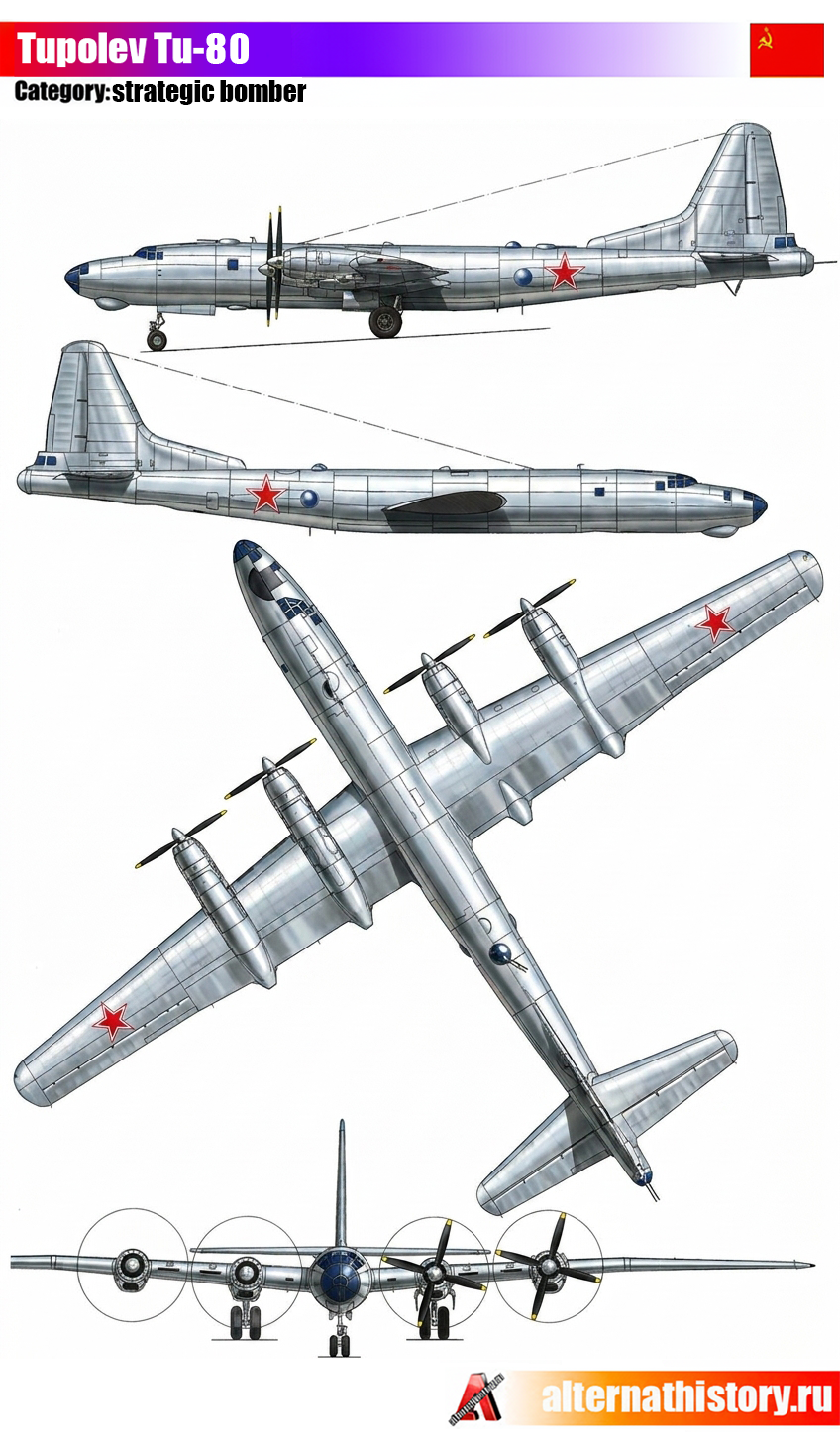
The Tu-80 was a four-engine mid-wing aircraft with a trapezoidal wing of high aspect ratio. The designers made a number of significant changes to the airframe compared to the base model. The wing area was increased by 3.5% to 167 m², which improved the lift characteristics. To reduce the tendency for lateral roll, the wing struts were installed without a transverse “V” angle, and the wing itself was given a double camber.
The circular-section fuselage was lengthened by four meters, which made it possible to expand the bomb bays and improve the crew layout. The forward pressurized cabin was completely redesigned based on experience gained during the development of the Tu-70 passenger aircraft, which significantly improved visibility from the pilots’ stations.
The powerplant remained unchanged—four ASH-73TKFN piston engines—but during the testing phase, the inner engines were fitted with AV-16U reversible propellers, which had proven their effectiveness. The capacity of the fuel tanks was increased by 15%, bringing the fuel capacity to 16,500 kg.
The defensive armament was modernized: the obsolete B-20 cannons were replaced with more advanced NR-23 cannons. The “Cobalt” bombing radar sight was upgraded with the “Cesium” add-on, resulting in the “Rubidium” system. The “Goodrich”-type wing de-icing system has been replaced by more advanced thermal elements.
The aircraft was to be equipped with modern electronic systems: the ARK-5 radio compass, the “Materik” and “Meridian” radio navigation systems, the “Magnesium” and “Barium” identification systems, RSB-5 radios, and “Kadmium” fire-control radars.
Flight Tests
The Tu-80 made its maiden flight on December 1, 1949. During factory tests at an altitude of 10,000 meters, the aircraft demonstrated a maximum speed of 545 km/h, which was a respectable figure for a piston-engine aircraft of this class. Its practical range with a standard bomb load of 3,000 kg exceeded 7,000 km, and its calculated maximum bomb load reached 12,000 kg.
However, the tests also revealed some problems. Due to a forward offset in the center of gravity, lead castings weighing about 900 kg had to be placed in the tail section of the prototype to ensure stability. Full-scale government tests were never conducted.
Technical Specifications:
- Wingspan: 43.45 m
- Length: 34.32 m
- Height: 9.04 m
- Wing area: 167.00 m²
- Normal takeoff weight: 51,500 kg
- Fuel capacity: up to 16,500 kg
- Engine type: 4 PD ASH-73TKFN
- Takeoff power: 4 × 2,400 l. s.
- Flight power: 4 × 2,000 l. s.
- Maximum speed near the ground: 428 km/h
- Maximum speed at altitude: 545 km/h
- Practical range: 7,000 km
- Practical ceiling: 11,200 m
- Crew: 11 people
- Bomb load: up to 12,000 kg
Reasons for Discontinuing Mass Production
Despite successful factory tests, the Tu-80’s fate was sealed by technological progress. In parallel with the “80” project, the Tupolev Design Bureau was actively working on the “85” bomber (the future Tu-85), which was originally designed for more powerful engines and was intended to have an intercontinental range.
The leadership of the Air Force and the aviation industry concluded that it was not advisable to begin mass production of the Tu-80 interim model: the resources of the factories and designers should be directed toward the creation of fundamentally new jet aircraft and next-generation heavy piston-engine bombers. The Tu-80, being a logical evolution of the Tu-4, could no longer radically alter the strategic balance of power.
Historical Significance
The only Tu-80 ever built did not become a museum exhibit. After the program was shut down, the aircraft was transferred to a test range, where it was used as a target for testing new weapons. Thus, the last Soviet piston-engine bomber ended its service life by helping to test weapons intended for aircraft of the jet age.
The Tu-80 became a symbol of sorts marking the end of an entire era. It embodied all the experience accumulated by the Soviet aviation industry in the 1930s and 1940s: from aerodynamic calculations to weapons systems. But time is relentless: jet aircraft were opening up new horizons of speed and altitude, rendering even the most advanced piston-engine aircraft obsolete.
Conclusion
The history of the Tu-80 is a story of a pivotal moment. Soviet designers, having created a technically advanced piston-engine bomber, effectively “buried” it themselves by betting on the future. The Tu-80 did not go into production not because it was bad, but because the world was already changing. It went down in history as the swan song of Soviet piston-engine aviation—powerful, beautiful, but no longer relevant. Today, the memory of it is preserved only in archival photographs and the dry lines of technical reports, serving as a reminder of just how rapidly aviation technology is advancing.