The little Chipmunk turned out to be one of the strangest spy planes of the Cold War

When people talk about Cold War reconnaissance aircraft, they usually think of the U-2, SR-71, RC-135, or at least the Canberra equipped with photographic equipment. Extreme altitudes, supersonic speeds, secret bases, and the risk of nuclear war. But one of the most unusual spy planes of that era looked completely different.
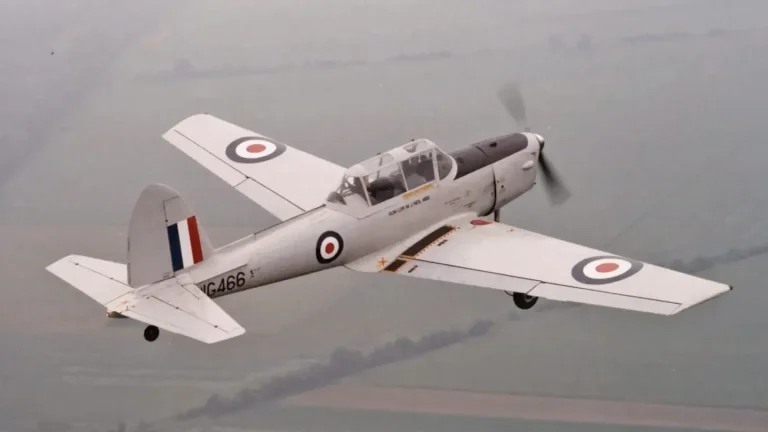
The small de Havilland Canada DHC-1 Chipmunk propeller-driven training aircraft—the plane on which generations of British pilots simply learned to fly—quietly conducted reconnaissance on Soviet troops in divided Berlin for decades.
And that is precisely where the almost perfect irony of the Cold War lies.
That’s because one of NATO’s strangest spy planes turned out to be a tiny, two-seat training aircraft with a piston engine—one that looked more like a flying club plane than a superpower’s intelligence-gathering tool.
The plane that was supposed to simply train cadets
The story of Chipmunk actually begins very peacefully.
Immediately after World War II, de Havilland Canada decided to develop a modern training aircraft to replace the aging Tiger Moth biplane. The world was entering the jet age, and the old open-cockpit training aircraft already seemed outdated.
That’s how the DHC-1 Chipmunk came to be.
The aircraft made its first flight on May 22, 1946. Moreover, this aircraft was particularly important for Canada—the Chipmunk became the first aircraft developed entirely in Canada after the war.
The design looked quite modern for its time:
an all-metal monoplane,
an enclosed cockpit,
a tandem pilot configuration,
good flight characteristics,
and very “user-friendly” controls.
The aircraft quickly became extremely popular in the countries of the British Commonwealth.
The RAF, the Royal Canadian Air Force, Portugal, and dozens of other countries used the Chipmunk as their primary training aircraft. A total of more than 1,200 aircraft were built, with the British producing nearly 1,000 under license.
On paper, it was the most peaceful aircraft imaginable.
But then the Cold War began.
Berlin turned out to be the perfect place for espionage
After World War II, Germany was divided among the Allies, and Berlin became a massive political anomaly—a western enclave deep within the Soviet occupation zone.
It was here that a unique legal situation arose.
Under postwar agreements, the Western Allies retained the right to use air corridors and certain flight zones around Berlin. Formally, this was established to maintain communication with the city’s western sectors. But it very quickly became clear that such a system was also ideal for intelligence gathering.
By the mid-1950s, tensions between NATO and the USSR had risen sharply.
Soviet troops were actively building up their forces in East Germany; new airfields were being built, and tank units and air defense systems were being deployed there. The West needed the most accurate information possible about what was happening literally right behind the Berlin Wall.
But there was a problem here.
After the Berlin Airlift, the Western Allies were effectively barred from using combat aircraft in the corridors. And that’s when the British came up with a nearly ingenious solution.
Operation Schooner: A School Plane Becomes a Spy Plane
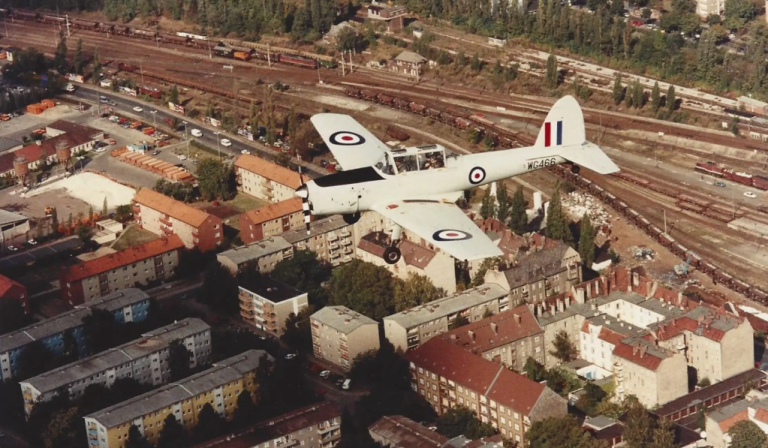
In 1956, the RAF launched a top-secret program called Operation Schooner, later renamed Operation Nylon. The purpose of the program seemed almost absurd.
The British began using standard Chipmunk aircraft for reconnaissance flights over the Soviet sector of Berlin.
The logic was very simple.
The training plane was not considered a threat. It was officially conducting “training flights.” The small, propeller-driven Chipmunk looked so harmless that it was ideal for the role of an aerial observer.
That is precisely why the operation proved to be surprisingly effective.
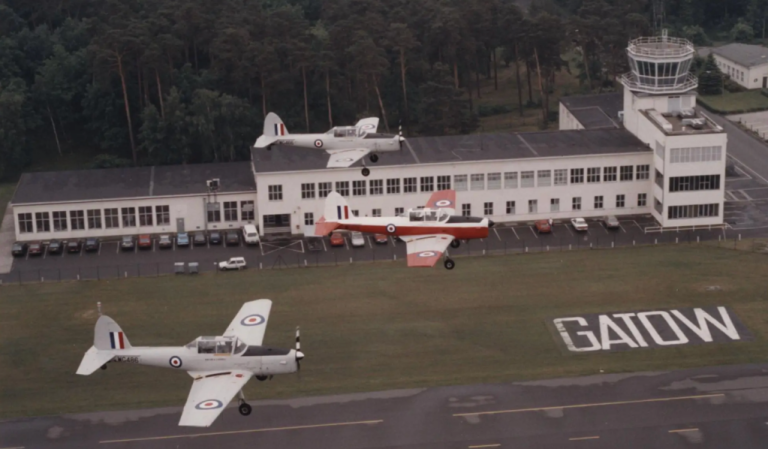
The planes took off from RAF Gatow and circled slowly over the authorized flight zone. Officially, it was pilot training. In practice, it involved monitoring Soviet airfields, the movement of military equipment, new radar installations, air defense positions, and the activities of Warsaw Pact forces.
In fact, Chipmunk’s speed and size turned out to be an unexpected advantage.
Large reconnaissance aircraft have always attracted attention. But the little Chipmunk looked almost like a civilian aircraft from a flying club. Against the backdrop of the heavy air traffic around Berlin, it was literally lost in the crowd.
A small plane with a very important job
From a technical standpoint, the Chipmunk was as far removed as possible from classic Cold War reconnaissance aircraft. No jet engines, no high altitudes, and no top-secret electronics. But it was precisely its simplicity that unexpectedly made it the ideal aircraft for “stealth espionage.”
The DHC-1 Chipmunk was a two-seat, all-metal training monoplane with a tandem seating arrangement. It was powered by a de Havilland Gipsy Major 8 piston engine with a power output of approximately 145 horsepower. By way of comparison, some modern compact cars already have more power. But for a small training aircraft of the late 1940s, this was quite sufficient.
Its maximum speed was approximately 220–225 km/h, and its cruising speed was about 145–160 km/h. Its service ceiling reached approximately 4,600 meters, and its range was about 400 kilometers.
On paper, the specifications seemed almost modest:
crew: 2;
length: about 7.7 m;
wingspan: 10.5 m;
maximum takeoff weight: approximately 950 kg.
But it was precisely these dimensions that made the Chipmunk so well-suited for reconnaissance missions over Berlin.
The aircraft offered excellent visibility from the cockpit, handled superbly at low speeds, and could remain airborne for long periods without attracting much attention. Some aircraft were fitted with photographic equipment and additional surveillance gear, but outwardly they were almost indistinguishable from standard RAF training aircraft.
And that was the whole philosophy behind the operation.
While the rest of the world was building massive jet reconnaissance aircraft like the U-2 or the Canberra, the British were, in effect, using a “flying flying club” to monitor Soviet troops in East Germany.
Moreover, the small piston-engine plane had an unexpected advantage over larger reconnaissance aircraft: it didn’t look threatening.
A large jet aircraft automatically drew attention. The Chipmunk, on the other hand, looked so peaceful and ordinary that it literally blended into the sky above divided Berlin.
An Airplane from the “Covert Espionage” Era
There’s something else about this whole story that’s particularly interesting.
Chipmunk perfectly captures the very spirit of the early Cold War—an era when intelligence was often based not on satellites and cyberwarfare, but on some very strange improvisations.
It was an era of
spy trains,
BRIXMIS officers,
hidden cameras,
surveillance missions,
and airplanes that were officially “just training.”
And that’s exactly why little Chipmunk turned out to be so important.
It wasn’t a superweapon.
It didn’t fly to the edge of space.
It didn’t carry nuclear bombs.
But for decades, he quietly gathered information about Soviet troops on one of the most dangerous fronts of the Cold War.
A car that has outlived its era
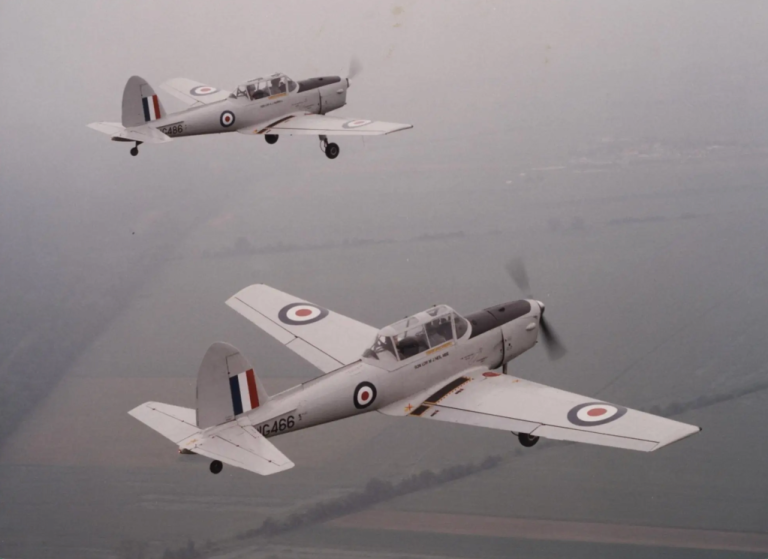
The most surprising thing is that the Chipmunk outlasted not only the Cold War but also many much more modern aircraft.
The RAF did not finally retire it until 1996. And hundreds of these aircraft are still flying today. Many are used by private flying clubs, flight schools, and historical aviation collections.
And there is a certain beauty to aviation history in this.
A small training aircraft, designed for the peaceful training of cadets, unexpectedly became part of a major geopolitical game played by the superpowers. And it wasn’t because of its speed or technology, but because of its very inconspicuousness.
While the world marveled at the SR-71, the U-2, and reconnaissance satellites, a tiny Chipmunk—one of the strangest spy planes of the Cold War—was slowly circling somewhere above Berlin.
This material is based on publications by The War Zone, RAF archives, and other publicly available sources.