The Master of the Pre-War Oceans. The Flagship of the Victorious Kaiserreich. The Superbattleship "Götterdämmerung"

May 31, 1916. The North Sea greeted the fleets with a leaden-gray veil of fog and low-hanging clouds. In our story, this day marked the climax of the Dreadnought Race—a grand but tactically inconclusive battle, after which both sides claimed victory. However, in the reality we are about to discuss, it all began differently—and ended differently as well.
The turning point was set in motion several years before the first shot was fired. In the late 1800s, German metallurgists from Essen and Kiel made a breakthrough that the British Admiralty did not learn about until the first salvos were fired. Krupp steel, alloyed according to a completely unique formula, made it possible to create barrels that could withstand unprecedented pressure from powder gases. The 305-mm, 50-caliber guns, developed for the new “König”-class dreadnoughts and “Derfflinger,” were equipped with a new generation of shells—heavy, armor-piercing, with ideal ballistics. At a maximum elevation angle of 16 degrees, their range reached 25 kilometers—nearly 5 kilometers more than that of the best British 305-mm guns.
Admiral Reinhard Scheer, who had taken command of the High Seas Fleet, was aware of this advantage. He knew that his ships would be able to shell the Grand Fleet while remaining out of range of its return fire. And he was ready to take advantage of it.
The Triumph of the High Seas Fleet
When, on May 31, 1916, Vice Admiral Franz von Hipper’s vanguard clashed with David Beatty’s squadron of battlecruisers, the Germans had already opened fire. The British ships—the pride of the empire, HMS Indefatigable, HMS Queen Mary, HMS Invincible, and others—were sailing at full speed, preparing to open fire from a range of 14,000 to 16,000 yards, as tactics dictated. But German shells had begun falling around them several minutes earlier.
The first salvo from the SMS Derfflinger and the SMS Seydlitz struck with astonishing accuracy. The British ships, which had not yet had time to return fire, were already reeling from the explosions. HMS Indefatigable was hit in the boiler room area and vanished in a pillar of fire eight minutes after the battle began—just as in our story, but long before she had a chance to fire a single salvo at the enemy. HMS Queen Mary followed suit; her thin deck could not withstand the new German “Panzersprenggranaten” (armor-piercing shells).
Beatty, stunned by what was happening, sent his remaining battlecruisers forward in an attempt to close the gap. But every kilometer he covered cost him another ship. By the time Admiral Jellicoe’s Grand Fleet had finally formed up in battle formation and was able to open fire, the British had already lost two battlecruisers, and four more had sustained heavy damage.
The Germans, on the other hand, did not lose a single ship. Their armor, reinforced with new Krupp cemented steel, withstood hits from British shells, which, moreover, lacked accuracy—the British were firing at the limit of their range, through smoke and fog.
The moment Jellicoe had feared most had arrived. His squadron, consisting of 28 dreadnoughts, came under methodical, almost clinical fire. German shells rained down—heavy, leaden, and relentless. HMS Malaya took a series of hits to the bow, and her speed dropped to 15 knots. HMS Warspite, whose rudder had jammed early in the battle, became a floating target. Jellicoe, realizing that he was continuing to lose ships without inflicting significant damage on the enemy, made the most difficult decision of his career. At 7:30 p.m., he gave the order: “Withdraw to the southwest. Do not engage in a general battle.”
The retreat was a disaster. HMS Malaya, unable to exceed 17 knots, took three more hits and sank along with most of her crew. HMS Warspite, engulfed in flames, followed her an hour later. Two more armored cruisers—HMS Black Prince and HMS Defence—were destroyed almost instantly when their ammunition magazines exploded one after another.
By dawn on June 1, 1916, the North Sea was littered with wreckage. Britain had lost four battleships and two battlecruisers. Germany had not lost a single major ship. The High Seas Fleet returned to Wilhelmshaven amid the enthusiastic cheers of the crowd. Kaiser Wilhelm II stepped out onto the bridge of the SMS Friedrich der Grosse and uttered a phrase that made headlines around the world: “Today we are the masters of the ocean.”
The Great Blockade and the 1916 Armistice
The victory at Jutland changed the course of the war rapidly and irrevocably. The High Seas Fleet, now ruling unchallenged in the North Sea, imposed a tight blockade on the British Isles. German battleships and battlecruisers patrolled off the coast of Scotland, preventing the Grand Fleet from even leaving Scapa Flow. Submarines, now operating in coordination with surface forces, blocked every trade route.
England, whose economy depended on imports of food and raw materials, began to struggle. Two weeks after the battle, bread ration cards were introduced in London. Three weeks later, dockworkers went on strike in Liverpool and Glasgow. A month later, on July 3, 1916, the British government requested a ceasefire through neutral channels.
The terms of the peace treaty signed in Stockholm on August 15, 1916, were moderate—the German Empire did not seek to destroy the British Empire. Germany limited itself to the demilitarization of certain bases, the payment of reparations, and, most importantly, unilateral restrictions on naval armaments. The British Navy was not to build battleships with a displacement exceeding 35,000 metric tons and armed with guns larger than 400 mm — the very same restrictions that, in our history, formed the basis of the 1922 Washington Treaty, but here they were imposed on only one side.
France, having lost its main ally at sea, sought peace shortly thereafter, in September 1916. Russia, left isolated and gripped by unrest in Petrograd and at the front, signed a separate peace even before the Bolshevik Revolution. World War I had ended. There was no Versailles, no revanchism, and no Weimar Republic. The German Empire loomed over Europe like a colossus.
The Interwar Race: The Birth of the Leviathans
The interwar period became an era of unprecedented naval construction. Germany, unbound by any treaties, continued to improve its super-battleships. While the 1920s saw the launch of the Scharnhorst-class ships with their 380-mm guns, in the early 1930s German engineers created yet another masterpiece — the 406-mm SK C/34 naval gun with a barrel length of 50 calibers. The firing range of this monster reached 42 kilometers—a figure that seemed fantastic for that time.
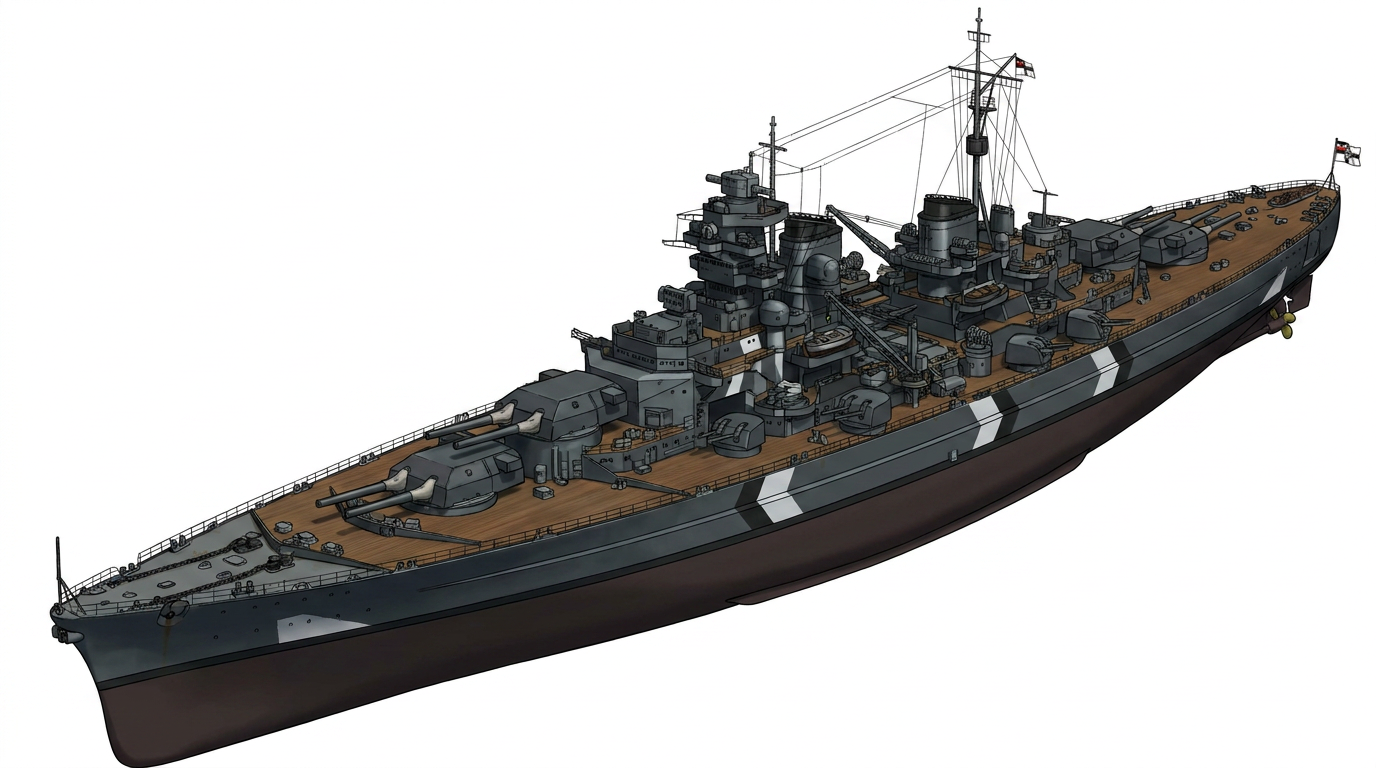
A new type of battleship was designed to carry these guns—the largest, most heavily armed, and best-protected ship ever conceived by humankind. The lead ship of the class was given a name that spoke for itself: “Götterdämmerung”—“Twilight of the Gods.” The second ship in the class was to be named “Wilhelm II,” in honor of the victorious Kaiser.
The project was developed at the Kriegsmarine design bureau in Kiel under the direction of Dr. Heinz Bongartz. Initially, variants with 508-mm artillery were considered—successors to the H-44 project, which existed in our history only on paper. However, Admiral Reder (in this reality, a loyal servant of the Kaiser, not the Führer) insisted on the 406-mm caliber: twelve guns in four triple-gun turrets provided a significantly greater salvo weight than eight 508-mm guns, while still ensuring acceptable speed and maneuverability.
The History of the Creation of “Götterdämmerung”
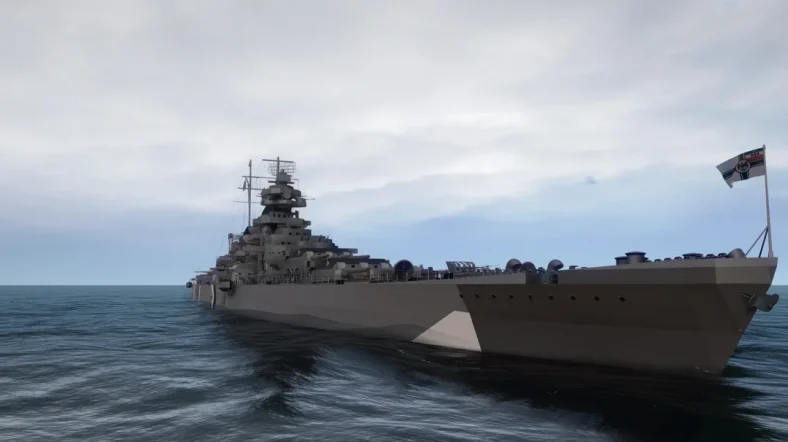
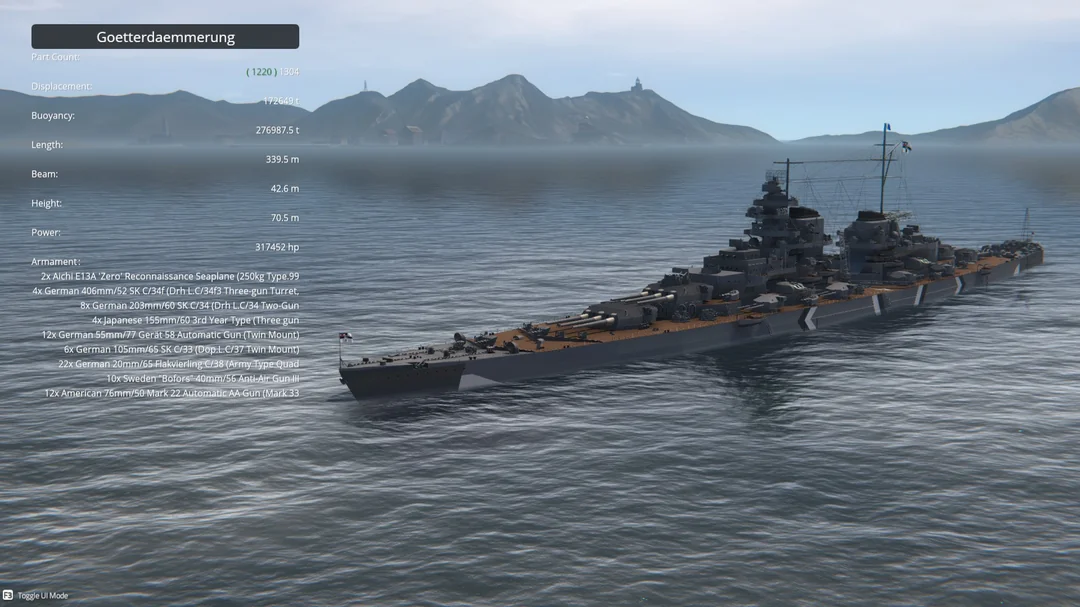
The keel of the lead ship was laid at the Blohm & Voss shipyard in Hamburg in March 1935. Construction took four years—the ship was launched in November 1939 and entered service in May 1941. Its silhouette astounded contemporaries: a gigantic hull nearly 340 meters long with a high freeboard, and a massive turret-like superstructure that reflected the hallmarks of the German school of engineering—functionality elevated to an aesthetic ideal. The four three-gun main-caliber turrets, arranged in a linear, elevated formation—two at the bow and two at the stern—resembled the gun turrets of a fortress set afloat.
The ship was equipped with the most powerful anti-aircraft armament—a reflection of the lessons learned from the Spanish Civil War and the growing threat posed by aircraft. Twenty-two quadruple 20-mm “Firling” mounts and ten Swedish 40-mm “Bofors” guns created an impenetrable close-range fire umbrella. Twelve twin 76-mm automatic guns rounded out the armament.
The armor of the “Götterdämmerung” was phenomenal. The 440-mm-thick main belt of Wotan Hart cemented armor, angled at 15 degrees, made the ship virtually invulnerable to any existing shells at ranges exceeding 15 kilometers. Deck armor reached 180 mm in critical areas. Underwater protection consisted of a multilayer system of bulges and torpedo bulkheads capable of withstanding a torpedo hit with a warhead containing 500 kg of TNT.
The second ship in the class, the *Wilhelm II*, was laid down in September 1936 at the AG Weser shipyard in Bremen and entered service in August 1942. Together, they formed the Kriegsmarine’s 1st Battleship Division—the most powerful squadron ever to sail the oceans.
Tactical and Technical Specifications of the Battleship “Götterdämmerung”
- Full displacement: 107,000 metric tons
Dimensions;
- Length: 339.5 meters
- Width: 42.6 meters
- Draft: 11.2 meters
Power plant:
- 12 Wagner high-pressure boilers,
- 4 Brown-Boveri steam turbines,
- Power: 260,000 l.s.
- Maximum speed: 29.5 knots
- Cruising range: 18,000 nautical miles at 16 knots
Weapons;
- Main armament: 4×3 — 406-mm SK C/34 L/50 (12 guns)
- Medium-caliber: 6×2 — 203-mm SK C/34 L/60 in Drh L C/34 mounts
- Anti-mine caliber: 4×3 — 155-mm guns
- Long-range anti-aircraft artillery: 12×2 — 76-mm automatic guns
- Small-caliber anti-aircraft artillery: 22×4 — 20-mm Flakvierling C/38, 10×1 — 40-mm “Bofors” L/56
Reservations;
- Main belt: 440 mm (Wotan Hart, 15° angle)
- Deck thickness: 80–180 mm
- Tower armor thickness: 400 mm (front), 220 mm (sides), 130 mm (roof)
- Cutting depth: 450 mm
- Aviation armament: 2 catapults, 4 Arado Ar 196 seaplanes
- Crew: 2,780 (including 108 officers)
An Asymmetric Response: The Aircraft Carrier-Based Grand Fleet
Realizing the dire straits it found itself in following the humiliating Treaty of Stockholm, the British Empire opted for an asymmetric response. The Admiralty, stung by the Jutland disaster, turned its attention to a new type of naval weapon—aircraft carriers. They were not subject to the unilateral restrictions imposed by Germany, and British industry launched a shipbuilding program unlike any other in history.
By the early 1940s, the Royal Navy had an impressive aircraft carrier force. In service were HMS Ark Royal, six Illustrious-class ships with their unique armored-deck design, and two of the newest Implacable-class ships—fast, modern vessels capable of carrying up to 81 aircraft. In total, the Grand Fleet comprised about 14 aircraft carriers—nearly twice as many as Germany, which was limited by its financial and industrial resources.
However, there was one fundamental problem that people preferred not to discuss behind the scenes at the Admiralty. The carrier-based aircraft at the disposal of British aircraft carriers—obsolete Fairey Swordfish biplanes, clumsy Fairey Fulmars, and even the relatively modern Supermarine Seafires—were inferior to German aircraft in every respect: speed, rate of climb, armament, and range.
The Steel Birds of the Kaiserreich
The reason for this superiority lay in a single name: Fokker. In an alternate reality where Germany did not lose the war, Antoni Fokker’s company was not forced to flee to the Netherlands. On the contrary, it remained in Germany, becoming one of the pillars of the Kaiser’s aviation industry. The famous Dutch engineer, having obtained German citizenship and unlimited funding, transformed his firm into the principal supplier to the Navy.
The legacy of the Fokker D.VII and Fokker D.VIII, which dominated the skies of World War I, has been reimagined for a new era. The Fokker D.XIV “Seeadler” (“Sea Eagle”) carrier-based fighter, adopted by the Kriegsmarine in 1939, embodied this legacy. Equipped with a 1,100 l.s. Daimler-Benz DB 601 inline engine, it reached speeds of up to 580 km/h—80 km/h faster than any British carrier-based fighter. Its armament—consisting of two 20-mm MG FF cannons and two 7.92-mm MG 17 machine guns—made it a deadly opponent for both aircraft and light ships. Its reinforced landing gear, arresting hook, and folding wings allowed it to operate from aircraft carriers without compromising its combat capabilities.
The Fokker G.XV torpedo bomber, based on the famous G.I, could carry a torpedo weighing up to 600 kg or a 500-kg bomb over a range of 900 kilometers. The twin-engine configuration ensured reliability, which was critical for flights over the sea, and its defensive armament of four machine guns allowed it to fend off enemy fighters.
It was precisely this combination—powerful battleships with a firing range of 42 kilometers and superior carrier-based aviation—that made the Kriegsmarine the most dangerous fleet in history by 1941. The *Götterdämmerung* and the *Wilhelm II*, accompanied by heavy cruisers and destroyers, formed the core of a force that no other navy in the world could withstand. The British aircraft carriers, despite their sheer number, were doomed—their planes simply could not break through the umbrella of German anti-aircraft artillery and fighter cover to inflict significant damage.
Epilogue: Shadows Over the Atlantic
By 1942, world politics was teetering on the brink of a new conflict. Germany, having established itself as the dominant power in Europe and Africa, was looking eastward, where pockets of tension still smoldered. Britain, wounded but not broken, was feverishly building up its aircraft carrier forces, hoping that quantity could make up for quality. The United States, maintaining its neutrality, watched the naval arms race with alarm, realizing that its own fleet—which did not yet possess superbattleships of that class—might find itself in a precarious position.
The *Götterdämmerung*, which set sail for the Atlantic for exercises in September 1942, became a symbol of this new reality. Its silhouette—massive, relentless, crowned with twelve 406-mm gun barrels—struck terror into the hearts of neutral observers. As the ship passed the Azores, Portuguese fishermen crossed themselves, mistaking it for a Norse giant from the ancient sagas.
A new war was looming. And this time, the Kaiserreich had every chance of emerging victorious.