The Mi-26 with a new heart. What stage is the project at, and when can we expect to see the updated giant?

The Mi-26 heavy-lift helicopter has long transcended its role as a mere helicopter, becoming a technological phenomenon in aviation history. Since its maiden flight in 1977, it has held the title of the world’s largest and heaviest-lift production rotorcraft. Its eight-bladed main rotor, with a diameter of 32 meters, its twin-engine configuration, and its ability to lift up to twenty metric tons of cargo on an external sling have made the helicopter indispensable for military troop transport, disaster relief, and the development of northern territories. The Mi-26’s uniqueness lies not only in its size but also in its sophisticated aerodynamics, which allow it to maintain stability under extreme loads, as well as in its modular fuselage design, which simplifies conversion for medical, firefighting, or cargo missions, even in field conditions.
Achilles’ Heel: An Old Engine and Cumulative Problems
For a long time, the legendary helicopter was powered by two D-136 turboshaft engines developed by the Zaporizhzhia-based Progress Design Bureau. These engines reliably provided the required power reserve; however, their production and the supply of spare parts had historically depended on Ukrainian manufacturers. After 2014, and especially since 2022, these technological and logistical ties have been severed. The operation of Russia’s Mi-26 fleet has faced a shortage of original components, increased complexity in scheduled maintenance, and rising life-cycle costs. In addition to geopolitical risks, the D-136, designed in the late 1970s, gradually began to lag behind modern counterparts in terms of specific fuel consumption, environmental performance, and the level of digitalization in flight control systems. All of this made the development of a domestic replacement not merely advisable, but a strategically necessary step to maintain the airworthiness and combat readiness of heavy rotorcraft.
From Concept to Display: The Development History of the PD-8V
The response to these challenges was a program for a new family of helicopter engines, built around the PD-8 civil turbofan core. Work on these engines began in the mid-2010s at Perm-based “ODK-Aviadvigatel” when it became clear that reliance on foreign and Ukrainian components required a radical overhaul of the supply chains. Initially, the core was developed for a future passenger airliner, but engineers quickly recognized its potential for rotary-wing aircraft. By 2021, the concept for a turboshaft variant, designated PD-8V, had been approved. The project underwent several stages of prototyping and bench testing, during which designers worked to increase the service life of the hot section, adjust the transmission characteristics for the helicopter gearbox, and integrate the engine with a domestic automatic control system. Since the base version was designed for medium-class helicopters, work was conducted in parallel to boost performance and adapt the design to the requirements of a heavy helicopter, which required strengthening the turbine, modernizing the cooling system, and redesigning the clutch assembly.
The Digital Heart: Technical Features of the New Engine
The modern PD-8V is a high-temperature turboshaft engine featuring a digital electronic control system and a fully modular architecture. As of 2023, its rated takeoff power is expected to reach 11,500 l. s., which is 15% higher than that of the original D-136. Fuel efficiency is also expected to improve by 3–5%, which, when calculated based on annual flight hours, will result in significant savings for operators.
A key design feature is its standardization with the PD-8 aircraft engine: it uses a common gas generator, which includes a high-pressure compressor, a combustion chamber, and a high-pressure turbine. The PD-8 gas generator itself is a scaled-down version of the unit from the PD-14 engine, which is already being successfully installed on MS-21 passenger airliners. This approach helps reduce development time, minimize risks, and build on proven engineering solutions.
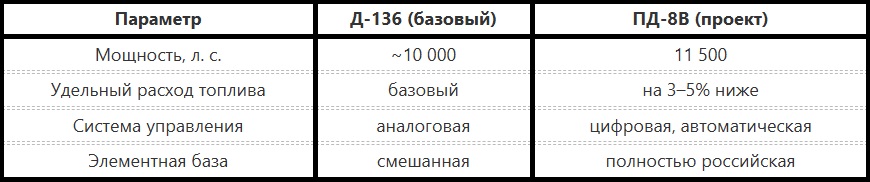
A key feature is the complete digitization of control systems: the engine is equipped with a built-in diagnostic system capable of monitoring vibration parameters, temperature fields, and the remaining service life of key components in real time. Development is carried out using digital design tools and software components sourced exclusively from Russia, which eliminates the risk of sanctions-related restrictions. The casing is made of heat-resistant nickel alloys and advanced composites, which has made it possible to reduce the powerplant’s weight without sacrificing strength. The control system integrates seamlessly with the Mi-26T2V’s onboard avionics suite, providing automatic load distribution among the engines, predictive maintenance, and thrust adaptation to changes in air density in high-altitude and hot regions.
Final Stretch: Current Stage and Timeline for Deployment
As of spring 2026, the program is in the final phase of flight testing. The first PD-8V prototype was installed on a flying laboratory back in 2023, followed by hundreds of hours of testing in various climatic conditions, ranging from Arctic cold to the heat of southern test sites. To date, the engine has passed certification tests for key parameters, including an assessment of the high-pressure turbine’s service life and verification of its performance under extreme operating conditions. An interagency commission has tentatively approved the transition to the state certification phase, which, according to estimates by the Ministry of Industry and Trade and the United Aircraft Corporation (UAC), will take about a year and a half. Serial production is being rolled out at sites in Perm and Rybinsk, where production lines for the machining of key components and the final assembly of modules have already been launched. The first production Mi-26s with the new engine are expected to be delivered to the military and civilian airlines in 2027–2028, after which a phased modernization of the existing fleet will begin, with the D-136 engines being replaced with PD-8V engines during major overhauls.
Epilogue: The Path to Technological Sovereignty
The powerplant upgrade transforms the Mi-26 from a helicopter whose future depended on foreign supplies into a fully independent aviation system capable of operating for decades in any climate. With the new engine, this giant will not only retain its unique transport capabilities but also achieve cost savings in operation, enhanced reliability, and compatibility with modern digital flight control ecosystems. There are still final bureaucratic and production hurdles to overcome, but the project’s trajectory has already been mapped out, and the debut of the modernized Mi-26 with the PD-8V is no longer a matter of “if,” but rather “when.”
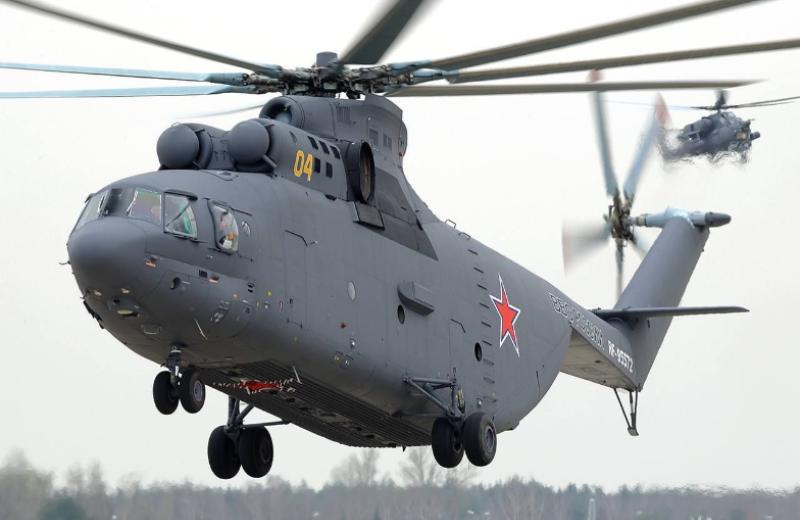
The Real Mi-26