The Rurik II Could Have Become Russia’s Derfflinger. What Would Its Specifications and Appearance Have Been?

After the Russo-Japanese War, the Imperial Russian Navy desperately needed new, powerful warships. One of them was the armored cruiser Rurik II, built in Great Britain. For its time, it was considered a formidable fighting ship, but the appearance of the British Invincible-class battlecruisers almost immediately rendered its design concept obsolete. What if Russian admirals had recognized the need for an entirely new type of warship a little earlier?
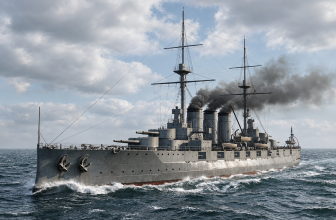
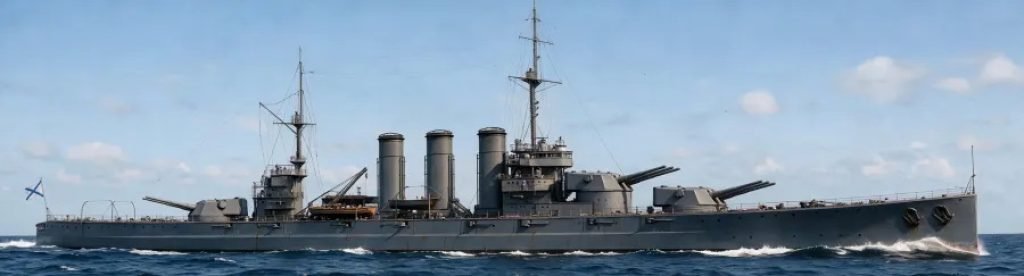
Imagine that instead of traditional armored cruisers, Russia decided to build two genuine battlecruisers — Rurik II and Bayan II — armed with nine 305 mm guns mounted in triple turrets. In terms of armor protection, they could have approached the German Derfflinger, although they would have been noticeably slower. This alternative design is based on material published by our respected colleague Stvolyar on his LiveJournal blog. Let us examine how successful such a warship might have been and what place it could have occupied in the history of the Imperial Russian Navy.
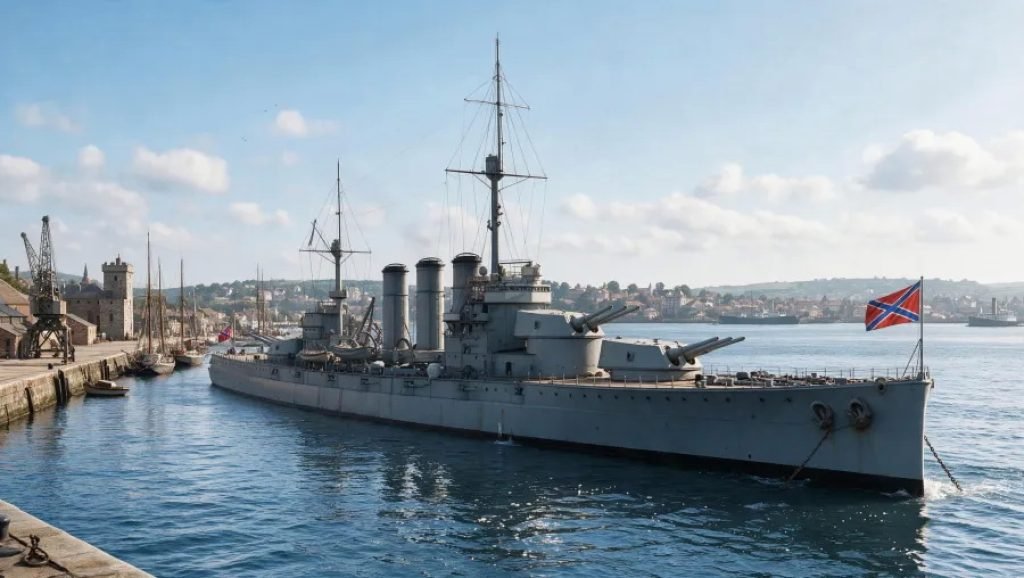
A Cruiser That Arrived Too Late for Its Own Era
In actual history, Rurik II was laid down at the British Vickers shipyard in 1905 and entered service with the Russian Navy in 1908–1909. Its armament consisted of four 254 mm guns and eight 203 mm guns. By the standards of armored cruisers, it was a powerful warship, but while it was under construction, the British developed the Invincible — a fundamentally new type of cruiser armed with eight 305 mm guns and capable of approximately 25 knots. As a result, the Russian ship was conceptually obsolete almost as soon as its construction was completed.
Let us suppose that the lessons of Tsushima prompted the Russian Naval Ministry to reconsider its shipbuilding program as early as 1905. Instead of completing several traditional armored cruisers, the decision was made to concentrate available funds on two large warships equipped with a uniform main battery. The design was developed with the participation of British specialists, but Russian engineers insisted on considerably heavier armor protection.
Implementing this concept would require accelerating the development of the 305 mm/52 gun and triple-gun turrets, which appeared later on Russian dreadnoughts in our timeline. This becomes the principal technological point of divergence in our alternative history. As a result, Russia acquires two warships displacing 23,750 tons, vastly surpassing the historical Rurik in firepower.
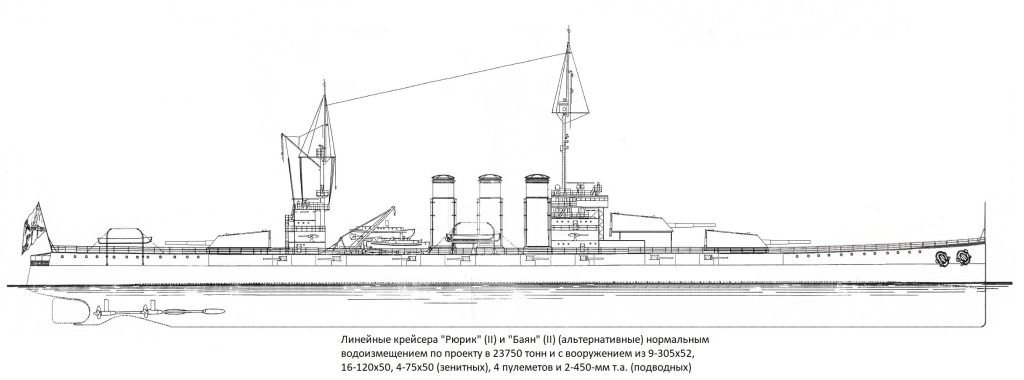
Nine Twelve-Inch Guns Instead of Eight
The most interesting feature of Stvolyar’s design is its use of triple-gun main battery turrets. The original alternative version envisaged eight 305 mm guns mounted in twin turrets. However, subsequent calculations showed that switching to three triple-gun turrets would increase the number of barrels to nine without significantly changing the design displacement.
According to the author’s calculations, the weight of the armament increases by 175 tons, from 2,500 to 2,675 tons. However, this additional weight is offset by an equivalent 175-ton reduction in the weight of turret and barbette armor. At the same time, the ship retains remarkably substantial protection: the main armor belt reaches 267 mm, as do the turret sides and the most heavily protected sections of the barbettes.
The main advantage of this arrangement is the ability to concentrate heavy artillery in fewer turrets, reducing the weight of rotating structures and the total extent of armored barbettes. However, the calculated balance of weights does not automatically guarantee that the ship could be successfully built. A real design would require detailed assessments of hull strength, stability, and ammunition magazine arrangements.
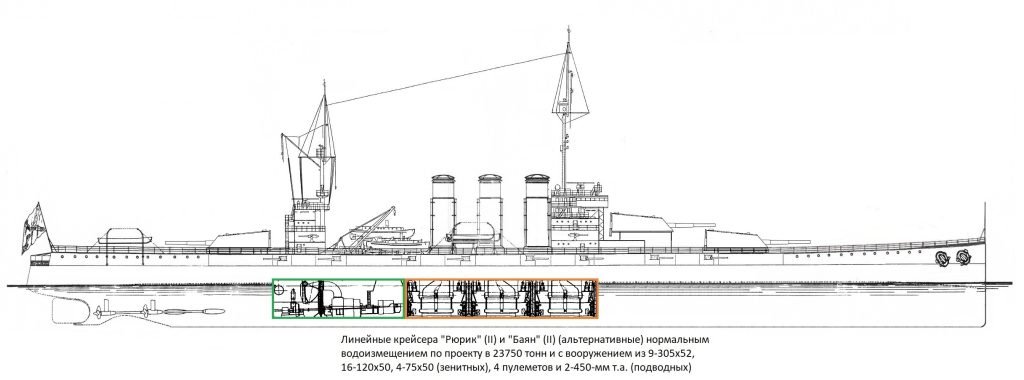
Technical Specifications
According to Stvolyar’s design, the ship would have had the following characteristics:
-
Displacement: 23,750 tons (normal).
-
Length: 188.98 m.
-
Beam: 25.60 m.
-
Draft: 8.23 m.
-
Propulsion: 24 Yarrow boilers, four shafts, steam turbines producing 32,500 hp, increasing to 42,500 hp under forced conditions.
-
Speed: 23 knots, or 24.5 knots with forced machinery output.
-
Fuel capacity: normal — 1,000 tons of coal and 250 tons of oil; maximum — 2,000 tons of coal and 500 tons of oil.
-
Main armament: 9 × 305 mm/52 guns in three triple-gun turrets.
-
Secondary armament: 16 × 120 mm/50 guns.
-
Anti-aircraft armament: 4 × 75 mm guns (a later modernization would be required if the ship entered service early).
-
Additional armament: 4 machine guns and 2 submerged 450 mm torpedo tubes.
-
Main armor belt: 267 mm over 60% of the ship’s length, tapering to 152 mm at the lower edge; 76.2 mm at the extremities.
-
Armored decks: lower deck — 38.1 mm; battery deck — 38.1–50.8 mm.
-
Main battery turrets: sides — 267 mm; roofs — 76.2 mm; floors — 114 mm.
-
Barbettes: up to 267 mm.
-
Conning towers: sides — 267 mm; roofs and floors — 114 mm.
-
Anti-torpedo bulkhead: 38.1 mm.
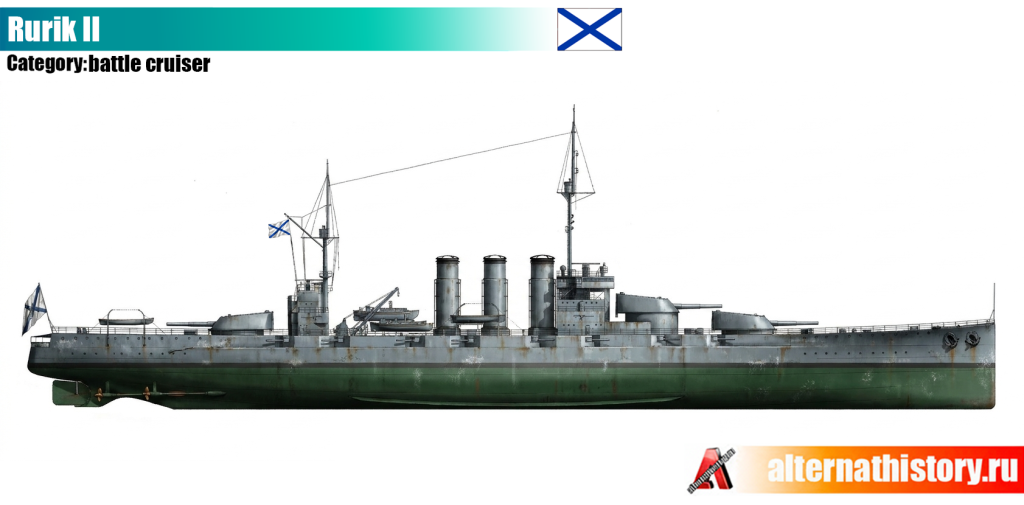
A Russian Derfflinger — Or Not Quite?
The comparison with the German Derfflinger is particularly tempting because of the heavy armor protection. However, the German battlecruiser was considerably faster: its designed speed was approximately 26.5 knots, while the Russian cruiser would have achieved only 24.5 knots even with its machinery operating at forced output.
On the other hand, nine Russian twelve-inch guns would have provided a very substantial broadside. In terms of its combination of artillery and protection, the alternative Rurik would have been an extremely formidable opponent for the first generation of British battlecruisers. However, escaping from a faster enemy or forcing such an opponent to accept battle would have been more difficult for the Russian ship.
Thus, what we have here is essentially a well-protected but relatively slow battlecruiser, approaching the concept of a fast battleship. And this characteristic could have had a significant influence on its operational career.
What Might Have Happened to the Alternative Rurik and Bayan?
Let us imagine that both ships were laid down in 1907–1908 and entered service by 1913–1914. Their very appearance would have significantly strengthened the Baltic Fleet. Instead of relatively weak armored cruisers, Russia would have acquired a pair of powerful capital ships capable of engaging the enemy’s heavy forces.
Following the outbreak of the First World War, Rurik and Bayan could have formed the backbone of a fast squadron of the Baltic Fleet. Their principal tasks would have included covering minelaying operations, supporting light cruisers, and destroying German reconnaissance forces. A possible encounter with German battlecruisers in the Baltic Sea is particularly interesting to consider.
Suppose that in the summer of 1915, a Russian squadron intercepted German warships covering a major minelaying operation. Rurik and Bayan opened fire at long range, exploiting the advantage of their nine-gun broadsides. The Germans were forced to withdraw, but their superior speed allowed them to avoid a decisive engagement. Such an operation could have become a major success for the Russian fleet, although it would not have changed the overall balance of naval power in the Baltic.
Speed would have remained the principal limitation. If confronted by a more numerous German formation, the Russian battlecruisers would have found it difficult to disengage. Their successful employment would therefore have required effective reconnaissance, protection by minefields, and close cooperation with the other forces of the fleet.
In Conclusion
The alternative Rurik II and Bayan II proposed by Stvolyar represent a highly interesting possibility for the development of Russian naval shipbuilding. Nine 305 mm guns, substantial armor protection, and a displacement of less than 24,000 tons would have made these vessels a formidable fighting force.
However, describing them as fully equivalent Russian counterparts to the Derfflinger would require certain reservations. In terms of protection, they would indeed have approached the German battlecruiser, but their speed would have been noticeably inferior.
Nevertheless, the appearance of such warships before the First World War could have given Russia an entirely different experience in constructing and operating heavy cruisers. Perhaps the history of Russian battlecruisers would then have begun not with the never-completed Izmail class, but with two powerful ships that actually managed to take part in major naval engagements.
Sources
The original design concepts and calculations by Stvolyar: