The Russian Blücher and Its History That Never Was. What Might the Second Rurik Have Looked Like with Eight 203 mm Guns?

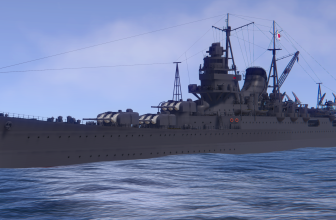
The resulting ship bears some resemblance to the famous German armored cruiser Blücher, although it differs in armament, dimensions, and layout. More importantly, such a Rurik could have become one of the first major Russian warships to feature superfiring main battery turrets. And if this experiment had proved successful, the development of the Russian fleet in the years leading up to World War I might have taken a somewhat different course.

After Tsushima — A New Cruiser Concept
In actual history, the second Rurik became one of the last and most powerful armored cruisers in the world. Ordered from the British shipbuilding firm Vickers after the Russo-Japanese War, she received four 254 mm guns in two turrets and eight 203 mm guns in four additional turrets.
Such armament looked impressive, but it had certain disadvantages. The different calibers of heavy artillery complicated fire control at long ranges, while the numerous turrets occupied considerable internal space and increased the weight of the upper structures.
Meanwhile, the real Rurik could achieve a speed of only about 21 knots. For a ship intended, among other duties, for reconnaissance and cruiser operations, this was already becoming inadequate by the time she entered service.
Now imagine that in 1905 the Russian Naval Ministry decided to reconsider its requirements for the new cruiser. Instead of maximizing the power of individual guns, priority would be given to a high volume of fire, armor protection, and somewhat greater speed.
The central principle would be the abandonment of a mixed heavy-caliber battery. The new Rurik would receive eight identical 203 mm guns, while the weight saved would be used to improve other characteristics.
Four Turrets Instead of Six
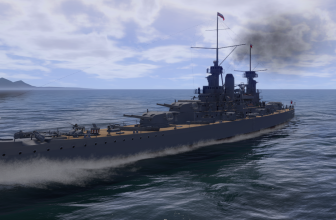
The most unusual feature of the alternative Rurik would be the arrangement of her artillery. All eight 203 mm guns, with barrels 50 calibers long, would be mounted in four twin turrets positioned along the ship’s centerline.
Two turrets would be located forward and another two aft. The inner turrets would be mounted higher than the outer ones, allowing them to fire over the turrets in front of them.
Such a superfiring arrangement would allow all eight main battery guns to be brought to bear on either broadside. By comparison, the historical Rurik could fire four 254 mm and four 203 mm guns in a broadside salvo.
The new ship would no longer face the problem of firing two different heavy calibers simultaneously. All guns would have identical ballistic characteristics, making fire correction considerably easier.
Of course, this would not necessarily mean an increase in the destructive power of a salvo. A single 254 mm shell was considerably heavier than a 203 mm shell, so the alternative Rurik would sacrifice some destructive power in exchange for a uniform main battery and potentially higher rate of fire.
On the other hand, ammunition supply and the organization of the gunnery service would become simpler. The arrangement would also provide better conditions for more advanced centralized fire control.

Twenty 120 mm Guns to Supplement the Main Battery
The secondary armament would remain virtually unchanged. Rurik would carry twenty 120 mm guns with 50-caliber barrels, mounted in casemates along the sides of the hull.
According to the designers’ intentions, this artillery would provide protection against enemy destroyers and engage the lightly armored sections of hostile warships. The casemate battery would be protected by 76 mm armor, with additional splinter-resistant bulkheads installed between the guns.
The armament would be completed by four 47 mm guns, eight machine guns, and two submerged 450 mm torpedo tubes.
Thus, in terms of the total number of artillery pieces, the alternative Rurik would remain a very heavily armed warship. However, the foundation of her offensive power would now be eight identical 8-inch guns.

British Machinery and Two Additional Knots
Another significant difference would be the propulsion system.
Instead of the relatively low-powered machinery of the historical Rurik, the proposal called for triple-expansion steam engines similar to those installed in the British Warrior-class armored cruiser HMS Natal, which was being built by the same firm, Vickers, at approximately the same time.
The new propulsion plant would develop 24,000 horsepower. Steam for the two engines would be supplied by 24 Yarrow water-tube boilers.
With a normal displacement of 14,000 tons, the calculated speed would reach 23 knots, making the ship two knots faster than the historical Rurik.
Of course, by the early twentieth century, even 23 knots was no longer an exceptional achievement. Nevertheless, for an armored cruiser combining powerful artillery with substantial protection, such a speed would have been quite respectable.
This was particularly true considering that the British Natal actually had a propulsion system of comparable output and could reach approximately 23 knots. Nevertheless, the calculated speed of the alternative Russian cruiser would still have required confirmation during sea trials.
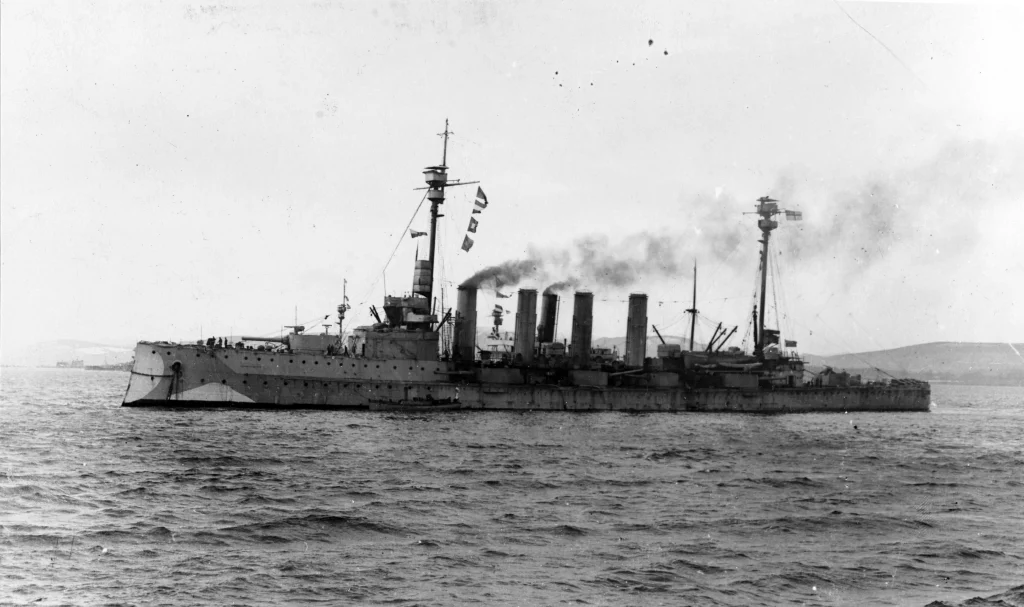
HMS Natal
Armor Protection Without Compromise
The armor protection of the alternative Rurik is particularly interesting. Despite reducing normal displacement to 14,000 tons, the designers propose fitting a continuous armor belt along the entire waterline.
Over the central 55% of the hull, its thickness would be 190.5 mm, tapering to 152 mm at the lower edge. Toward the bow and stern, the armor would become thinner, measuring 114 mm and tapering to 76.2 mm.
The main battery turrets would be protected by 190.5 mm armor, with the upper sections of the barbettes receiving protection of the same thickness. The conning tower would have 229 mm armor.
Particular attention would be paid to protecting the ship’s internal compartments. In addition to armored decks ranging from 25.4 to 50.8 mm in thickness and the sloped sections of the lower deck, the design would incorporate a 38.1 mm anti-torpedo bulkhead extending along the central section of the hull.
The result would be a relatively compact but well-protected armored cruiser. Admittedly, achieving such a favorable combination of armor, speed, and armament within the proposed displacement would have been difficult. In actual shipbuilding practice, projects of this kind often gained weight as detailed design work progressed.

Technical Specifications of the Alternative Rurik
- Country — Russian Empire.
- Type — armored cruiser.
- Normal displacement — 14,000 tons.
- Length at the waterline and overall length — 157.73 m.
- Beam — 21.79 m.
- Draft at normal displacement — 7.92 m.
- Propulsion — 2 triple-expansion steam engines.
- Boilers — 24 Yarrow water-tube boilers.
- Power output — 24,000 hp.
- Maximum design speed — 23 knots.
- Coal capacity — 1,000 tons normal, 2,000 tons maximum.
- Main battery — 8 × 203 mm/50 guns.
- Main battery turrets — 4 twin turrets in a superfiring arrangement.
- Anti-destroyer artillery — 20 × 120 mm/50 guns.
- Additional armament — 4 × 47 mm guns and 8 machine guns.
- Torpedo armament — 2 submerged 450 mm torpedo tubes.
- Main armor belt — up to 190.5 mm.
- Armor at the bow and stern — up to 114 mm.
- Main battery turret armor — up to 190.5 mm.
- Barbettes — up to 190.5 mm.
- Conning tower — up to 229 mm.
- Armored decks — 25.4–50.8 mm, excluding the sloped sections.
- Anti-torpedo bulkhead — 38.1 mm.
All specifications are taken from Stvolyar’s proposed alternative design. These are calculated figures that were never confirmed by construction or sea trials.

The Russian Rival to the German Blücher
Now comes the most interesting question: how would such a ship have compared with contemporary developments in cruiser design?
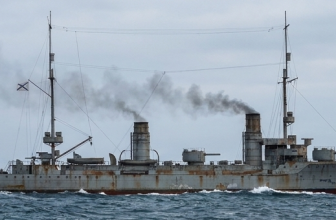
At approximately the same time, Germany was building the armored cruiser Blücher, which became one of the most unusual ships of her class.
With a normal displacement of approximately 15,842 tons, the German cruiser carried twelve 210 mm guns in six twin turrets. Her maximum speed reached 25.4 knots, while her armor belt was up to 180 mm thick.
Consequently, the German cruiser would have surpassed the alternative Rurik in both speed and the total number of heavy guns. However, Blücher could not bring all twelve guns to bear on a single broadside: her broadside consisted of eight 210 mm guns.
Therefore, in an artillery duel, both ships would have had eight main battery guns available for a broadside salvo. The German shells were somewhat heavier, but the Russian cruiser would have possessed a more compact and rational artillery arrangement, as well as substantial armor protection.
However, Blücher had one extremely important advantage: speed. She could choose the engagement range and, if necessary, avoid a confrontation. Therefore, the alternative Rurik would not have enjoyed any guaranteed superiority over the German cruiser.

Armored cruiser Blücher
How Might Her Service Have Unfolded?
Let us suppose that British shipbuilders successfully completed the new design and that, by 1909, the Baltic Fleet received an entirely different Rurik.
The ship would become the flagship of the cruiser forces and take an active part in naval exercises. Particular attention would be paid to firing the eight 203 mm guns under centralized fire control.
Operational experience would confirm the advantages of a uniform main battery. Russian specialists would gain practical information about the arrangement of superfiring turrets, the effects of muzzle blast, and the operation of ammunition magazines.
Nevertheless, by the outbreak of World War I, even such a ship would already be inferior to the latest battlecruisers in speed and artillery power. Therefore, her most likely role would remain operations in the Baltic Sea, covering minelaying missions and supporting light naval forces.
Here, her eight 203 mm guns could prove extremely useful, particularly in engagements with German light cruisers and in supporting destroyer attacks.
However, it would be a considerable exaggeration to suggest that a single such ship could have changed the course of the war in the Baltic.

Instead of an Afterword
Stvolyar’s alternative Rurik represents a very interesting attempt to reconsider the concept of the Russian armored cruiser at the beginning of the twentieth century.
Instead of a heavy ship with mixed-caliber artillery, we get a more compact and faster cruiser with a uniform main battery, good armor protection, and a modern turret arrangement.
At the same time, we must remember that armored cruisers as a class were already approaching the end of their era. The appearance of the British Invincible and subsequent battlecruisers quickly rendered many of the advantages of such ships obsolete.
Nevertheless, this version of Rurik could have become a very successful transitional design. Moreover, the use of a superfiring arrangement on a major Russian warship even before the appearance of domestic dreadnoughts would have been of considerable interest for the development of Russian naval shipbuilding as a whole.
What do you think? Should the Russian Naval Ministry have abandoned the 254 mm guns in favor of eight 203 mm weapons? Or was the real Rurik, with her powerful 10-inch guns, the better choice?