Deadlift: Different Weight Classes, Different Goals
The first thing anyone who begins to compare these two powerplants notices is the difference in their rated thrust. The American giant is capable of generating up to 47,000 kilogram-forces of thrust, which officially makes it the most powerful civilian aircraft engine in history. The Russian PD-35 is designed for a thrust class of about 35,000 kilogram-forces. At first glance, the advantage seems overwhelming. However, such an assessment would be superficial. The fact is that the GE9X was developed for a specific platform—the heavy wide-body Boeing 777X, whereas the PD-35 is geared toward future Russian aircraft, including modernized versions of the Il-96 and new designs that may have different weights and aerodynamics. Comparing these engines “head-to-head” is like comparing a truck to a semi-trailer: both serve the purpose of transportation, but under different conditions. Therefore, in the “thrust and mission” category, it is more accurate to speak not of one side’s victory, but of parity resulting from different engineering philosophies.
Technological Core: Composites, Ceramics, and Generations of Experience
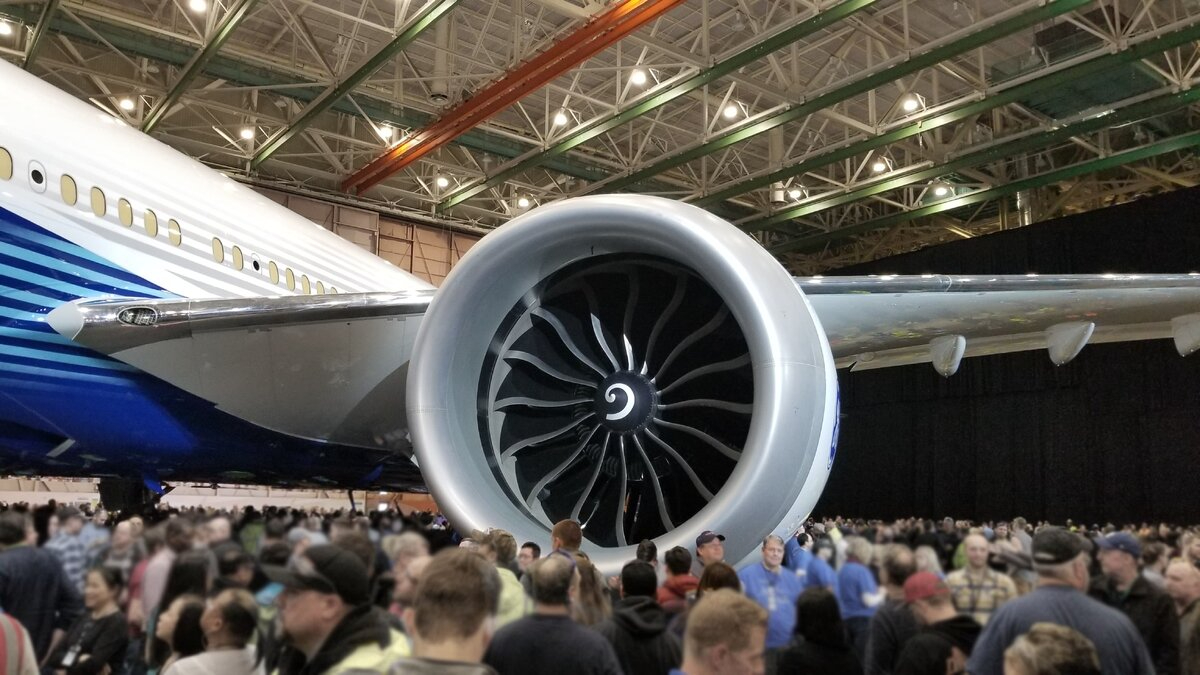
This is where the most interesting part of the comparison begins. The American GE9X embodies decades of continuous development in engine technology. Its fan, with a diameter of three and a half meters, is made of composite materials; ceramic composites are used in the hot section, and the bypass ratio reaches ten to one. It is an engineering masterpiece, every component of which has been refined for maximum efficiency.
The Russian PD-35, in turn, is based on technologies developed during the creation of the PD-14 engine for the medium-range MS-21. These include single-crystal turbine blades, advanced heat-resistant alloys, a digital control system, and wide-chord titanium fan blades. However, in terms of the extent to which advanced composites and ceramic matrix materials have been adopted, the American school still maintains a significant advantage. This gap is due less to a lack of expertise than to historical context: while Western companies have continuously invested in research, the Russian industry endured years of stagnation. Nevertheless, the very fact that Russia has returned to the heavy civil engine segment is already a technological achievement.
Fuel Efficiency: Figures That Still Need to Be Confirmed
The key advantage of any modern aircraft engine is fuel efficiency. It is this factor that determines ticket prices and the profitability of air travel on long-haul routes. The GE9X has a claimed specific fuel consumption in cruise mode ranging from 0.49 to 0.52 kilograms per kilogram-force per hour. This is approximately 10 percent better than that of the previous-generation GE90 engines and ranks among the best in the world.
For the PD-35, calculated values ranging from 0.51 to 0.53 kg/kgf·h are given. If these figures are confirmed in actual operation, the Russian engine will be on par with the best Western counterparts, such as the GEnx, and will significantly outperform the previous generation of domestic powerplants. However, the key word here is “calculated.” To date, the PD-35 has not yet completed a full cycle of flight tests, and its actual fuel efficiency remains the subject of design estimates. The American engine, on the other hand, has already logged thousands of hours on test aircraft, and its performance has been confirmed in practice. In this category, the advantage currently lies with the U.S., but with one important caveat: the gap is not insurmountable and can be narrowed as the Russian project is refined.
Program Readiness: Between Certification and Sovereignty
One of the most pressing issues is the actual readiness of both programs. The GE9X has completed its main testing phases and has been certified for installation on the Boeing 777X. However, the aircraft itself is facing delays in certification and market entry, so it is still too early to talk about widespread commercial flights with this engine.
The PD-35 is at an earlier stage of development. For Russia, this is not merely a technical project, but a matter of strategic independence. Only a few countries in the world are capable of developing heavy civilian engines of this caliber, and rejoining this “exclusive club” has significance that goes beyond mere technical specifications. Even if the PD-35 falls short of its American counterpart in certain respects, its existence will ensure Russia’s technological sovereignty in the wide-body aircraft segment. In this sense, success is measured not only by numbers but also by a country’s ability to independently solve the most complex engineering challenges.
Conclusion: Why There Is No Simple Answer
Comparing the PD-35 and the GE9X is like debating whether current leadership or the ability to catch up and overtake is more important. Today, the American engine is indeed ahead in terms of materials, proven fuel efficiency, and program maturity. However, the Russian project is not an attempt to copy, but rather an effort to establish its own school of heavy engine engineering, drawing on accumulated experience and new technological solutions. In the context of a changing geopolitical reality, the ability to produce such engines domestically is becoming no less valuable an asset than record-breaking performance figures. Therefore, the question of “who is ahead” has no clear-cut answer: it all depends on which criteria we consider decisive.
Features:
GE9X
- Traction: up to 47,000 kgf
- Fan diameter: 3.4 m
- Dual-circuit ratio: approximately 10:1
- Application: Boeing 777X
- Specific fuel consumption (cruising mode): 0.49–0.52 kg/kgf·h
- Materials: composite fan, ceramic composite materials in the hot section
PD-35
- Traction: approximately 35,000 kgf (design value)
- Class: heavy turbofan engine
- Application: Promising Russian wide-body aircraft
- Specific fuel consumption (cruising mode, estimated): 0.51–0.53 kg/kgf·h
- Technologies: single-crystal turbine blades, heat-resistant alloys, digital control system, wide-chord titanium fan blades
- Status: Prototype development and ground testing phase