The first generation of modern naval drones was conceptually very simple. Take a small high-speed boat, add satellite communications, cameras, navigation equipment, and several hundred kilograms of explosives. The mission was equally straightforward: travel as far as possible, locate a ship or harbor facility, and crash into it. In practical terms, it was a guided torpedo that traveled on the surface rather than underwater.
But this concept has an obvious drawback: after every successful attack, the platform disappears together with its warhead. There is little sense in installing an expensive radar, sophisticated communications equipment, or complex weapons on such a craft because all of it will be lost during the first strike.
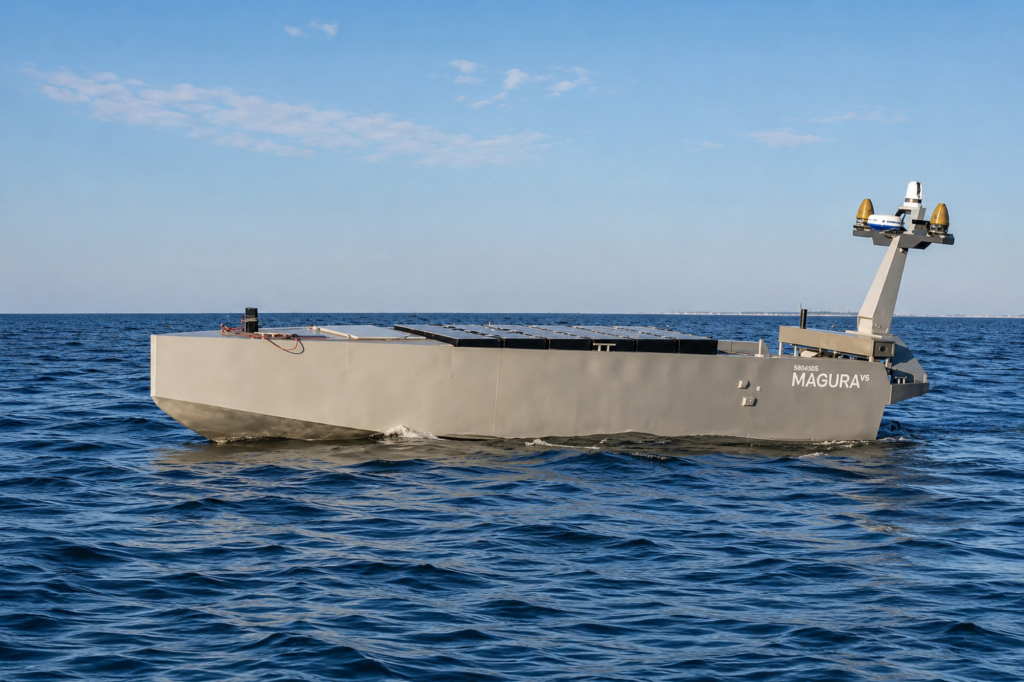
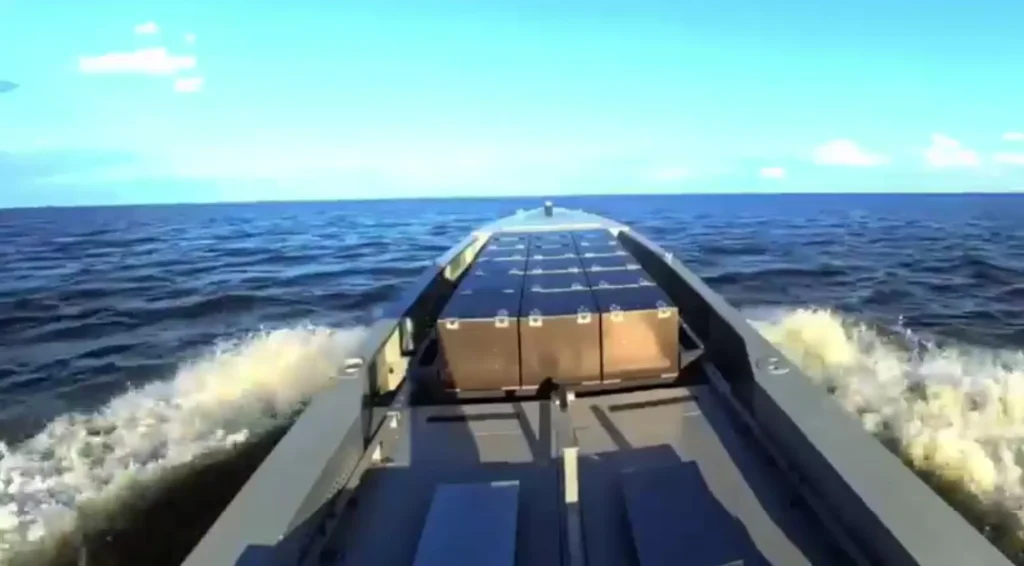
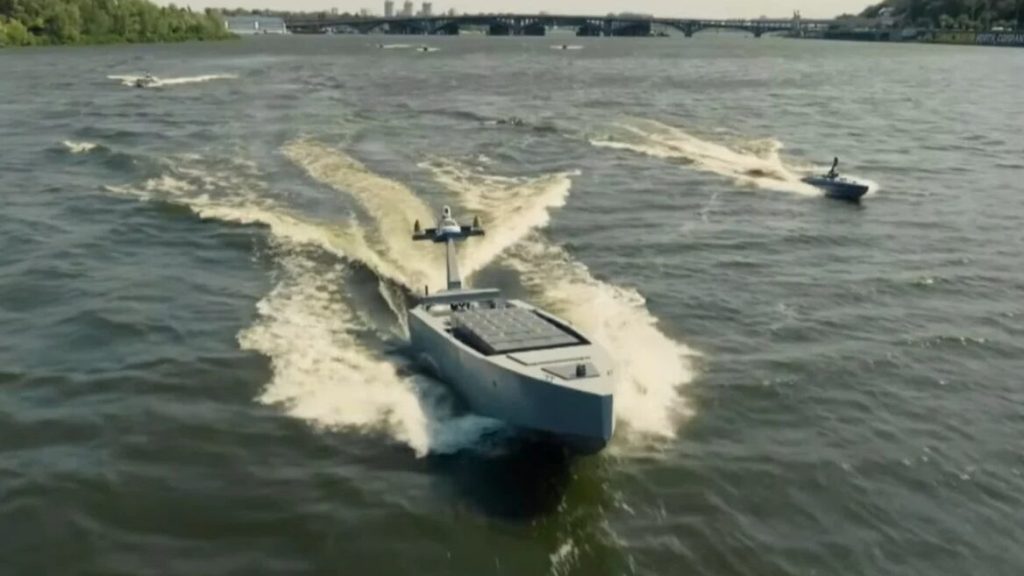
The Magura MV11, unveiled in August 2026, points toward a very different direction. This is no longer a small boat built around an explosive charge, but a large unmanned maritime platform designed for autonomous operations lasting up to a week and capable of carrying as much as 2,200 kilograms of payload. Its first publicly demonstrated configuration is particularly unusual: the deck carries 18 vertically launched Sting interceptor drones.
It is essentially a drone nesting doll: an unmanned vessel carrying unmanned aircraft designed to destroy other unmanned aircraft.
But there is something much more interesting here. The MV11 suggests that unmanned surface vessels are beginning to repeat the evolution of conventional warships — only much faster.
From Disposable Attack Boat to Combat Platform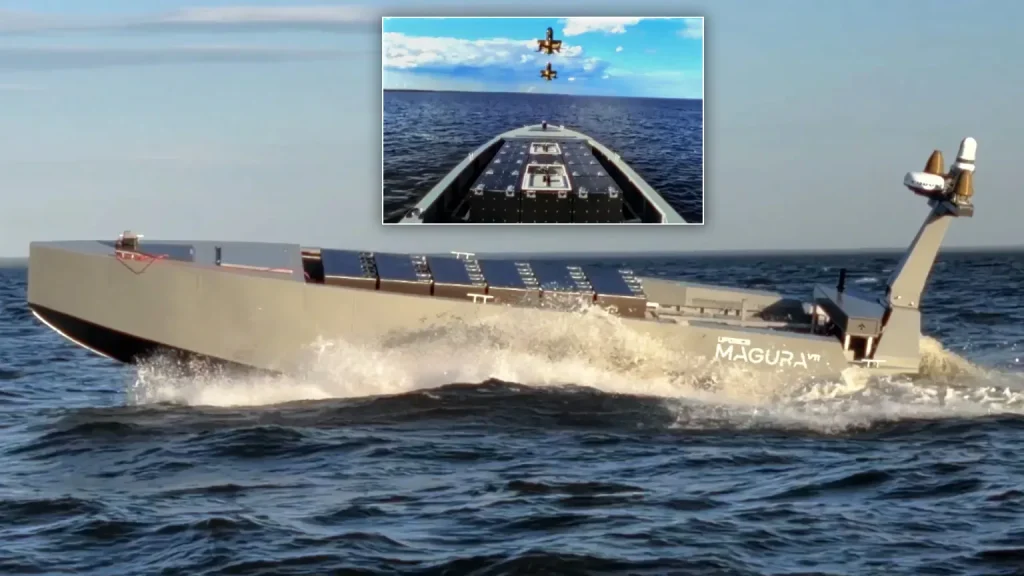
The first wave of modern USVs was largely driven by the need for the cheapest possible way to attack a large warship. The economics were extremely attractive: losing several unmanned boats could still make sense if even one succeeded in damaging a target worth tens or hundreds of millions of dollars.
Early designs were therefore optimized primarily for speed, range, and warhead weight. The cheaper the platform itself, the better. Sophisticated sensors, serious weapon systems, and large payload capacity simply were not necessary.
Gradually, however, it became clear that a remotely controlled boat could perform far more missions. Machine-gun mounts, rockets, FPV drones, and even modified air-to-air missiles began appearing on maritime drones. Variants of Magura have already been demonstrated carrying R-73 and AIM-9 Sidewinder missiles adapted for engaging aerial targets.
Sea Baby, meanwhile, evolved into a carrier for small strike drones. Some variants can transport multiple FPV drones inside launch compartments and release them only after reaching the operational area.
That development revealed a simple fact: if a naval drone can travel hundreds of kilometers, why destroy the carrier together with the target?
It may be far more useful as a reusable weapons platform.
The MV11 Is a Very Different Machine
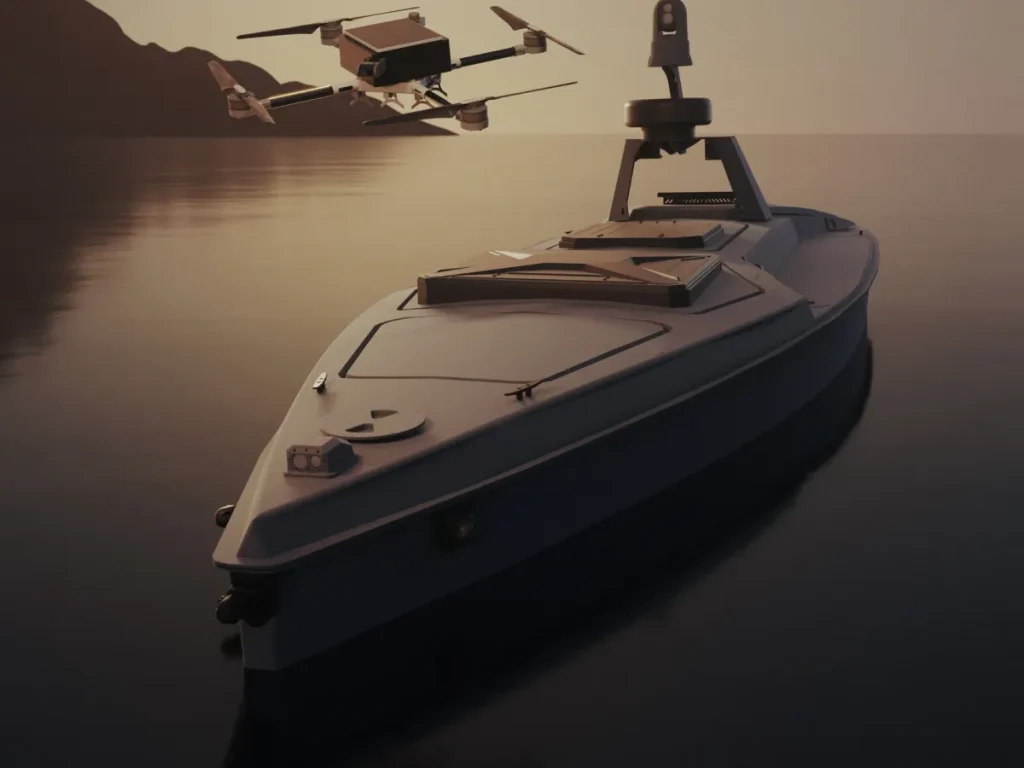
This is why the specifications of the MV11 matter more than its appearance. Developer UFORCE claims a payload capacity of up to 2.2 tons and an endurance at sea of as much as seven days. Compared with the original generation of explosive attack boats, that represents a dramatic increase in capability.
The most important factor is not even the specific numbers but the available weight and internal volume. Two tons of payload can be used in many different ways. Today it means interceptors. Tomorrow it could mean reconnaissance UAVs, strike FPV drones, additional fuel, electronic-intelligence equipment, communications relays, electronic-warfare systems, or entirely different weapons.
Published images of the MV11 already show a relatively sophisticated mast carrying an electro-optical system, navigation radar, and additional antennas. Equipment resembling satellite communications terminals can also be seen on the deck. The exact sensor configuration has not been disclosed, so it would be premature to claim that the vessel has a fully independent air-surveillance capability.
But the architecture already resembles a small warship rather than a guided torpedo.
It simply does not need a bridge.
Why Does a Naval Drone Need 18 Small “Anti-Aircraft Missiles”?
The most visually striking element of the demonstrated configuration is the battery of 18 Sting interceptors. Calling them anti-aircraft missiles, however, would be inaccurate.
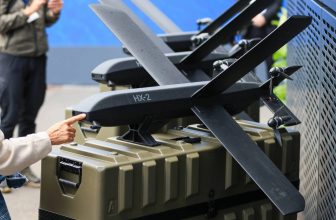
Sting is a small electric quadcopter interceptor weighing approximately 4 kilograms, developed by Wild Hornets primarily to engage Shahed-type attack drones and other relatively slow aerial targets. It carries a small warhead and is controlled by an operator. Its reported maximum altitude reaches roughly 7,000 meters, while maximum range can reach several dozen kilometers depending on configuration and conditions. Its cost is estimated at only a few thousand dollars per unit.
That price is precisely what makes the idea interesting.
Using a conventional surface-to-air missile costing hundreds of thousands or even millions of dollars against a relatively inexpensive attack drone is not always economically sustainable. Sting proposes a completely different model: use a small interceptor costing a few thousand dollars instead.
The MV11 then allows a battery of these interceptors to be moved far offshore.
The result is something resembling a floating forward air-defense outpost.
Why Move Air Defense Out to Sea?
This is where the concept becomes particularly interesting.
Imagine an aerial target approaching the coast over the sea. In a conventional architecture, shore-based sensors detect it and interception begins relatively close to the protected area.
An unmanned maritime platform potentially allows the interception line to be pushed forward. Several MV11s could theoretically operate tens or even hundreds of kilometers offshore and launch their interceptors before incoming drones approach the main land-based air-defense network.
Of course, the boat alone is not enough. Such a system requires external detection and targeting data, reliable communications, operators, and a broader information network. It also remains unclear how effectively the MV11 can independently detect small aerial targets.
Conceptually, however, this creates a very interesting architecture. A large radar does not necessarily have to be installed on the unmanned vessel itself. Targeting information could come from a shore-based radar, aircraft, another ship, or another drone, while the MV11 serves as a distributed launcher.
The radar can be in one location, the operator in another, and the weapon itself somewhere else entirely.
This Is Starting to Look Like a Real Fleet
On a conventional warship, almost everything is concentrated on one hull. The radar detects a target, the combat-management system tracks it, an operator makes the decision, and a missile launched from the same ship performs the interception.
This is convenient, but expensive. Damage to one vessel can simultaneously remove sensors, weapons, command facilities, and crew from the fight.
Unmanned systems allow this architecture to be broken into separate components. One platform conducts reconnaissance, another acts as a communications relay, a third carries electronic-warfare equipment, a fourth carries interceptors, and a fifth launches strike drones.
Losing one node is undesirable, but it does not destroy the entire system.
This is where the MV11 becomes much more interesting than simply another “large naval drone.” Its payload capacity allows individual vessels to be specialized. One MV11 could carry interceptors, another could serve as a reconnaissance platform, a third could operate as a communications relay, and a fourth could carry strike UAVs.
Instead of one universal warship, the result is essentially a distributed unmanned warship, physically divided among several hulls.
The Maritime Drone Mothership Is Not an Entirely New Idea
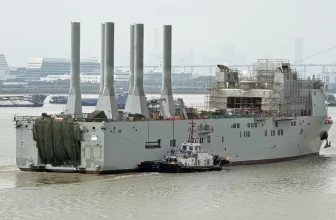
The carrier-USV concept is already developing into a distinct category. Other unmanned catamaran designs with broad working decks have been demonstrated carrying containerized launch systems for aerial interceptors.
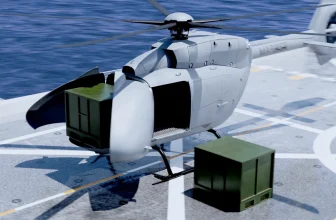
At the same time, Sea Baby has acquired the ability to launch FPV drones near the target area. This dramatically increases the effective range of a small aerial drone: instead of flying all the way from shore, it spends most of the journey aboard a maritime carrier and launches only when it reaches the operational zone.
That is almost literally the fundamental principle of an aircraft carrier.
An aircraft has limited range, so the ship transports it closer to the enemy.
An FPV drone has even less range, so an unmanned boat can perform exactly the same function.
The difference is primarily one of scale.
USVs May Be Solving an Old Problem of Small Warships
Naval architecture has always faced the same contradiction. The smaller the ship, the cheaper it is and the more examples can be built. But a small hull means less fuel, poorer seaworthiness, weaker sensors, and fewer weapons.
Removing the crew partially changes that equation.
The MV11 does not need crew quarters, a galley, sanitary facilities, extensive lifesaving equipment, or many of the systems required to sustain sailors. It does not require a conventional bridge. Many command functions can be physically removed from the vessel and transferred ashore.
The freed weight and volume can instead be used for fuel, electronics, and payload.
That means a relatively small unmanned hull can carry a surprisingly substantial weapons load.
There is still no magic involved. Seaworthiness, power generation, communications, and damage resistance remain serious limitations. A large conventional warship can remain deployed for weeks or months, survive bad weather, absorb damage, and continue operating because a crew is aboard to maintain and repair it.
The MV11 remains a much more limited platform.
The difference is that those limitations can potentially be compensated for through numbers.
The Biggest Problem May Be Communications, Not Weapons
This is potentially the Achilles’ heel of the entire concept.
The more sophisticated an unmanned warship becomes, the more information it needs to receive and transmit. Cameras, navigation, control, targeting data, interceptor telemetry — all of this requires reliable communications.
For a simple one-way attack USV, losing the data link is a serious problem, but parts of the route can potentially be completed autonomously. For a floating air-defense node, the situation is much more complicated. The operator needs to know where the target is, where the interceptor is, and what is happening around the carrier.
Satellite terminals can solve part of this problem, but they also create dependence on external communications infrastructure.
The real revolution in unmanned naval warfare is therefore not determined solely by engines, hulls, or weapons.
It depends on the ability to connect large numbers of inexpensive platforms into a single network.
And That Produces Something More Interesting Than a “Drone Aircraft Carrier”
The phrase “drone aircraft carrier” sounds dramatic, but it is somewhat misleading. The MV11 is not trying to replace a conventional aircraft carrier. It cannot match its range, seaworthiness, sensors, survivability, or combat capacity.
It makes more sense to view it as a floating modular platform.
Today it carries 18 Sting interceptors. Tomorrow, the same payload space could accommodate entirely different equipment. That modularity, combined with relatively high payload capacity, is what makes the concept interesting.
Recent demonstrations of maritime unmanned systems have already shown several forms of specialization: drone carriers, air-defense platforms, electronic-warfare systems, and vessels carrying rocket weapons.
In other words, we are no longer watching the evolution of one particular drone.
We may be seeing the emergence of a family of specialized unmanned warships.
And This Is a Very Familiar Story
The earliest military aircraft were used primarily for reconnaissance. Then machine guns appeared. Then bombs, torpedoes, and specialized equipment. Gradually, the generic “airplane” divided into fighters, bombers, reconnaissance aircraft, attack aircraft, transports, and numerous other specialized classes.
Something similar is now happening with unmanned vessels, only much faster.
First came the kamikaze boat. Then the reconnaissance USV. Then the FPV carrier. Machine guns and missiles followed. Now we have a large platform carrying its own battery of aerial interceptors.
The next step is predictable: specialization.
The important question is therefore no longer whether one unmanned boat can replace a frigate. It almost certainly cannot.
A much more interesting question is this: how many of a frigate’s functions can be distributed among ten far cheaper unmanned platforms?
That Is Why the MV11 Is More Important Than Its 18 Sting Interceptors
Technologically, there is no magic here. A large unmanned boat has been equipped with a working deck, communications, sensors, and containers carrying small quadcopters. Every individual component already exists.
But this is often how the most interesting changes in military technology occur. New physics is not always required. Sometimes the breakthrough comes from connecting existing components in a different way.
Early naval drones were weapons.
The MV11 is increasingly a carrier of weapons.
That represents a fundamentally different stage of development.
A disposable attack boat has one predetermined mission. A platform capable of carrying 2.2 tons can receive an entirely new mission simply by changing its payload.
Today it is a floating counter-drone battery. Tomorrow it could be a strike-drone mothership, reconnaissance platform, communications relay, or electronic-warfare node.
And that is why the most important feature of the Magura MV11 may ultimately be neither the size of its hull nor the 18 interceptors on its deck.
The naval drone is gradually ceasing to be a torpedo with a camera. It is beginning to evolve into a genuine combat vessel — only with the most expensive, heavy, and vulnerable system removed from the design: the crew.