Until very recently, Israel was considered one of the world’s most technologically advanced armies in the field of unmanned aerial vehicles. For decades, Israeli companies have set the trends in reconnaissance UAVs, loitering munitions, and surveillance systems. But the war in the north of the country unexpectedly revealed something extremely troubling: the era of cheap FPV drones is changing the rules of the game even for an army like the IDF.
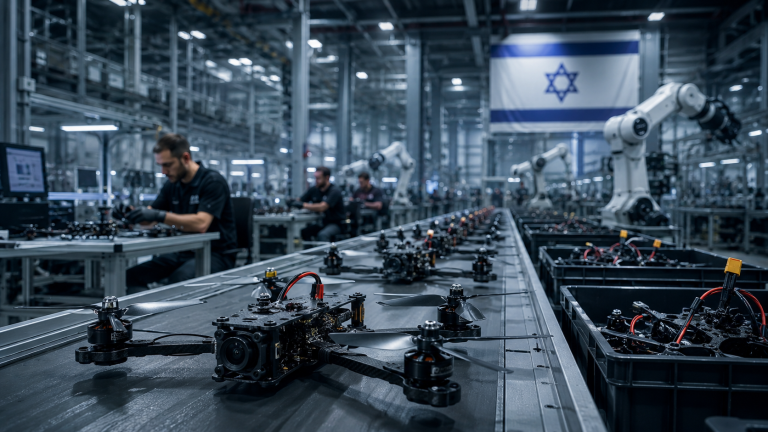
Israel is now effectively acknowledging this officially. It has been reported that the army is setting up its own factory for the mass production of FPV drones—those very same cheap “kamikaze” drones that have completely changed the nature of the war in Ukraine over the past two years and are now rapidly changing the course of the conflict in southern Lebanon as well.
Moreover, this is no longer just about purchasing individual drones from private companies, but about an attempt to turn the production of attack FPVs into a full-fledged military industry. According to Israeli media reports, the plant is expected to produce thousands of drones per month, and tens of thousands in the future.
The war in Lebanon has changed dramatically
The main reason for this rush is Hezbollah’s actions.
In recent months, the group has sharply increased its use of FPV drones against Israeli forces in southern Lebanon. Moreover, we are no longer talking simply about makeshift quadcopters carrying grenades, but about a fully systematic tactic clearly inspired by the Russian-Ukrainian war.
FPV drones controlled via fiber-optic links proved to be a particularly unpleasant surprise for Israel. Unlike conventional drones, they do not use radio channels and are therefore virtually invulnerable to traditional electronic warfare systems. The Israeli military, which for decades has relied on powerful electronic warfare capabilities, unexpectedly faced a threat against which its usual methods are ineffective.
Videos of attacks on Israeli Merkava tanks, engineering vehicles, and even heavy Namer armored personnel carriers began appearing online in large numbers. According to analysts, in recent weeks alone, Hezbollah has deployed dozens of FPV drones, some of which have resulted in casualties among Israeli troops.
For an army accustomed to absolute technological superiority, this was a very painful wake-up call.
Israel is now following Ukraine’s example
The most interesting thing about this story is just how much the very philosophy of war is changing.
Until recently, FPV drones were viewed as weapons used by semi-guerrilla groups or as a stopgap solution for underfunded armies. But the conflict in Ukraine has shown that a cheap quadcopter equipped with a warhead is capable of destroying equipment worth millions of dollars.
Now Israel is also beginning to accept this reality.
In essence, the IDF is shifting to a model of mass-produced, disposable weapons. Not complex and expensive precision-guided missiles, but huge swarms of cheap drones that can be manufactured in literally industrial quantities.
Moreover, the Israeli military wants to localize production as much as possible. One of the reasons for establishing its own factory was dependence on Chinese components. Prior to this, the army had been purchasing FPV systems from local companies, but a significant portion of the electronics and components still came from China. In the context of a major war, this began to be viewed as a serious risk.
Now Israel wants a production chain that is entirely “blue and white”—that is, as Israeli as possible.
Drones are becoming the new Kalashnikov
Another aspect of this whole story is particularly telling: FPV drones are gradually becoming a versatile weapon on the modern battlefield.
Initially, they were viewed solely as strike vehicles designed to target military equipment or infantry. But now Israel is simultaneously developing FPV interceptor drones—aircraft that will destroy enemy drones by ramming them or detonating explosives.
In fact, a new “micro-war” between drones is beginning.
Moreover, cost is a major factor here. A modern air defense system may have to use missiles costing hundreds of thousands of dollars to take down a drone worth just a few hundred. Such costs quickly become uneconomical, even for wealthy countries.
FPVs are changing the game. Now, an enemy drone can be taken down by another inexpensive drone.
That is precisely why Israel is in such a hurry to begin mass production.
The world is entering an era of cheap war
Just ten years ago, the future of war was envisioned as a clash between stealth aircraft, hypersonic missiles, and artificial intelligence. All of these technologies are indeed advancing. But at the same time, another reality has emerged—war fought with cheap, mass-produced systems.
An FPV drone costing a few hundred dollars is now capable of destroying a tank, an armored personnel carrier, a radar station, or even thwarting an offensive by an entire unit. And most importantly, such systems can be produced by the thousands—literally in garages and small workshops.
And now even high-tech Israel is forced to adapt to this new era.
Establishing its own FPV drone factory is not just another IDF military project. It is an acknowledgment that the future of warfare is already here. And it appears to be far cheaper, simpler, and more widespread than the generals of the early 21st century ever imagined.
источник https://www.twz.com/news-features/israel-building-factory-to-pump-out-its-own-fpv-drones