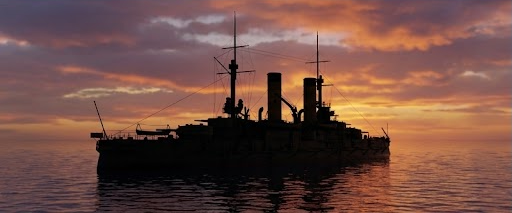
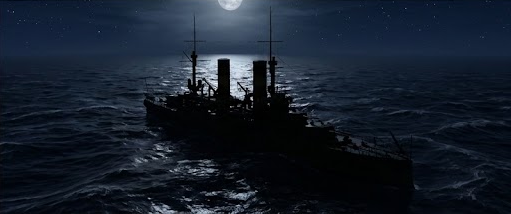
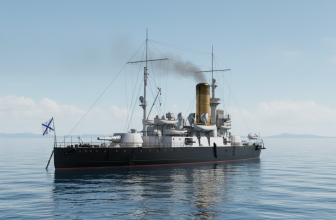
The World of Russian 7-Inch Guns. The RIF’s Main Striking Force in the Russo-Japanese War: The 14,000-metric-ton “Retvizan”-class squadron battleships

This is perhaps the most important and interesting article on the world of Russian 7-inch guns. It will focus on the mainstay of the Russian Imperial Navy. It is not the cruisers—even the armored ones—nor is it one of the first Russian battleships, the battleship “Sisoy the Great.” In this article, we’ll examine the main force of the Russian Imperial Fleet in the Far East—the 14,000-metric-ton squadron battleships. These included the “Retvizana,” the “Tsarevich,” and the “Borodino”-class ships—all designed in the United States.
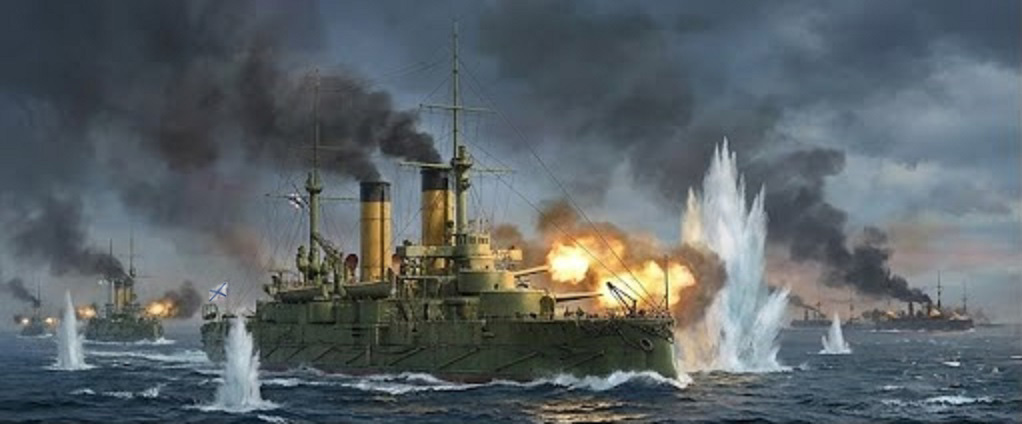
The Battle of the Yellow Sea
Smoke drifted across the leaden surface of the Yellow Sea, mingling with wisps of steam billowing from the punctured pipes. On the bridge of the Retvizana, Captain First Rank Eduard Shchensnovich kept his eyes fixed on the periscope. Main-caliber guns roared all around, but it was the steady, measured fire of the medium-caliber batteries that set the rhythm of the battle.
“Distance: fifty-five cable lengths. Target: the flagship. Fire from the starboard battery!” shouted the senior gunner.
A rumble shook the deck. Eight 7-inch shells fired from the *Retvizan* and the *Tsarevich* struck the Japanese flagship with terrifying accuracy. Two struck the stern, piercing the thin armored deck and exploding inside the superstructure. The third exploded near the mainmast, showering the deck with shrapnel and incendiary mixture.
“The flames have spread to the lifeboats! The fire crew reports that the hatches to the stern tower holds have been sealed, but the ventilation system is damaged!” the officer on watch reported over the intercom.
“Repeat the volley. Target the sources of fire. Don’t let them contain the damage!” ordered Shchensovich.
Another deafening roar. The 7-inch shells, carrying twice as much explosive as standard 6-inch shells, blazed like torches. The fire, fueled by the wooden structures and lacquered surfaces of the Japanese ship, spread rapidly downward. At 2:17 p.m., there was a faint pop, followed by a deafening roar. A column of black smoke and orange flames shot up above the *Mikasa*. The ammunition in the stern magazines detonated. The flagship of the combined fleet snapped in two and began to slowly list to one side.
The entire Russian squadron, without slowing down, slipped through the gap that had opened in the Japanese formation. The commander of the Japanese forces, Rear Admiral Nasibe Tokioki, who was flying his flag aboard the armored cruiser *Kasuga*, gave the signal to retreat upon seeing the destruction of his flagship and the critical damage sustained by the remaining ships. The Russian battleships, having retained their combat capability, sailed at full speed toward Vladivostok. The Japanese squadron was forced to return for repairs: virtually all of its ships required dry-docking, boiler replacements, and major restoration of their superstructures. The Russian fleet’s breakout was a success.
The Birth of the “Seven-Inch Doctrine”
At the turn of the 1880s and 1890s, the Naval Technical Committee of the Russian Empire revised its principles for artillery armament. At that time, 152-mm guns were considered the global standard for medium-caliber artillery. Russian engineers proposed a radical solution: to switch to 178-mm (7-inch) guns as the medium caliber for battleships and the main caliber for cruisers. The idea was based on qualitative superiority. A single 7-inch shell possessed enough destructive power to put armored cruisers out of action, cause critical fires on battleships, and inflict damage comparable to hits from heavy guns, but with a significantly higher rate of fire.
In accordance with this doctrine, the battleship “Sisoy the Great” was designed in the early 1890s and became the first vessel to carry 7-inch artillery. Following successful trials at the proving ground, a competition was announced for the design of a new-generation squadron battleship. French designers proposed traditional layouts with staggered gun batteries, but the American shipyard “Kramp” won the contract. Their engineers developed a line-of-battle, elevated arrangement for the medium-caliber guns, in which the turrets were aligned in a single line with the stern and bow guns elevated. This layout provided maximum firing angles, concentrated broadside fire, and excellent stability during firing. It was this design that formed the basis for the series of 14,000-metric-ton “Retvizan”-class battleships.
Technical Specifications
- Standard displacement: 14,000 metric tons
- Length at the waterline: 400 feet (121.92 m)
- Maximum length: 405 feet (123.44 m)
- Maximum width: 74 feet (22.56 m)
- Draft at normal displacement: 25 feet (7.62 m)
- Coal supply: 875 metric tons (normal) / 1,625 metric tons (full)
- Boilers: 20 Belville water-tube boilers, 1898 model
- Engines: 2 triple-expansion steam engines, with a combined power of 16,000 l.s.
- Speed: 18.0 knots
Ordering (Stainless Steel and Chromium-Nickel Steel):
- Full circumference at the top (height: 7 feet 6 inches or 2.29 m): 254 mm (65% of the length) / 102 mm (35% of the length), tapering to 152 mm toward the bottom
- Full upper belt (height: 7 feet 6 inches or 2.29 m): 152 mm (65% of the length) / 102 mm (35% of the length)
- Crossbeams in the central section of the upper belt (whose lower edges adjoin the lower armor deck and its slopes): 152 mm
- 107-mm gun casemate (height: 7 feet 6 inches or 2.29 m): 76.2 mm (side walls and crossbeams) / 25.4 mm (partition walls within the casemate)
- Casemate armor for 107-mm guns: 38.1 mm
- Anti-torpedo bulkhead (65% of the length): 38.1 mm
- Lower armor deck (beveled carapace, including 12.7 mm of deck plating): 50.8 mm
- Battery deck (including 12.7 mm deck plating): 38.1 mm
- Upper deck within the 178-mm gun casemate (casemate roof, including the 12.7-mm-thick deck plating): 25.4 mm
- Medium-caliber turret gun mounts: 152 mm (above the upper deck) / 102 mm (from the gun deck to the upper deck)
- Medium-caliber turrets: 152 mm (side) / 38.1 mm (roof) / 38.1 mm (floor)
- Main-caliber turret thicknesses: 254 mm (above the upper deck) / 178 mm (from the gun deck to the upper deck) / 102 mm (from the lower deck to the gun deck)
- Main-caliber turret armor: 254 mm (side) / 50.8 mm (roof) / 76.2 mm (floor)
- Combat compartment: 254 mm (side) / 50.8 mm (roof) / 50.8 mm (floor) / 102 mm (service duct)
- Armament: 4×305/40-mm guns, 8×178/45-mm guns, 12×107/45-mm guns, 8×47-mm guns, 2×37-mm guns, 2×63.5-mm landing guns, 4 machine guns, 2×450-mm underwater torpedo tubes
Service Before the War
The ships of this class entered service in 1902–1903 and were immediately assigned to the First Pacific Squadron. Even during the Baltic maneuvers and crossings of the Mediterranean Sea, the 7-inch batteries underwent thorough testing. The gun crews perfected the coordination between the main and medium-caliber crews, learning to quickly switch between targets depending on range and angle of engagement. Tactical guidelines were revised: instead of the traditional linear exchange of heavy shells at maximum ranges, the fleet relied on maneuvered fire with medium-caliber guns aimed at superstructures, bridges, and unprotected sections of enemy ships. By February 1904, the Retvizan and the Tsarevich had become not merely the flagships of their divisions, but the core of a new combat doctrine, in which fire from 7-inch guns was regarded as the primary means of defeating enemy manpower and compromising the enemy’s fire resistance.
After the Battle of the Yellow Sea
The sinking of the *Mikasa* and the severe damage sustained by the rest of the Japanese fleet radically altered the strategic balance. Faced with the impossibility of carrying out high-quality repairs on the ships within a reasonable timeframe due to the overload at the Kure and Sasebo shipyards, as well as an acute shortage of experienced dockyard specialists, the Tokyo cabinet agreed to negotiate. The terms of peace proved to be significantly more favorable for Russia. The Second Pacific Squadron did not have to undertake an exhausting voyage across three oceans. The First Squadron, having preserved the core of its battle line, fully accomplished its objectives: the blockade of Port Arthur was lifted, communications with Vladivostok were restored, and the Japanese fleet was driven back to its bases. The Russian battleships, having sustained only minor damage, continued to serve on active duty, demonstrating full combat capability and readiness for new operations.
Guardians of the Empire
After the peace treaty was signed, the “Retvizan”-class ships were not decommissioned. Between 1906 and 1909, they underwent a scheduled modernization: new optical rangefinders were installed, the ventilation system in the gun magazines was improved, the mine-resistant bulkheads were reinforced, and some of the 47-mm guns were replaced with more modern, rapid-firing mounts. The “Borodino”-class battleships also returned to service; in this alternate history, they were not lost at Tsushima. Together with the “Retvizan”-class ships, they formed a homogeneous heavy line that became the backbone of the united fleet. By the start of World War I, the seven-inch guns had already been surpassed in range by the latest artillery systems; however, the ships were successfully employed for coastal support, escorting transports, and training exercises. Some vessels were converted into artillery training ships, while others served in the Mediterranean Sea, ensuring a constant presence of the imperial flag off the coasts of the Allies. All battleships, including the “Retvizan” and “Borodino,” remained on the fleet’s roster until the mid-1920s, when they were gradually replaced by the first ships of a new generation—but now as part of a maritime power that had maintained its continuity.
The Empire That Endured
The victory at sea was not merely a tactical success but a strategic turning point that determined the country’s future course. The success of the First Pacific Squadron alleviated social and economic tensions. There was no ruinous campaign by the Second Fleet, no Tsushima shock—and thus, the fertile ground on which the revolution actually flourished never materialized. The government, drawing on growing industrial potential, stable maritime communications, and increased national prestige, carried out moderate constitutional and agrarian reforms, preserving the autocracy in a renewed form. The architects of the new fleet, engineers, and sailors became national heroes, and the “seven-inch doctrine” found its way into textbooks as an example of sound technological foresight. Russia confidently integrated into the global economy; its imperial structure withstood the trials of the early twentieth century; and the contours of the future were no longer sketched on the barricades but forged in shipyards and naval academies. The seven-inch guns of the *Retvizan* and the *Tsarevich* went down in history not merely as an artillery caliber, but as a symbol of naval power that altered the course of world events and preserved the empire amid the tides of a new era.