Following up on my previous post about how the Pentagon has acquired a weapon it won’t be able to handle, I’d like to share another article from Zen on this topic.
As for Iran.
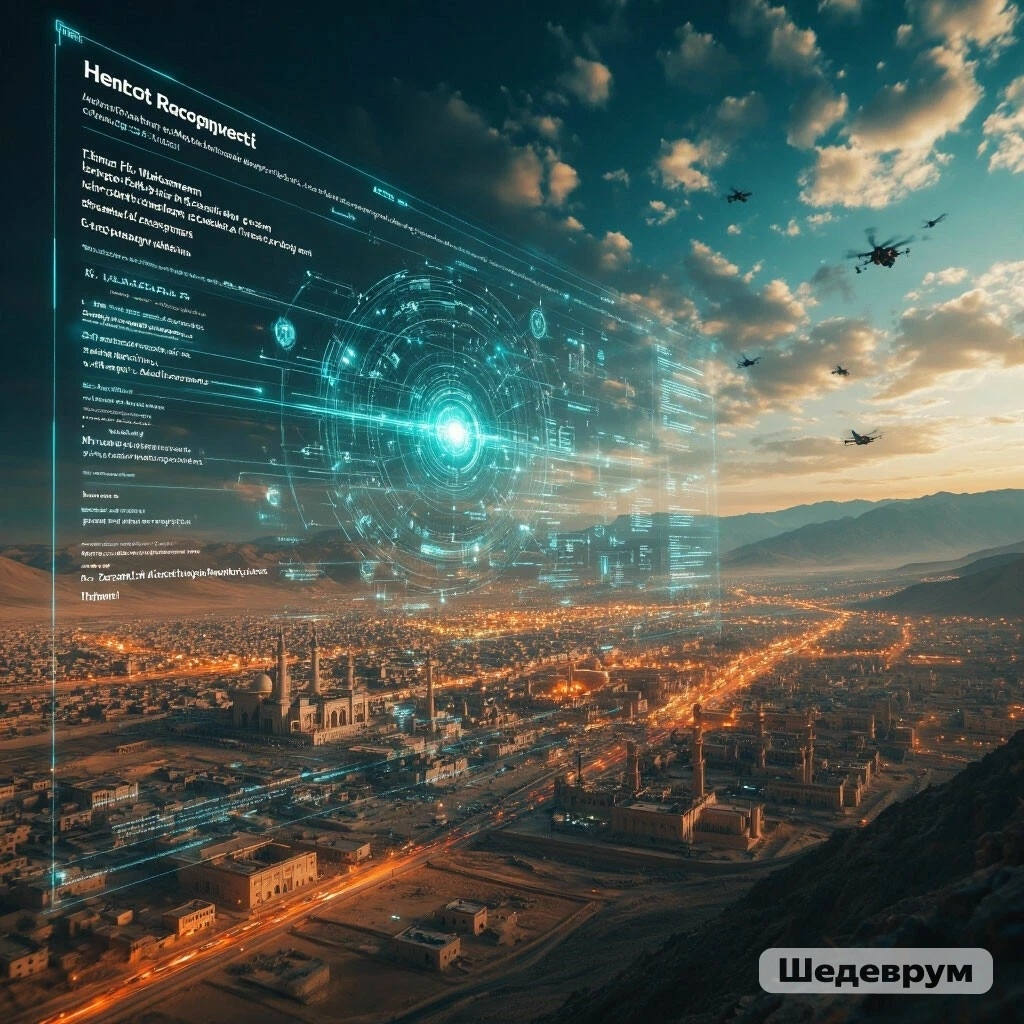
By all accounts, something is definitely amiss there—in terms of decision-making. It really does seem as though Trump has begun to actively use AI in managing and planning foreign policy actions.
Over the past six months—and actually even a little before that—Trump has really picked up the pace of his decision-making. He was constantly jumping from Greenland to Mexico, from there to Iran, then to Venezuela, to Canada, to Cuba… And so on, in a never-ending cycle. What’s more, each time it felt as though things were getting serious: troops were being deployed, and so on.
On the one hand, his actions were perceived as chaotic. On the other hand, try to devise a troop deployment plan—one that would be perceived by the enemy (with its intelligence services, top-notch analysts, etc.) as a real threat. It’s possible, of course—but it would take quite a bit of time, and secrecy isn’t guaranteed.
All in all, it seemed as though Trump had begun to radically outpace other world leaders in decision-making. While before the Venezuela situation it might have seemed that he was, as they say, “just showing off” (with no real calculation or planning behind his escapades), it subsequently became clear that, at the very least, this isn’t always the case.
To sum up: The pace of staff work in the U.S. has suddenly picked up sharply. This is despite the fact that, on the contrary, “disarray and instability” have begun to emerge within Trump’s team.
The conclusion? Well, yes: one possibility is that he replaced the staff with AI (which, by the way, could have further exacerbated the disarray and instability within the team). A neural network (currently the most advanced form of AI) could easily replace a staff or a team of analysts, and do a month’s worth of work in a single day. All that would be left is to print out the instructions and draft the orders (and the AI would help with that, too).
And it seems that’s pretty much what they did in the case of Venezuela. Then, inspired by the result, Trump decided to attack Iran as well—placing his complete trust in the “electronic dummy.”
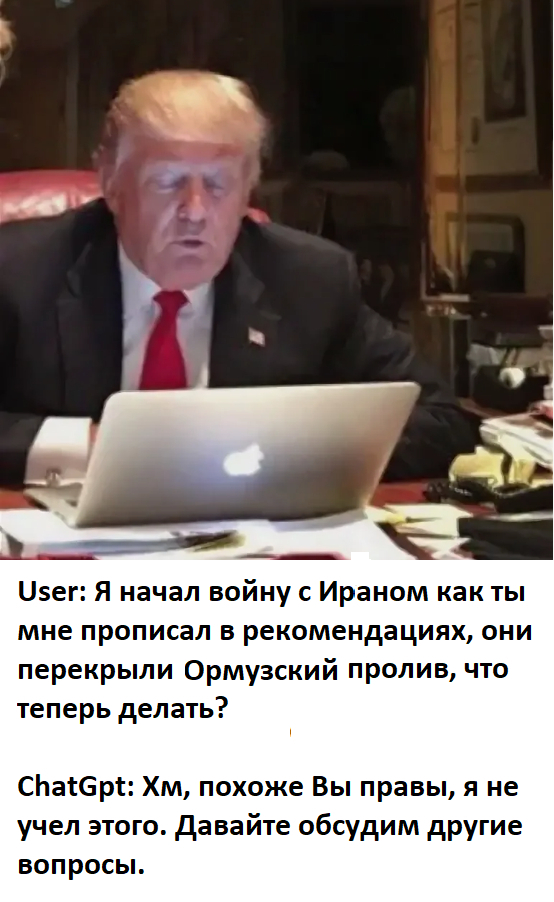
What’s more, the creator of the neural network (it seems Claude from Anthropic held key positions there), having realized in time that something was amiss, refused to cooperate with the Pentagon one day before the attack on Iran. But the wheels of events were already in motion and could not be stopped.
There is simply too much that is… inhuman about the attack plan itself. First and foremost: striking the top leadership is “forbidden” under the rules of war.
- First, it’s usually a suicide mission. It’s difficult to defeat the U.S. in a war… but it’s much easier to target the U.S. president personally—and even more so a former president. So escalating the confrontation to this level is completely disadvantageous for the U.S. in particular (and for the stronger side in general). And it’s certainly not the wisest idea for someone who will no longer be president in two and a half years.
- Second, if the enemy’s top leadership is eliminated, there is no one left to make peace with. A devastating blow may prompt the enemy to surrender. But someone has to make that decision. But if there is someone who can make that decision, it means the command structure has not collapsed—and in that case, is there any reason to surrender?
In short, the machine has no sense of self-preservation—and this is evident from its attack plan.
Well, and a number of specific actions—including an attack on a girls’ school. Apparently, there used to be a military base there—a long time ago. But that hasn’t been the case for a long time now. The AI, which was using outdated data, mistook the school for some kind of barracks. A human could have figured it out. But…
And, of course, the most important point is the lack of a Plan B. It was clearly assumed that failure was impossible. The assumption was that once the rahbar was removed, power would automatically shift to the president—who is considered relatively liberal—resistance would be more or less suppressed, and those who had participated in protests before the war would continue to riot during it. And this certainly isn’t a matter of the neural network: it would have actually suggested various options. It’s precisely Trump’s recklessness… which was exacerbated by his previous success.
Well, there are also some nuances. Pereslegin’s team is currently evaluating the possibility of applying AI to governance (at the request of one of our senior officials). And they’ve identified a crucial aspect of how neural networks work that drastically increases the likelihood of a military conflict if they’re also tasked with foreign policy.
The neural network focuses on the “correct,” most likely outcome. First, it analyzes what is known about similar events from the past.
And so, regarding the July Crisis (the assassination of Archduke Ferdinand in Sarajevo in 1914), its course and outcome, there are millions of references, whereas for the Bosnian Crisis and both Moroccan Crises—which could also have served as a trigger for the start of World War I but did not (the situation was defused at the time)—there are orders of magnitude fewer. What does this mean for the neural network? It means that a military outcome for a crisis is the norm, whereas a peaceful outcome is a statistical anomaly. So it is precisely these kinds of decisions—those involving the use of force—that it will make. Moreover, it will likely prioritize successful “case studies”: their veterans earn honors and high-ranking positions, and these cases receive more coverage than the failed ones…
And let’s not forget: a neural network allows for quick decision-making—and that’s precisely why it’s better than a team of human analysts (for a user at the presidential level). Analysts, however, can explain their reasoning. And a neural network? Sure, it can do that too, of course. But it would still take time to make sense of the 20 or 200 pages it would generate as an explanation for its decision—which would diminish the benefit of using it.
As a result, the evaluation of the AI’s reasoning will become increasingly formalistic each time—and ultimately, the decision-maker will simply rubber-stamp its decisions anyway. In other words, under the current working methods, the AI will completely “overwhelm” the human.
Well, that’s Pereslegin’s conclusion: it’s not indisputable, but for now, that’s the conclusion.
At least, that’s how it will be until the first major glitch, after which people will stop trusting AI unconditionally…
Well, take Iran—there’s a setback like that. Clearly, the degree of recklessness in Trump’s actions—or, at the very least, their pace—should ultimately slow down.
Although… Maybe he’ll try once again to do exactly what the AI advises him to do—this time to defuse the crisis.
It will be interesting to see what advice real neural networks will give the U.S. leadership in the current situation—and to compare that with its actual actions.
P.S.: The name of the operation, by the way, is “Epic Fury”… Seriously, what kind of kindergarten nonsense is this? In the Middle East, they love colorful names, but even there, things haven’t gone this far. “Al-Aqsa Storm,” “Damascus Steel”… Well, Hezbollah called its retaliatory strike against Israel “Fierce Fury,” but that’s clearly a direct response to the “Epstein-style fury” of the U.S. and Israel. Iran, on the other hand, has the extremely neutral “True Promise—4.” IMHO, it also smacks of neural network-generated creativity.
Source: https://dzen.ru/a/abWbCJIcxgc26kX1