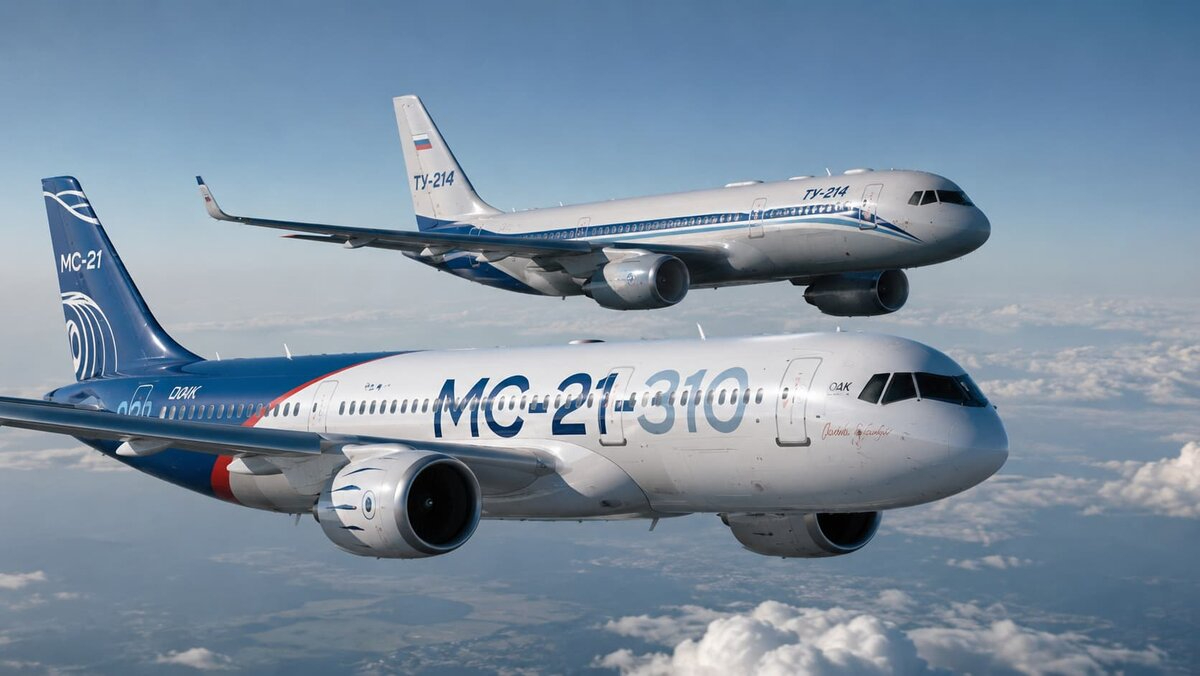
As Russian civil aviation shifts its focus toward domestically produced aircraft, the question of choosing between the time-tested Tu-214 and the promising MS-21 has never been more pressing. The two aircraft represent different eras, different approaches, and different development strategies. Which one will prove to be more effective in actual operation?
Historical Context and the Philosophy Behind Its Creation
The Tu-214 is a extensively modernized version of the Soviet Tu-204, which was developed in the late 1980s. The aircraft was developed at a time when reliability, maintainability, and the ability to operate in challenging conditions were top priorities. Its design has been proven through decades of service, and the production line at the Kazan Aviation Plant is well-established and fully operational.
The MC-21, on the other hand, was designed from the ground up in the 21st century as a response to global challenges in aircraft manufacturing. It was developed with an eye toward modern requirements for fuel efficiency, environmental sustainability, and passenger comfort. The aircraft embodies the Russian aviation industry’s aspiration for a technological breakthrough and to compete with global leaders—the Boeing 737 MAX and the Airbus A320neo.
Fuel Efficiency: The Battle for Every Liter of Fuel
The MC-21 was originally designed to reduce fuel consumption. Thanks to its new high-aspect-ratio composite wing, advanced aerodynamics, and PD-14 engines, the aircraft achieves a fuel consumption rate of approximately 0.53–0.56 kg per seat-kilometer in its standard configuration. This is one of the best figures in its class.
The Tu-214 was developed in the late 1980s with less efficient aerodynamics. Its PS-90A engines are reliable and proven, but their specific fuel consumption is higher—around 0.59–0.62 kg per seat-kilometer. Given rising jet fuel prices, this difference becomes a significant economic factor. In this regard, the MS-21 retains the advantage.
Capacity and Comfort: Space vs. Density
The MC-21 carries between 163 and 211 passengers, depending on the configuration. Its wider fuselage has made it possible to create one of the most spacious cabins in the narrow-body aircraft class. Larger windows, a comfortable cabin pressure equivalent to an altitude of 1,800 meters, and spacious overhead bins set a new standard for the passenger experience.
The Tu-214 typically carries about 180–210 passengers, but it has a denser seating configuration and a narrower cabin. The aircraft belongs to the previous generation of commercial aircraft, and although it offers an acceptable level of comfort, by today’s standards it falls short of the newer model. In terms of comfort and ergonomics, the MS-21 comes out on top.
Flight Range: A Hallmark of the Soviet School
Here, the situation changes dramatically. The Tu-214 has a range of about 6,500–7,000 km, which allows it to fly longer routes without technical stopovers or load restrictions. This makes it a versatile asset for airlines operating on transcontinental and regional routes.
The MC-21-310, in a two-class configuration, has a range of approximately 3,830 km. This is sufficient for most domestic and short-haul flights, but longer routes require either a reduction in commercial load or technical stopovers. Right now, Tupolev’s “old school” is making a comeback: the Tu-214 is better suited for long-haul flights. That’s a point in its favor.
Technological Feasibility: Digital vs. Mechanical
Digital avionics, a modern cockpit with active side control sticks, and a system with quadruple redundancy make the MC-21 the most technologically advanced Russian passenger airliner. Composite materials account for more than 30% of the airframe, which reduces weight and extends the airframe’s service life.
Much has been said about the Tu-214’s three-person cockpit, but that is far from the main problem. Exactly how the Tu-214 will be relaunched remains unknown. An avionics upgrade is possible, but fundamental design limitations will remain. From the standpoint of technological potential, the MC-21 looks more promising.
Readiness for Operation: Right Now vs. Tomorrow
The Tu-214 has been in series production for quite some time. Although production at KAZ is modest, it is indeed underway, and the aircraft has completed all stages of certification and testing under real-world conditions. Airlines can receive a “turnkey” aircraft without delays or risks.
The MC-21 is only now entering the mass deployment phase. Although the aircraft is technologically more advanced, the Tu-214 remains the more “proven” platform today, with predictable logistics for spare parts and maintenance. In terms of practical operation and flight readiness, the Tu-214 still holds the advantage.
Technical Specifications
Tu-214
- Maximum takeoff weight: 110.75 metric tons
- Maximum commercial payload: 25.2 metric tons
- Maximum landing weight: 93 metric tons
- Fuel weight when fully fueled: 35.71 metric tons
- Required runway length for takeoff: 2,030 m
- Range with maximum commercial payload: 3,800 km
- Maximum range: up to 6,500–7,000 km
- Cruising speed: 850 km/h
- Practical ceiling: 12,500 m
- Passenger capacity: up to 210
- Engines: 2 × PS-90A, thrust of 16,000 kgf each
- Wingspan: 41.8 m
- Length: 46.1 m
- Height: 13.9 m
MS-21-310
- Maximum takeoff weight: 85,000 kg
- Range in a two-class configuration: 3,830 km
- Maximum range: up to 6,400 km (depending on configuration)
- Cruising speed: 870 km/h (0.82 Mach)
- Number of passengers: 163–211
- Engines: 2 × PD-14
- Wingspan: 35.90 m
- Length: 42.25 m
- Height: 11.45 m
- Required runway length for takeoff: 2,410 m
- Percentage of composite materials: more than 30%
Final Comparison and Outlook
To sum up, we can conclude that the final score is 3–2 in favor of the MC-21. The MC-21 proved to be the superior modern commercial airliner thanks to its technology, fuel efficiency, and comfort. It is this aircraft that has come closest to matching the level of its global competitors and is setting the course for the development of Russian civil aviation.
The Tu-214 meets different requirements. Its advantages include long range, a proven design, and immediate operational readiness. Given the sanctions restrictions and the need to maintain domestic air service, the Tu-214 could become the “workhorse” on routes where the MS-21 has not yet been able to reach its full potential.
In the long term, the MC-21 is undoubtedly a priority. But until the program reaches full-scale production and resolves issues with international certification, the Tu-214 remains a strategically important asset. Neither a winner nor a loser, but rather two complementary tools in the arsenal of Russian aviation.