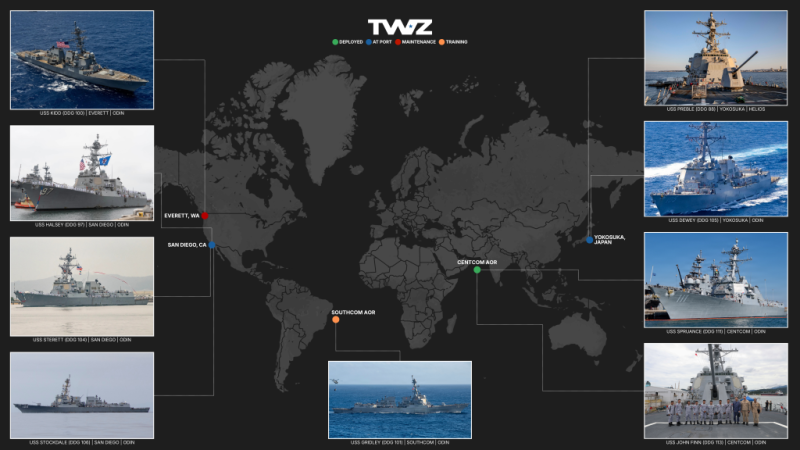
“The War Zone” has published some very interesting information about U.S. Navy warships currently equipped with laser weapons, as well as their basing and deployment. So I decided to put together a brief overview of the current state of the U.S. laser fleet:
Currently, the U.S. Navy has nine destroyers equipped with laser weapons: eight in active service and one undergoing modernization. They are divided into two groups based on the type of laser system installed on them:
The first group consists of eight Arleigh Burke-class destroyers equipped with the AN/SEQ-4 ODIN (Optical Dazzling Interdictor, Navy — Optical Dazzling Interdictor, Naval). This is a relatively small infrared laser housed in a compact turret. Its power output is only about 30 kilowatts, which—given the relatively small size of the focusing system—is usually insufficient to physically destroy enemy missiles and drones.
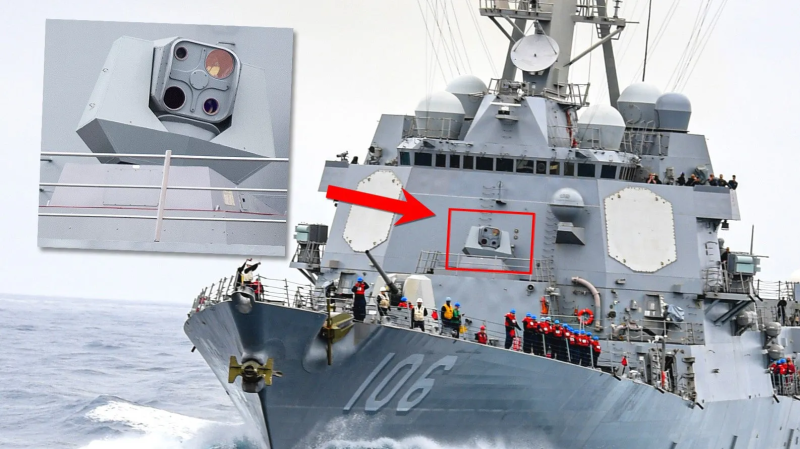
Installation of ODIN in the bow section of the DDG-106 USS “Stockdale”
ODIN’s primary mission is clearly stated in its name. It is a “dazzler,” an “optical interdictor”—in other words, a device designed to blind enemy optical and optoelectronic guidance systems. Its purpose is not to burn up enemy drones in flight, but to effectively disable their cameras. And for this task, a power output of 30 kilowatts is more than sufficient, even at significant distances.
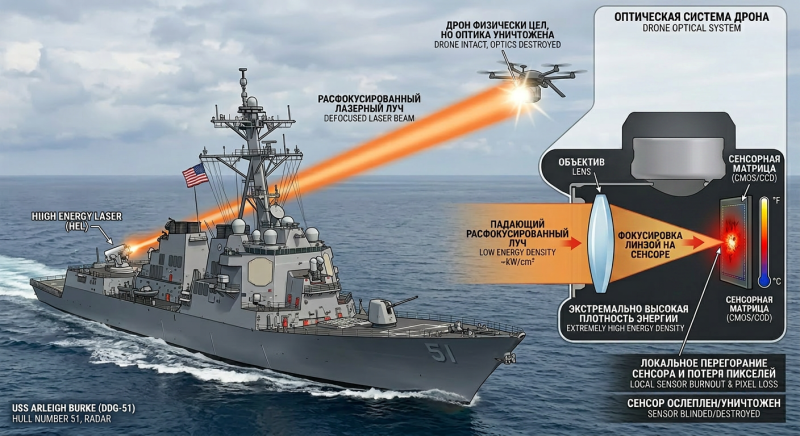
Optical systems are, in principle, extremely vulnerable to laser radiation. The very operation of any camera (including the Mk.1 Mod 0 organic eye) is based on focusing the incoming light onto the sensor that detects it. And if a coherent laser beam is introduced into this stream—even if it is out of focus due to distance—the camera’s lenses will obediently converge it into a single point directly on the sensor array. With consequences for the sensor that are easy to imagine.
This means that the ODIN drone’s camera can be blinded at a distance many times greater than the distance at which it can physically destroy the drone. Dozens of kilometers are no limit for the “dazzler’s” blinding beam; the target’s optics will still meticulously focus it onto the sensor array. And each such laser attack takes just a few seconds.
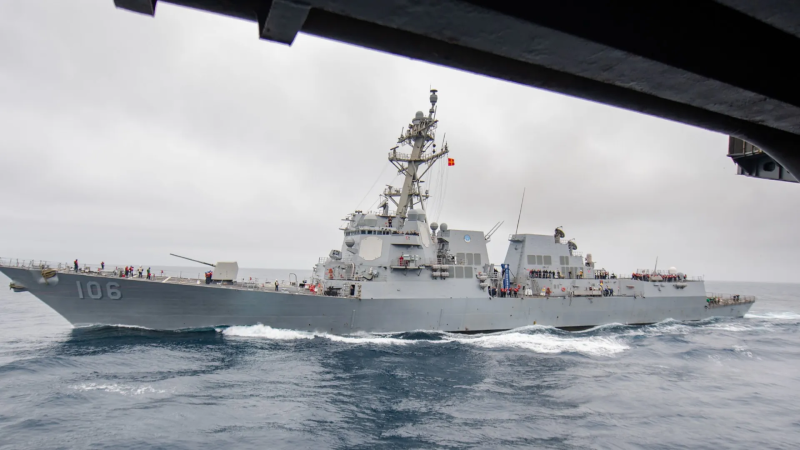
A ship equipped with ODIN, while unable to destroy drones in flight, can quickly and effectively blind them, disabling their guidance systems. ODIN is also deadly to enemy electro-optical reconnaissance systems, such as aircraft-mounted FLIR cameras. It is interesting to note, by the way, that ODIN’s secondary function is to serve as a powerful telescope for optical reconnaissance. Adaptive optics, which focus the laser beam onto the target, can also very effectively collect light from the target onto the sensor array (turning the laser into a telescope).
Currently, the following ships are equipped with ODIN:
* DDG-97 USS “Halsey” — based in the Port of San Diego;
* DDG-101 USS “Gridley” — is accompanying the aircraft carrier “Nimitz” on a diplomatic tour of countries in South and Central America;
* DDG-104 USS “Sterret” — based in the Port of San Diego;
* DDG-105 USS “Dewey” — is based at the Yokosuka forward operating base in Japan;
* DDG-106 USS “Stockdale” — based in the Port of San Diego;
* DDG-111 USS “Spruance” — deployed along with the USS Abraham Lincoln Carrier Strike Group in the Arabian Sea;
* DDG-112 USS “John Finn” — deployed along with the USS Abraham Lincoln Carrier Strike Group in the Arabian Sea;
Another of the ODIN-class destroyers—DDG-100 USS “Kidd”—is currently at the shipyard in Everett, Washington, undergoing a two-year overhaul and modernization. Its laser has been temporarily removed and transferred to the Naval Training Center in Port Wainamie, California, for personnel training:

The first class of U.S. sailors to graduate with the specialty of “laser system operator”
The second group of U.S. laser-equipped destroyers currently consists of a single ship—DDG-85 USS “Preble”—equipped with the HELIOS high-energy combat laser (High-Energy Laser with Integrated Optical Dazzler and Surveillance system).
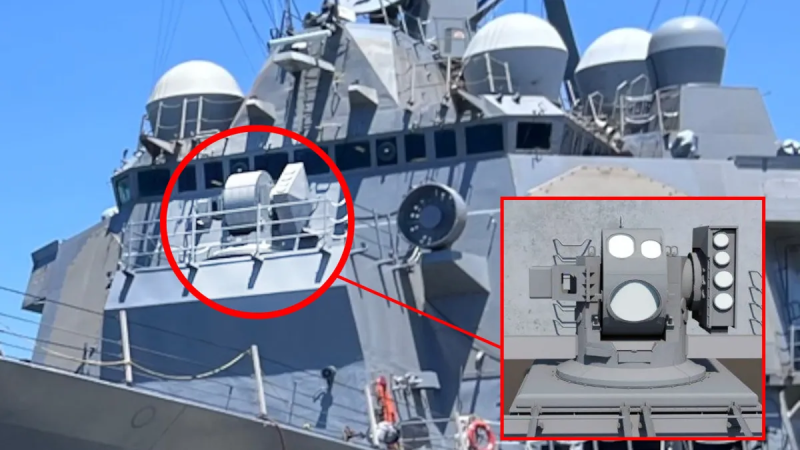
Unlike its predecessor, the HELIOS laser is a fully-fledged combat system with a maximum power of 60 kilowatts and significantly improved focusing capabilities. For HELIOS, blinding enemy optics is a secondary task; this laser is powerful and accurate enough to directly strike enemy drones, burning holes in them with its beam.
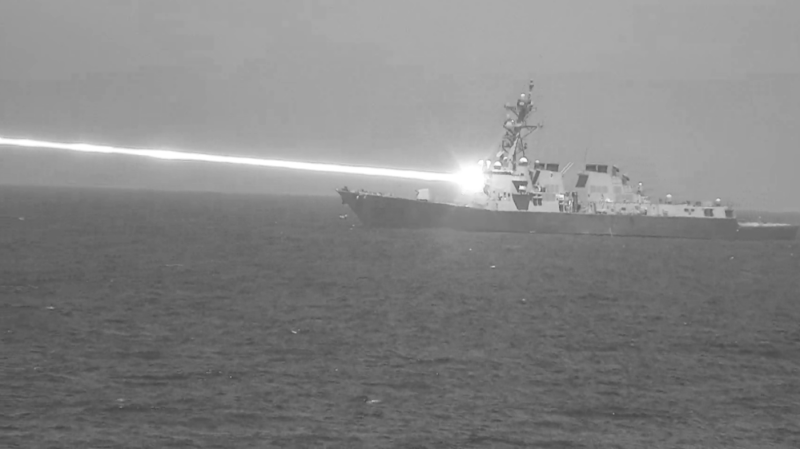
HELIOS during exercises in 2024. An infrared camera detected a band of superheated air through which the beam is passing
During tests in February 2026, HELIOS successfully destroyed four target drones. The specific type of drones destroyed by the laser is unknown, but they are presumed to be Type 3 according to the U.S. classification (i.e., weighing up to 600 kg and flying at speeds of up to 460 km/h). In other words, they were roughly the same size as the now-well-known Iranian “Shaheds.”
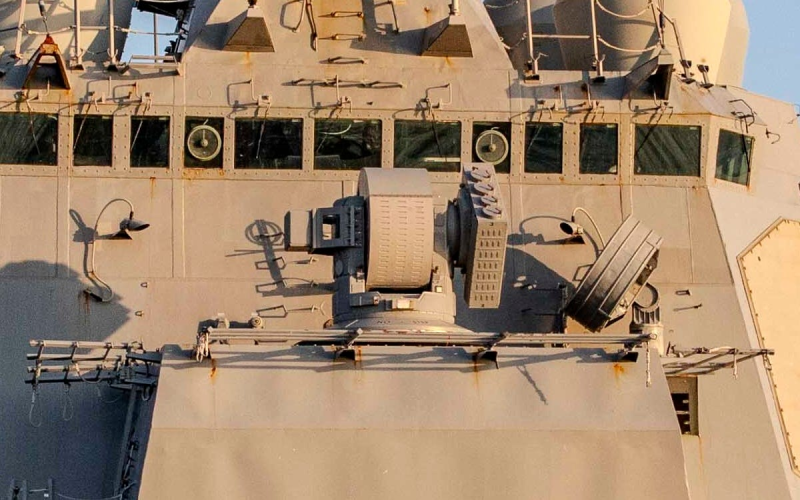
An important feature of HELIOS is that this laser is a fully developed weapon system and is integrated into the ship’s “Aegis” combat management system. This means that the laser receives target designation from the ship’s sensors, is automatically guided, and participates in the overall “target allocation” among the ship’s weapon systems. ODIN lacks such integration; it is guided manually by an operator who receives only approximate target data.

Currently, the U.S. Navy has exactly one HELIOS laser at its disposal. Lockheed Martin received a contract to manufacture two lasers, but one of them was intended for ground-based bench testing. It is currently unclear whether the U.S. Navy plans to purchase more lasers of this type or intends to wait for more advanced systems to become available.
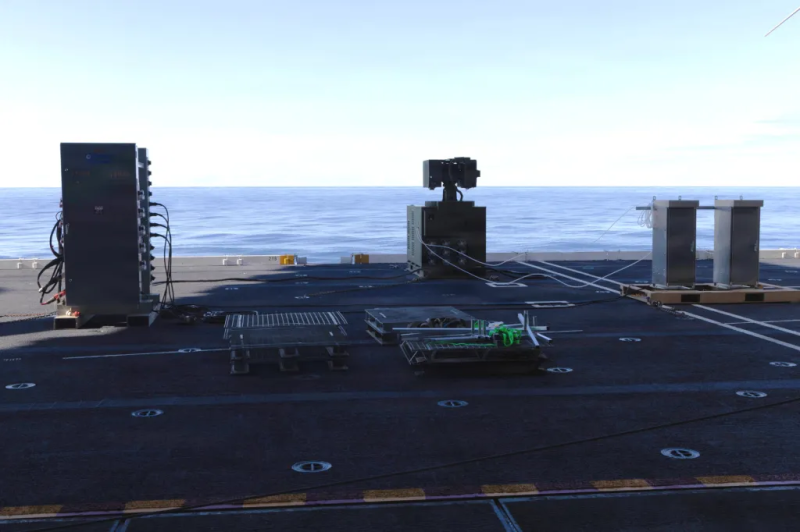
In addition to the ships mentioned above, two other U.S. Navy vessels were equipped with laser systems on an experimental basis. First, there were tests of the palletized LOCUST (Laser Operable Counter-UAS System) laser aboard the aircraft carrier USS George H.W. Bush (CVN-77). This installation was not permanent and was merely an experiment in using an existing land-based laser to protect ships.
Another experimental laser — the Mk 2 Mod 0 Laser Weapon System Demonstrator (LWSD), with a power output of up to 150 kilowatts — was installed on a trial basis aboard the San Antonio-class dock landing ship, LPD-25 USS “Portland.” This laser system is an evolutionary advancement of the AN/SEQ-3 Laser Weapon System (LaWS) prototype, developed in 2014 by Kratos Systems.
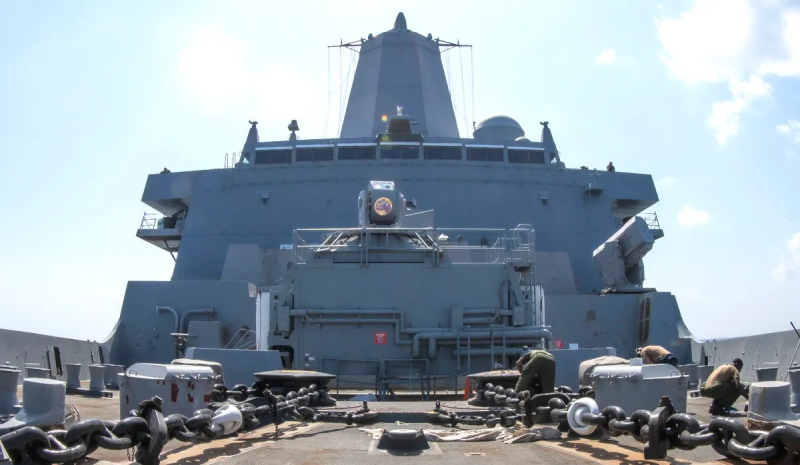
This system is also experimental and is not intended for combat use under normal circumstances. It is interesting to note that, until recently, the U.S. Navy wanted to shut down this program, and in 2023 ordered the removal of the experimental laser from the USS Portland. However, due to the changed geopolitical situation—and, most importantly, the changed nature of the battlefield—the laser was urgently reinstalled in 2025 to continue testing.