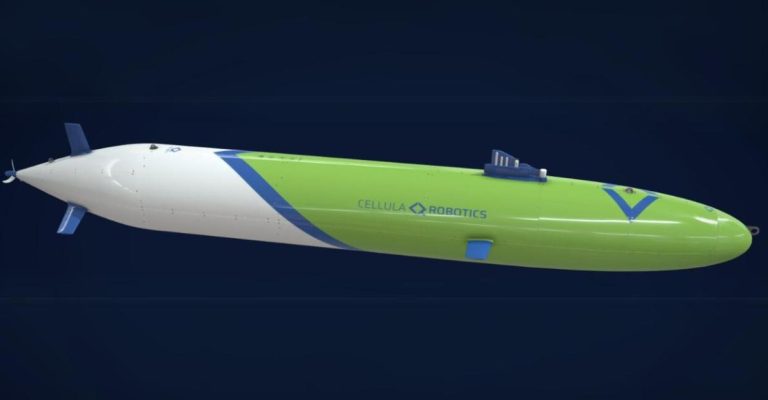
In recent years, underwater drones have been gradually moving away from the traditional “battery—charging—short mission” model toward much more autonomous solutions. The Canadian company Cellula Robotics has unveiled one of the most striking examples of this transition—the Envoy, a hydrogen fuel cell-powered vehicle.
The project is interesting not so much for its form—which is nothing new—but rather for its combination of range, autonomy, and architecture. However, quite a few oversimplified interpretations have already emerged, so it’s important to carefully distinguish the actual specifications from these interpretations.
Trials: What We Know for Sure
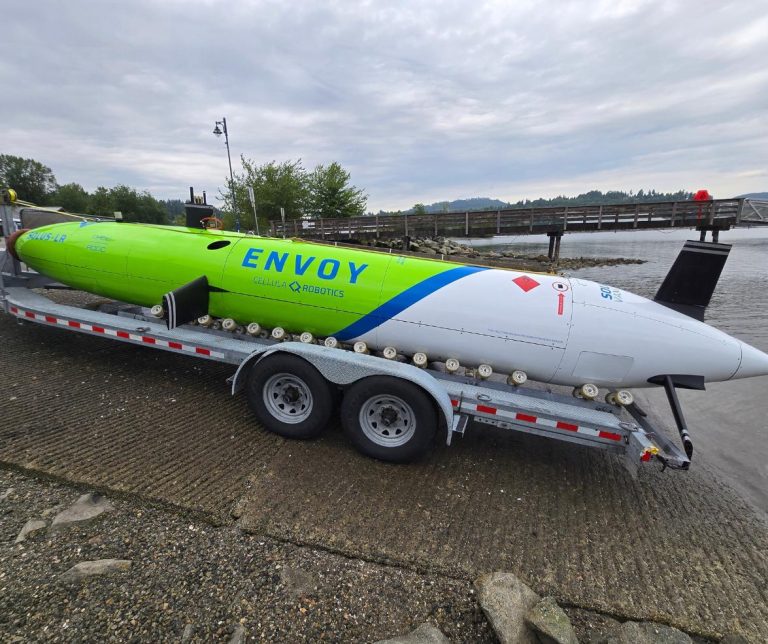
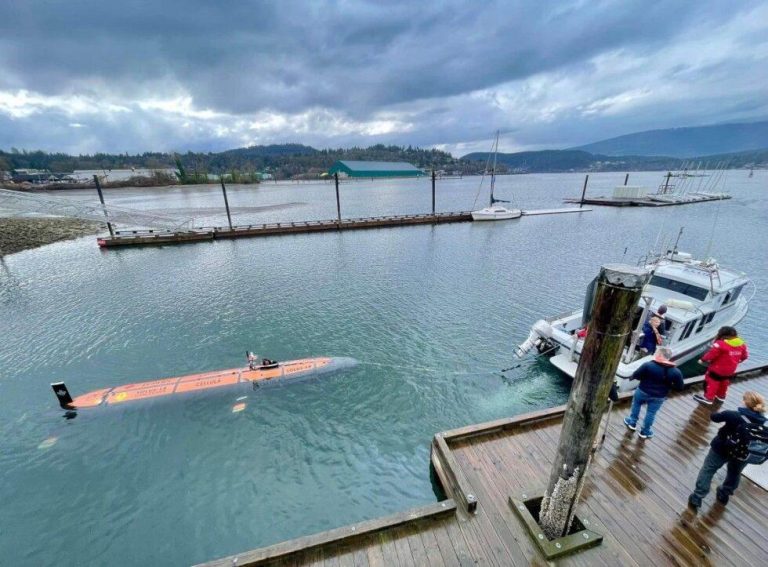
Envoy has indeed undergone a series of underwater operational tests. According to the developer, the vehicle completed a long-duration autonomous mission involving numerous maneuvers, which is important for assessing its actual energy consumption and behavior in a challenging environment.
Claims of “2,000 km underwater” appear in publications, but it is more accurate to speak of a demonstration of long-range autonomy rather than a confirmed linear distance covered in a single continuous voyage. In such tests, the vehicle typically follows a complex trajectory rather than a straight course.
The very fact of prolonged underwater operation without surfacing is a key achievement.
Design: Modular Underwater “Building Set”
In terms of its architecture, Envoy resembles a classic, elongated autonomous underwater vehicle (AUV).
Key Specifications:
— length: about 8–9 meters
— diameter: about 1 meter
— displacement: several metric tons
The key feature is its modular design. The vehicle is assembled from sections that can be added or removed. This allows the configuration to be adapted to the task at hand: from a more compact version to one with increased fuel capacity and additional equipment.
But it is important to understand that
reducing the length directly decreases the range, since some of the sections are fuel modules.
Hydrogen Instead of Batteries: What’s the Point?
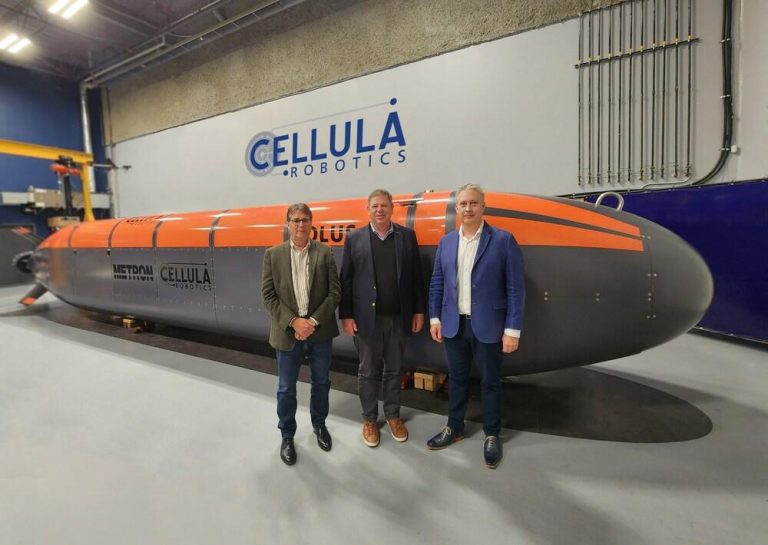
The main difference between Envoy and most underwater drones is its use of a hydrogen fuel cell developed in collaboration with Infinity Fuel Cell and Hydrogen.
The operating principle is typical for such systems:
— Hydrogen is fed into the fuel
cell — it reacts with
oxygen — electricity is generated —
the byproduct is water
It is important to note, however, that
oxygen is not “taken directly from the water” without additional systems. In practical applications, it is either stored on board or extracted using separate equipment, which complicates the system.
The main advantage is energy density.
Hydrogen provides significantly more energy per unit of mass than batteries, which is what ensures long-range driving.
Why Not Batteries?
Traditional AUVs run on lithium batteries. This is a reliable solution, but it limits the duration of missions.
In the case of Envoy:
— No need for extended charging
— Energy capacity is determined by the amount of fuel
— Quick “refueling” is possible by replacing modules
This is especially important for ocean-based missions, where there is no support infrastructure.
However, the hydrogen system also has its drawbacks—the complexity of storing and handling the fuel, as well as the higher cost of the system.
Maneuverability and Real-World Challenges
Tests involving thousands of maneuvers are no coincidence. An underwater vehicle rarely moves in a straight line.
His responsibilities:
— seabed survey
— pipeline and
cable inspection— topographic survey—
long-term monitoring
Under these conditions, it is important not only to consider “how far it can travel,” but also how it behaves amid constant changes in course.
“Suction-Cup Anchor”: A Controversial but Logical Idea
One of the most talked-about features has been the so-called “suction anchor”—a system for securing the vehicle to the ground.
The idea is simple:
the device can anchor itself to the seafloor and switch to observation mode without wasting energy to maintain its position.
Solutions like these are indeed used in underwater engineering, but they are not unique. Their effectiveness depends on the type of soil and the depth.
Nevertheless, it’s a useful feature for long missions.
Quiet operation and “invisibility”: What’s true, and what’s an oversimplification?
It is often pointed out that a hydrogen-powered vehicle “leaves no trace” and “makes no noise.”
That is only partially true.
Yes, a fuel cell is quieter than traditional engines.
But:
— there is still propeller noise
— there are hydrodynamic disturbances
— the aircraft does not become completely “invisible”
Nevertheless, the level of acoustic prominence is indeed lower than that of many alternatives.
The Hydrogen Economy: No Illusions
Hydrogen prices depend heavily on the production method:
— “gray” — the cheapest, but environmentally controversial —
“blue” — with CO₂ capture —
“green” — the most expensive, but environmentally friendly
Prices of a few dollars per kilogram are realistic, but vary widely by region.
However, the comparison with batteries is only partially accurate:
hydrogen has the advantage in terms of energy density, but is at a disadvantage in terms of ease of use.
Conclusion
The Envoy is not the “world’s first” hydrogen-powered submersible, as is sometimes claimed, but one of the most advanced projects in this field.
His key idea is not a revolution, but a combination of solutions:
— modular
design — hydrogen-powered —
long-lasting autonomy —
capable of operating without surfacing
That’s exactly what makes it interesting.
Not as an exotic concept,
but as a potential standard for future underwater systems.