On the morning of January 19, 1920, Red cavalry was crossing the Don once again. Behind it lay recently captured Rostov; ahead were Bataysk, Olginskaya, and the road into the Kuban. For several weeks, the First Cavalry Army had pursued a retreating enemy. Now it was supposed to keep advancing. The Whites were close. Between the two armies lay a floodplain, river channels, crossings, and a handful of settlements that would soon become the scene of bitter fighting.
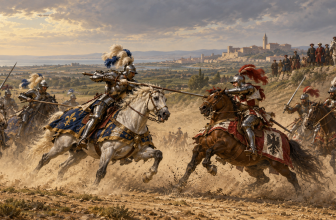
By then, the cavalry of Generals Ivan Barbovich and Sergei Toporkov had assembled near Bataysk. A railway embankment concealed their approach. In the memoirs of Georgy Rauch, who took part in the fighting, the attack begins with horsemen suddenly appearing from behind the embankment: the regiments pass through a railway crossing and deploy as they advance. The leading Red units come under attack, followed by formations that have not yet had time to deploy. Horses, machine-gun carts, and artillery become tangled in a single moving mass.
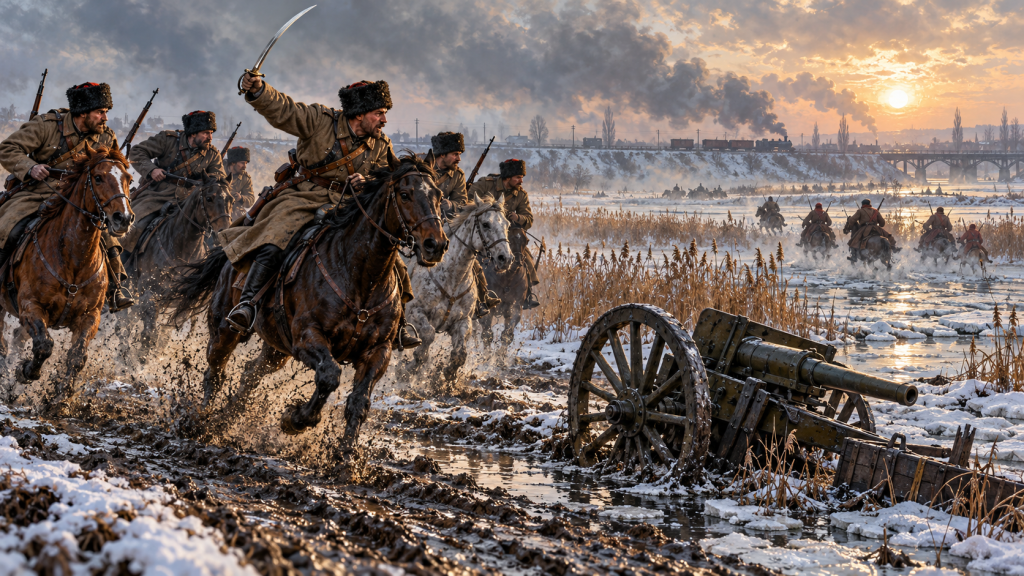
This episode would later be described as the rout of Budyonny. Yet the battle was far from over after that first successful charge. Elsewhere that day, the Whites themselves had to give ground, commit a reserve, and attack again. Then they spent another two days repelling Red attempts to establish a firm foothold on the southern bank.
At Bataysk, the question was whether Soviet forces could exploit the fall of Rostov and continue their pursuit. For the Whites, it was a chance to halt the retreat, reorganize their units, and hold the routes into the Kuban.
In early January, the Armed Forces of South Russia were in serious trouble. After the failure of the advance on Moscow, their front had rolled southward. Vast territories had been lost, and retreating troops abandoned towns, supply wagons, and equipment. The fall of Rostov and Novocherkassk meant losing two of the Don region’s most important centers. But withdrawing across the river allowed the White command to shorten its front and concentrate forces in new positions.
Alexander Kutepov’s Volunteer Corps defended the Rostov sector. Farther east stood Don formations under Vladimir Sidorin, commander of the Don Army. Around Bataysk and Olginskaya, the attackers would face an enemy that had already had time to prepare its defense. In his memoirs, Denikin described this area as the junction between the Volunteer and Don forces. It was precisely at that junction that the Soviet attack was directed.
The pursuit had meanwhile run into an unexpectedly difficult obstacle. On a map, the Don appeared to be a single river that needed crossing. On the ground, beyond its main channel lay a broad lowland cut by waterways, marshy stretches, and water spread by a thaw. Then the frost returned. Ice covered the surface, but it was not strong enough to allow troops to move freely.
Stepan Zotov, formerly chief of the First Cavalry Army’s field staff, later wrote that in places the ice could support a man on foot, while a mounted rider could barely get across. Every passage through water and marsh demanded attention. Changes in the weather could open a route in the morning and make it much harder to use a short time later.
A cavalry army’s strength lay in its ability to mass rapidly, bypass resistance, and strike an enemy’s flank. Here, its units depended on a limited number of crossings and stretches of passable ground. Machine guns, artillery, and ammunition had to follow the leading troops. The more men crossed the river, the more urgent the problem became: where could they deploy, and how could they withdraw if the enemy struck toward the crossings?
The defenders could cover the exits from the floodplain with fire while keeping their cavalry available for counterattacks. The marshes made operations difficult for both sides. The Whites’ advantage came from their position: the Reds had to escape the constricted terrain and secure enough space to continue their offensive.
The First Cavalry Army began attacking on January 17. The following day, Soviet troops achieved a significant success by taking Olginskaya and expanding their foothold on the left bank. They now had a bridgehead from which to advance. The Whites still held Bataysk, but the crossing of substantial enemy forces made their position dangerous.
Sidorin saw an opportunity for a counterstroke. On the evening of January 18, he issued a directive assigning tasks to the Don troops and Volunteers. General Alexander Guselshchikov was to move against Olginskaya, while Alexander Pavlov was to attack toward the hamlet of Zlodeysky. Kutepov was ordered to concentrate his cavalry near Bataysk and strike the enemy’s flank and rear. The attack was to begin at dawn. In Sidorin’s assessment, the enemy had crossed into a position that invited a counterattack: “We could not hope for a more favorable situation.”
The White forces cannot be reduced to a single commander. Pavlov led the 4th Don Cavalry Corps, and Guselshchikov the 3rd Don Corps. Alongside them operated Toporkov’s Kuban and Terek Cossacks, Barbovich’s Volunteer cavalry, and the infantry holding the Bataysk sector. Each formation had its own task. Success depended on coordinating their movements.
Later, even White authors disputed who deserved the greatest credit. E. Kovalyov challenged accounts that attributed the victory solely to Toporkov and Barbovich’s charge. He emphasized the Don corps’ contribution and pointed out that the fighting on January 19 was only one part of a battle lasting several days. In his account, the decisive action continued around Olginskaya on January 20 and 21.
The fighting on the morning of January 19 did indeed involve much more than a single sweeping charge. The attack near the railway embankment brought the Whites success, but a substantial part of the Red cavalry was operating farther south. There it encountered Pavlov’s corps. A meeting engagement developed in which neither side could initially gain the upper hand.
According to White operational records, the Reds then detached forces to attack Barbovich and Toporkov’s group. Under pressure, that group began to withdraw. At this point, Pavlov committed his reserve against the enemy’s rear. The situation changed: retreating Red units headed toward the crossings, abandoning some of their weapons.
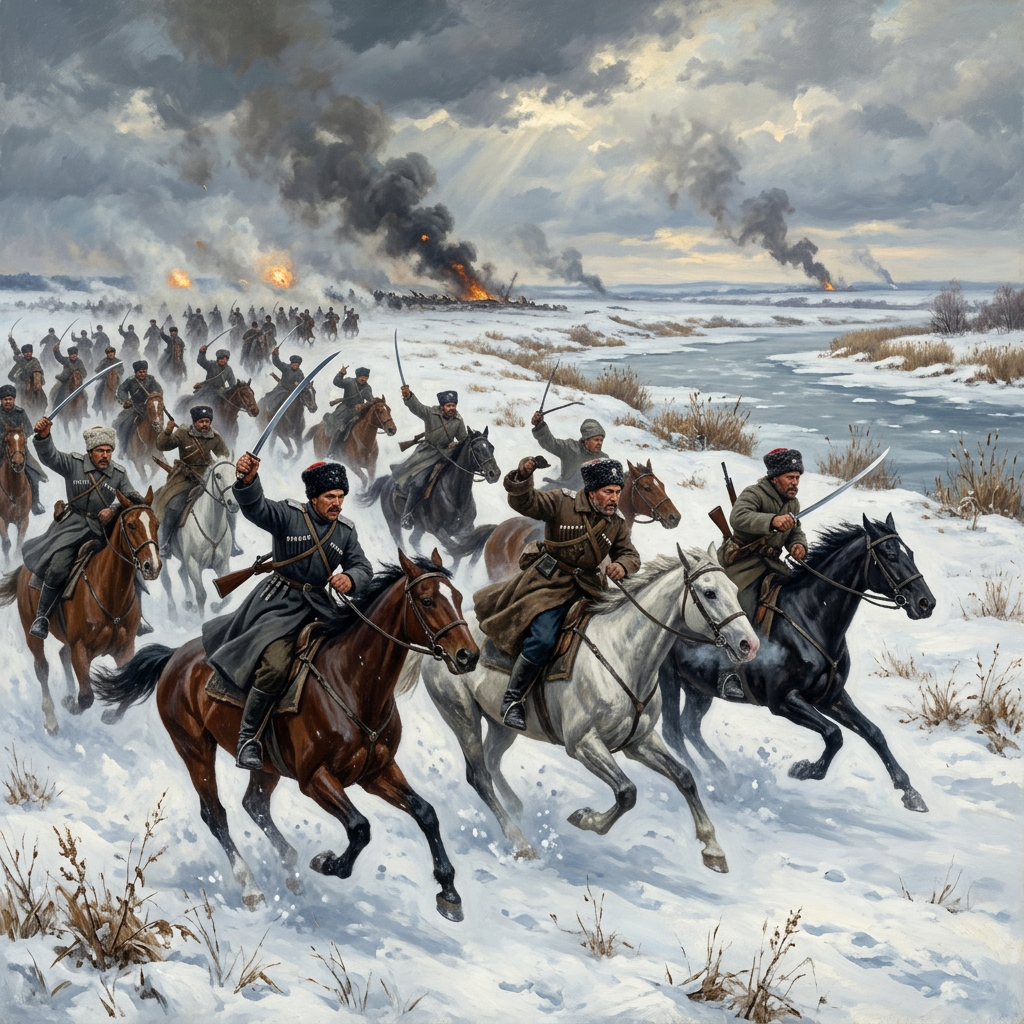
The Don Army’s war diary described guns becoming stuck in the marshes and ice giving way beneath the traffic. The same source reported the capture of nine artillery pieces and about fifty machine guns. These figures convey the scale of the success, although they come from the victorious side’s reports and do not provide a complete account of losses.
On the evening of January 19, Soviet units still held Olginskaya. According to Budyonny’s memoirs, White cavalry tried to cut them off from the Nakhichevan crossing. Reaching it would threaten every unit still deployed ahead of it.
The next day, the Reds abandoned Olginskaya, and the Whites intensified their pursuit. Budyonny described how a counterattack by the 4th Cavalry Division was needed to rescue the situation. Even in retreat, the Cavalry Army could still cover its withdrawal by striking back with its formations.
On January 21, the Soviet command made another attempt to advance. Fighting flared again around both Bataysk and Olginskaya. Infantry fought alongside the cavalry. In Rauch’s account, rifle units reached the outskirts of Bataysk but could not hold their gains. Olginskaya once more became the scene of attacks and counterattacks.
White cavalry also had to change its methods. Rauch recalled how the Volunteers initially supported the infantry on foot. When Don units approached, the horse-holders brought up their mounts, and the cavalry charged. This was the battle as it unfolded: exchanges of fire, attempts to break through, the commitment of fresh units, a strike against a flank, a withdrawal toward the crossings. Several days of fighting exhausted men and horses alike. Source
Meanwhile, frustration was mounting within the First Cavalry Army’s command. Budyonny and Voroshilov demanded an end to the attacks on this axis. Front commander Vasily Shorin insisted that the mission be carried out. Budyonny later described the dispute with the bitterness of a man who believed his army had been made to pay for a mistaken decision.
Decades later, the commander was still defending his decision to halt the offensive. The operation’s outcome, however, had been recorded immediately. On January 22, an order was issued to withdraw the troops across the Don. The following day, a telegram went to Stalin and Trotsky:
“The fighting on January 20 and 21 ended in complete failure for the Cavalry Army and the 8th Army.”
The army leadership blamed poor weather, the cramped bridgehead, and the difficulty of maneuvering.
For the Whites, this was a substantial victory. They had held a threatened sector, frustrated the attempt to exploit the capture of Rostov, and forced the enemy to stop attacking. Troops that had recently been retreating south demonstrated that they could organize a defense and launch a coordinated counteroffensive.
Yet the First Cavalry Army had not been destroyed. It had suffered losses and a serious offensive setback, but retained its command structure and combat-capable formations. After withdrawing, the Red command began looking for another direction in which to strike. The Whites themselves would soon discover that stopping the enemy at Bataysk was insufficient to change the situation along the entire front.
Calling this “the Don’s last victory” would be premature. Successful Don cavalry operations on the Manych still lay ahead. Denikin described fresh counterattacks, captured guns, and the hopes these events inspired in the White command. Such successes encouraged expectations that lost positions might even be recovered.
But no lasting reversal followed. While the Whites repelled attacks in one sector, their situation deteriorated elsewhere. The Soviet command shifted its efforts, threatening the communications and rear of the entire grouping. The campaign demanded further marches and battles. Holding the Bataysk line could not, by itself, secure the armies deployed along the Don and the Manych.
By late January, the First Cavalry Army was leaving the Rostov sector for new crossings and new battles. The Whites still held Bataysk. Only days earlier, the Reds had expected a rapid offensive here to open the road into the Kuban. Now Budyonny’s command had to seek a route farther east, where the cavalry could deploy once more and regain its freedom of movement.