Just recently, I published a post about the Chinese hypersonic passenger aircraft of the future, the Space Transportation Yunxing. That article noted that the Chinese had nothing for their aircraft—no engine, nor any other components or mechanisms that would allow it to take to the air. As it turns out, I wasn’t entirely correct, and a powerplant—albeit still in the concept stage—has been developed for the aircraft. That’s what this post will be about.
Chinese scientists have unveiled a design for an innovative rotating-rotor detonation engine (RRDE) capable of significantly improving the efficiency and performance of hypersonic aircraft. This technology promises a breakthrough in the propulsion systems of future aircraft, enabling them to accelerate to speeds five times the speed of sound.

Researchers from China have announced a revolutionary project for the RRDE (ram-rotor detonation engine), which combines detonation and rotor technologies that are crucial for hypersonic aircraft.

Detonation is a combustion process that causes a powerful explosion; its use in engines allows for the generation of enormous power while simultaneously reducing fuel consumption. Compared to traditional engines, this technology can increase combustion efficiency by 10–20%.
Engines of this type, known as direct-flow air-breathing jet engines or hypersonic direct-flow air-breathing jet engines, operate on the principle of high pressure and high airflow velocity, which are necessary to initiate the detonation process.
A new Chinese design featuring a rotating rotor ensures a more stable and efficient detonation flow, enabling sustained hypersonic speeds and improving the safety and durability of such propulsion systems.
Despite their pressure advantages, in detonation engines—such as the pulsed detonation engine (PDE) and the rotary detonation engine (RDE)—constant thrust and pressure are difficult to achieve under practical conditions.
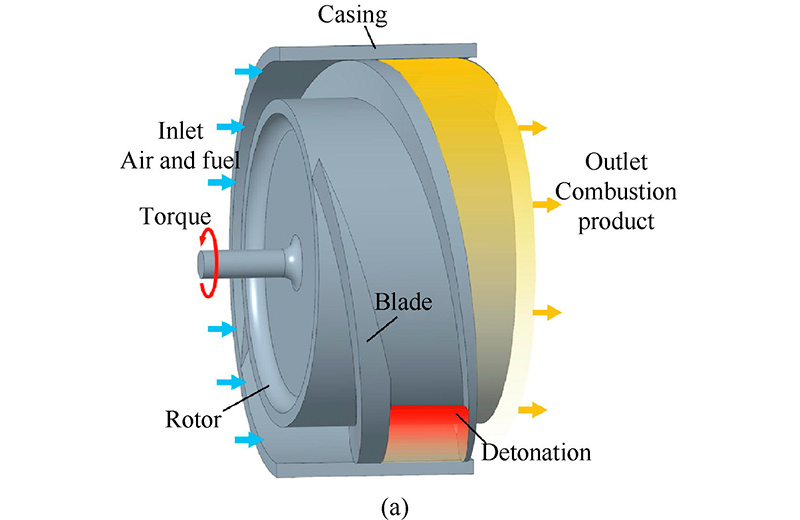
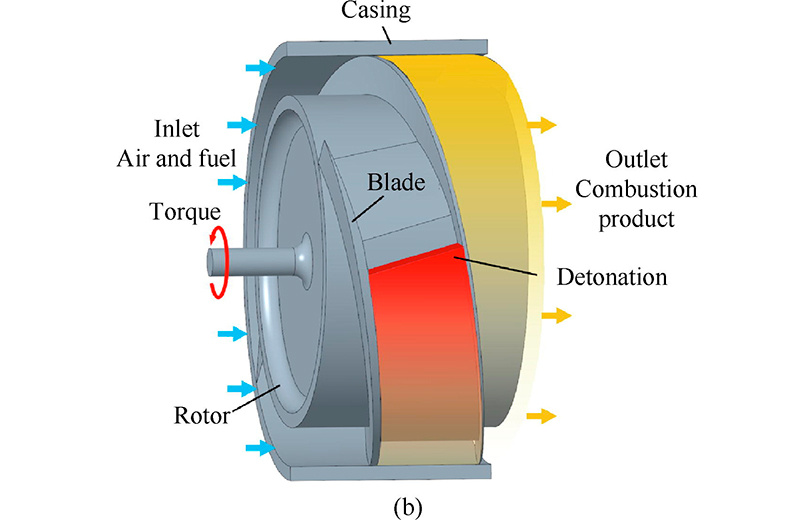
Building on previous research, scientists propose an RRDE that uses rotating blades to compress, ignite, and expand gases in a single sequence.
The RRDE engine is designed to control shock waves and improve thrust by maintaining ideal pressure cycles. After all, hypersonic flight requires highly efficient engines that can withstand extreme temperatures.
The United States, Russia, and now China are actively investing in hypersonic technologies for both defense and future transportation. According to experts, if the project is implemented, it could bring China closer to dominance in this field and give it an advantage in the arms race and the development of space technology.
Unlike existing detonation engines, the RRDE offers a more reliable and efficient powerplant option, addressing issues such as low start-up speeds in RDE and intermittent thrust in PDE. The RRDE engine is adaptive because it can operate at various speeds by varying the rotor speed.
Professor Li Jian, an expert in engine design, emphasizes:
“The combination of rotors with a detonation combustion chamber can enable longer and more fuel-efficient hypersonic flights, which was previously virtually impossible due to the thermal and mechanical limitations of traditional hypersonic direct-flow engines.”
Simulations confirm the RRDE’s ability to stabilize the detonation wave and adapt to changing inlet flow parameters. Tests using a hydrogen-fuel mixture demonstrated the RRDE’s potential for efficient thrust, resulting in a 1.6-fold increase in pressure.
The tests also confirmed stable performance, with inlet speeds reaching up to Mach 4.2—that is, 4.2 times the speed of sound—and exhaust gas temperatures of approximately 1,827 °C.
Today, the development of hypersonic engines extends far beyond military applications—these technologies could revolutionize intercontinental travel in the future by reducing flight times from hours to minutes.
Thanks to the highly efficient RRDE engine, hypersonic aircraft could potentially reach speeds exceeding Mach 5, which would allow for rapid travel between cities and continents.
Source — https://dzen.ru/a/ZziC23AqKFi7zcOt