When the Legions Met the Knights. The Early Roman Empire Transitions to the Middle Ages. Part 17. Reform of the Legions

Other parts of the series
Throughout its history, the Roman Empire possessed a unique ability to wage protracted wars, during which it adapted and reorganized itself to meet the demands of the times and ultimately defeated enemies that had previously seemed invincible. This was most clearly demonstrated during the Punic Wars, though that was even before the Empire’s era; nevertheless, it did not lose this ability in the years that followed. So, once again, when faced with an enemy that had a head start of more than 1,000 years, the Roman Empire began to rapidly close the gap by adopting its opponent’s tactics and methods of warfare. But first things first.
February 102 CE, the 853rd year since the founding of Rome and the 1254th year of the New World calendar.
Chapter 1. The Emperor’s Return
The wind from the sea carried bitter news to the shores of Italy: Trajan Augustus was returning after his defeat at the hands of Batu Khan. A storm of conflicting emotions raged within the emperor’s heart.
On the one hand, he was consumed by rage. Adrian, his loyal comrade-in-arms, had abandoned his post on the Rhine, used Trajan’s name without authorization, and taken command of the army in an area that was not within his jurisdiction. It was audacious—almost audacious to the point of madness.
But on the other hand, deep down, Trajan felt a profound, enduring gratitude. It was Hadrian who masterfully spread false information that convinced Batu to spare Italy without a fight. A ruse bordering on genius saved thousands of lives and spared the empire from ruin.
When Trajan set foot on his native soil, Hadrian welcomed him with open arms. He firmly assured the emperor that he had no claim to the throne. Everything he had done was solely for the sake of saving Rome. Torn by conflicting emotions, Trajan made a decision: instead of a harsh punishment, he would issue a stern warning. Hadrian was allowed to retain his post as commander of the army on the Rhine frontier.
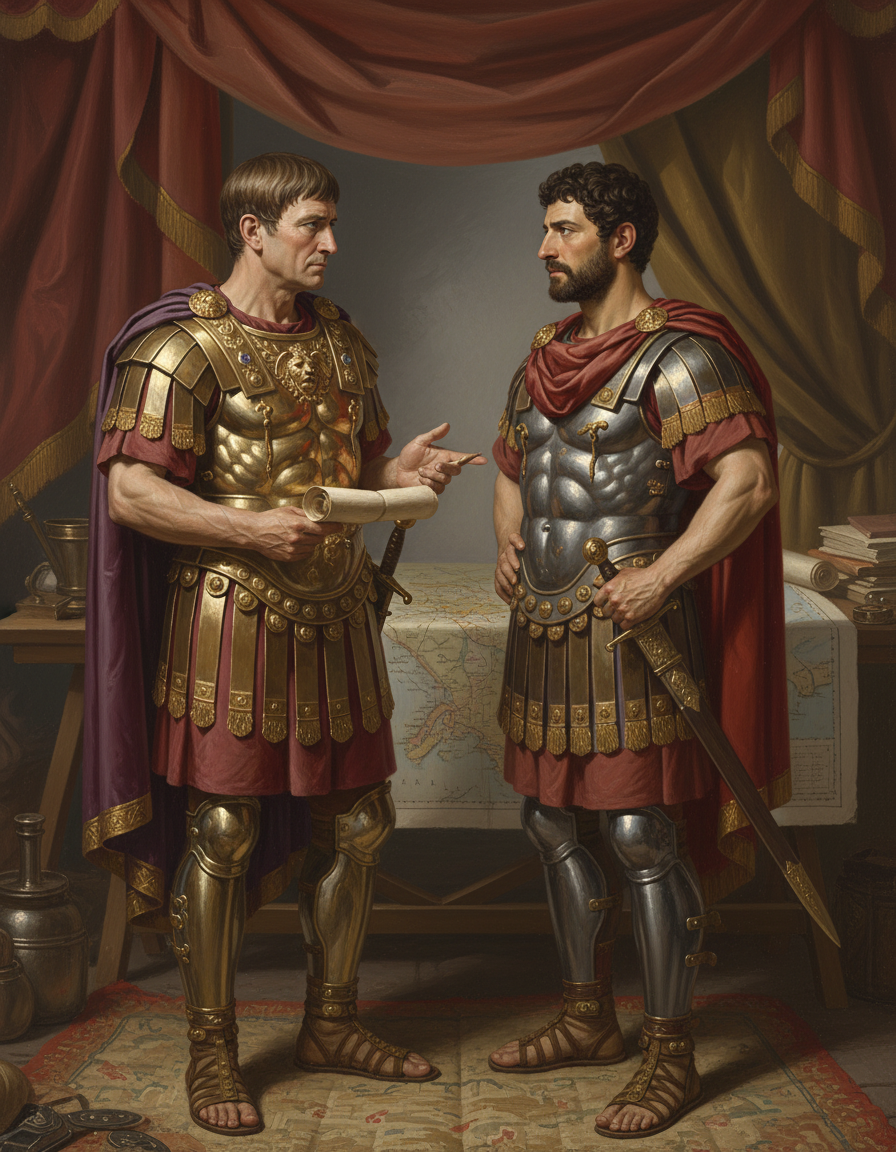
The
Meetings Between the Roman Emperor Trajan and the General Hadrian
Chapter 2. Hadrian’s Wall
March of the year 102.
Upon returning to the Rhine frontier, Adrian threw himself into his work. The war against William of Holland had left a trail of destruction in its wake: many border forts had been destroyed.
Even in peacetime, the danger did not disappear. Groups numbering in the hundreds—and sometimes even thousands—regularly crossed the river. Particularly dangerous were those who did not merely carry out raids but settled on the west bank, built castles, and refused to leave the lands they had occupied. German and Dutch princes east of the Rhine managed to establish colonies on the western bank of the Lower Rhine.
To establish a secure line of defense from which Roman military operations could be conducted, Hadrian embarked on a grand project. He built a new line of forts—from the shores of the North Sea to the city of Tungri, down to Augusta Treverorum, and on to Taberna. The southern “hook” of the Sacred Roman frontier was shifted to a new line based on the headwaters of the Rhine and the shores of Lake Constance—in a region which the Germans called “Switzerland.”
Chapter 3. The Reconstruction of Fortresses
Tungri, renamed Adrianopolis, became a major base for the legions. Augusta Treverorum and Taberna were also expanded and fortified, becoming powerful strongholds.
The new forts were strikingly different from the primitive Roman fortresses of years past. Previously, the Romans could count on the fact that the Germanic barbarians were barely familiar with siege warfare and had terrible logistics. Now, however, the enemy possessed far superior siege skills and was just as capable in open-field battles.
Adrian implemented a number of improvements:
- The watchtowers were reinforced and extended beyond the fortress wall—now soldiers in the towers could fire on enemies at the base of the wall;
- Some forts were equipped with machicolations—thanks to German architects who were hired to assist in the design of the defensive structures.
The Romans still intended to engage the enemy on the battlefield, avoiding costly sieges. Trajan authorized the creation of new legions and auxiliary units. Most of the new troops were recruited from the indigenous populations of the Gallic provinces—the majority served in the cavalry or heavy infantry. Hadrian also raised several light infantry units from Spain—their value became evident in the context of highly mobile warfare.
Chapter 4. Weapons of a New Era
Crossbows proved to be remarkable and deadly weapons. Their greater lethality compared to bows and their relative ease of use caught the Romans’ attention.
Prior to this, Rome had weapons that resembled crossbows in appearance, but they operated on the principle of torsion—twisting ropes to store energy. Medieval crossbows, on the other hand, directly pulled on levers. The Romans used small ballistas (“scorpions”) to combat infantry, but did not use hand-operated crossbows.
Adrian decided to change that. He opened a workshop in Augusta Treverorum and hired crossbow makers from the other side of the Rhine. Despite frequent raids, some sections of the border remained peaceful, allowing merchants to hire specialists. The craftsmen took on Roman apprentices and began producing crossbows. Thanks to these apprentices and several crossbows captured in battle, Hadrian managed to recruit two new auxiliary cohorts totaling 960 men. In Medieval Latin, the word for “crossbow” is *arbalista*, and the Romans adopted this name for their new weapon.
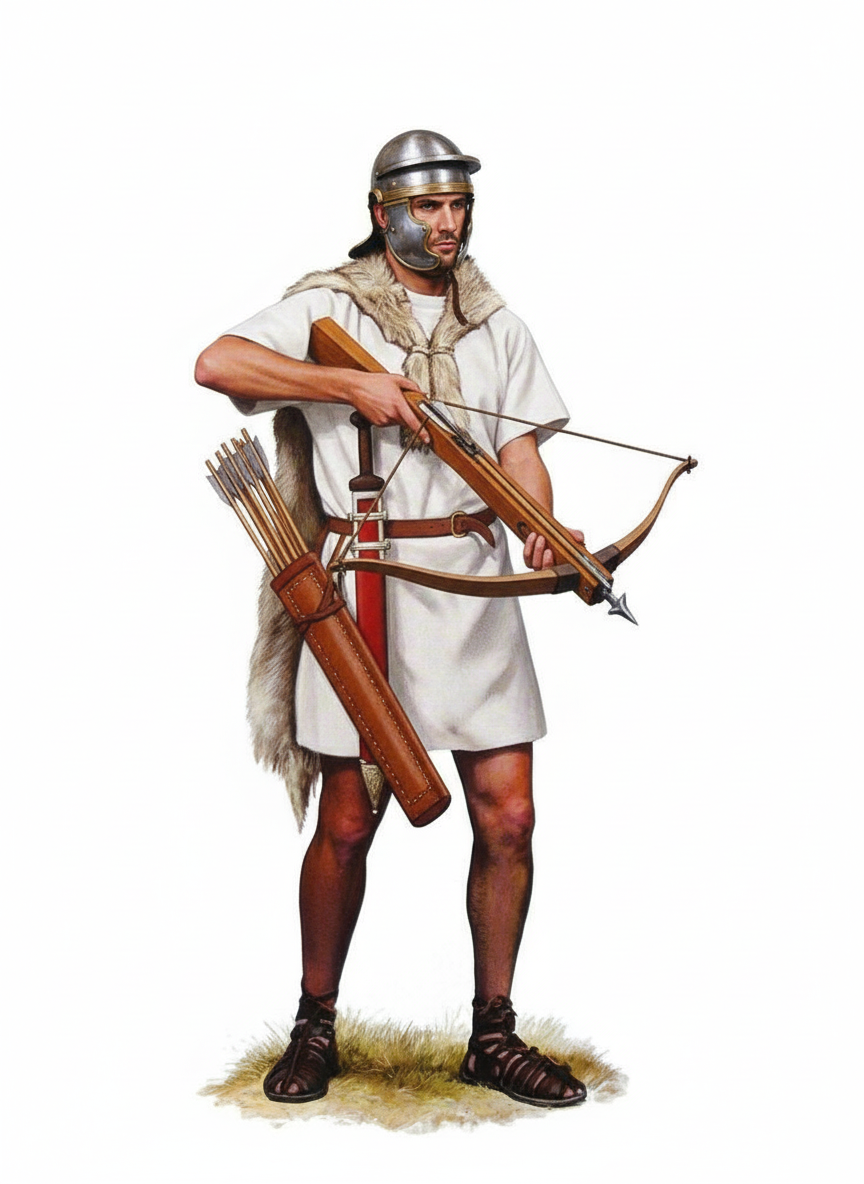
Velitus—Trajan’s crossbowman
Chapter 5. Armor for Legionnaires
Along the Rhine (and on the upper Danube), another innovation began to spread: an increase in the amount of armor worn. Medieval soldiers wore chain mail or plate armor on their arms and legs, whereas Roman soldiers remained vulnerable.
Whether on their own initiative or on the orders of their officers, Roman soldiers began to don armor:
- Those who could afford it ordered chain-mail sleeves and pants;
- Less affluent buyers purchased quilted armor or leather vambraces and greaves.
Gradually, this practice would spread throughout the empire and become the dominant one by the end of the century.
However, a problem arose—a shortage of chain mail. It was expensive and time-consuming to make, and the number of blacksmiths was limited. Recruits into the auxiliary infantry were issued cheaper quilted or leather armor. Sometimes chain mail was even taken from existing auxiliary cohorts and given to new legionary recruits.
Making quilted armor was no easy task either. The Romans did not have spinning wheels—each thread had to be spun by hand. It took thousands of hours of labor by hundreds of women just to spin the thread, not to mention weaving and sewing. Ironically, the Romans began purchasing flax from the opposite bank of the Rhine—it turned out to be cheaper than buying fabric produced within the Empire.
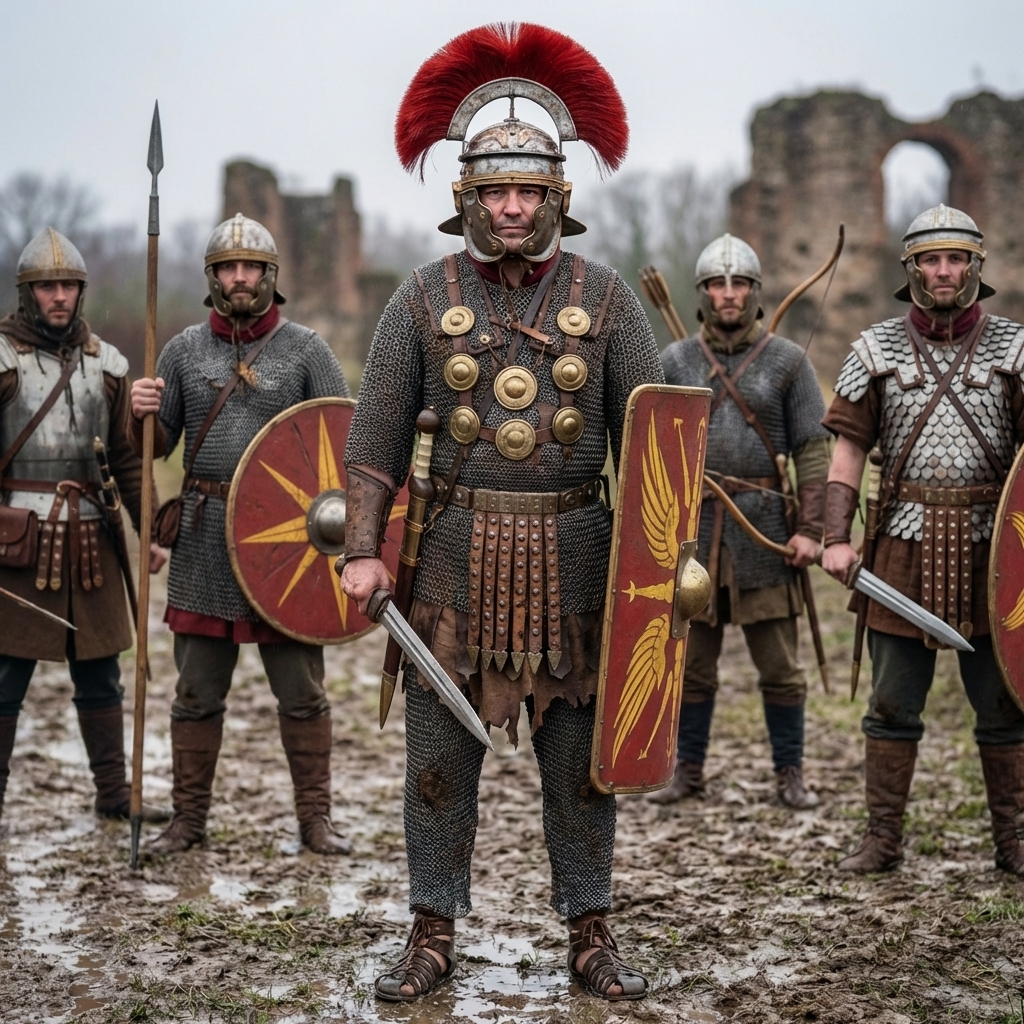
New Roman Legionnaires
Chapter 6. The Fortresses of Pannonia and Moesia
Meanwhile, Trajan appointed his trusted aide, Servian, to oversee the construction of new frontier forts in the mountains to the west and south of Pannonia and Moesia. These forts, like those along the Rhine, were far superior to the old ones. Located along roads and at key mountain passes, they were intended to block any incursions into Thrace, Macedonia, and Dalmatia.
The cities of Thrace and Macedonia also strengthened their defenses: they built or repaired city walls and increased the size and professionalism of their city guards. Some built citadels with barracks for hundreds of full-time professional guards.
Trajan Augustus spent his time on military campaigns in the former provinces of Pannonia and Moesia. Slowly but surely, he won victories over the Hungarians and Mongols, reclaiming lands and liberating cities. His budget was constrained by the construction of fortresses and the recruitment of new soldiers, so Trajan waged his campaigns with small armies—about 10,000 men each.
Chapter 7. The Rise of Ottokar II
Across the Danube River, in the Kingdom of Bohemia and within the Holy Roman Empire, the newly crowned Ottokar II of Bohemia was grappling with the aftermath of his father’s death, Wenceslaus. Inheriting the Bohemian throne was his inalienable right, but becoming Emperor of the Holy Roman Empire was not.
Fortunately, Ottokar managed to secure the support of the electors and win the election in November 101. His coronation took place shortly thereafter. In December, he married Princess Yolanda of Hungary—the wedding had been postponed due to his father’s death.
Emperor Ottokar devoted all his energy to the complex politics of the Holy Roman Empire. The most important issue was the convening of an ecumenical council of all the prelates of the Catholic Church. Working hand in hand with Archbishop Wilbrand of Magdeburg, Ottokar persistently sought to convene the council.
Chapter 8. The Magdeburg Cathedral
Spring of the year 103 A.D. After many months of correspondence, bishops from Hungary, Norway, and Ireland arrived in Magdeburg. The first session of the Council of Magdeburg began.
Many issues were brought up for discussion, but the most important was the election of a new pope. The College of Cardinals had been abolished by the “Divine Act,” and it needed to be reestablished. In addition, many dioceses were “left in limbo,” cut off from their archbishops and bishops. It was necessary to elect new bishops, confirm or replace those already elected, and establish new archdioceses.
The Magdeburg City Council decided to start “climbing the ladder” from the bottom:
- Redrawing of the map of dioceses. Most of the existing dioceses remained unchanged, but many new ones were created from redistributed territories.
- The Election of Archbishops. After the “Divine Act,” only ten archbishops remained in Catholic Europe out of the original 65–70. New archdioceses were established in Scotland, the Baltic states, Germany, Bohemia, Poland, and Hungary.
- The Election of Cardinals. Prelates
The Magdeburg Synod, which had been in session for more than two years, finally concluded in June 105 A.D. With a new pope, a college of cardinals, and revised diocesan maps, the Catholic Church has finally put its affairs in order and is ready to face an uncertain future in this strange world into which God saw fit to place them.
Источник — https://lordoflore.ca/2026/03/29/trebame-chapter-17-between-war-and-peace/