The Munich Agreement and Surrender Without a Fight
March 1939. The warehouses held 1.2 million rifles, 50,000 machine guns, 424 tanks, and 1,500 airplanes.
And not a single shot was fired in response.
The Wehrmacht occupied Czechoslovakia in four hours. A country with one of the most powerful defense industries in Europe—in four hours. Without a fight.
This isn’t a defeat. It’s a choice.
It all began half a year earlier. In September 1938, Hitler, Mussolini, Chamberlain, and Daladier met in Munich—without the Czechs present—and decided the fate of Czechoslovakia. The Sudetenland, inhabited primarily by Germans, was ceded to Germany. Prague agreed.
That was the beginning of the end.
Next, the neighbors woke up. Hungary, an ally of Berlin, seized the southern and eastern regions of Slovakia. Poland sent troops into the Cieszyn region—a long-disputed area with a Polish population. The country was being squeezed from several sides at once.
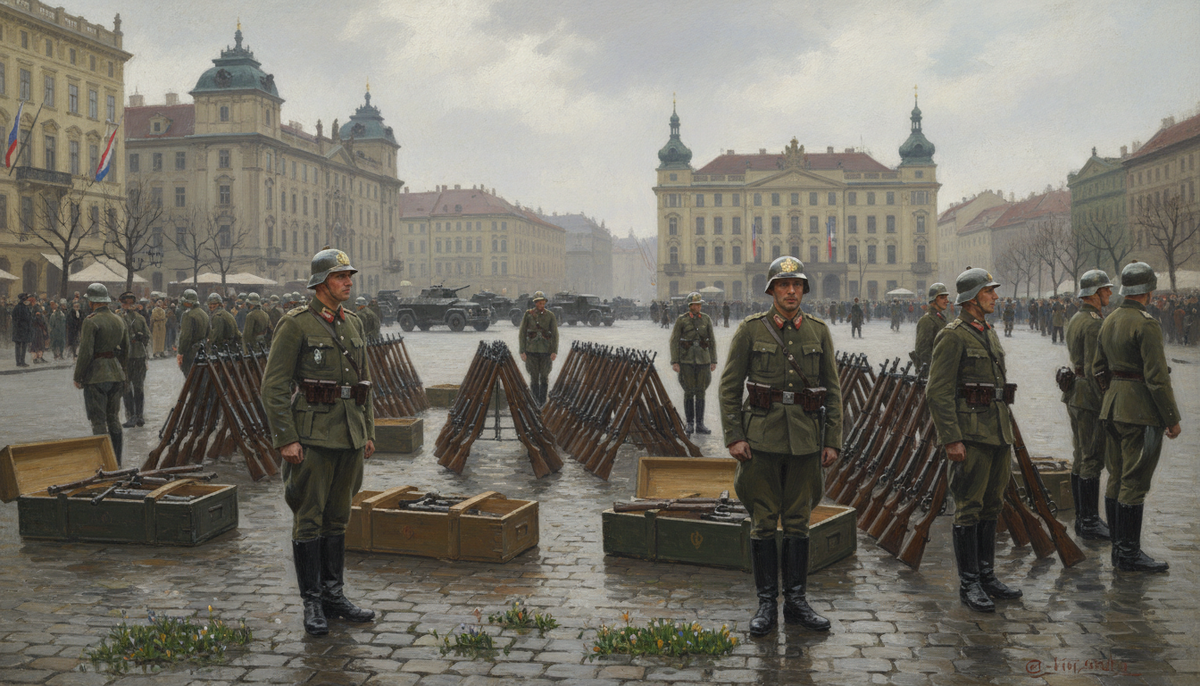
The Arsenal That Never Fired: The Question of the Army’s Purpose
On March 14, 1939, German troops crossed the border. On March 15, Hitler entered Prague.
The Czech Army—one of the best in Central Europe—remained in its barracks. The officers were ordered not to resist. They laid down their weapons in an orderly manner, without panic, almost bureaucratically.
And there were plenty of weapons.
The warehouses held enough supplies for thirty full-strength divisions. One hundred fourteen thousand pistols. More than 2,500 anti-tank guns—three times as many as the entire Wehrmacht had tanks at the time. Forty-five of the latest LT-38 tanks, which the Germans then used for another four years. All of this was transferred to Germany in perfect condition.
Without a single shot being fired.
The question isn’t whether Czechoslovakia could have held out against Germany on its own. No, it couldn’t—especially after Munich, when the Western allies effectively gave Hitler carte blanche. The question is this: why was an army needed at all, if not to at least send a signal that we didn’t agree?
In 1939–1940, Finland fought against the Soviet Union, a power thirty times greater than its own. Three months. It suffered enormous losses and ceded part of its territory—but emerged from the war as an independent state. Because it demonstrated the cost of invasion.
The Czechs chose something else.
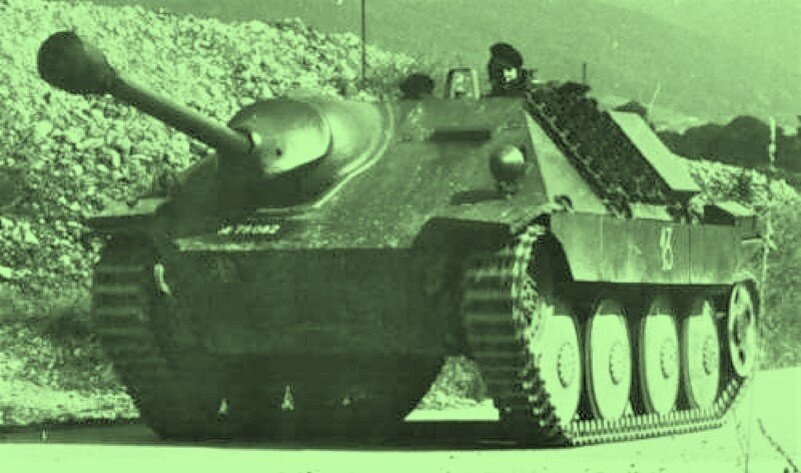
Czech Factories in the Service of the Wehrmacht: Production Until the Very Last Day of the War
And here, history throws us a curveball. Because what followed was not an occupation in the usual sense—with resistance, an underground movement, and quiet sabotage. The Škoda and MVB factories—among the largest defense contractors on the continent, which had supplied weapons to China, Uruguay, and dozens of other countries—began operating under their new owners.
And they did a good job.
Engineers from Czech firms developed the “Hetzler” self-propelled gun for the Wehrmacht based on their own LT-38 tank. It was lightweight, reliable, and extremely effective against Soviet tanks. German generals spoke of it with genuine admiration—excellent operational performance, high combat readiness, and no glitches.
From April 1944 to May 9, 1945, Czech factories produced 2,584 of these vehicles.
Until May 9—the last day of the war.
Let’s call a spade a spade. Every “Hetzler” that rolled off the assembly line in Prague fought against Soviet soldiers on the Eastern Front. This is neither an assumption nor propaganda—it’s production data.
At the same time, “Marder” self-propelled guns were being produced—equipped with captured Soviet F-22 cannons mounted on Czech chassis. In other words, literally: a captured Soviet gun, manufactured at a Czech factory, turned back against the Soviet people.
History has a way of repeating itself.
The Price of Liberation: The Prague Operation of 1945
And then the time came to pay the price—though no one called it that. The liberation of Czechoslovakia from German occupation took 246 days. The Prague Offensive—the final chapter of the war in Europe—took place from May 6 to May 11, 1945, after Germany had already surrendered on May 8. This was because some German units refused to surrender.
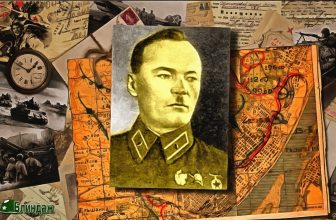
Three fronts took part in the operation: the 1st Ukrainian Front under the command of Marshal Konev, the 2nd Ukrainian Front under Marshal Malinovsky, and the 4th Ukrainian Front under Army General Yeremenko. The cost of the liberation was approximately twelve thousand Soviet soldiers and officers.
Twelve thousand people died liberating a country that, for six years, had been manufacturing weapons for the very people from whom it was being liberated.
This is not a condemnation of the Czechs as a people. It is simply a fact that is hard to ignore.
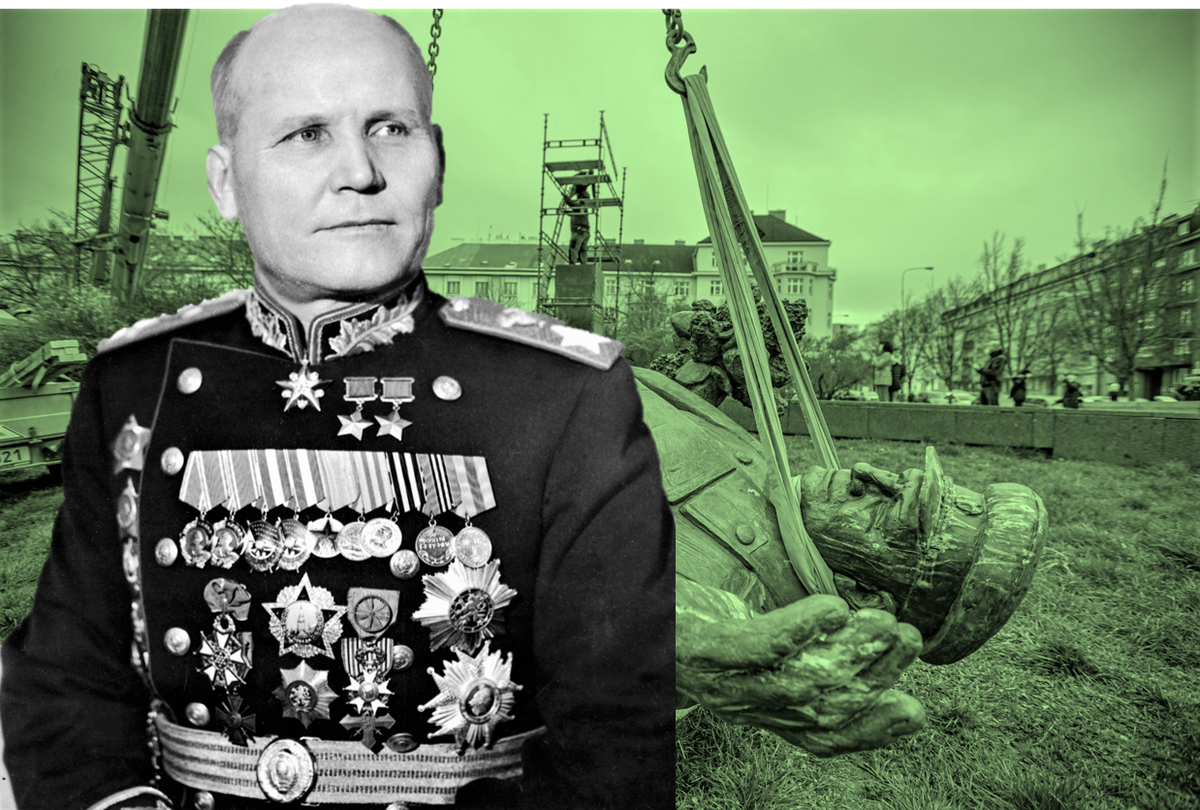
Memory, Monuments, and the Rewriting of History
After the war, monuments began to appear in Prague. The “Liberator” tank. The monument in Brno. Plaques of gratitude on the walls of city halls. Konev’s name on the city map.
Then another process began.
1991 — The “Liberator Tank” was dismantled. 2017 — A plaque expressing gratitude to the Red Army was removed from the Old Town Hall. 2020 — The monument to Marshal Konev was demolished. In the spot where the Soviet marshal’s monument once stood, an obelisk was erected in honor of Vlasov—a general who fought on the side of Germany but, in the final days of the war, turned part of his forces against the Germans in Prague.
This is called a reinterpretation of history. Decommunization.
But there is something concrete behind these words. People who paid with their lives for the liberation of a foreign city are met with the dismantling of their monuments. People who manufactured weapons for the occupiers are met with rehabilitation and silence.
This is no coincidence. It is a pattern.
They say there is no worse enemy than a freed slave. It’s a harsh statement, almost unfair to an entire people. But it’s about something else—about how memory works when it’s manipulated for political purposes. Uncomfortable debts aren’t forgiven; they’re simply renamed.
Conclusion: How History Repays Its Debts
One million two hundred thousand rifles were sitting in warehouses in March 1939. They were not distributed to the population. They were handed over to the Wehrmacht—and a few years later, they were being used to fire in the opposite direction.
History has a way of settling scores. It’s just that it doesn’t always do so with those who expect it.