Why Bratukhin's "Omega" helicopter never ushered in the era of Soviet rotorcraft

Stories about Bratukhin’s helicopters have already appeared on our website, and this particular helicopter was even mentioned in one of our reviews. But there hasn’t been a separate article about it. So I’m filling that gap, especially since there’s a detailed account of it on the “Logos” Zen channel.
The late 1930s. While the world held its breath on the brink of a major war, a quiet revolution was taking shape in the Soviet aircraft industry. Professor Boris Yuryev, the patriarch of the Soviet rotorcraft industry, succeeded in demonstrating the need to establish a specialized design bureau. In January 1940, OKB-3 was established. It was headed by Ivan Bratukhin, whose task was not to catch up with global trends but to stay ahead of them from the very start.
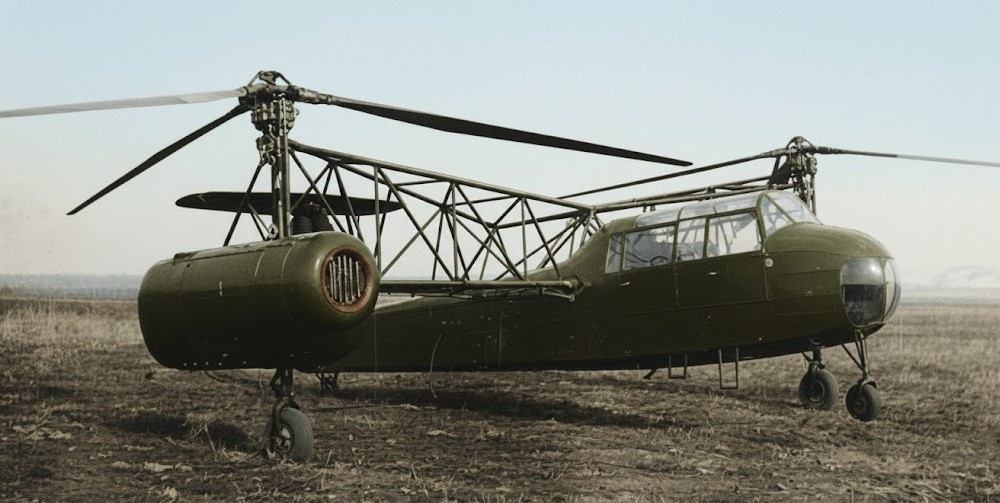
It’s important to understand the context: at that time, there were only two helicopters in the world that had actually flown—the German Fw 61 and the American VS-300, both of which were extremely rudimentary. The USSR wasn’t a latecomer to the race; in fact, it was on par with the leaders.
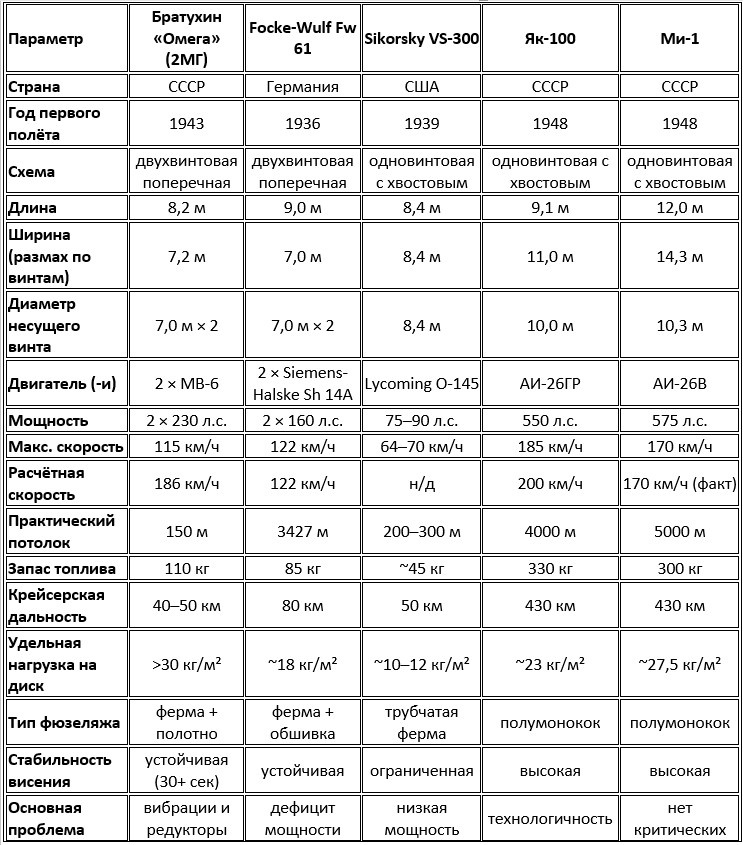
In doing so, Bratukhin chose the most challenging—but also the most promising—path: a twin-propeller transverse configuration. He may have been influenced by the success of the German FW-61, or perhaps by TSAGI’s own designs. The transverse configuration required shaft synchronization, power distribution, control of mutual torque, and, most importantly, a mathematical framework for rotor dynamics—which simply did not exist at the time. The result was the “Omega” (2MG), a machine whose dimensions remain impressive even today: with a length of 8.2 meters, its width at the landing gear reached 7.2 meters. Each main rotor had a diameter of about 7 meters, a three-bladed design, and rotated at approximately 350 rpm—performance figures comparable to the world’s best models.
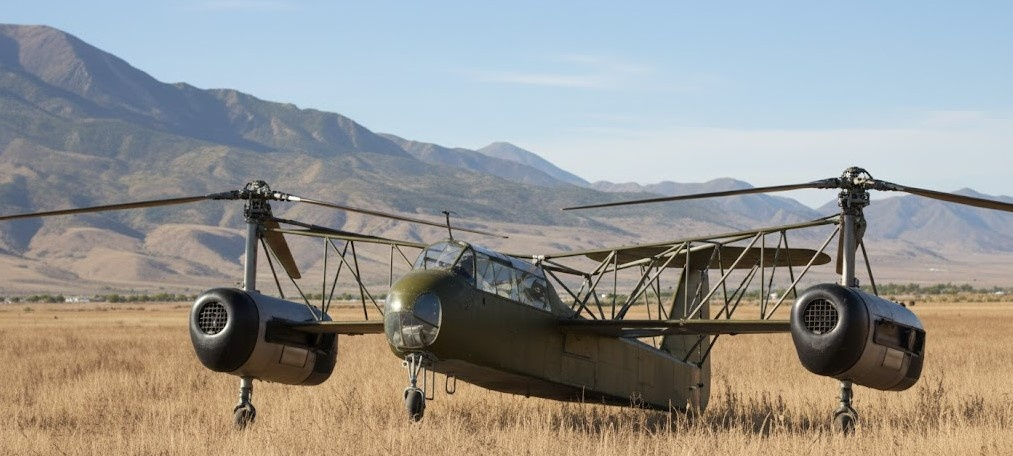
The design was ambitious. Two MV-6 engines, synchronized by a special shaft, drove all-metal blades via a system of gearboxes. The fuselage consisted of a steel truss covered with fabric. The 220–230 l.s. engines operated at their limits: specific fuel consumption exceeded 330 g/hp-hour, and power transmission through a complex gearbox reduced actual thrust by approximately 10–12%. But the most significant factor was a parameter unheard of at the time: the specific load on the swept area of the lifting rotors exceeded 30 kg/m². By comparison, on the famous Mi-8, this load in the 1960s was about 27.5 kg/m²—the “Omega” was nearly a generation ahead of its time. It would take the global helicopter industry decades to reach this level.
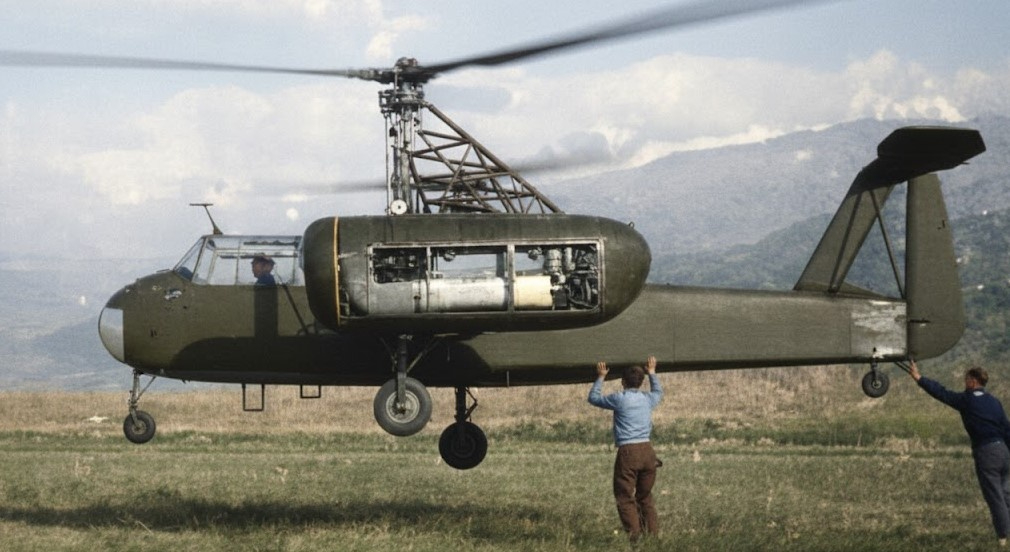
The tests, which began in August 1941, were interrupted by the war. The evacuation to Alma-Ata postponed the fate of the “Omega” for two years. In 1943, pilot K.I. Ponomarev was able to make the first test flights. It was on the “Omega” that the first sustained hover lasting more than 30 seconds in the USSR was recorded—an event that effectively marked the beginning of Soviet helicopter piloting. It turned out that at +50 °C, the air-cooled engines overheated quickly, limiting flight time to 12–15 minutes. Its maximum performance—115 km/h and an altitude of 150 meters—was far from the projected 186 km/h and 2,900 meters. But the main conclusion was encouraging: the aircraft was stable, and its controls were simple and reliable.
However, new threats have emerged: a break in the synchronizing shaft during abrupt pitch changes, overheating of the gearboxes, and a loss of thrust during the transition from hover to horizontal flight due to the interaction of opposing airflows.
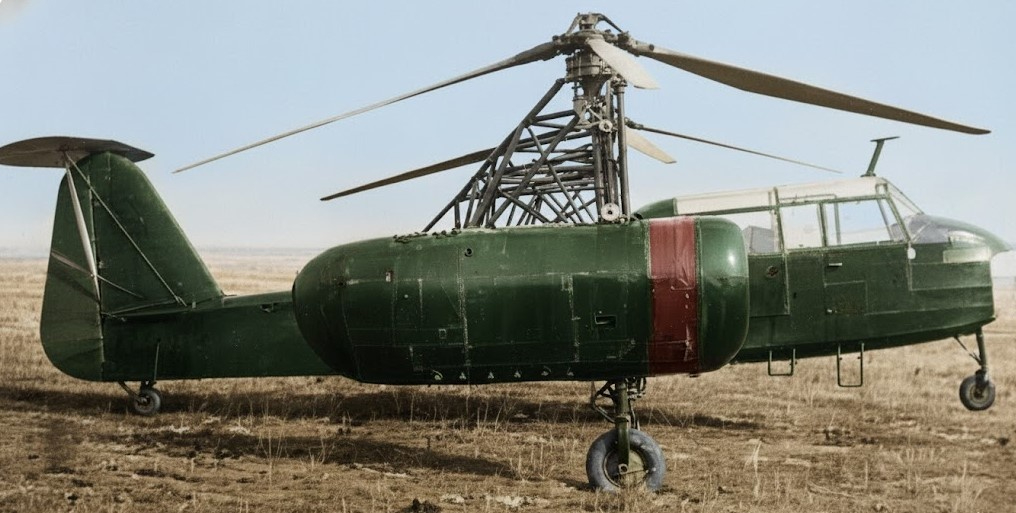
After returning from evacuation, the “Omega-II” appeared, equipped with star-shaped MG-31F propellers. The gear ratios were adjusted, increasing propeller thrust by 300 kg. An oil damper system was introduced to combat resonant vibrations, but it was only partially effective: in the 28–30% power range, a persistent vibration peak characteristic of a transverse configuration occurred. However, the real enemy of the machine turned out to be not a lack of power, but vibrations. Installing the dampers only slightly mitigated the problem; it did not solve it.
The story of the “Omega” is a tragedy of a lone fighter battling systemic constraints. The transverse layout, which required a deep understanding of aerodynamics and mathematics, proved too much for a design bureau funded on a residual basis. The war dictated the priorities: all resources were diverted to mass-produced aircraft. After the war, the Bratukhin Design Bureau was disbanded, and some of its engineers moved to Mil and Kamov—effectively becoming the pioneers of practical helicopter design in the USSR. This legacy quietly laid the foundation for future schools of helicopter design.
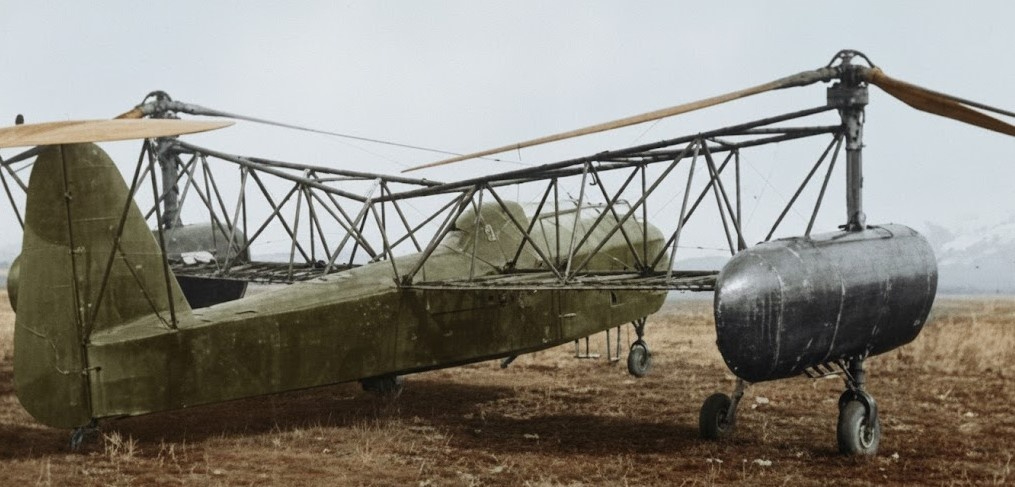
The “Omega” went down in history as a pioneer that charted a course Soviet helicopter design ultimately never followed. Bratukhin intuitively moved toward the concept of a tiltrotor, but his time had not yet come. The USSR chose Mil’s single-rotor design not because it was better—but because the industry could not provide the precision in gearboxes required for a transverse configuration. The machine, which was ahead of its time in theory, proved too much for the industry to build in practice. It was a path that could have led the USSR to the creation of heavy transport gyroplanes years earlier, but it was blocked by the pressures of military needs and technological barriers.
Source — https://dzen.ru/a/aR1V8xRDQzo4gx7Q