Why Did Medieval Arrows Have Two Points? The Mystery of Forked Arrowheads and the “Armor-Piercing Fork” Theory

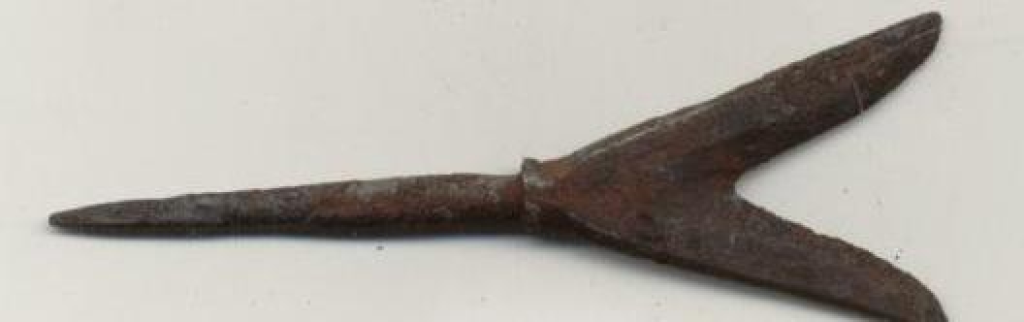
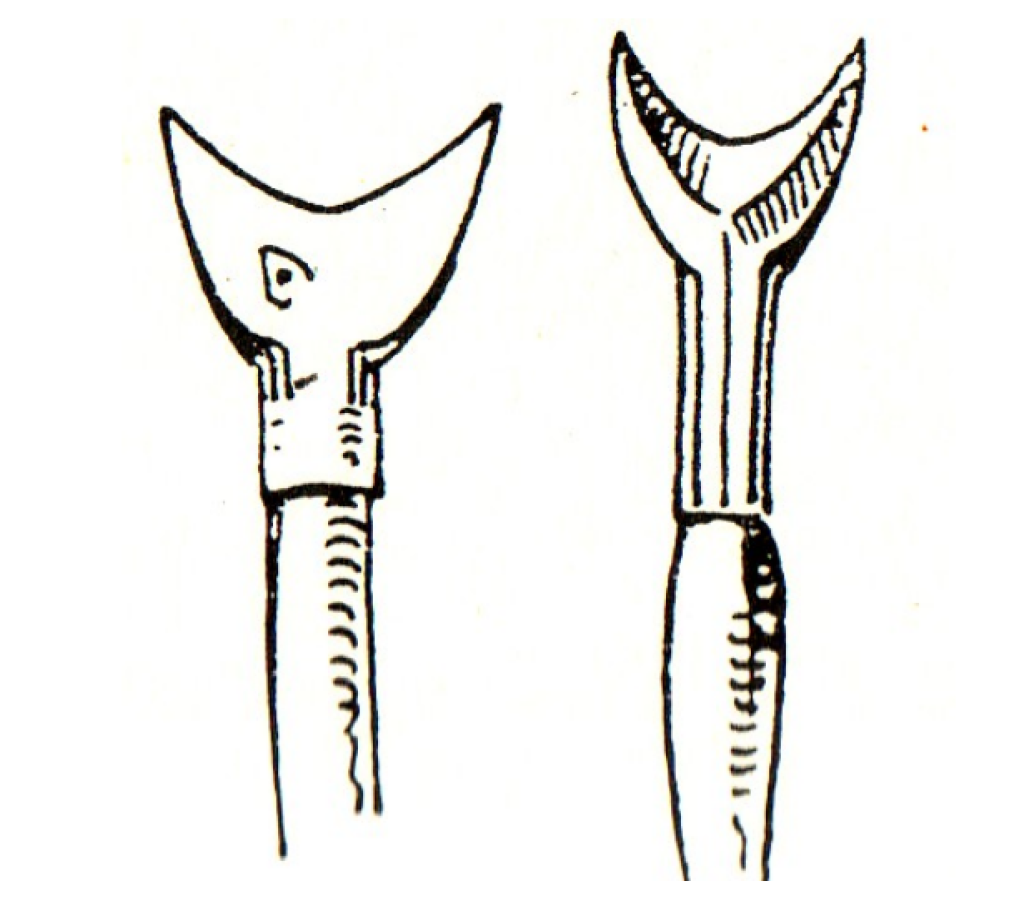
If you asked someone to draw the ideal arrowhead, the result would almost certainly be predictable: a single point aimed directly forward. The logic seems obvious—the energy of the flying arrow should be concentrated on the smallest possible area so that the head can penetrate the target as deeply as possible. Many historical war arrowheads followed exactly this principle, including the famous medieval bodkin. Yet archaeologists have also found something very different: arrowheads whose working ends split into two prongs, forming a V, Y, or small crescent. Such finds are known from different parts of Eurasia, while European examples occur in several distinct forms. The London Museum, for example, holds an iron Type 6 arrowhead measuring 76 mm in length and weighing almost 20 grams, with a forked working end whose tips curve slightly inward. At first glance, the design seems almost absurd: instead of forging one strong point, the smith made two, increasing the width of the head, complicating its manufacture, and potentially worsening its aerodynamics. Yet these arrowheads existed for long enough, and in enough places, that they cannot simply be dismissed as unsuccessful experiments. They must have solved a very specific problem.
This is where one of the smaller mysteries of historical weaponry begins. In Russian archaeological literature, such heads are usually described as forked or two-pronged srezni; in Western literature they are often called forked arrowheads or “forkers.” Their purpose has been explained in various ways: hunting birds and small game, cutting ropes or rigging, inflicting broad slicing wounds, and even fighting enemy archers. There is also a much more intriguing hypothesis: the two diverging points may have reduced the chance of ricochet when an arrow struck armor at an angle. If so, what appears to be an exotic hunting arrow might instead represent an unusual attempt to solve one of the central problems of medieval missile weapons. The difficulty is that an attractive engineering hypothesis is not the same thing as evidence for the historical purpose of an object.
Why Make an Arrowhead Shaped Like a Fork?
A conventional narrow arrowhead works according to a simple principle. The mass and velocity of the arrow provide kinetic energy, while a small contact area concentrates that energy at the point. If the objective is to penetrate mail or another resistant barrier, this is exactly what one would expect. Broad hunting heads work differently: long cutting edges create a larger wound and encourage blood loss. A forked arrowhead seems to sit somewhere between these two principles. It has two sharp points, but an empty space lies between them, meaning the center of the target is not struck by a point at all.
Then there is aerodynamics. The wider and more complicated the head, the harder it becomes to make the arrow fly as efficiently as one fitted with a compact point. Yet surviving archaeological examples certainly do not look like toys. One medieval English forker from Wiltshire measures around 60 mm long and more than 45 mm wide; other finds show similarly substantial working sections. Archaeological classifications include crescent-shaped and V-shaped varieties, often with sharpened inner edges. In other words, these are not pieces of iron that happened to split during manufacture. Their geometry was deliberate.
That makes it tempting to search for some unusual military explanation. If the arrowhead was more difficult to manufacture and potentially less aerodynamically efficient, surely it must have offered some major advantage on impact. But this is precisely where modern intuition can mislead us. Medieval hunters also needed highly specialized projectiles, and the requirements placed on them could be every bit as sophisticated as those of military archers.
No, They Almost Certainly Were Not Designed to Cut Bowstrings
One of the most spectacular explanations claims that the fork was intended to catch and cut ropes—ship rigging, for example, or even the bowstring of an enemy archer. It is an image perfectly suited to cinema: the arrow crosses the battlefield, a thin cord passes neatly between the two prongs, the sharpened inner edges close on it like a pair of blades, and the enemy suddenly finds himself without a functioning weapon. The problem becomes obvious as soon as we consider the probability of such a shot. Hitting a human being with an arrow is vastly easier than deliberately catching a thin, rapidly moving bowstring inside a small notch at the end of an arrowhead.
Ropes are a somewhat more interesting possibility. Specialized cutting arrows did exist in various cultures and contexts, and the geometry of a fork could theoretically hold material between sharpened edges. But that does not mean every archaeological forked arrowhead was a “rope cutter.” The shape of an object can tell us what it is capable of doing, but not necessarily what it was actually made to do. This is one of the persistent problems of interpreting ancient weapons: a modern engineer may invent five convincing uses for an object that its owner eight centuries ago employed for only one.
The Bird-Hunting Explanation Seems Strange—Until You Imagine the Shot
The most common archaeological interpretation is far less dramatic: forked arrowheads were primarily hunting weapons. In Western European typologies, such finds are generally classified among hunting arrowheads. Archaeological reports describe crescent-shaped forkers with sharpened inner edges and associate them particularly with hunting birds and small game. The presumed logic is that a broad, forked head was less likely to slip harmlessly through plumage and could more effectively strike a wing or neck.
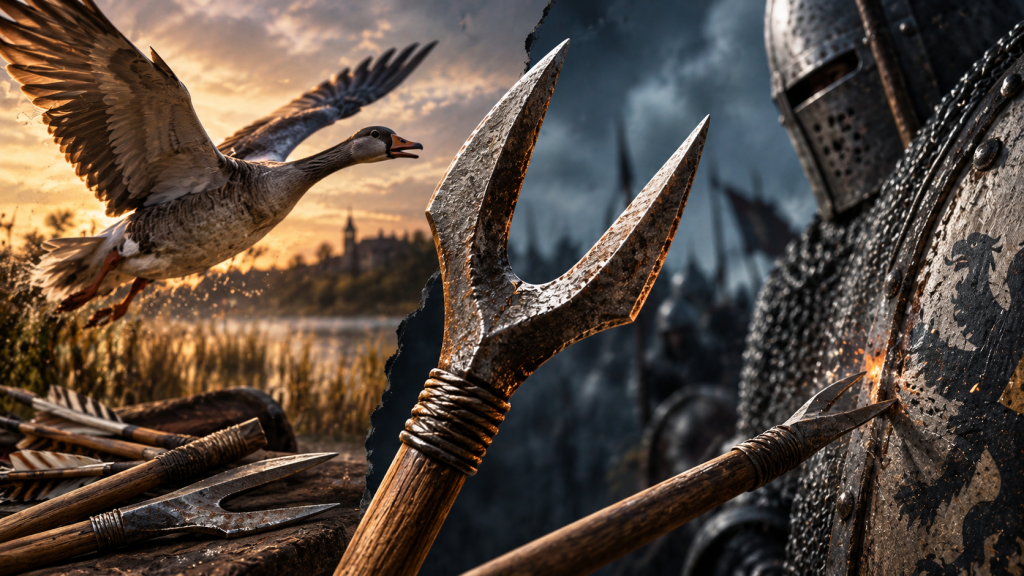
And here we have something much stronger than modern speculation—a medieval written source. The Italian writer Pietro de’ Crescenzi, in his agricultural treatise of the early fourteenth century, recommended a special sagitta bifurcata, literally a forked arrow, for hunting large birds. According to the description, it could cut or seriously damage the neck or wing of a wild goose or another large bird. That is remarkably close to a direct medieval answer to the question of why an arrow might need two points.
Suddenly the strange geometry begins to make sense. When hunting birds, deep penetration into the torso is not necessarily the primary objective. Bringing the bird out of the air may be more important. An ordinary narrow point that strikes imperfectly can pass between feathers or glance along a wing while causing relatively limited damage. A broad forked head increases the effective striking area, while sharpened inner edges turn the impact into a cutting blow. If a wing or neck passes between the prongs, the result can be far more serious than a small puncture.
A broad head also offers another practical advantage when hunting small game: a missed arrow is less likely to bury itself deeply in grass or undergrowth. That may sound trivial today, but a well-made arrow with an iron head was an object worth recovering. The unusual geometry could therefore both increase the chance of stopping a small, fast-moving target and make a missed arrow easier to find. Modern reconstructors of historical archery have suggested precisely this function for some European Type 6 forked hunting heads.
Then Why Make Such an Arrowhead So Sophisticated?
This is where the argument behind the armor-piercing hypothesis becomes interesting. Russian archaeological literature describes some two-pronged srezni of surprisingly sophisticated construction. Archaeologist Yuri Morgunov noted one example whose main body was forged from relatively soft steel while plates of harder high-carbon steel had been forge-welded onto its cutting edges. At the same time, he described two-pronged srezni as possessing considerable penetrating ability and referred to ethnographic parallels for their use against waterfowl. At first glance, this really does seem contradictory: why invest so much work in an arrowhead intended for a duck?
But this reasoning risks imposing modern assumptions about manufacturing economics on a medieval object. A high-quality cutting edge does not automatically imply an armor-piercing function. A knife can have a hardened blade without being designed to penetrate armor. If a forked arrow was intended specifically to cut feathers, skin, muscle, tendons, or the bones of relatively small prey, the ability of its edges to remain sharp would be perfectly rational. In fact, hardened material concentrated along the cutting surfaces may tell us more about the importance of slicing performance than about armor penetration.
Even so, the military hypothesis is not entirely without foundation. Studies of material culture in medieval Rus’ note that the precise function of some such arrowheads remains uncertain: they have often been interpreted as hunting heads, but there are also indications that similar forms could occur in military contexts. Analogous forked arrows existed far beyond Eastern Europe—for example in Japan, where several varieties of split or crescent-shaped heads were known. This is another warning against an overly simple formula in which “shape X always means purpose Y.” Different societies could use the same basic geometry for different purposes.
What If Two Points Really Did Reduce Ricochet?
Now we come to the most intriguing hypothesis. One of the fundamental problems when shooting at a hard surface is that an arrow rarely strikes it at a perfect right angle. Armor has complex geometry, the wearer is moving, the arrow may arrive from above or from the side, and the curved surfaces of helmets and later plate armor could themselves encourage deflection. When a conventional point strikes obliquely, it can begin sliding across the surface rather than penetrating it. The poorer the angle of impact, the greater the risk that a significant part of the arrow’s energy will be lost without achieving penetration.
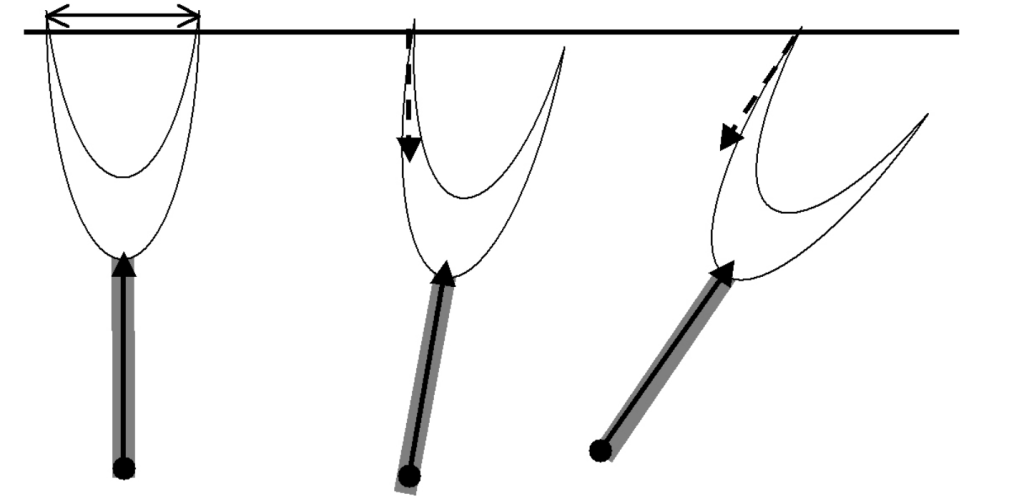
A forked head theoretically changes the mechanics of initial contact. During an almost perpendicular hit, both prongs strike the surface simultaneously. At a modest angle, however, one prong reaches the target first. Depending on the geometry of the fork, this can theoretically place that working point at a more favorable local angle to the surface than the longitudinal axis of the arrow itself. From this comes the idea of an anti-ricochet arrowhead: instead of the entire point beginning to slide across the obstacle, one of the two prongs may “bite” into it.
On paper, the idea is elegant. More importantly, it explains the very feature that appears disadvantageous for ordinary penetration: the two separated points. If one of them can catch an inclined surface, the probability of immediate deflection may indeed change. The original argument behind this theory suggests that prongs diverging at roughly 40 degrees could allow one point to meet the target at a more favorable angle even when the arrow itself arrived obliquely. But this is where we need to draw a very thick line between a physically plausible effect and a historically demonstrated purpose. The available archaeological and written evidence does not allow us to confidently identify forked arrowheads as specialized armor-piercing ammunition.
Because After “It Grips the Armor” Comes Another Question: What Happens Next?
This is where the armor-piercing hypothesis encounters a serious engineering problem. To incapacitate an armored man, avoiding ricochet is not enough. The arrow must concentrate sufficient energy on a small area, defeat or separate the material of the armor, and retain enough residual energy to damage the body behind it. A narrow bodkin is geometrically much better suited to that task: almost all the arrow’s energy is concentrated behind one strong point. A forked head does the opposite, dividing its working structure between two separated prongs.
Even if one prong penetrates the protection, further movement of the head will soon be restricted by the second prong or by the central part of the fork. In other words, the same geometry that might theoretically improve the initial contact can hinder deep penetration. It becomes a trade-off: reduced tendency to glance away does not automatically mean greater armor penetration. For a true armor-piercing projectile, the depth of penetration matters much more than the mere fact that the point left a hole or scratch.
It is revealing that specialized military and presumed armor-piercing arrowheads in Western European archaeological typologies generally look quite different. Narrow, robust points are classified separately from broad hunting heads and forked hunting heads. That does not prove that no forked arrow was ever fired at an armored man. On a battlefield, people used whatever weapons were available. But there is an enormous difference between saying “someone could have shot this at a warrior” and saying “this was designed specifically to penetrate armor.”
Perhaps We Are Looking for One Function Where Several Existed
There is another problem: the term “forked arrowhead” groups together objects from different periods and cultures that may look similar without necessarily serving the same purpose. A European crescent-shaped forker, an Old Rus’ two-pronged srezni, and a Japanese karimata belonged to different weapons traditions. Even within Europe, their dimensions, angles between the prongs, mass, attachment methods, and sharpening varied considerably. It would be strange to assume in advance that every smith from England to East Asia adopted the same shape for exactly the same reason.
Some variants are clearly well suited to cutting. Others may have been used against birds. Still others could have been intended for small terrestrial game. Certain forms might theoretically damage the tendons of larger animals. There are also indications of use in military contexts. Even the idea of firing a forked arrow at a rope is not physically impossible—the problem begins only when that specialized possibility is transformed into a universal explanation for every archaeological find. The history of weapons is rarely as neat as modern typologies would like it to be.
One conclusion, however, seems considerably more secure than the others. The idea that forked arrows were created primarily as a means of penetrating metal armor remains an interesting engineering hypothesis rather than an established historical fact. Properly testing it would require a controlled experimental program: identical shafts and fletching, reconstructed heads of different types, bows of comparable performance, controlled launch velocities, metal and textile armor targets, and repeated impacts at different angles. Researchers would need to measure not merely the number of ricochets, but penetration depth, damage to the arrowhead, and the amount of energy transmitted beyond the armor. Without such tests, saying that “two prongs ricochet less” tells us very little about actual combat effectiveness.
The Strangest Explanation May Have Been the Most Ordinary One
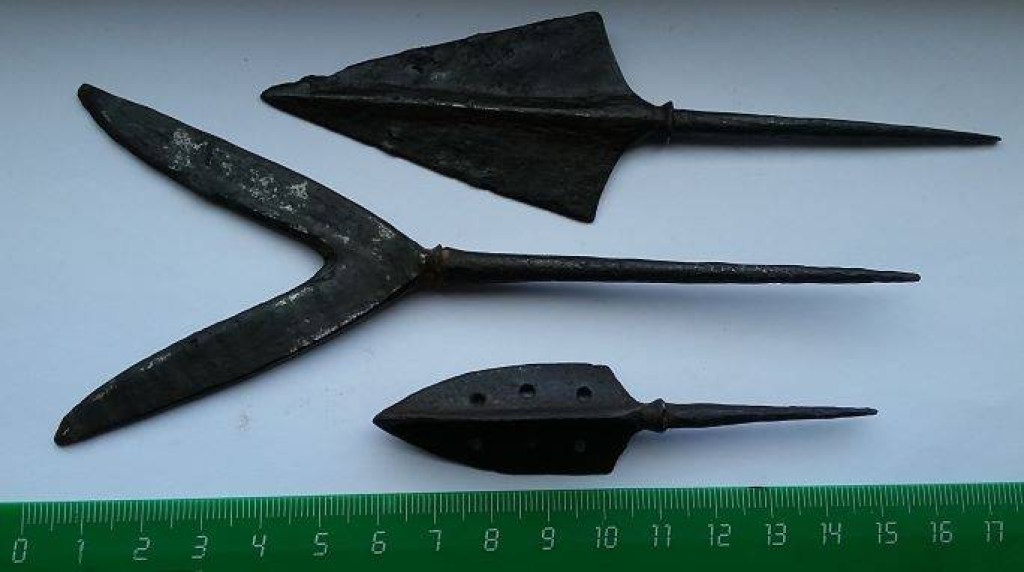
And here the story comes full circle. At first, it seems absurd that a complicated iron arrowhead with two sharpened prongs could have been intended for hunting birds. Surrounded by images of knights, armor, and medieval warfare, we instinctively want to find a more impressive function for it: cutting bowstrings, stopping cavalry, or cleverly defeating armor. Yet a fourteenth-century written source explicitly describes a forked arrow for large birds, while archaeological classifications consistently place European forkers among hunting arrowheads. There is nothing primitive about that explanation. Medieval hunting also required specialized weapons, and arrowheads were selected not according to the simplistic rule that “sharper is always better,” but for particular targets.
The mystery of the forked arrowhead may therefore exist partly because we have been asking the wrong question. We look at its two points and ask: why complicate an arrow unless it was meant to penetrate better? But its maker may never have needed deep penetration in the first place. He may have wanted a larger cutting area, something capable of catching a wing, neck, or another part of a small fast-moving target and preventing the head from slipping away after contact. The anti-ricochet armor theory remains worthy of experimental testing because there is a genuinely interesting physical idea behind it. For now, however, archaeology and written evidence point toward a much less spectacular answer. The forked arrow may have been complicated not because a medieval weaponsmith was trying to defeat armor, but because he understood very well how difficult it was to hit a flying bird—and make that single hit count.