Why Does Turkey Need an Intercontinental Ballistic Missile? An Analysis of the Yıldırımhan Project

The news that Turkey has, in effect, openly begun discussing the development of an intercontinental ballistic missile seems, at first glance, too sensational even by the standards of the modern arms market. This is especially true for a NATO country that, just a few years ago, was associated primarily with strike drones rather than heavy strategic systems. But if we take a closer look at the development of Turkey’s missile program in recent years, it becomes clear that this is not a sudden leap forward, but rather a steady climb up the range ladder.
This is precisely the focus of The War Zone’s article—not so much on the Yıldırımhan missile itself, but rather on the reasons why Ankara decided to pursue ICBMs in the first place.
From “Bora” to “Typhoon”
Turkey’s long-range missile program did not come out of nowhere. It was built on the Bora/Tayfun series developed by Roketsan.
At first, the focus was on relatively compact operational-tactical systems. But gradually, the range began to increase.
The first major milestone was the Tayfun—Turkey’s first ballistic missile, which went far beyond the capabilities of conventional tactical systems. Following tests conducted between 2022 and 2025, it became clear that Ankara was no longer limiting itself to battlefield weapons.
The Tayfun Block 4 is particularly noteworthy—a significantly larger version of the missile, measuring about 10 meters in length and weighing over 7 metric tons. In fact, it already represents an intermediate step between an operational-tactical system and a medium-range system.
The next step is Cenk
Following Tayfun, Cenk—a medium-range missile with a claimed range of about 2,000 kilometers—was added to the Turkish program.
It is here that the logic behind this development becomes clear. Turkey is following the classic pattern:
— first, tactical missiles
; then SRBMs
; then MRBMs
; and only after that, an attempt to move up to the ICBM class
In essence, Yıldırımhan doesn’t seem like a standalone project. It looks more like the culmination of an existing line of development.
What is Yıldırımhan?
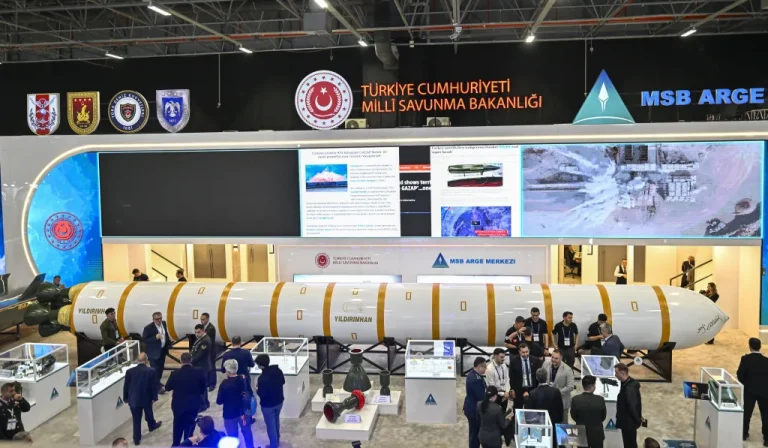
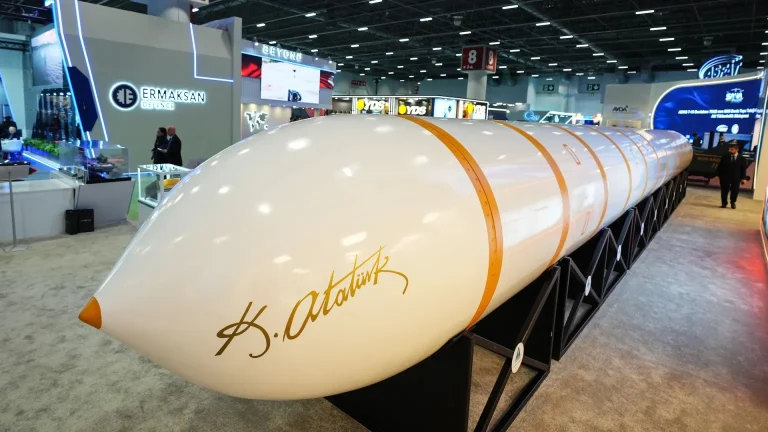
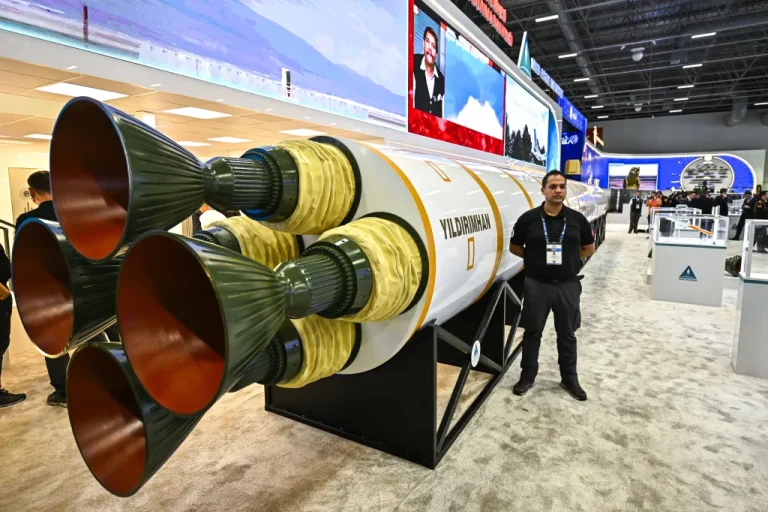
The Yıldırımhan system, which has been publicly unveiled, currently exists more as a demonstration of intent than as a finished weapon.
The claimed specifications seem extremely ambitious:
— range of about 6,000 kilometers
— speed up to Mach 25
— large warhead
— intercontinental class
But the problem is that there is a huge gap between the exhibition model and the actual ICBM.
Even Turkish officials admit that there is no fully functional flying prototype yet.
Why Does Turkey Need ICBMs in the First Place?
And this is where things really get interesting.
The TWZ article asks the question directly: Against whom, exactly, does Turkey intend to use an intercontinental ballistic missile?
From a purely military perspective, Ankara’s current threats can be countered with significantly simpler systems.
Even the Tayfun Block 4 is already outperforming:
— the Eastern Mediterranean
— the Middle East
— most of its regional rivals
And with a range of about 2,000 km, the Cenk effectively turns Turkey into a full-fledged regional missile power.
Against this backdrop, the development of ICBMs appears to be less of a military objective and more of a political one.
This isn’t about war, but about status
This is the most important point.
For Ankara, the development of ICBMs is not just a matter of striking a distant target. It is a matter of technological standing.
A country capable of independently developing:
— a heavy ballistic missile
— a guidance system—
an engine
— a guidance system—
a mobile launch complex
is automatically reclassified into a different category of states.
That is precisely why many analysts believe that, for Turkey, the mere fact of possessing such technologies is more important than their practical application.
The main problem is testing
But here, Ankara runs up against a fundamental geographical problem.
Turkey simply does not have enough space to fully test a missile with a range of 6,000 km. The main test site is located near the Black Sea, and its size does not allow for standard testing of intercontinental systems.
That is precisely why there is talk of cooperation with Somalia and the potential establishment of spaceport infrastructure on the Indian Ocean coast.
At first glance, this seems strange, but the logic is clear: testing such systems requires a vast body of water.
A Technological Leap
The transition from Tayfun to Yıldırımhan also marks a qualitative change in the missile itself.
Early Turkish systems followed a relatively “low” trajectory within the atmosphere.
An intercontinental ballistic missile is in a whole different league:
— spacewalk —
operations in the exoatmospheric region —
complex
ballistics — systems for overcoming missile defense
This is no longer just a “big rocket,” but a full-fledged strategic system.
And the main issue is the warhead
And this is where the most awkward part of the whole story comes in.
An ICBM without nuclear weapons is an extremely expensive and controversial tool.
TWZ explicitly states that developing an intercontinental ballistic missile designed exclusively for a conventional warhead appears atypical for modern military doctrine.
Officially, Turkey makes no mention of any nuclear component. But the very fact that it is moving toward ICBMs inevitably raises such questions.
Conclusion
The story about Yıldırımhan is significant not because Turkey will acquire a fully-fledged intercontinental ballistic missile tomorrow.
What is important is this: For the first time, Ankara is openly demonstrating that it no longer views itself solely as a regional power.
Tayfun, Cenk, and now Yıldırımhan are no longer separate projects, but rather a coherent missile program built on the same logic that once guided other countries seeking to join the ranks of strategic players.
And even if the ICBM itself remains, for now, more of a demonstration of ambition,
the trajectory of the Turkish missile industry’s development already appears quite realistic.
источник https://www.twz.com/nuclear/what-is-behind-turkeys-pursuit-of-an-icbm