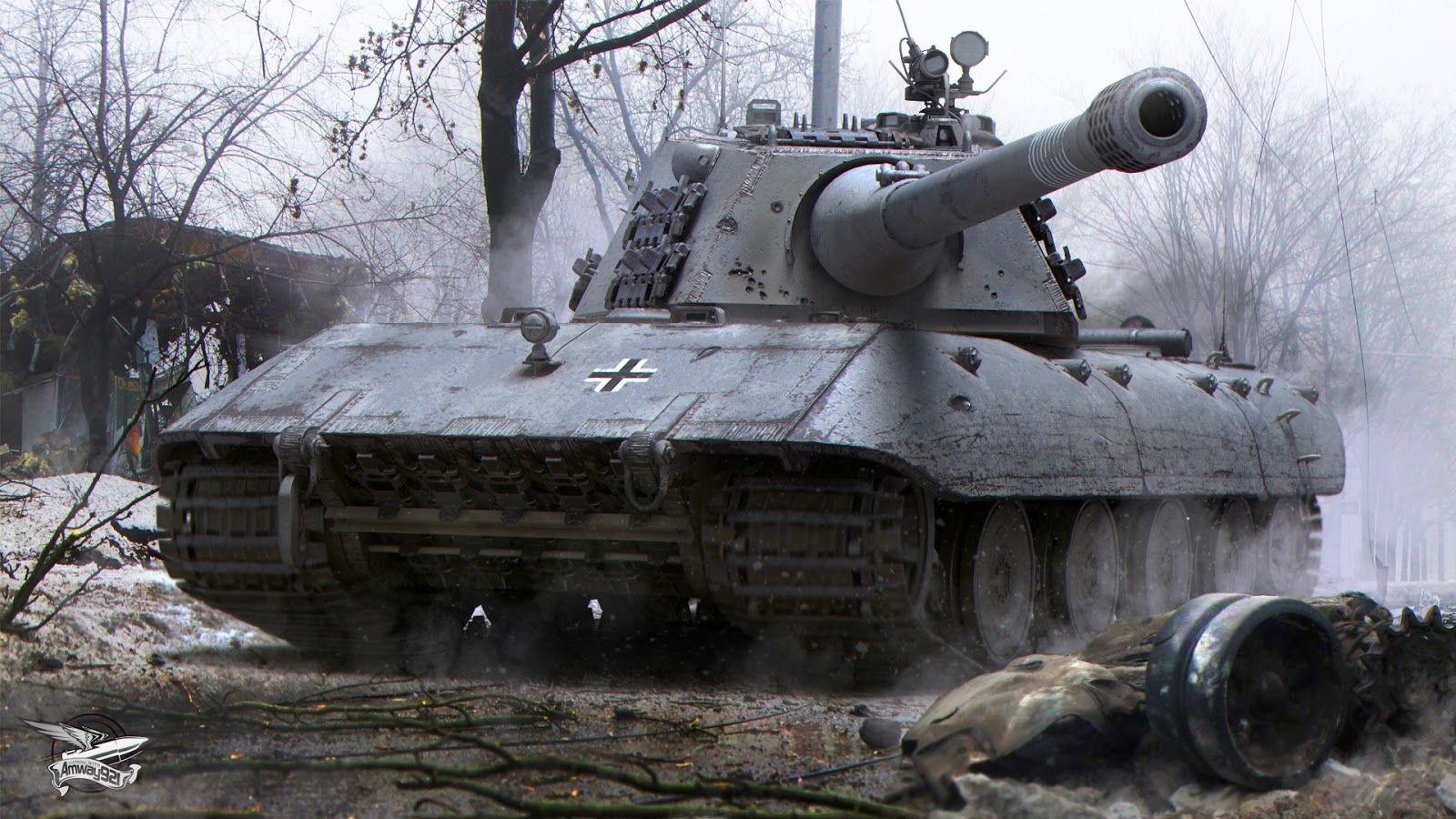
The History of the E-100 Super-Heavy Tank, a Rival to the Pz.Kpfw. Maus
While things were going well for the 6th Division of the Armaments Department with light and medium tanks, the situation was quite different when it came to heavy—and especially super-heavy—tanks. Right up until the spring of 1942, under the leadership of Heinrich Knipkamp, some rather strange combat vehicles were being developed, the effectiveness of which was highly questionable. It was no coincidence that the Tank Commission, headed by Ferdinand Porsche, was established in late 1939. Its activities did not truly begin until 1941, but that was enough to get the 6th Division of the Armaments Department moving. Moreover, the turrets for their tanks were originally designed for Porsche’s tanks.
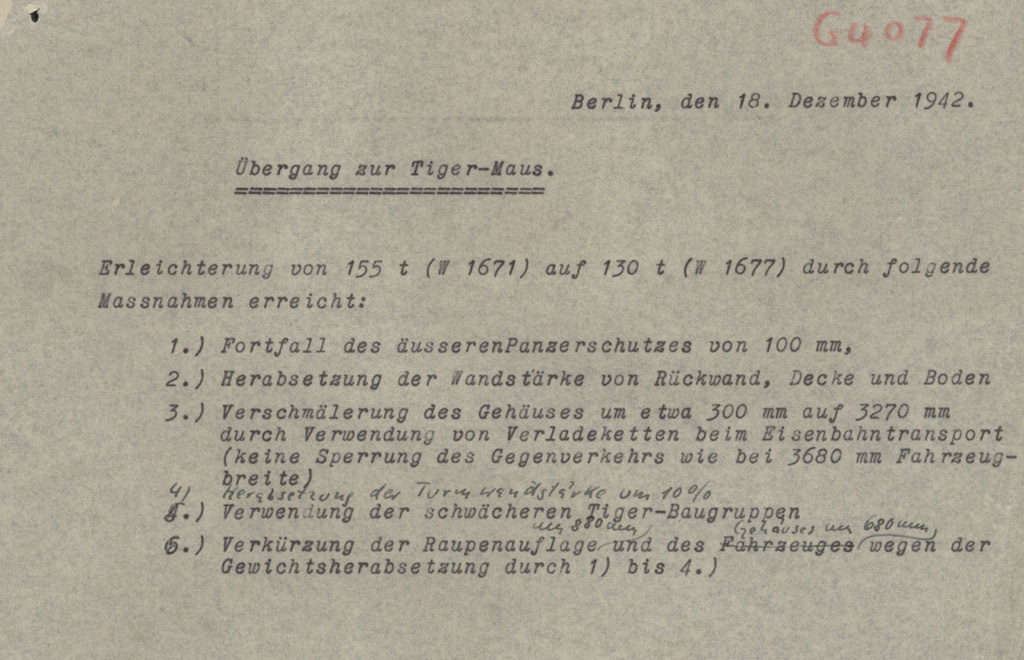
There are very few references left to the Tiger-Maus
In the case of heavy tanks, victory ultimately went to Henschel and the 6th Division of the Armaments Department, which oversaw their development. But it was won in a hard-fought—and not entirely fair—battle. As for super-heavy tanks, the Pz.Kpfw. Maus took the lead. Nevertheless, Knipkamp attempted to create a rival to the heaviest tank in history, following a tried-and-true approach of utilizing off-the-shelf solutions. This is how the Tiger-Maus project came into being, which later evolved into the E-100.
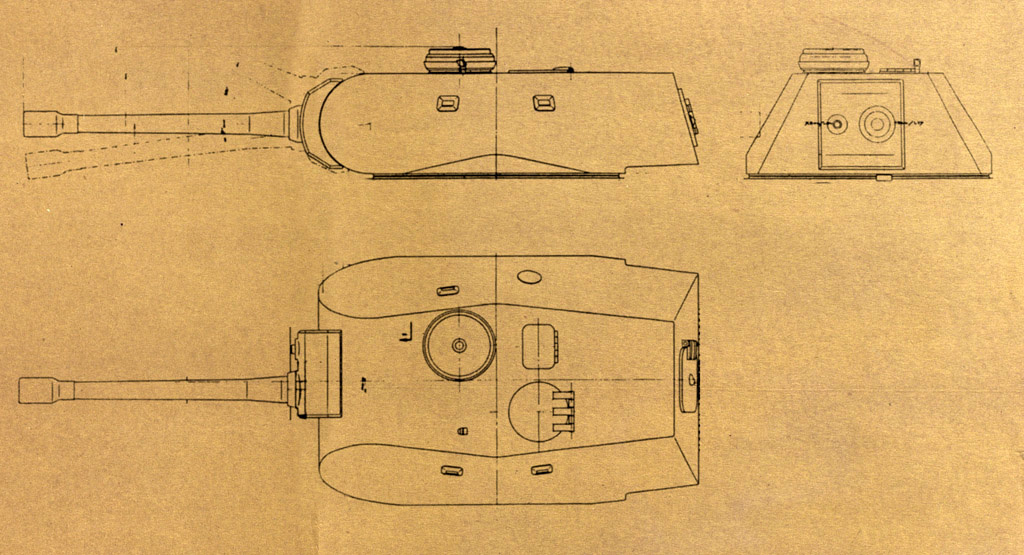
Development of this tank began with the turret
It must be said that the design of the Pz.Kpfw. Maus did not take shape immediately. Moreover, there is every reason to believe that the initial design, presented in June 1942, incorporated the Krupp turret that had been developed for the latest version of the Pz.Kpfw. Löwe super-heavy tank. It was armed with a 149-mm gun with a barrel length of 37 calibers. However, this design was short-lived; by July, it had become clear that a significant redesign would be required. This decision spelled the end for the Pz.Kpfw. Löwe, and the project was canceled in July 1942. But, as the saying goes, no place stays empty for long.
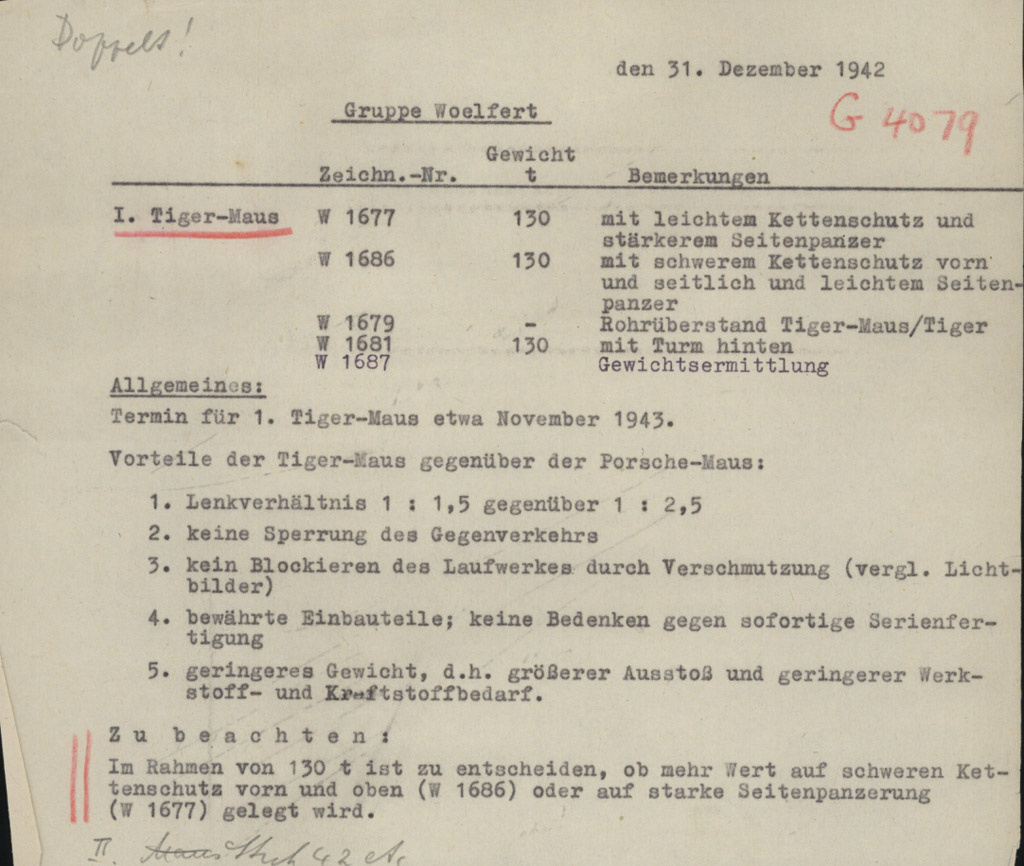
By the end of its development, the tank’s combat weight had dropped to 130 metric tons. After that, it was no longer needed.
On September 11, 1942, a meeting was held between representatives of the 6th Section of the Armaments Department and representatives of Krupp to discuss work on the turret for the Pz.Kpfw.Maus. Lieutenant Colonel Fritz Holtzhauer was concerned that the Porsche K.G. tank design contained a great many completely new components and assemblies, including the engine. Lieutenant Colonel Erich Wölfert, who was in charge of tank development at Krupp, quite skillfully capitalized on Holtzhauer’s concerns. As a backup option, he proposed the concept of an alternative Porsche tank with a combat weight of 150 metric tons. The design of this prospective tank proposed making maximum use of components from the Pz.Kpfw. Tiger II heavy tank. Holtzhauer supported the idea and suggested revisiting the discussion a month later.
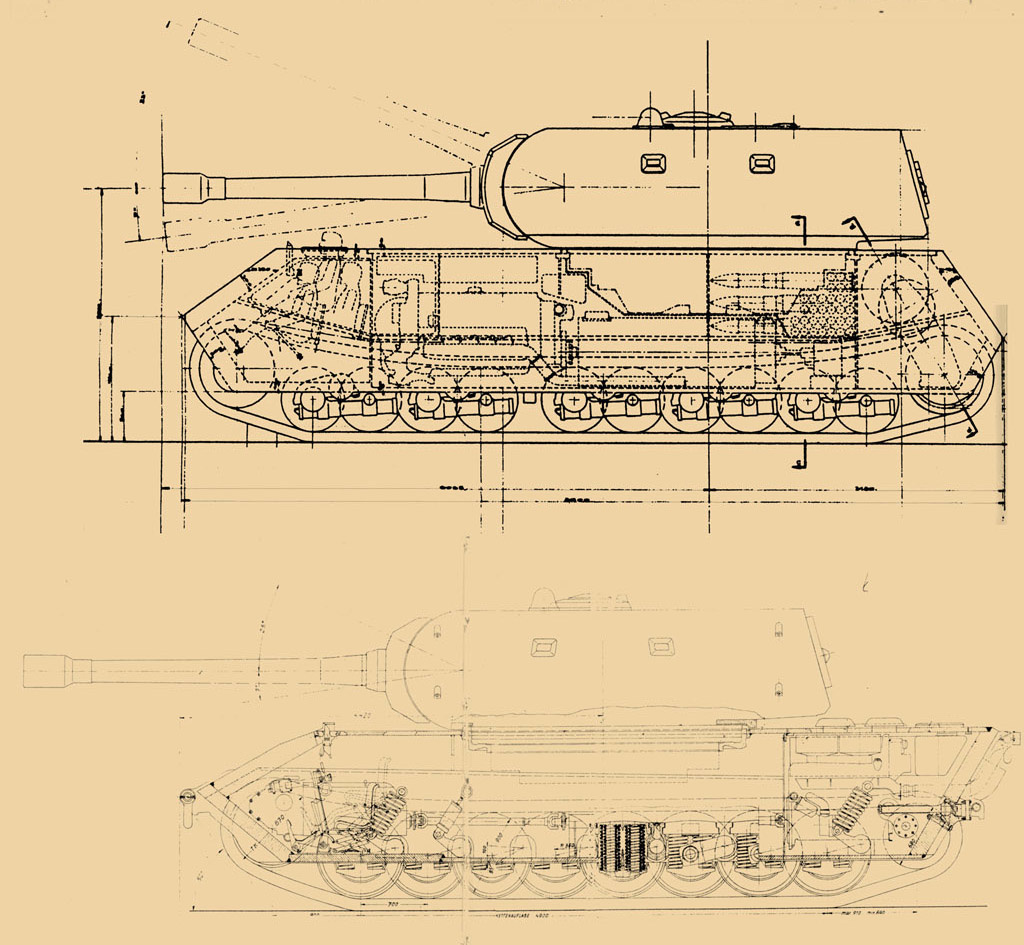
These two diagrams explain where the E-100 came from. Essentially, yes, it is the Tiger-Maus, just with a different suspension system.
For Krupp, building tanks from turrets was a familiar process. This is how the Pz.Kpfw.IV came into being. In correspondence, this project was designated “Tiger-Maus,” and it is also referred to as “Krupp-Maus” in NARA documents. The project was based on technical solutions typical of the “menagerie,” which was clearly a plus in Knipkamp’s eyes. This included the transport tracks—well-known in specialized circles—which were needed to transport the tank by rail. When mounted on them, some of the road wheels were removed, which allowed the required width to be achieved.
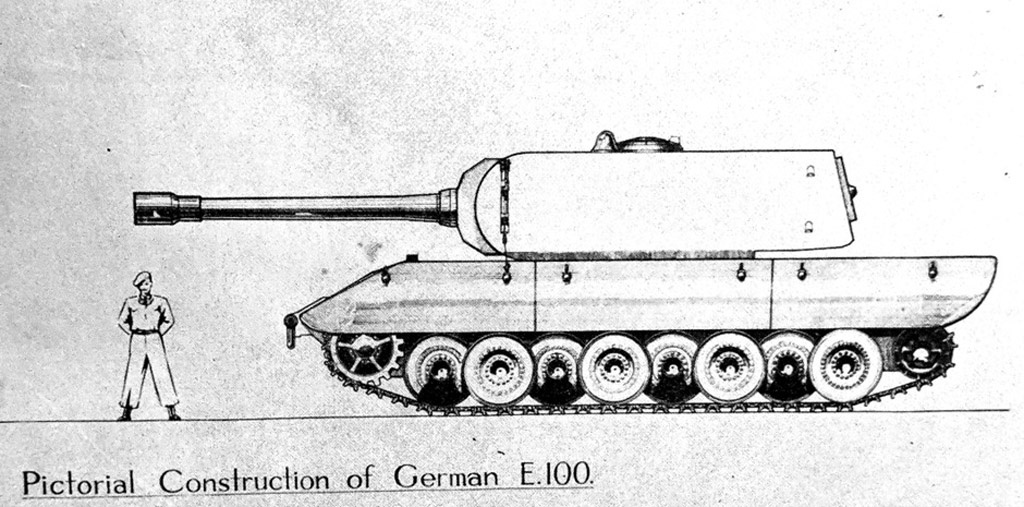
In reality, they wouldn’t have built it that way out of metal. This tower dates from January 1943
Unlike Porsche K.G., Krupp’s engineers chose not to enclose the Tiger-Maus’s running gear within a hull. Instead, a highly original solution was adopted that allowed the tank to be wider than the railroad gauge while still fitting within that gauge when necessary. Massive screens were developed to protect the sides, which could be removed when the tank was in transport mode. The crane equipment used to install and remove the screens was mounted directly on the turret. The project was proposed in two variants; according to the description, in drawing W 1671, the turret was moved to the rear of the hull. Incidentally, at the same time, the fighting compartment was also moved aft on the Pz.Kpfw.Maus (drawing K 3385 dated November 14, 1942).
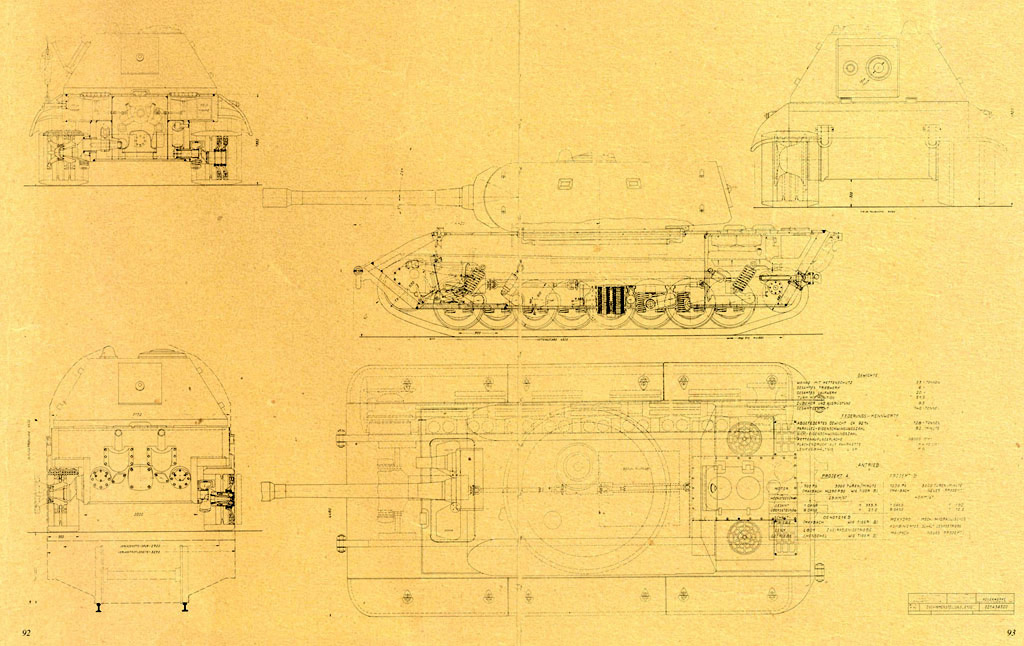
The legs of the E-100 are based on this preliminary design
It would seem that such a project could be completed quickly. The first designs for the Tiger-Maus appeared in November 1942. But it turned out that things weren’t quite that simple. The tank’s combat weight was estimated at 150 metric tons. At the same time, the Maybach HL 230 engine was supposed to be tuned up to 1,000 metric horsepower—a load it would hardly have been able to withstand. And even with that power, it still wouldn’t have been enough. Such a tank would hardly have been able to exceed 20 km/h, and how the transmission (the same as that of the Pz.Kpfw. Tiger II) would have functioned is another question entirely. The commission—which, incidentally, included Ferdinand Porsche—saw more flaws than merits in the Krupp design.
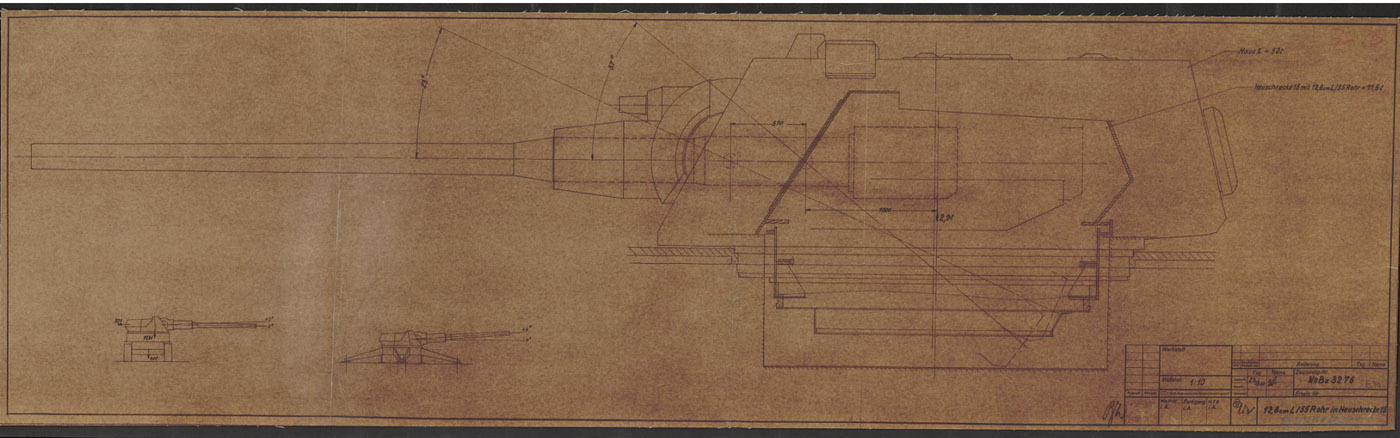
And this is what the tower that would have been built on it looked like
As an alternative to the Maybach HL 230, engines were proposed that were intended for the Pz.Kpfw.Maus, but they were far from being ready for mass production. The problem was exacerbated by the fact that, with each passing month, the competitor’s weight increased due to the growing thickness of its armor, reaching 170 metric tons by November. The project reached this milestone on November 30, 1942, when the preliminary design W 1674 was prepared. The chassis weighed 122 metric tons, of which 82 metric tons were accounted for by the hull itself. The tank was planned to use road wheels with a diameter of 650 mm, which was smaller than those of the Pz.Kpfw. Tiger II. The tank was powered by the same MB 507 diesel engine (later designated MB 517) that had been developed for the Pz.Kpfw. Maus. The commission reviewed this variant on December 1, 1942, and rejected it. The transmission components from the Pz.Kpfw. Tiger II were absolutely unsuitable for this design.
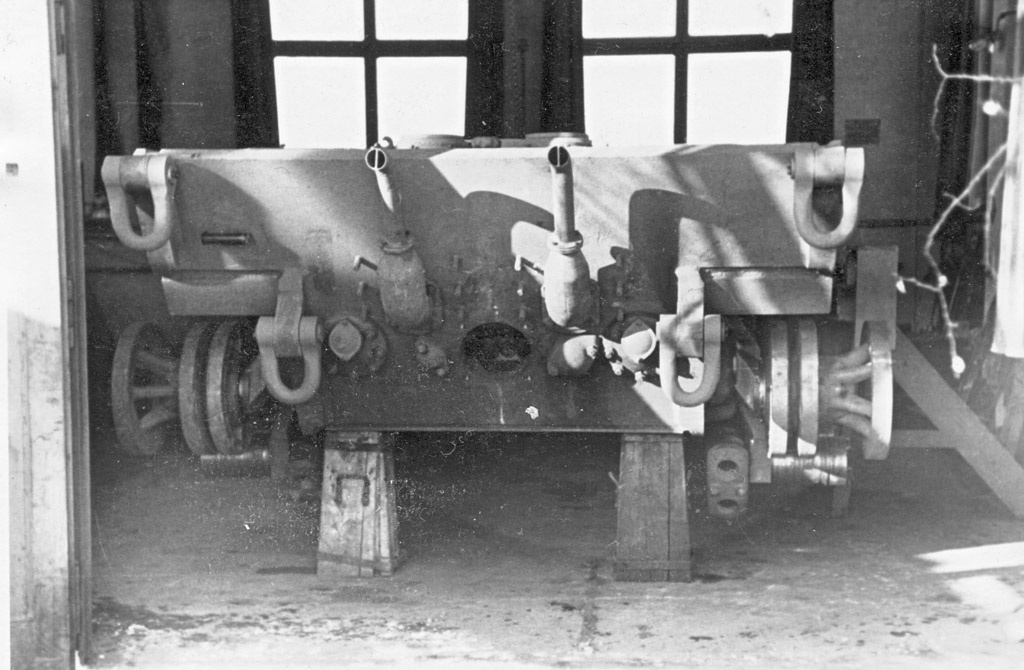
To be more precise, it wouldn’t have been approved. Essentially, only the chassis was approved.
The logical solution was to drastically reduce the tank’s weight. On December 7, 1942, Krupp presented a new design (drawing W 1677). The Tiger-Maus’s combat weight was reduced to 130 metric tons, and the diameter of its road wheels reached 800 mm, matching those used on the Pz.Kpfw. Tiger II. According to calculations, the maximum speed was supposed to reach 23 km/h, but given the specific power output of 5.4 l.s. per metric ton, this seems overly optimistic. At the same time, an alternative variant (drawing W 1681) with the turret mounted at the rear was prepared. The commission rejected this variant during its review of the project on December 8.
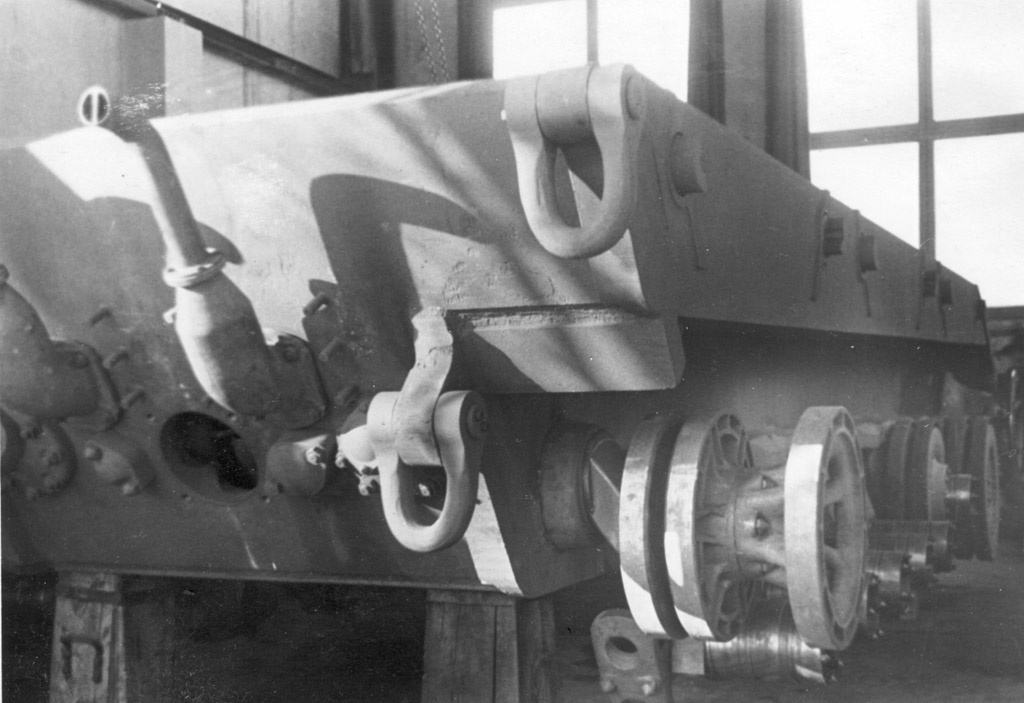
The chassis was developed as part of the work on the self-propelled artillery system
The preliminary design for the W 1677 was approved; it was believed that using components from the Pz.Kpfw. Tiger II would allow it to be built more quickly. Torsion bars were approved for the tank’s suspension, and the first prototype was expected to be completed by the fall of 1943. But there was a tricky issue: the Pz.Kpfw. Maus was appearing around the same time. In other words, it wouldn’t actually be any faster. On December 15, 1942, Holtzhauer, after a series of consultations with the OKH, decided to reject the Tiger-Maus. Hitler put an end to the matter once and for all, having quite rightly concluded that Porsche’s creation held greater promise.
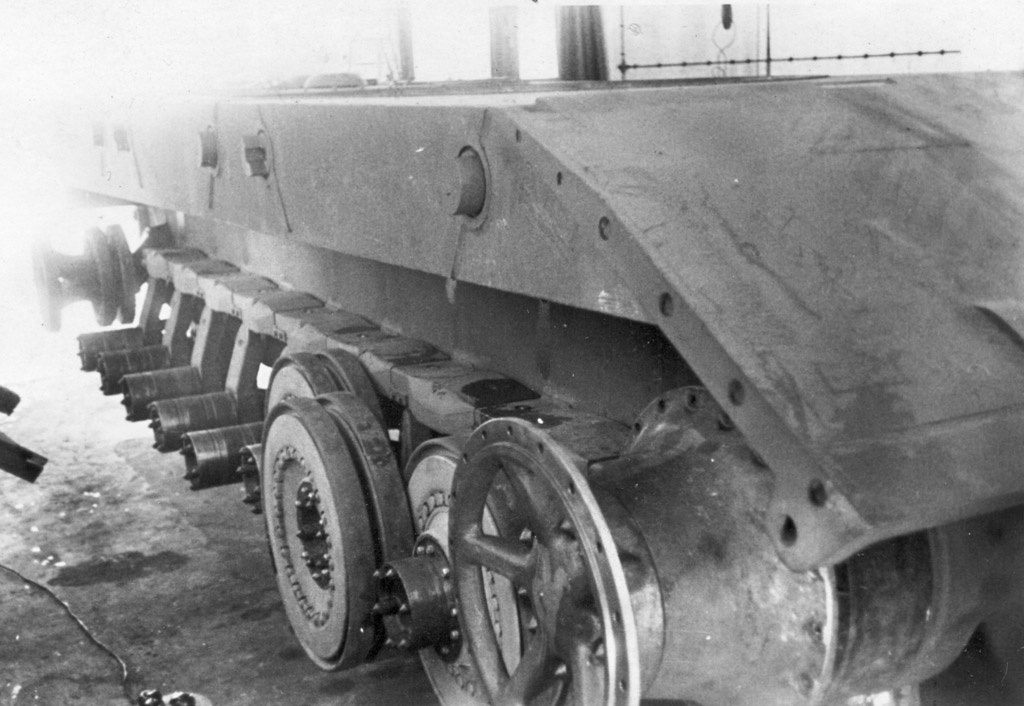
The only part from Adlerwerke here is the suspension
Officially, work on the Tiger-Maus had ceased, but in reality, that wasn’t quite the case. The project was more or less put on hold, and it isn’t all that difficult to understand what it looked like at the time work was halted. In April 1943, the 6th Division of the Armaments Department initiated the development of combat vehicles in the E series (Entwicklung, meaning “development”). The E series included the 10-15-metric-ton E-10 tank destroyer, the medium (combat weight 25–30 metric tons) tank destroyer E-25, the partially standardized medium/heavy tanks E-50/E-75, and the super-heavy tank E-100.
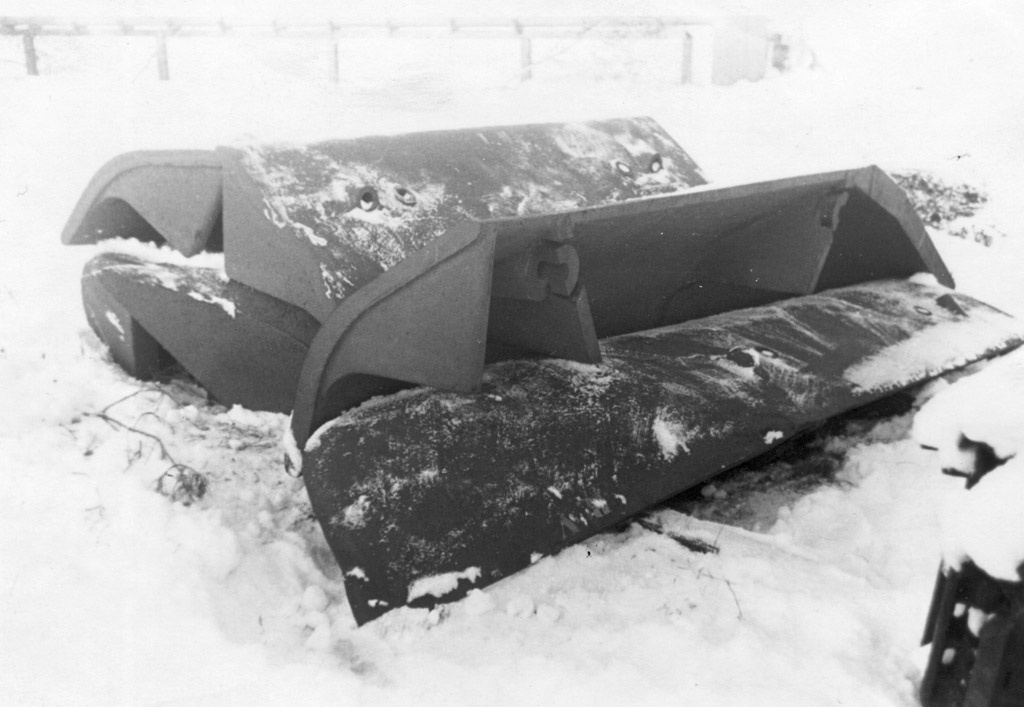
On-board displays, which first appeared on the Tiger-Maus
For some reason, the E-100 was the only one of these to reach the chassis construction stage. In early March 1944, Adlerwerke of Frankfurt am Main submitted drawing 021A38300. Now, this drawing is extremely interesting. This was especially true of the turret, which many researchers consider the “canonical” design for the E-100. But it was precisely the turret that gave Adlerwerke away. The Pz.Kpfw. Maus in drawing K 3387, dated January 1, 1943, had an identical turret. The turret remained in this form for just over two weeks, after which it was redesigned again. It is also worth noting the removable side screens and the widespread use of components from the Pz.Kpfw. Tiger Ausf. B.
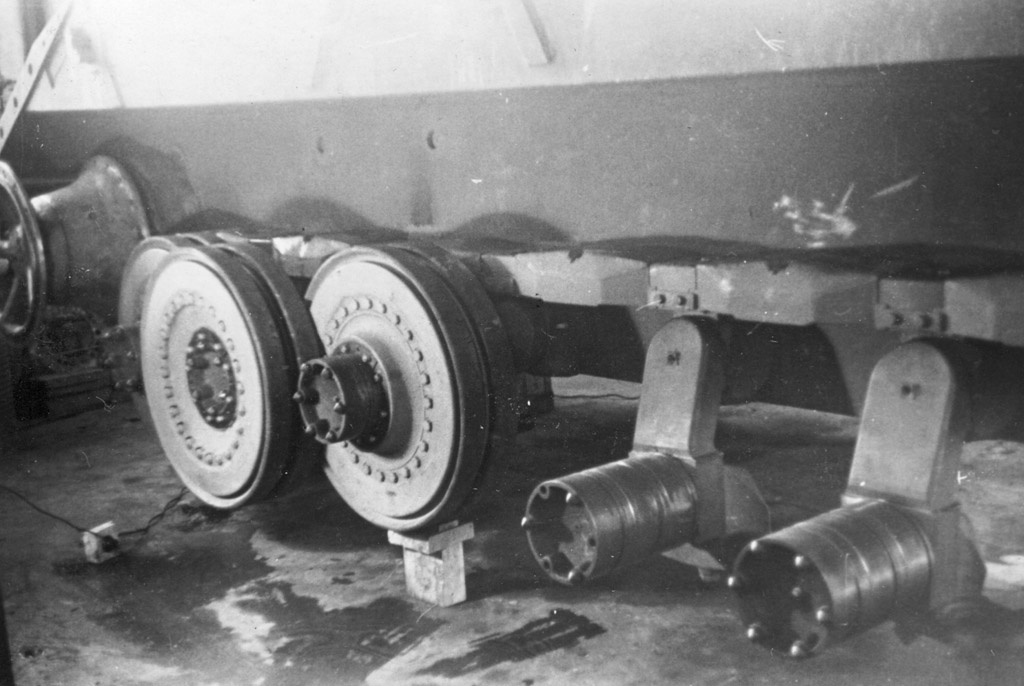
They never finished the suspension
Yes, that’s right; in fact, drawing 021A38300 is nothing more than the same Tiger-Maus, but with an Adlerwerke suspension and support rollers increased to a diameter of 900 mm. This was necessary to accommodate the requirement to move the suspension components outside the hull’s interior. According to the drawing, the tank, armed with a twin-barreled 149-mm and 75-mm gun, was to have a combat weight of 140 metric tons. Two engine options were proposed. In the first version, the tank was to be equipped with a 700-silyny Maybach 230 engine producing 700 l.s., with the transmission and turret mechanisms taken from the Pz.Kpfw. Tiger II. The estimated top speed was 23 km/h. The second variant was to feature a new Maybach engine with a power output of 1,200 l.s.; no specific details were provided regarding the transmission or turret mechanism. The maximum speed of 40 km/h seems extremely optimistic, especially given a specific power output of 8.57 l.s. per metric ton.
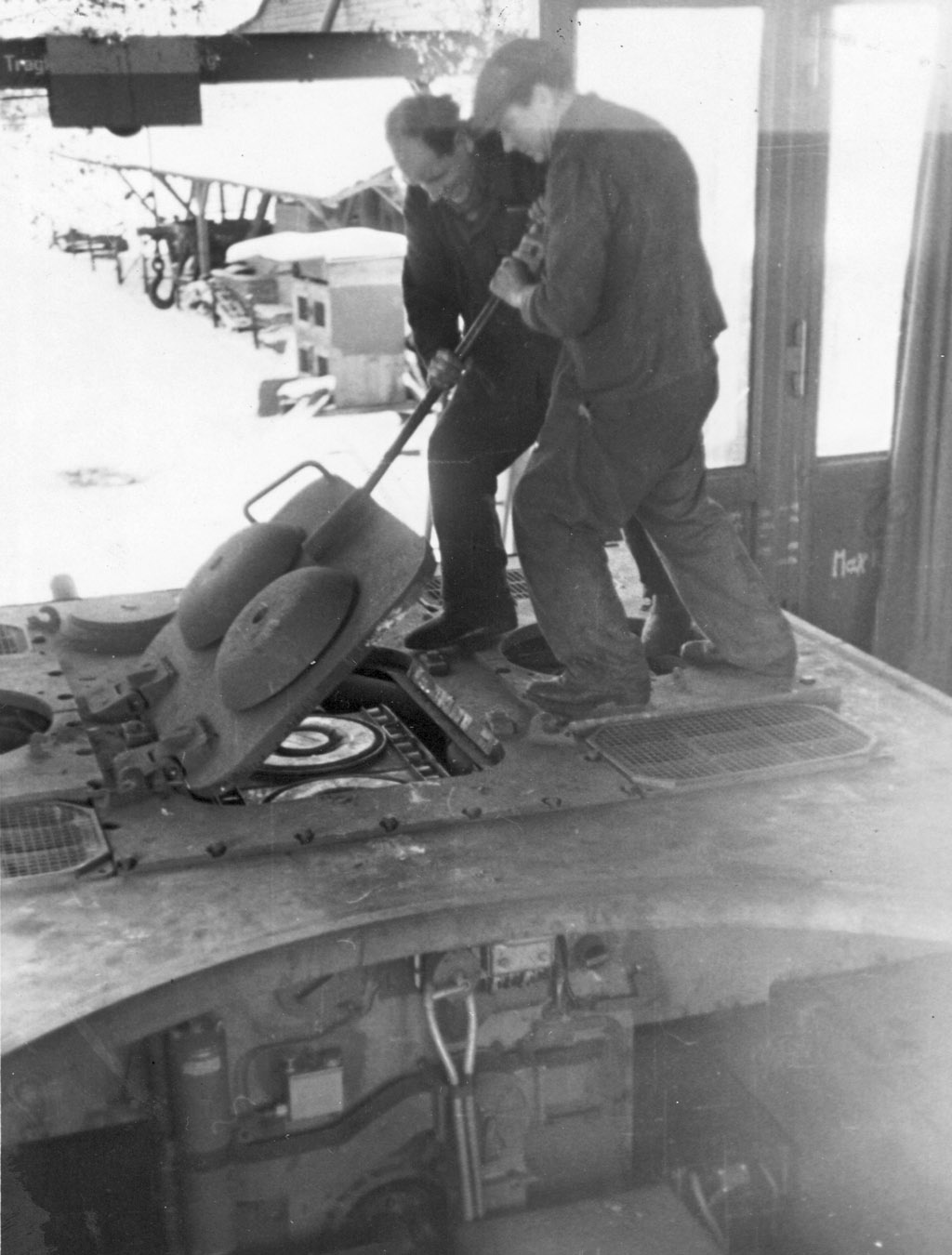
“And what’s under the lid?”
Knipkamp didn’t exactly hide the fact that the so-called new tank was actually a project from over a year ago that had been dusted off. Initially, however, he convinced Holtzhauer that it was a different vehicle, developed by a different company. In reality, Krupp and Henschel were behind the project, and the Tiger-Maus was brought back from obscurity in connection with the resumption of the Pz.Kpfw.Maus mass production program. This discussion began in early 1944. Knipkamp’s reasoning was quite clear: the E-100 would be a simpler and lighter super-heavy tank compared to the Pz.Kpfw.Maus.
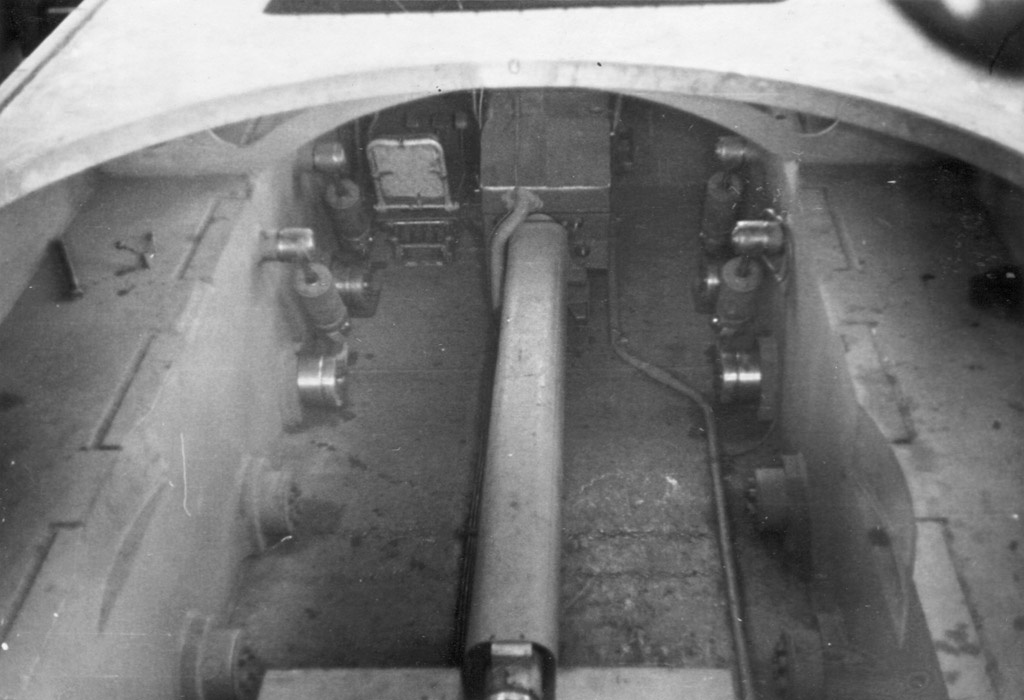
Inside the control room
Meanwhile, one simple thing must be clearly understood: the tank, as depicted in drawing 021A38300, would never have been built. Not only had the 149-mm gun been scrapped back in March 1943, but the turret itself had undergone significant changes in the meantime. As early as March 1944, Krupp began work on a new turret, better known as the Maus II turret. The rounded shape of the front was abandoned; the turret became more streamlined, and the guns (a 128-mm KwK L/5 and a 75-mm KwK L/36) were arranged one above the other. Another important change was the installation of a stereoscopic rangefinder. The E-100 was also supposed to be equipped with such a turret, but with a weight reduced to 35 metric tons. The weight reduction of more than 10 metric tons was achieved by reducing the thickness of the turret sides to 80 mm.
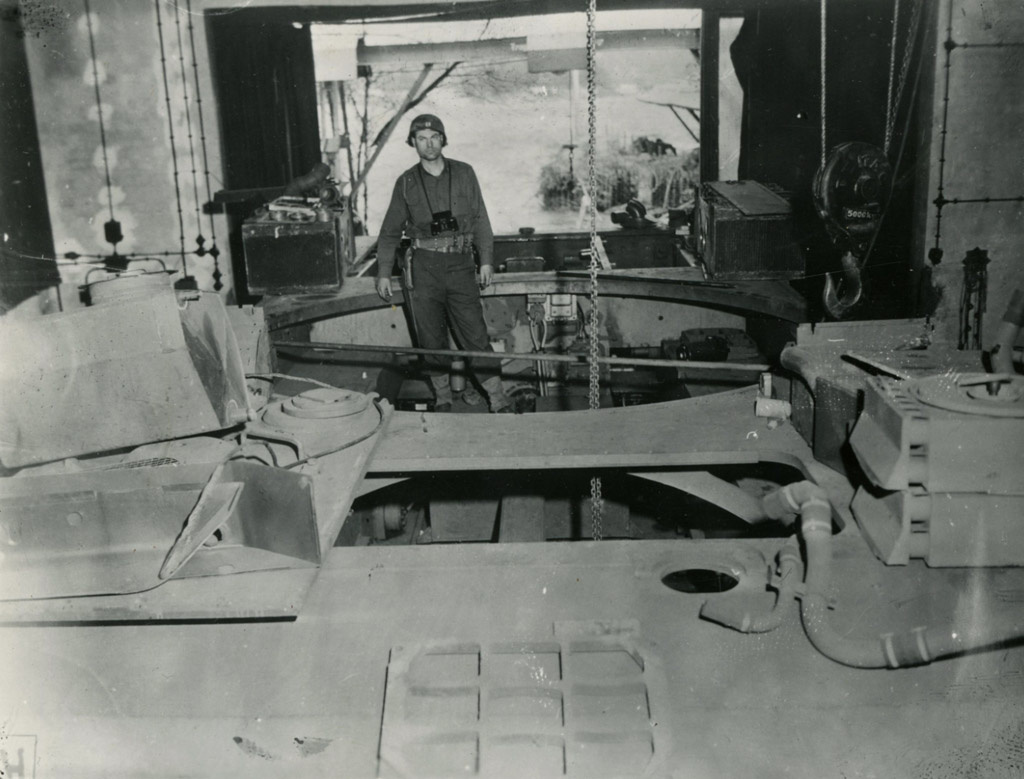
The Americans discovered a tank like this
The main issue was that there was no urgent need for the E-100. Moreover, the argument that the E-100 would be simpler and could be brought into mass production more quickly no longer held water. For the Pz.Kpfw.Maus, Krupp had, in one form or another, cut or assembled 30 sets of hulls and turrets. In addition, by March 1944, the first Pz.Kpfw.Maus prototype was already undergoing testing, and work was underway on a second, fully functional prototype. Since the component base had already been finalized, the idea of rapidly bringing a competing tank into production by using existing mass-produced components from the Pz.Kpfw.Tiger Ausf.B was becoming somewhat obsolete. Not to mention that the Pz.Kpfw.Maus had proven its viability.
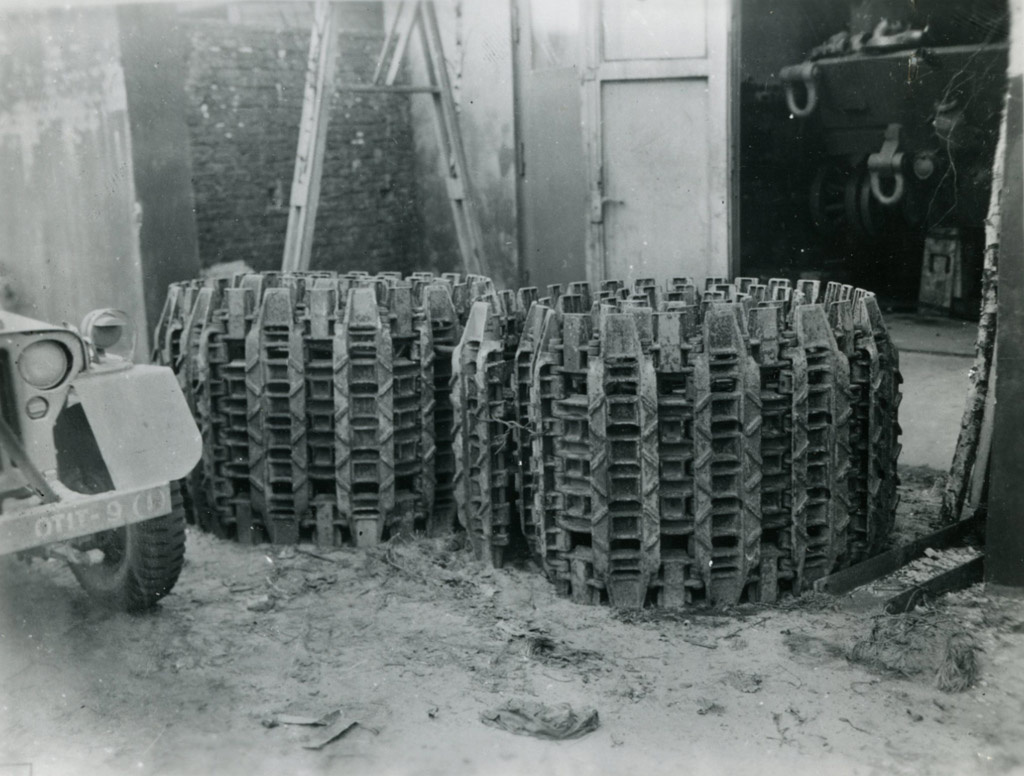
E-100 Track Belts
Under the circumstances, the only thing they were able to accomplish with the E-100 was the construction of a prototype chassis with a mock-up turret. Moreover, judging by drawing 021A38300, development of the tank destroyer known as the Sturmgeschütz E-100 was already underway at that time. This is precisely why the drawing mentions 149- and 173-mm-caliber guns (15 cm StuK L/63 and 17 cm StuK L/53). As far as we can tell, the initial idea was simply to install the new guns in the standard turret, but it turned out that such a move wouldn’t fly. One way or another, the hope that they could push through a basic tank version hadn’t gone away.
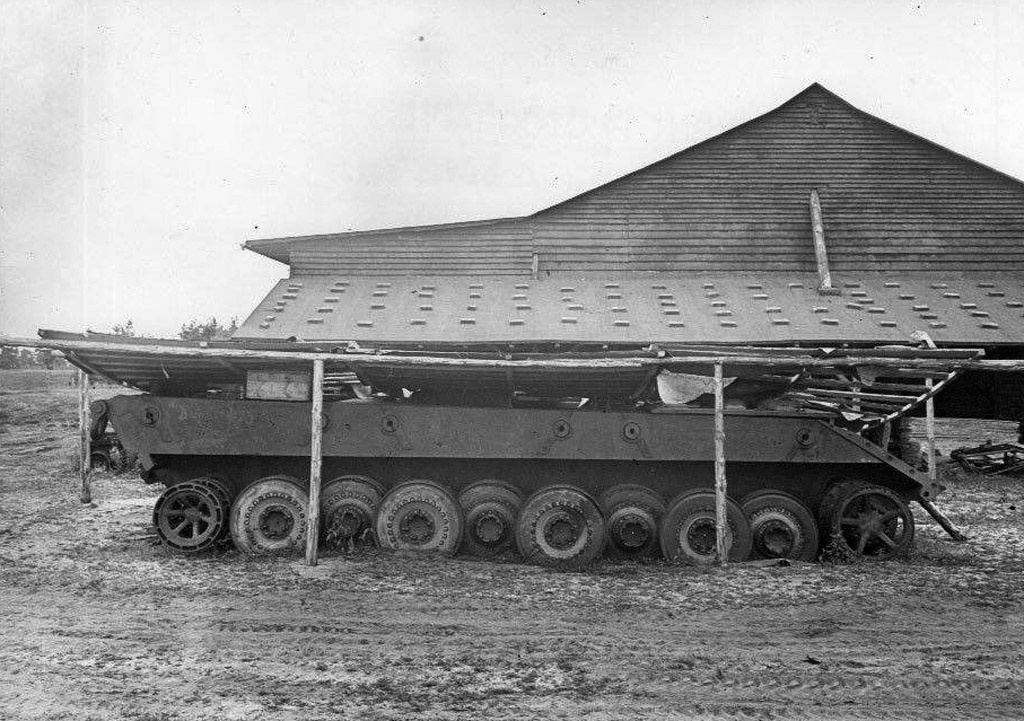
Before leaving for England
Henschel was the actual developer of the tank; Adlerwerke was responsible only for the running gear. This largely explains why a prototype of the tank was built, even if only partially. Moreover, this happened against all odds. On July 10, 1944, Hitler issued an order to halt work on super-heavy tanks and self-propelled guns. The order was carried out, but only partially. Various modifications continued to be made to the design of the Pz.Kpfw. Maus, including the replacement of the gasoline engine with a diesel one. Meanwhile, Henschel was quietly assembling a prototype chassis for the super-heavy tank.
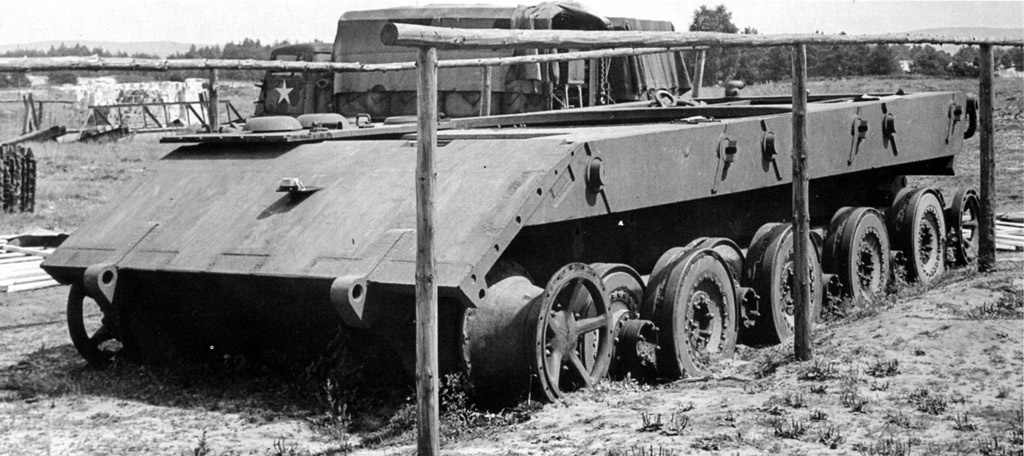
The undercarriage has been partially assembled
In fact, it wasn’t exactly kept under wraps. Section 6 of the Armaments Department was well aware of what was happening. The Henschel test site in Hausenbeck, not far from Paderborn, was chosen as the assembly site. Given the difficult situation on the front lines and the fact that the factories working on the E-100 program were overloaded with other orders, work on assembling the prototype chassis proceeded extremely slowly. As of January 1945, the hull was largely complete, as were the components in the engine compartment. The running gear had been partially assembled, but since Adlerwerke was able to assign only three people to the project and the springs had been sent to an unknown destination, the suspension was not ready. Judging by the condition of the E-100 at the end of the war, the springs never arrived.
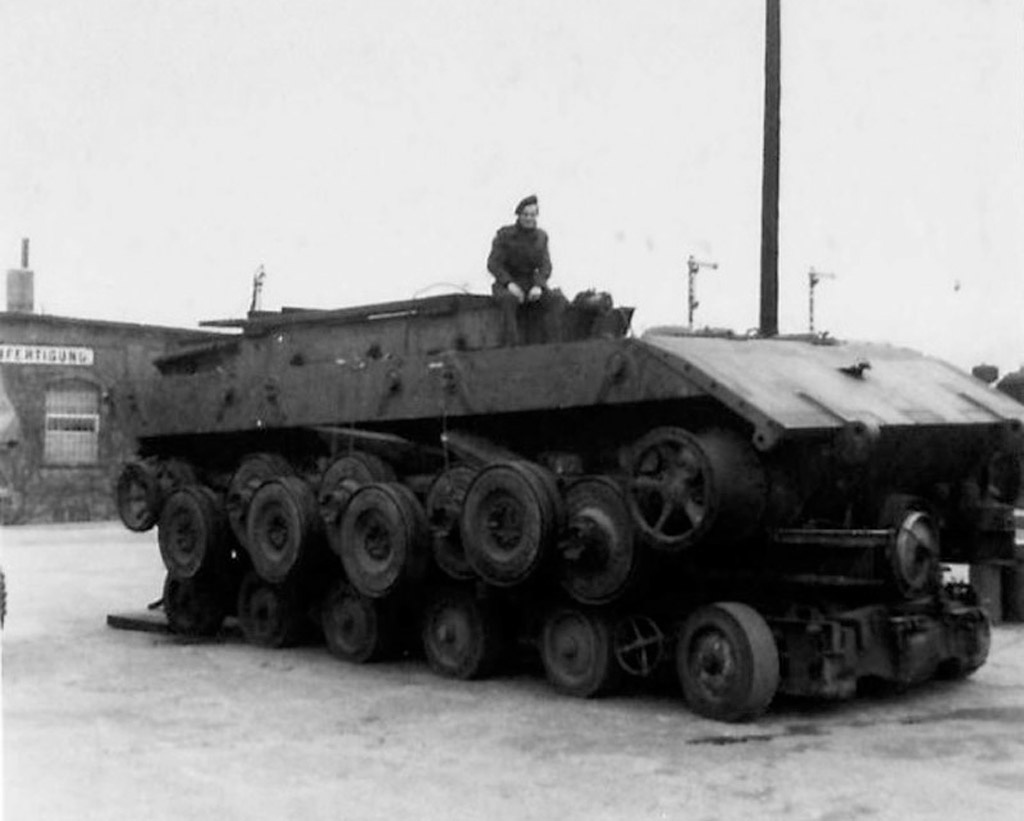
Shipping to England
Porsche K.G. did manage to bring at least one of its super-heavy tanks to a fully operational state; they even attempted to use it in combat. In the case of the E-100, they were unable to even get the chassis to a working condition. By the time the Henschel testing ground in Haustenbeek was captured, the tank’s chassis had not been completed—perhaps for the best. For there are serious doubts that even in its unfinished state, the chassis could have functioned for any length of time. As it is, devotees of that gloomy German genius still harbor some hope that “if only there had been another half-year, then…”. Nothing would have come of it. By March 1945, the E-100 had already been forgotten.
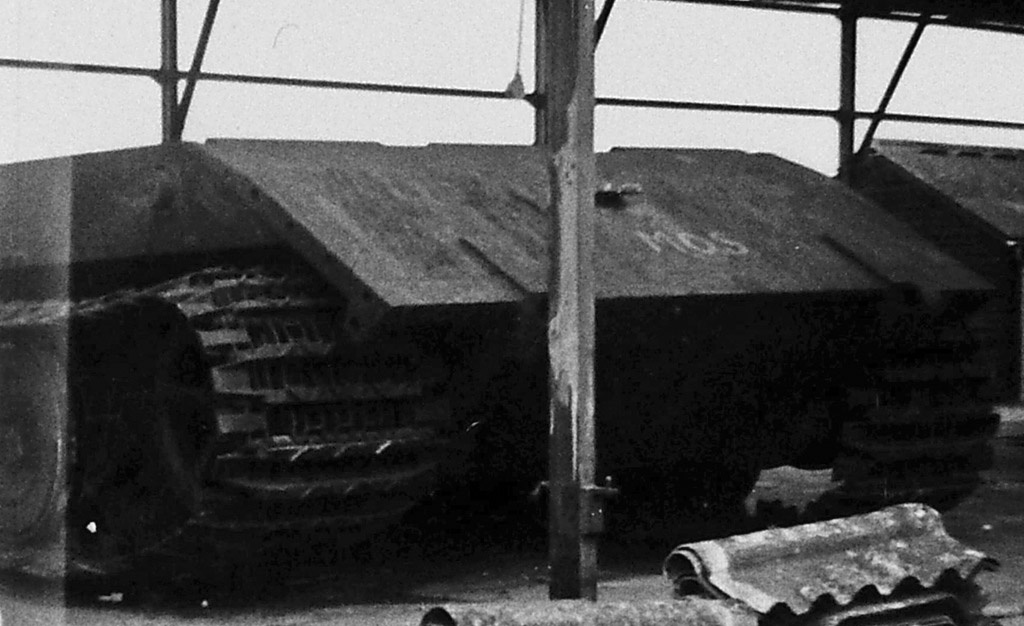
In Bowington, the last photograph taken during his lifetime
The chassis met with a sad fate. The Americans limited themselves to studying the vehicles captured at Houtenbeek, while the British had other plans. They did, however, install springs in the suspension. After assembling all the available components, the E-100 was loaded onto a super-heavy trailer and the vehicle set off for Foggy Albion. Once in England, tracks were installed on the tank, but reports that it underwent road tests are untrue. Until the early 1950s, the E-100 was housed at the tank school in Bovington; it was later sold for scrap. The same fate awaited most of what was removed from the Henschel test site in Haustenbeek.
List of Sources:
-
-
- BAMA (Bundesarchiv)
- NARA
- Panzer Tracts No. 6-3 — Schwere-Panzerkampfwagen Maus and E 100 development and production from 1942 to 1945, Thomas L. Jentz, Hilary L. Doyle, Panzer Tracts, 2008
- Special Panzer Variants: Development — Production – Operations, Walter J. Spielberger, Hilary L. Doyle, Schiffer Publishing, 2007
-